Tag Archives: wounded

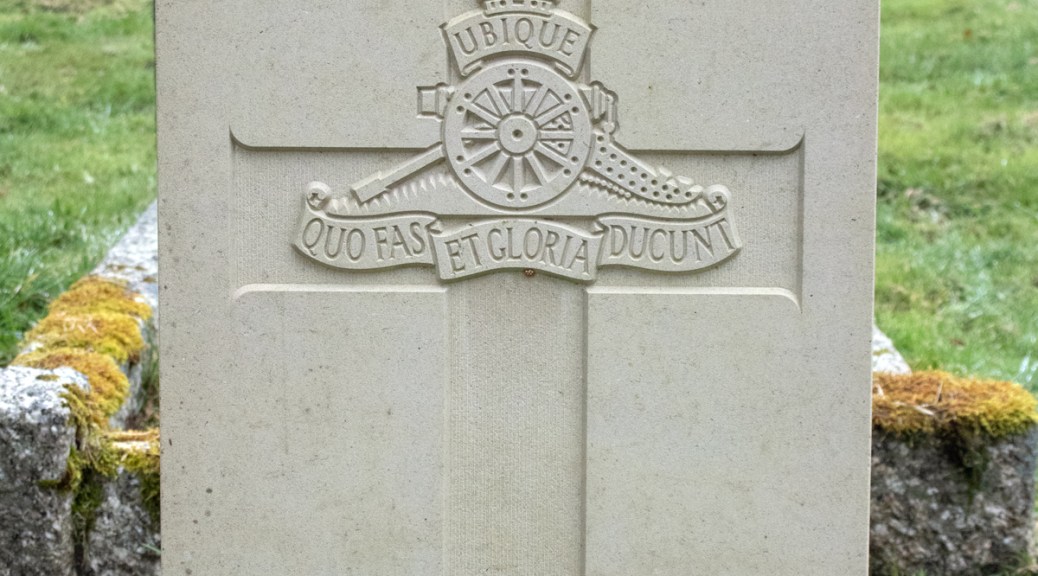
Bombardier Charles Newbery

Bombardier Charles Newbery

Charles James Anderson Newbery was born in Misterton, a stone’s throw from Crewkerne, Somerset, in the spring of 1895. The oldest of eight children, his parents were Benjamin and Edith Newbery. Benjamin was a farmer, who passed away in 1908, when his son was just 13 years of age.

Charles seems not to have spent a great deal of time in the family home, however: the 1901 census found him living with his paternal grandmother, while the 1911 census, taken three years after his father’s death, recorded him as living with his paternal aunt, and working on their farm.

The farming life seemed to suit Charles: indeed he emigrated to Australia to pursue the life. When war broke out in Europe, however, he returned to England’s shores to better serve King and Country. He enlisted in the Royal Garrison Artillery on 18th October 1915, and was given the rank of Gunner.

Charles’ service records confirm that he was 5ft 5ins (1.65m) tall and weighed 140lbs (63.5kg). He was noted as having a mole on his left shoulder and an upper denture.

Private Newbery was sent to France in April 1916 and, a little over a year later, was promoted to Bombardier. He was attached to the 137th Heavy Battery and all seemed to be going reasonably well for him. He had ten days’ in England in July 1917, and a further two weeks’ in March 1918.

On 13th August 1918, possible during the Battle of Amiens, Charles was injured by a gun shot wound to his right leg. He was initially treated at the 47th General Hospital at Le Treport on the French coast, but was medically evacuated to Britain for further treatment.

Charles was moved to the 4th Northern General Hospital in Lincoln. To complicate matters, he had contracted bronchitis and, while his injury was being managed, it was a combination of the lung condition and cardiac failure to which he succumbed. Private Newbery passed away on 2nd September 1918, his mother and sisters by his side. He was just 23 years of age.

Charles James Anderson Newbery was taken back to Somerset for burial. He was laid to rest in Crewkerne’s Townsend Cemetery, not far from the family home.


Bombardier Charles Newbery
(from ancestry.co.uk)

Edith had to write to the regimental office three times to get her late son’s belongings back, and in the end it took more than six months to do so. She received the items he had on him in Lincoln in April 1919: they included and “upper row [of] teeth, cigarette case, wallet containing letters, hair brush [and] comb, disc, letter, wristlet watch, note paper and envelopes.”


Private Albert Taylor

Private Albert Taylor

Albert Edward Taylor was born in the autumn of 1887 and was the fifth of eight children to John and Mary Taylor. John was a mason and both he and Mary came from Crewkerne, Somerset, which is where they raised their family.

Albert worked as an errand boy when he left school, but he sought a career and, enlisted in the Army Service Corps in July 1904. He lied about his age to join up, suggesting he was nearly 22, where he was actually just 17 years of age.

Driver Taylor’s service records confirm that he was 5ft 3ins (1.6m) tall and weighed 115lbs (52.2kg). He was noted as having brown hair, blue eyes and a fresh complexion. He had a mole between his shoulder and the back of his neck, and his religion was recorded as Baptist.

Albert’s contract was for two years’ service, followed by ten years in the Army Reserve. While a military career was what he sought, he seems to have had a disregard for rules, and regularly had run ins with authority, as his Regimental Defaulter Sheet testifies.

On 19th December 1904, while based in Woolwich, Surrey, he was absent without a pass from 6am until 12:15am on 30th December. He was confined to barracks for eight days.

The following year, Driver Taylor had moved to Bordon in Hampshire. On 28th November 1905, he was absent without a pass, from midnight until 8:30am on 1st December. He was again confined to barracks, this time for ten days.

A third offence came on 29th May 1906, by which time Albert had moved to Aldershot, Hampshire. He was found in neglect of duty ‘in allowing dirty pudding cloths to be deposited in the cupboards of the cookhouse’ and being ‘absent from work from 1:30pm till found in his barrack room at 9:20pm.’ For these, he was confined to barracks again, this time for eight days.

Within a matter of weeks, he was found in neglect of duty again, having broken out ‘of barracks after tattoo and remaining absent till apprehended by the Military Police at about 10:50pm’ and being ‘drunk and improperly dressed.’ This time the punishment was more severe and he was detained in prison for 96 hours.

Unsurprisingly, Albert’s military career didn’t go much further than this. When his two-year contract came to an end, he returned to Somerset and found employment as a mason.

In July 1910, Albert married Mabel Wallbridge, the daughter of a carman, also from Crewkerne. The couple set up home on the outskirts of the town, and went on to have a son, Frederick, who was born later that year.

The 1911 census found the young family living in a cottage in Lye Water, with Albert listing himself as a ‘mason (army pensioner)’. While the military reference may have been added with a sense of pride, irony or bloody mindedness, Albert was not to fully leave his army career behind. When war came to Europe in 1914, he was still within his reserve status, and was called up to play his part.

Private Taylor was to leave his family behind: son Frederick had now been joined by daughters Kathleen and Joyce, and Mabel pregnant with another daughter, Rosaline, who was born in January 1915. Albert was assigned to the 1st Battalion of the Somerset Light Infantry and, in contrast to his previous tenure on the Home Front, he soon found himself in the thick of things.

Albert’s regiment was involved in some of the fiercest opening skirmishes of the First World War, and he would have been caught up on the Battles of Le Cateau, the Marne, the Aisne and Armentières. By the spring of 1915, the battalion was entrenched at Ypres, and it was here during the Battle of St. Julien that Private Taylor was injured.

Albert has received a gun shot wound to the left side of his skull and was medically evacuated to Britain for treatment. He was admitted to the Beechfield House Hospital in Southampton, but his wounds proved too severe, and he passed away on 14th May 1915, at the age of 27 years old.

The funeral of Private Albert Edward Taylor, of the Somerset Light Infantry… who died from wounds received at the Front, took place with military honours at the Cemetery [in Crewkerne] on Tuesday afternoon, and attracted a large attendance. As a mark of respect to the memory of the deceased soldier blinds were drawn at the private and business houses en route to the Cemetery, while the flag erected outside the Victoria Hall for the children’s Empire-day celebration was lowered to half-mast.

Rev. J Street (Unitarian Minister)… spoke of the painful circumstances and the heroic conduct of the deceased, who had sacrificed his life for others. Although death was attended with pain and sorrow, yet in after years deceased’s children would look back with pride to the part their father took in the present war.

Taunton Courier and Western Advertiser: Wednesday 26th May 1915

Albert Edward Taylor was laid to rest in the cemetery of his home town, Crewkerne.


Private Albert Taylor (from findagrave.com)

Albert’s headstone gives his initials as AC Taylor. They should be AE Taylor.

Private William Pinney

Private William Pinney

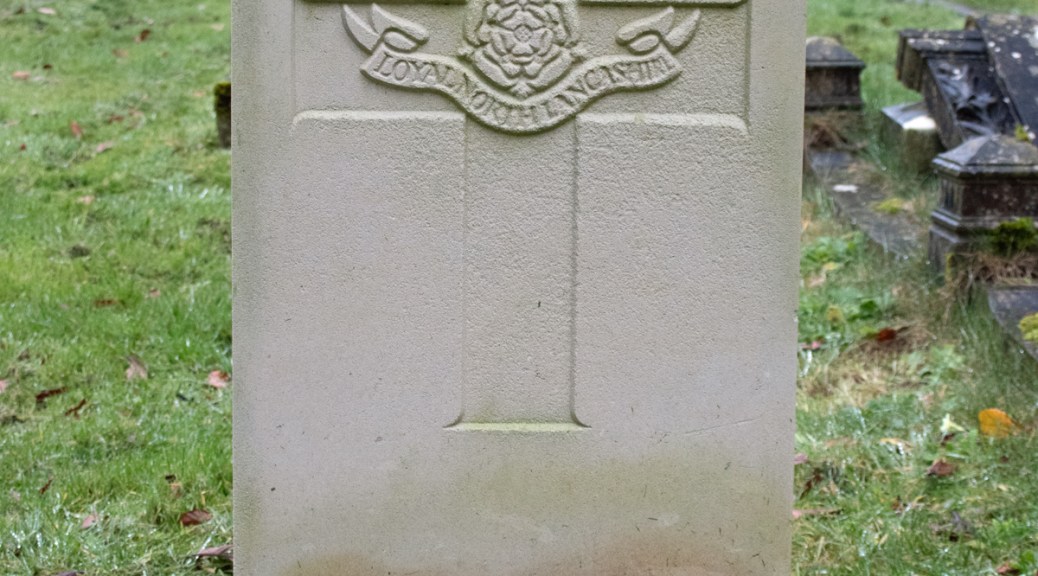
The details of William Pinney’s life seem destined to remain a mystery. His headstone – in Crewkerne Cemetery, Somerset – confirms that he was a Private in the Loyal North Lancashire Regiment, and that he died on 14th August 1919.

The British Army Register of Soldiers’ Effects expands a little on this, identifying that he was in the 2nd Battalion of the regiment. The document states that he died of wounds and had been admitted to the War Hospital in Southampton, Hampshire (this is likely to have been the Royal Victoria Hospital in Netley). It also confirms that his effects were to be passed to his widow, Sarah Pinney.

From this point on, some elements of supposition come in to the research.

There is a marriage certificate for a William Pinney and Sarah Jane Witheyman at the parish church in Crewkerne on 6th January 1911. This record gives William’s age as 23, and shows that he was a weaver and the son of weaver William Pinney Sr. Sarah, meanwhile, was five years older than her new husband, worked as a factory hand, and was the daughter of another factory hand, George Witheyman.

The same year’s census gives more information about William Pinney. He was one of eleven children to William and Mercy Pinney, and every member of the family over school age was involved in weaving and spinning. It should be noted, however, that the census was taken on 2nd April 1911, three months after William’s marriage and, while the ages on the document match, the document states that he is single.

The same census for Sarah tells a similar story. She is noted as being one of twelve children to George and Amelia Witheyman. George is noted as being a ‘hand ackler’, or handyman, while Sarah and the two of her teenage brothers still at home are all working as mill hands. The same anomaly arises as William, however, as she is also noted as being single.

Returning to the marriage certificate, an answer to the anomaly in the dates seems to resolve itself, however. The marriages are noted in chronological order, and the previous wedding to be solemnised in Crewkerne Parish Church was on 26th December 1911, while the following one was on 14th February 1912. It would appear, therefore, that Leonard Jackson, the curate of the church, entered the incorrect date on the certificate.

The census records and marriage certificate all seem to fit the William and Sarah Pinney who were separated by William’s death in 1919. There are certainly no documents suggesting another William Pinney in the Crewkerne area around that time period. It is reasonable to assume, therefore, that they do all connect to the gravestone in the town’s cemetery.

Private Pinney’s military records are missing, or no longer available, so it is not possible to trace his actions during the First World War. The 2nd Battalion of the Loyal North Lancashire Regiment served in India during the first half of the conflict, moving to Egypt in 1917 and to France the following year. It is not possible to confirm where William served, but wherever he fought, he was wounded, and these injuries were to prove fatal. He passed away in the Southampton hospital on 14th August 1919, nine months after the end of the war, aged around 31 years old.


Private Alfred Lansdell

Private Alfred Lansdell

Alfred John Edward Lansdell was born on 25th October 1882 in Fulham, London. The fourth of six children, his parents were James and Matilda Lansdell.

James was a trunk maker, working in his father’s business. By the time of the 1901 census, he was recorded as living by his own means, while Alfred had taken up employment as a hotel porter in Chelsea.

By 1902, Alfred had moved to Somerset and set up home in Bath. He married local woman Alice Stevenson, and the couple went on to have a daughter, Lena, who was born in November 1904.

The 1911 census found the family living in central Bath, Alfred continuing his portering work, with one of his colleagues, lift operator Thomas Ward, boarding with them.

War came to Europe and on 9th December 1915, Alfred stepped up to play his part. He enlisted in the Worcestershire Regiment, and was formally mobilised the following June. Alfred’s service records confirm that he was, at the time of his review, he was 35 years old and 5ft 6ins (1.67m) tall.

Private Lansdell was assigned to the 1st/7th Battalion and by October 1916, he was shipped to France. He was very much on the Front Line, and was wounded on 19th August 1917, while at Ypres. His casualty record notes that “while waiting in a shell hole for a further move on he was wounded… in the back”. He has been shot, and the bullet penetrated his kidney.

Initially treated in a hospital in France, Private Lansdell was transferred to England on 25th October. He was admitted to the Norfolk War Hospital and remained there for some time.

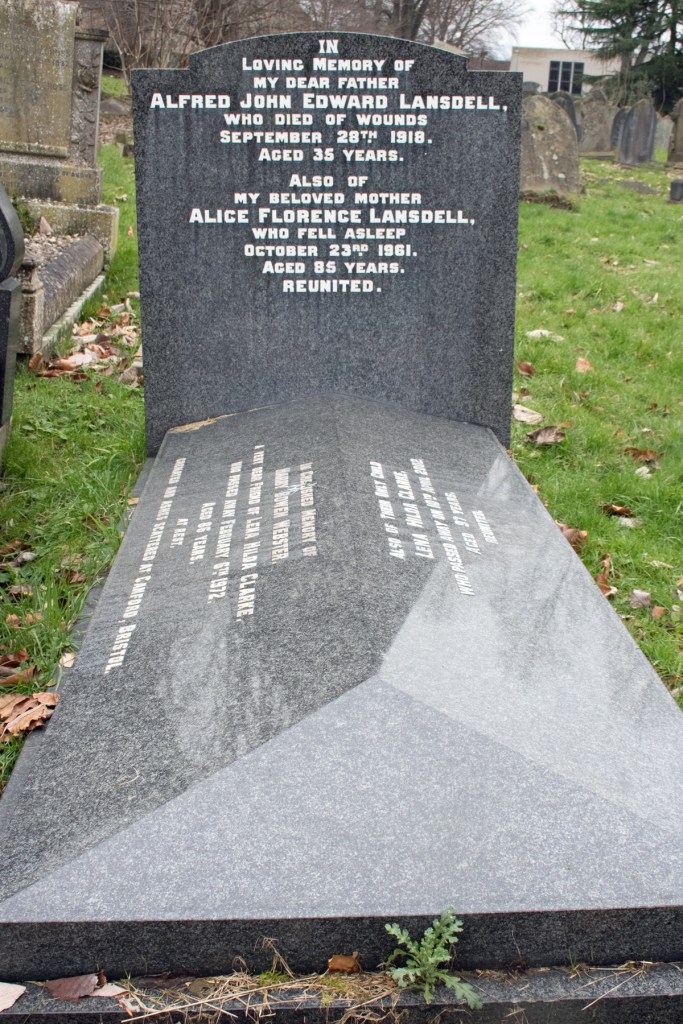
Alfred’s injuries were too severe for him to continue in the army, and he was formally discharged on 20th March 1918. He eventually returned home to Bath, but in the end his poor health was to get the better of him. He passed away at home on 28th September 1918, at the age of 35.

Alfred John Edward Lansdell was laid to rest in St James’ Cemetery, Bath. Alice lived on until 1961, when she was buried with her late husband, a couple reunited after more than four decades.


Lance Corporal Francis Ball

Lance Corporal Francis Ball

Francis William Ball was born in the spring of 1893 in the village of Wrington, Somerset and was one of ten children to Joseph and Mary Jane Ball. Joseph was a general labourer while Mary Jane took in washing to earn a little more money for the family.

Little information is available about Francis’ early life. The family travelled the county when he was growing up, and, according to the 1911 census, they were living in Walcot, a suburb of Bath. The same census notes that Francis was apprenticed, although crucially the trade he was learning is missing from the document.

When war came to Europe, he enlisted in the Yorkshire & Lancashire Regiment as a Private. Francis’ service records are lost to time, but he would have enlisted by the summer of 1917, and during his time in the army, he was promoted to Lance Corporal. He was attached to the 2nd/4th Battalion, who served in France, most notably at Arras and Cambrai.

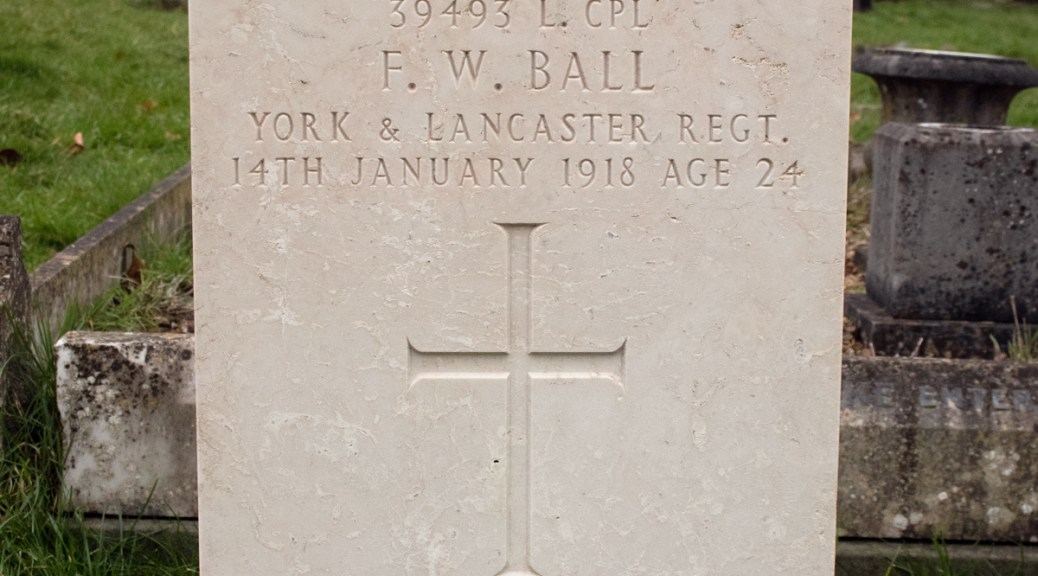
At some point late in 1917, or early in 1918, Lance Corporal Ball was injured and medical evacuated to Britain for treatment. He was admitted to the 2nd Western General Hospital in Manchester, but his wounds were to prove too severe. He passed away on 14th January 1918, at the -age of just 24 years old.

Francis William Ball’s body was brought back to Somerset for burial. He was laid to rest in the St James Cemetery, Bath.


Private Francis Millard

Private Francis Millard

The early life of Francis Albert Millard is lost to time. He was born in 1894 in Bath, Somerset. His gravestone notes that he was the adopted son of AE and H Evans, though there are no census records confirming the three as a family. His military records specifically note that he has “no relations alive only one brother who is younger than myself nor have I any guardians”.

Interestingly, when Private Millard passed, Mrs Harriet Evans, who was noted as a foster mother, applied for his personal effects. Two days later, and Albert Francis Millard, who was claiming to be Francis’ father, also put in an application.

Francis was working as a seaman when he formally enlisted. He had previously been a volunteer in the Durham Light Infantry, and was readily accepted in the regiment’s 2nd Battalion. He joined up in November 1911, his service records noting that he was 5ft 3ins (1.6m) tall, 104lbs (47.2kg) in weight, with a fresh complexion, blue eyes and light brown hair. He was also noted as having a tattoo of the figure of a woman on his right forearm and a scar on his left buttock.

Over the next couple of years Private Millard was reprimanded a couple of times for small misdemeanours – being absent from bread rations on 15th September 1912, and being absent from the company officer’s lecture on 22nd February 1913. During this time he had been promoted to Lance Corporal, but the reprimand he received demoted him to Private once more. Overall, however, his service appears to have been a positive one and, when war was declared, he soon found himself on the Western Front.

[Priavte Millard] was present at the retreat from Mons. He took part in the advance over the Marne and the Aisne, and [had] been engaged in the battles around Ypres. In the early part of August [1915] a charge was ordered, and in this he took part. The late Captain RH Legard… to whom Millard was servant, fell. Millard ran to his assistance, and was wounded in two places…

Bath Chronicle and Weekly Gazette: Saturday 21st August 1915

Francis received gun shot wounds to his thigh and across his spinal column. He was medically evacuated to Britain for urgent treatment. Admitted to the King George Hospital in South London, his admission notes make for stark reading:

Patient very collapsed. Sunken eyes, some delirium. Small circular wound on right shoulder behind level 1st Dorsal spine 2″ from middle line; wound on inner side of left thigh, with suppuration and cellulitis. Can move both arms but very poor power. Patient continued to go downhill rapidly after admission despite stimulation (brandy, [strychnine], saline).

A telegram was sent to Harriet and she took the first train to London. She arrived on the evening of Tuesday 17th August, and remained by Francis’ bedside until he passed away the following morning. He was just 21 years of age.

The shattered body of Francis Albert Millard was brought back to Somerset for burial. He was laid to rest in the city’s St James Cemetery.


Private Edgar Cox

Private Edgar Cox

Edgar Albert Cox was born in Wanstrow, Somerset, in the spring of 1897. The youngest of five children, his parents were railway packer Herbert Cox and his wife, Orpha.

When he left school, Edgar found employment as a live-in farm hand in Upton Noble, a mile from where his parents lived. When war came to Europe, however, he felt a pull to serve, and enlisted in the Somerset Light Infantry.

Full details of Private Cox’s military service are lost to time, but he was assigned to the 8th (Service) Battalion, and arrived in France towards the end of July 1915. He certainly saw action at the Somme, where his troop was involved in the battles of Bazentin Ridge, Flers-Courcelette and Morval.

It was in the battle of le Transloy, however, that Edgar was injured. His wounds were severe enough for him to be medically evacuated to Britain for treatment, and he was admitted to the 1st Southern General Hospital in King’s Norton, Birmingham. Sadly his wounds were too much for his body to bear: he passed away on 9th October 1916, at the age of just 19 years old.

The body of Edgar Albert Cox was brought back to Somerset for burial. He was laid to rest in the quiet graveyard of St Mary’s Church in his home village of Wanstrow.


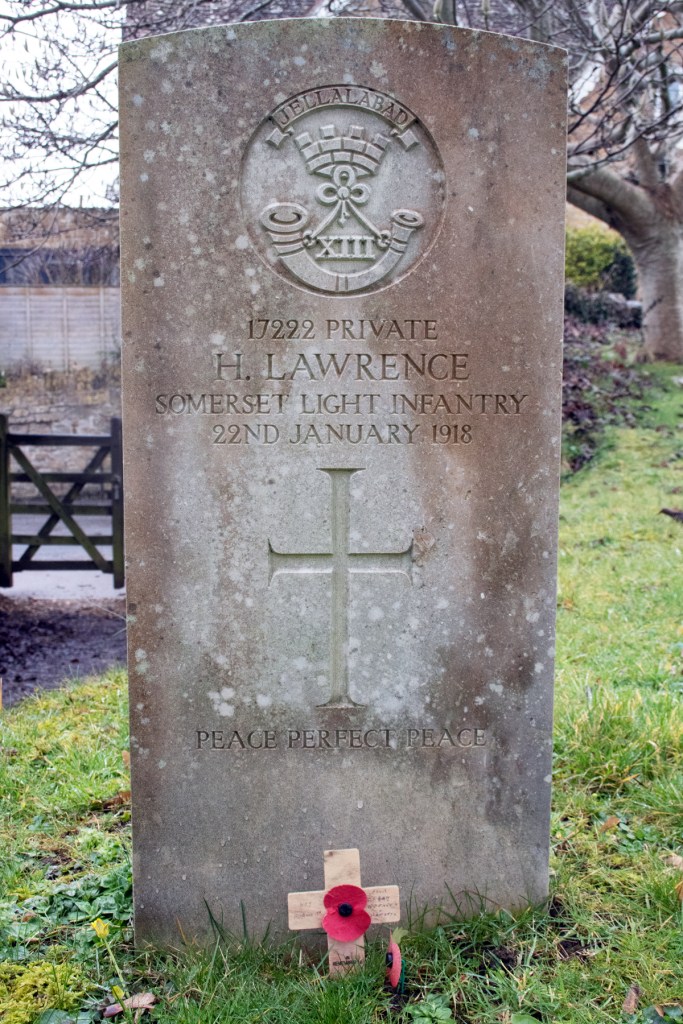
Private Harry Lawrence

Private Harry Lawrence

Harry Lawrence was born on 21st March 1895 in the Somerset village of Merriott, and was one of seven children to Samuel and Rose Lawrence. Samuel was a farm labourer, and, when he left school, this is work that Harry also took up.

When war was declared, Harry stepped forward to play his part. He had enlisted in the Somerset Light Infantry by the summer of 1917 and, while his full service records are no longer available, he definitely spent time on the Front Line in France.

Private Lawrence’s troop – the 6th (Service) Battalion – was involved in some of the fiercest fighting of the war, at the Somme, Arras and Ypres. At some point he was injured, and medically evacuated back to Britain for treatment.

He had been under medical treatment for some time in St George’s Hospital, London. Unfavourable symptoms, resulting from concussion of the brain, set in, which terminated fatally, and death this added one more name to the already long list of the Roll of Honour of [Merriott].

Western Chronicle: Friday 8th February 1918

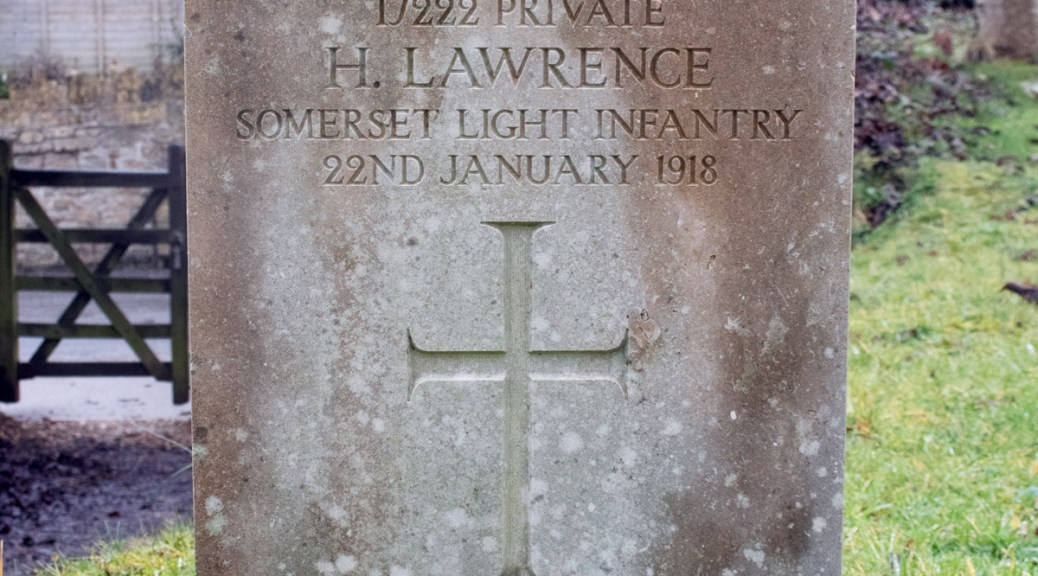
Harry Lawrence died in St George’s Hospital on 22nd January 1918. He was just 22 years of age. His body was brought back to Somerset for burial, and was laid to rest in the quiet graveyard of All Saints’ Church in his home village.


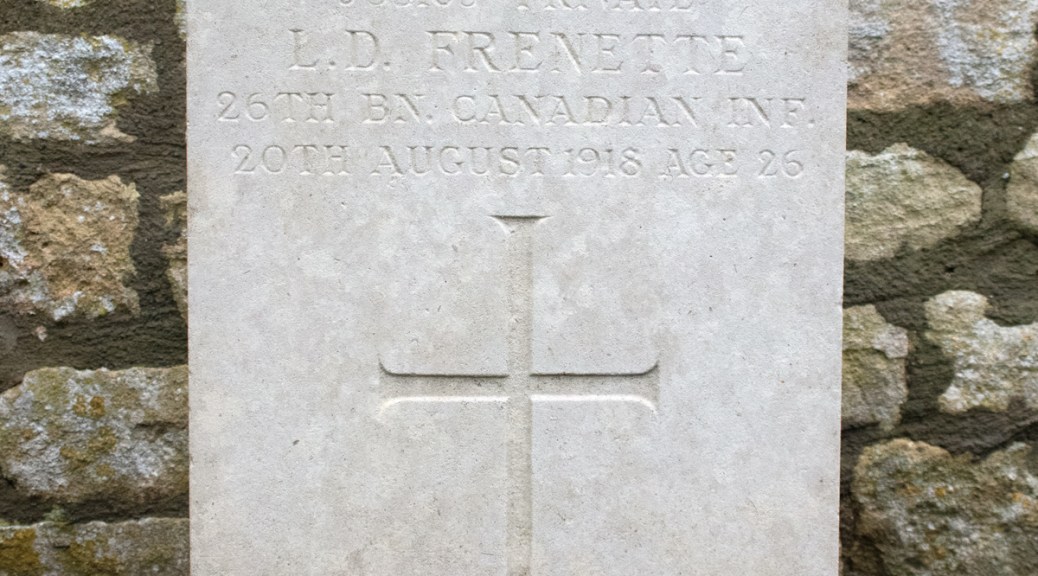
Private Leon Frenette

Private Leon Frenette

Leon D Frenette was born on 2nd June 1893, in the coastal village of Petit Rocher, New Brunswick, Canada and was the son of Denis and Sarah Frenette.

Leon’s early life is difficult to piece together – the 1901 Canadian census records five Frenette families living in the same neighbourhood, but of the two whose head is given as Denis, neither has a son by that name (although one has a son called Joseph Leon).

When war came to the distant European shores, Leon was working as a school teacher in Bathurst, a town 12 miles (20km) to the south of Petit Rocher. He stood up to play his part for King and Empire, though, having served in a local militia for a while.

Leon joined the Canadian Expeditionary Force as a Private. His service records give his height as 5ft 4ins (1.63m), his weight as 130lbs (59kg) and stated that he had a medium complexion, with brown eyes and black hair. In the section of the records that noted distinguishing marks, the medical officer had identified two small brown birthmarks on his left buttock.

Private Frenette arrived in England on board the SS Corsican on 5th November 1916. Assigned to the 132nd Battalion of the Canadian Infantry, he was based at a military camp near Bramshott, Hampshire. The influx of overseas soldiers would have been a bit of a shock to the locals, but Leon appears to have been up to the challenge. Within a matter of weeks, he was admitted to the camp hospital, suffering from a bout of gonorrhoea.

By the end of the year, Private Frenette had been transferred to the 104th Battalion, and moved to Witley Camp in Surrey. His ailment seems to have returned a couple of times, and he was admitted to the camp’s medical facility in January and March 1917.

By the autumn of 1917, Leon had been transferred again, this time to the 26th Battalion. The troop was based on the south coast at Shoreham, West Sussex, and it was from here, on 16th November 1917, that Private Frenette was finally sent to France.

Leon would have arrived at an already battle-scarred Western Front. Over the next year, he was involved in fighting at Cambrai and Arras. His time was not without incident, and he forfeited a day’s pay on 20th March 1918, for “contravention of full dress order, i.e. being without a belt.”

The 26th Battalion’s next offensive was at Amiens, and it was here, on 12th August 1918, that Private Frenette was badly wounded with a gun shot wound to his right arm. Initially treated on site, he was medically evacuated to England for further treatment.

Leon was first admitted to a hospital back in Bramshott, but then transferred to Bath War Hospital in Somerset. His medical report confirms that he was first seen there at 4:30pm on 20th March, and a compound fracture of his humerus. He haemorrhaged and died of shock at 11:45pm that day. He was just 25 years of age.

With family on the other side of the Atlantic, it was not going to be possible for Private Leon Frenette to be taken home for burial. Instead he was laid to rest in the Roman Catholic Cemetery of the city in which he had passed away, Bath.


Quartermaster Serjeant Iva Brewer

Quartermaster Serjeant Ivor Brewer

Iva Victor Brewer was born on 2nd May 1886, the fourth of four children to James and Annie Brewer. James was a farm labourer from Weston-super-Mare, but the family were living in Bathampton by the time of Iva’s birth. James died in 1887, and Annie remarried three years later. Her new husband, Thomas Dolman, was the manager of the George Inn in Bathampton, and the couple went on to have four children of their own, half-siblings to Iva.

Tragedy struck again when Annie passed away in February 1897, at the age of just 37 years old. By the time of the next census in 1901, Iva was boarding with his stepfather’s parents; the following year, however, Thomas also passed away, and the children were left to build their own lives.

Iva – who was now going by his middle name, Victor – found an escape in the army and, according to the 1911 census was an Acting Bombardier in No. 69 Company of the Royal Garrison Artillery, based in Colaba, at the tip of the Mumbai peninsula.

By the time war was declared, Victor had cemented his military career. Full details of his service are no longer available, but the summer of 1916 he had left India for Aden, and was then mentioned in dispatches that October for his bravery in the field at the Somme.

In November 1917, the now Battery Quartermaster Sergeant Brewer was injured in fighting at Passchendaele, and was medically evacuated to Britain for treatment. It seems that he was treated in South Wales, and it seems a whirlwind romance set in when he was living in Pontardawe, near Swansea. On 2nd January 1918, Victor married Laura Seddon, a railway inspector’s daughter from the village of Ystalyfera, just up the valley from Victor.

The couple moved to Bathampton before Victor returned to the fighting. He was badly wounded and, having been evacuated back to Britain in May 1918, he was admitted to the Northern Central Hospital in London where his shattered leg was amputated. Sadly, bronchial pneumonia set in while he was recovering, and he passed away from the subsequent sepsis. Quartermaster Sergeant Brewer passed away on 7th May 1918, days after his 32nd birthday.

Iva Victor Brewer was brought back to Bathampton for burial. He was laid to rest in the quiet graveyard of St Nicholas’ Church in the village.


Tragedy was to strike again, sadly. After his funeral, Laura returned to Wales and found employment at a draper’s store.

…the loss of her husband played on her mind.

On Monday she set off for Bathampton, and on her way posted two letters to her late husband’s relatives.

One ran: “I cannot live without my husband. If you don’t hear from me, search Bathampton, as I shall be there somewhere.” Another letter asked her relatives to let her mother in the Swansea Valley know.

She reached Bath, and it is thought she there took a taxi to Bathampton. She then paid a visit to the cemetery, and placed her hat and handbag on her husband’s grave. At the canal-side nearby she laid her fur coat on the bank, and, it is supposed about midnight, plunged into the water

Western Gazette: Friday 9th April 1920

Laura was just 27 years old when she died: she was buried with Victor, husband and wife reunited again.