Tag Archives: Engineman

Engineman John Raven

Engineman John Raven

The loss of another Gorleston man in the service of King and Country is recorded this week in the death of Chief-Engineer John Edmund Raven, RNR, of 46, John-road, Gorleston, who was among the victims of the air raid at Chatham on September 3rd. Chief-Engineer Raven, who was 43 years of age, had been in the Service nearly three years, and was sailing from this port. Some seven weeks ago he was taken ill and went to Chatham to undergo an operation, following which he was allowed home for a few days and returned to Chatham Naval Barracks on the sick list, where he was on the night of the raid. He was very popular with his comrades at the Naval Base at Gorleston, and his loss is much regretted by the crew of his ship. To his widow and two children every sympathy has been extended in this heavy blow which follows hard on the loss a few weeks ago of her daughter after a brief illness.

[Yarmouth Mercury: Saturday 15th September 1917]

John Edmund Raven was born on 28th December 1872 in Caister, Norfolk. The middle of six children, he was the youngest of three sons to Robert and Ann Raven. Robert was a farm labourer-turned-fisherman, and, after his untimely death in 1883, it was the sea to which his son turned to support his widowed mother.

In the autumn of 1902, John married Eliza Casey. A milkman’s daughter from Gorleston, Norfolk, she was employed as a domestic servant when the couple exchanged vows. They set up home at 46 John Road, Gorleston, and went on to have three children: Elsie (who would pass shortly before her father), Gladys and Jack.

Little further information is available about John’s life. As the newspaper report suggests, he joined the Royal Naval Reserve as an Engineman towards the end of 1914, and was based out of HMS Pembroke, the Royal Naval Dockyard in Chatham, Kent.

On the night of the 3rd September 1917, Engineman Raven was billeted in temporary accommodation set up in the dockyard’s Drill Hall. That night, an audacious raid by German bombers landed two explosives directly on the building, shattering its glass roof, and killing dozens of the men sleeping within. John was one of those to be killed. Contrary to his obituary suggested, he was actually 45 years of age.

The body of John Edmund Raven was taken back to Norfolk for burial. He was laid in the family plot, reunited with his daughter, Elsie, far too soon.


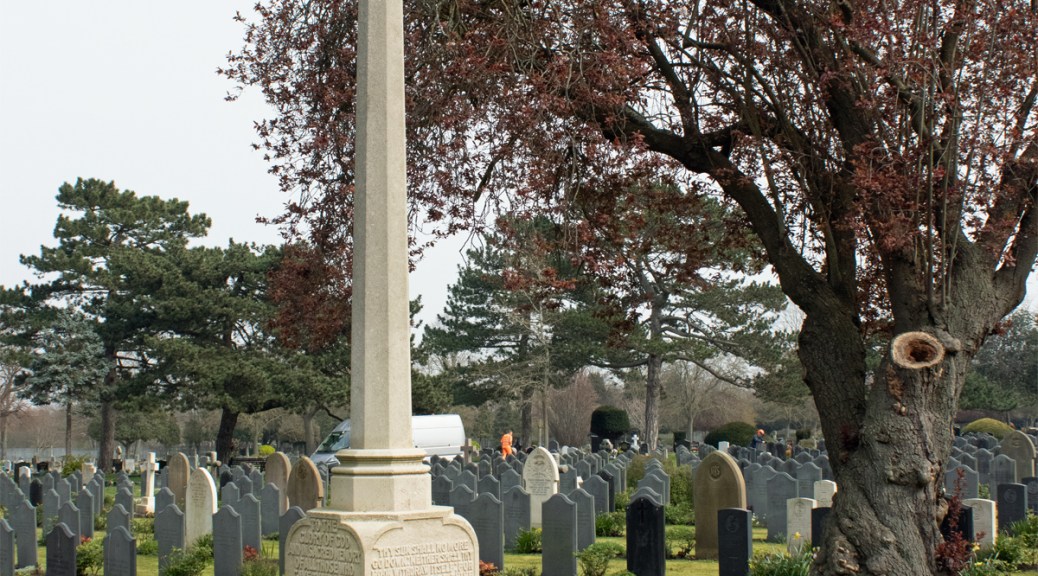
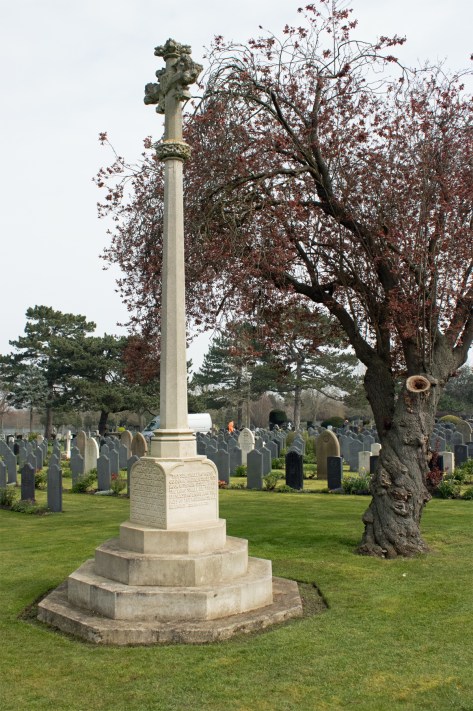
[Note: the photo above is of the memorial to the Chatham Air Raid victims, close to the mass grave for those whose bodies were not identified, in Woodlands Cemetery, Gillingham, Kent.]

Engineman George Rae

Engineman George Rae

George William Rae was born on 7th February 1883 in South Shields, Country Durham. The youngest of five children, he was one of four sons to Henry and Elizabeth Rae. Henry was a boatman, and it seemed inevitable that George would follow in his father’s footsteps.

There are big gaps in George’s timeline: the 1891 census found him living with his aunt and uncle. The next record for him confirms his marriage to Mary Elizabeth Smith in January 1904. There is scant information for her, but the couple had five children, three of whom died before they reached their first birthday.

Tragedy followed tragedy: George’s father died in 1908, and his mother passed the following year. Mary died shortly after the birth of her and George’s last child, also named George, in 1911. The census taken that year recorded George Sr as a fireman aboard the coal hulk Haytian, which was moored in Portland Harbour, Dorset. He was one of the vessel’s sixteen crew members.

Now a widow, George had two children to support. In the summer of 1913, he married a second time, to Elizabeth Flood. Again, there is little information available about her, but the couple went on to have a child, daughter Emily, who was born in the summer of 1914.

Conflict was closing in on Europe by this point, and on 24th March 1916, George formally joined the Royal Naval Reserve. His service record shows that he was 5ft 4ins (1.63m) tall, with blue eyes and a fair complexion. He was also noted as having a tattoo of a woman and two flags across his chest.

Engineman Rae was assigned to the gunboat-turned-minesweeper HMS Halcyon. She remained his home for the next eighteen months, patrolling off the coast of East Anglia. By the summer of 1917, George became shore-based, initially at HMS Actaeon in Portsmouth, Hampshire, then at HMS Pembroke, the Royal Naval Dockyard in Chatham, Kent.

Pembroke was a busy and overcrowded place at this point in the war. The battleship HMS Vanguard had sunk, and its replacement crew – who were stationed in Chatham – were left in limbo while new postings were found for them. The base also suffered an outbreak of meningitis, and temporary accommodation was set up to space out the servicemen and, hopefully, slow the spread of the disease. Engineman Rae found himself in one of these speedily-created barracks in the dockyard’s Drill Hall.

On the night of the 3rd September 1917, four German aircraft carried out a daring raid on the North Kent coast. Chatham came under fire, and two explosives landed a direct hit on the Drill Hall. Dozens of men were killed while they were sleeping, and many more – including Engineman Rae – were injured.

George was taken to the Royal Naval Hospital in Chatham for treatment, but his wounds would ultimately prove fatal. He succumbed to them on 11th September 1917, at the age of 34 years old.

The body of George William Rae was taken back to County Durham for burial. He was laid to rest in South Shields’ Harton Cemtery.


Tragedy would continue to haunt the Rae family. Elizabeth died a year after her husband, leaving three children – two from George’s first marriage, and one from his second – orphans. Sadly, there is little additional informational about what happened to them – none appear in the 1921 census.


[Note: the photo above is of the memorial to the Chatham Air Raid victims, close to the mass grave for those whose bodies were not identified, in Woodlands Cemetery, Gillingham, Kent.]


Engineman John Foreman

Engineman John Foreman

John Kerr Foreman was born in Aberdeen, Scotland, on 18th December 1878. The son of Thomas and Jessie, details of his early life are sparse. The 1881 census records him living on York Street with Jessie, while the next return notes him as living just round the corner at 4 Links Street with his paternal grandfather, Jessie Kerr.

Thomas’ absence from the documents would suggest that he was away at the time the details were taken. John’s grandfather was a fish labourer, and the family lived next to the port. It is likely that Thomas was a fisherman or part of a boat crew, and a life at sea was something that his son also fell into.

John does not appear on either the 1901 or 1911 census returns. In the early 1900s he married Lily Craig, the daughter of another fish worker. They went on to have five children between 1905 and 1916 but, like her husband, there is no record of Lily or the family in the early 20th century.

When war broke out, John stepped up to play his part. Joining the Royal Naval Reserve – another hint at an undocumented life at sea – on 36th May 1916, his papers note that he was 5ft 8ins (1.73m) tall, with grey eyes and a fair complexion. He was also recorded as having a number of tattoos: a pierced heart, thistle and the word Scotland on his right arm, and an anchor and his initials on his left.

Engineman Foreman’s time in the navy was actually spent on shore. For eighteen months he was attached to HMS Gunner, the shore base at Granton Harbour, near Edinburgh. In August 1917, however, he was transferred south. He arrived at his new home, HMS Pembroke, the Royal Naval Dockyard in Chatham, Kent, on 4th August 1917.

The dockyard was a particularly busy place that summer, and temporary accommodation was set up. John found himself billeted at Chatham Drill Hall, away from the main barracks.

On the night of 3rd September 1917, Chatham suddenly found itself in the firing line, as the German Air Force launched a bombing raid. One of the bombs landed squarely on the Drill Hall, and Engineman Foreman was badly injured. He was taken the naval hospital in the town, but died from his injuries the following day. He was 38 years old.

The body of John Kerr Foreman was taken back to Scotland for burial. He was laid to rest in Aberdeen’s Trinity Cemetery, a short walk from where his family still lived.


Engineman John Foreman
(from findacrage.com)

[Note: the photo above is of the memorial to the Chatham Air Raid victims, close to the mass grave for those whose bodies were not identified, in Woodlands Cemetery, Gillingham, Kent.]
Engineman Charles Clarke

Engineman Charles Clarke

Charles Alfred Clarke was born in Lowestoft, Suffolk on 1st June 1888. The middle of eleven children, his parents were William and Jane Clarke. William was a fisherman, and, according to the 1901 census, the family lived at Coopers Cottages, on Hemplands, close to the town centre, and not far from the seafront.

Given his father’s trade, and the fact that his older brothers also followed suit, it is no surprise that Charles found work as a fisherman. The 1911 census recorded him as one of eight crew on board the John & Sarah, a 36ft steam boat, that had moored in Penzance, Cornwall. Charles was noted as being an engineman and fish packer.

Away from the sea, Charles had found love. Clara Fletcher was two years his junior, and was the daughter of publican Samuel, who ran the Mechanic’s Arms on Lowestoft’s Crown Street. The couple exchanged vows in the summer of 1916, the wedding being registered in Mutford, to the south east of their home town.

By this point, and with war raging across Europe, Charles had been called into military duty. Attached to the Royal Naval Reserve from May 1915, he was attached to the torpedo gunboat HMS Halcyon, which acted as a depot ship off the Suffolk coast. His service papers note that he was 5ft 6ins (1.68m) tall, with hazel eyes and a fresh complexion.

Engineman Clarke remained with Halcyon until the summer of 1917, when he was transferred to HMS Pembroke, the Royal Naval Dockyard in Chatham, Kent. The base was a particularly busy place at that point in the war and temporary accommodation was set up. Engineman Clarke found himself billeted at The Drill Hall, away from the main barracks.

On the night of 3rd September 1917, Chatham suddenly found itself in the firing line, as the German Air Force launched a bombing raid. Two bombs landed squarely on the Drill Hall, shattering its glass roof, and Engineman Clarke was amongst the dozens killed. He was 29 years of age.

The body of Charles Alfred Clarke was taken back to Suffolk for burial. He was laid to rest in the town’s cemetery on Normanston Drive.


[Note: the photo above is of the memorial to the Chatham Air Raid victims, close to the mass grave for those whose bodies were not identified, in Woodlands Cemetery, Gillingham, Kent.]


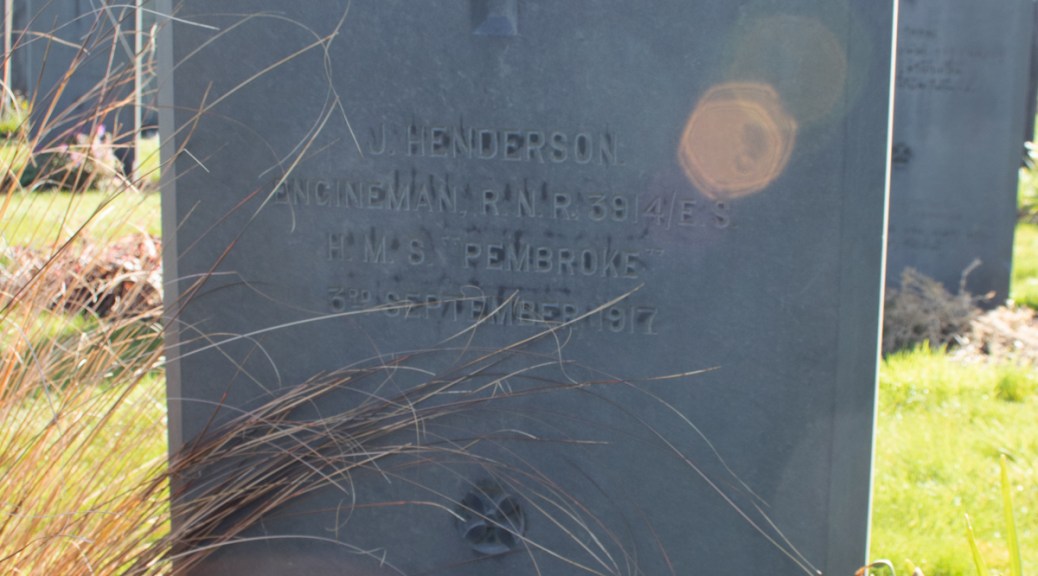
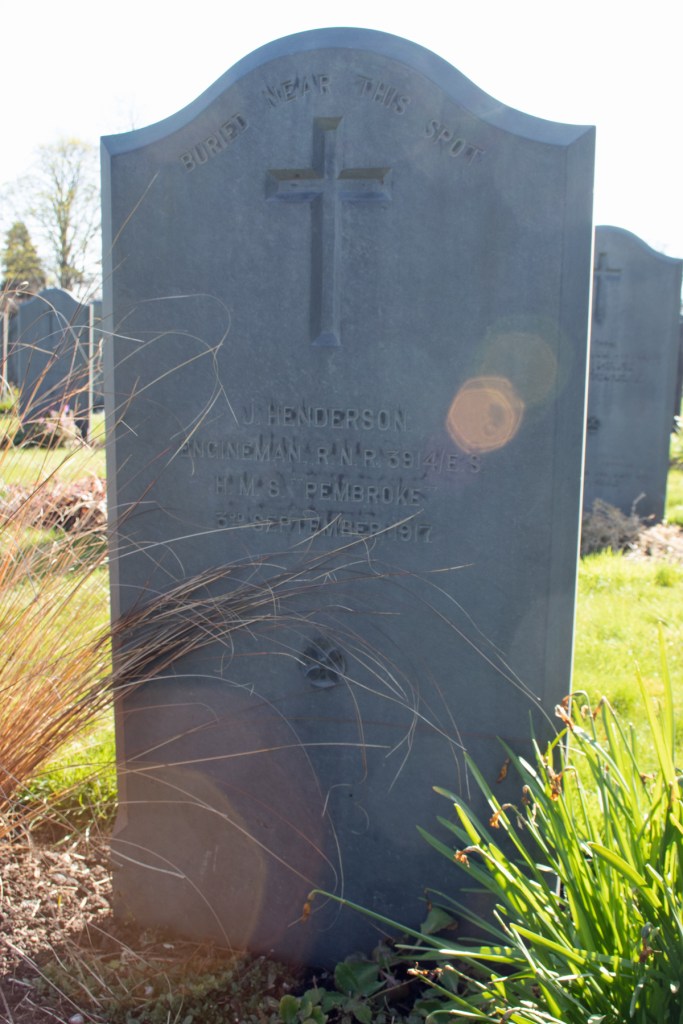
Engineman John Henderson

Engineman John Henderson

John Henderson was born on 21st May 1887 in Leith, near Edinburgh. His parents were John William Henderson (known by both of his first names) and Matilda Jane Henderson (known as Jane), and he was one of eight children.

There is little documented about John’s early life and, in fact, the main information about him comes from his service records during his time in the Royal Naval Reserve. Before enlisting he was already involved in shipping in some form – again, however, this is not detailed – but he formally enlisted on 13th August 1915, serving as an Engineman.

John’s records confirm that he was 5ft 4.5ins (1.63m) tall, with blue eyes and a ruddy complexion. He was also noted as having a couple of tattoos on his forearms, including a pair of clasped hands over a heart.

All of Engineman Henderson’s postings were shore-based. He was initially assigned to HMS Columbine, the naval base at Port Edgar, on the Firth of Forth. This was bring constructed at the time, and John was employed as part of that construction process. While here, he was injured on his left hands while laying some cables in April 1916 and lost the tip of his finger.

When he had recovered, Engineman Henderson was transferred to HMS Gunner, the Granton Naval Base in Edinburgh. He spent fifteen months working there, before being assigned to HMS Pembroke, the Royal Naval Dockyard in Chatham, Kent, in August 1917.

The Dockyard was particularly busy that summer, and the large number of extra servicemen meant that John was billeted in temporary accommodation in Chatham Drill Hall.

On the 3rd September 1917, the first night air raid carried out by the German Air Force bombarded the town, and scored a direct hit on the Drill Hall; Engineman Henderson was among those killed that night. He was just 30 years of age.

John Henderson was laid to rest, along with the other victims of the Chatham Air Raid, in the Woodlands Cemetery, Gillingham.


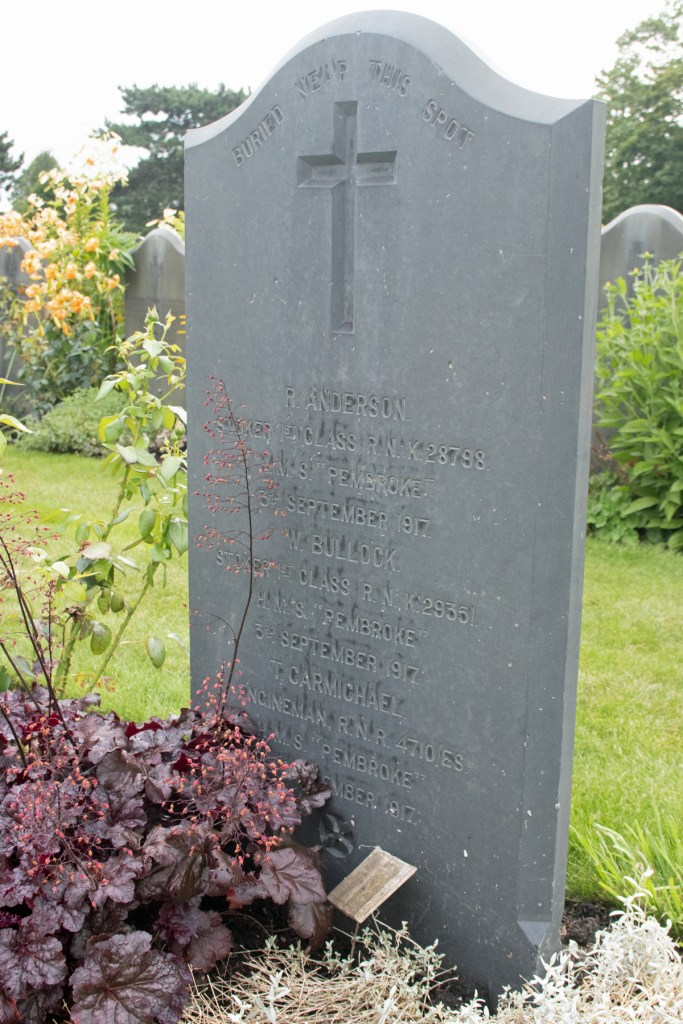
Engineman Thomas Carmichael

Engineman Thomas Carmichael

Thomas Carmichael was born on 19th December 1888, the older of two children to George and Elizabeth – Lizzie – Carmichael. George was an engine fitter from Hull, Yorkshire, and this is where he and Lizzie raised their young family.

Little further information is available for Thomas’ early life. He married a woman called Annie, but no documents remain to confirm when their wedding was. The couple settled in Hull, and went on to have two children, a girl and a boy.

War had his Europe by this point, and Thomas enlisted in the Royal Naval Reserve. He joined the Royal Naval Reserve as an Engineman on 16th May 1916, serving primarily at the shore-based establishments of HMS Pembroke (the Royal Naval Dockyard in Chatham, Kent), HMS Gunner (the Granton Naval Base in Edinburgh) and HMS Vivid (the Naval Dockyard in Devonport).

Engineman Carmichael arrived in Chatham in August 1917. The Dockyard was particularly busy that summer, and the large number of extra servicemen meant that Thomas was billeted in temporary accommodation in Chatham Drill Hall.

On the 3rd September 1917, the first night air raid carried out by the German Air Force bombarded the town, and scored a direct hit on the Drill Hall; Engineman Carmichael was among those killed. He was just 28 years of age.

Thomas Carmichael was laid to rest, along with the other victims of the Chatham Air Raid, in the Woodlands Cemetery, Gillingham. Tragically, the Navy Death Records state that he was Buried as unidentified in one of the following graves: 516, 522, 642, 735, 935, 937 or 948.


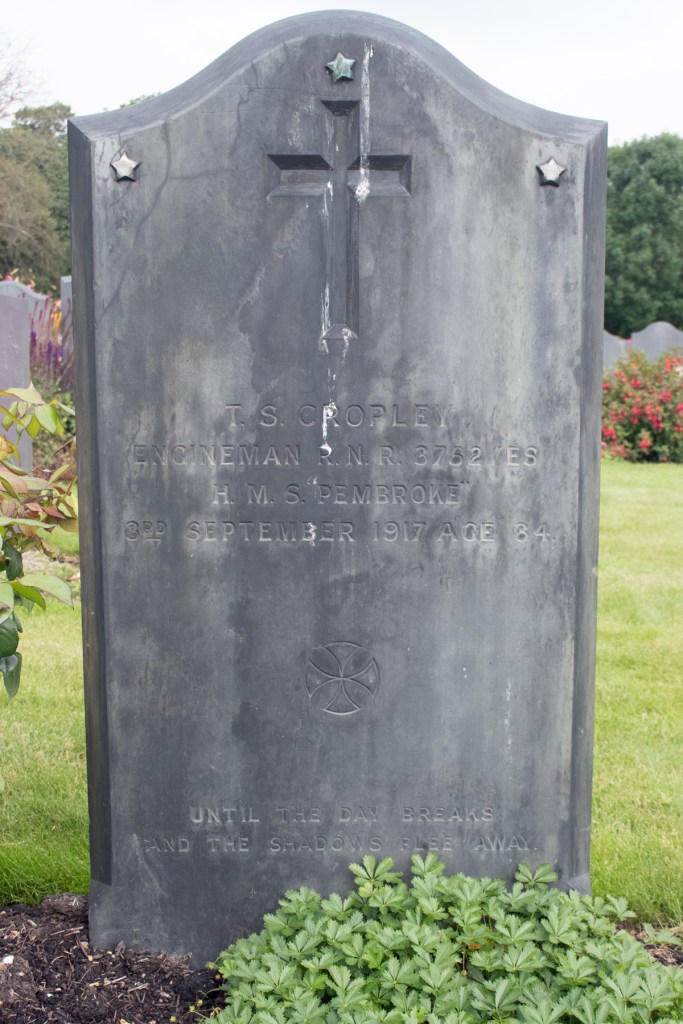
Engineman Thomas Cropley

Engineman Thomas Cropley

Thomas Samuel Cropley was born on 16th November 1882 in the Suffolk village of Mutford. The fifth of eight children, his parents were Robert and Hannah Cropley. Given Mutford’s proximity to the Hundred River Hundred and the coastal town of Lowestoft, it is little surprise that Thomas’ father was a ropemaker. Hannah was also employed, the 1901 census recording her as a monthly nurse – helping women during the month after childbirth.

Thomas’ location to the coast made fishing an ideal choice of work for him, and when he left school he followed his three older brothers into the trade. Indeed, he listed his trade as a deep sea fisherman on his marriage records.

As a young man, he had met bricklayer’s daughter Edith Tuttle, and they tied the knot on 29th May 1906. The couple set up home in Factory Street, Lowestoft, and went on to have seven children.

Sadly, little information on Thomas’ wartime service remains documented. His knowledge of boats and the sea made the navy an obvious option for him, and he enlisted in the Royal Naval Reserve.

Engineman Cropley was assigned to HMS Pembroke – this Royal Naval Dockyard at Chatham in Kent. While it is likely that he served on ships as well, this is certainly the base to which he returned.

Thomas found himself based here in the summer of 1917, which was a particularly busy place at that point in the war. Additional accommodation was desperately needed and he found himself billeted at Chatham Drill Hall, away from the main barracks.

By 1917, the German Air Force had suffered huge losses during the daylight bombing raids it had been undertaking. It was imperative for them to minimise these losses, and so a new tactic – night time raids – was employed.

The first trial of this approach was on the night of 3rd September 1917, and Chatham suddenly found itself in the firing line, startlingly unready and fundamentally unprotected. One of the German bombers landed a direct hit on the Drill Hall, and Engineman Cropley was killed. He was just 34 years old.

Ninety-eight servicemen perished during the Chatham Air Raid that night. They were buried in a mass funeral at the Woodlands Cemetery in nearby Gillingham. This, too, is where Thomas Samuel Cropley was laid to rest.


The lives of Thomas’ family outlines a lot about living conditions in the late nineteenth and early twentieth centuries, with a large number of his relatives dying young.

His father was 68 when he died in 1916; Hannah had passed away fourteen years before, when she was 56 years old. Of his siblings, two did not survive childhood, one died their 20s, one was aged 40, while three reached their late sixties.

Thomas’ widow died in 1921, at the age of 35; their two youngest children died before their first birthdays. Of the other five, one was 31 when he died, while the others lived much longer – one was in their mid-70s, two in their eighties, and the oldest reached her hundredth birthday. A varied legacy indeed.