Category Archives: injury

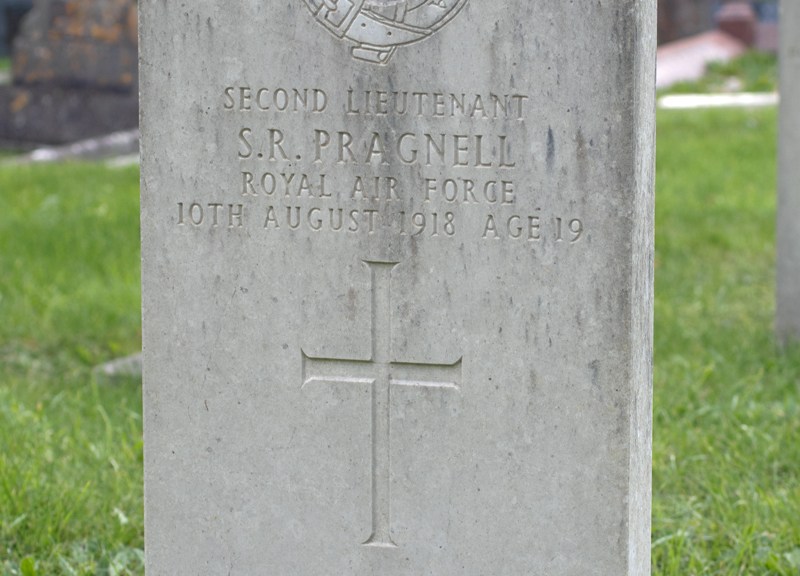
Second Lieutenant Sidney Pragnell

Second Lieutenant Sidney Pragnell

Sidney Ralph Pragnell was the eldest of two children of Edward and Ellen Pragnell. Edward grew up in Sherborne, before moving to London to work as a chef; he found employment as a cook in an officer’s mess, which took him and his wife first to Ireland – where Sidney was born – and then to the barracks at Aldershot.

By the time of the 1911 census, Edward had brought his family back to Dorset, and was running the Half Moon Hotel, opposite the Abbey in Sherborne. Sidney, aged 12, was still at school.

When war broke out, Sidney was eager to play his part, even though he was underage. An article in the local newspaper highlights his keenness and how he progressed.

…he was keen to serve his country and joined every local organisation his age would allow him to. He was an early member of the Sherborne VTC and Red Cross Detachment, and was actually the youngest member of the Volunteers to wear the uniform. Whilst still under age, he enlisted in the Royal Naval Division at the Crystal Palace and after a period of training was drafted as a qualified naval gunner to a merchant steamer carrying His Majesty’s mails and in this capacity went practically round the world. In February he joined the RNAS and after some air training in England went to France to an air station, where he passed all the tests with honours and gained the ‘wings’ of the qualified pilot. Lieutenant Pragnell then decided to go in for scouting and came back to England for advanced training in the special flying necessary for this qualification and it was whilst engaged in this that he met with the accident which resulted in his death.

Western Chronicle: Friday 16th August 1918.

The esteem in which Second Lieutenant Pragnell was held continues in the article, which quotes the condolence letter sent to his parents by his commander, Major Kelly.

It is with deep regret that I have to write you of the death of your son, Second-Lieutenant SR Pragnell. Your boy was one of the keenest young officers I have ever had under my command and was extremely popular with us all and his place will be extremely hard to fill.

The service can ill afford to lose officers of the type of which Lieutenant Pragnell was an excellent example and it seems such a pity this promising career was cut short when he had practically finished his training. May I convey the heartfelt sympathy of all officers and men in my command to you in this your hour of sorrow.

Western Chronical: Friday 16th August 1918.

What I find most interesting about this article is that the letter from Major Kelly detail how Edward and Ellen’s son died, and this this too is quoted by the newspaper.

Your son had been sent up to practice formation flying and was flying around the aerodrome at about 500 feet with his engine throttled down waiting for his instruction to ‘take off’. Whiles waiting your boy tried to turn when his machine had little forward speed. This caused him to ‘stall’ and spin and from this low altitude he had no chance to recover control and his machine fell to earth just on the edge of the aerodrome and was completely wrecked. A doctor was there within a minute, but your boy had been killed instantaneously.

Western Chronicle: Friday 16th August 1918.

Further research shows that the aerodrome Second Lieutenant Pragnell was training at was RAF Freiston in Lincolnshire, which had been designated Number 4 Fighting School with the specific task of training pilots for fighting scout squadrons. He had been flying a Sopwith Camel when he died.

Second Lieutenant Sidney Ralph Pragnell lies at rest in the cemetery of his Dorset home, Sherborne.

Private Edward Lewsley

Private Edward Lewsley

Edward (Teddy) Lewsley was born in 1894, the ninth of twelve children to James and Charlotte Lewsley from London.

James had worked with horses, and become a cab driver at the turn of the century; Edward started as a general labourer on finishing school.

Edward’s military history is a little vague. From his gravestone, we know that he joined the Duke of Cornwall’s Light Infantry and was in the 1st Battalion. The battalion fought at the Battles of Mons, Marne and Messines.

In the spring of 1915, Edward’s battalion fought in the Second Battle of Ypres and, given the timing, it seems likely that he was involved.

Whether he was on the Western Front or stationed in the UK, Private Lewsley was admitted to the Red Cross Hospital in Sherborne, where he passed away on 30th May 1915. He was buried in the town’s cemetery.


One of Edward’s brothers also enlisted in the Light Infantry.

Daniel Lewsley first joined the East Surrey Regiment in 1909 and continued through to 1928. This included a stint as part of the British Expeditionary Force in France.

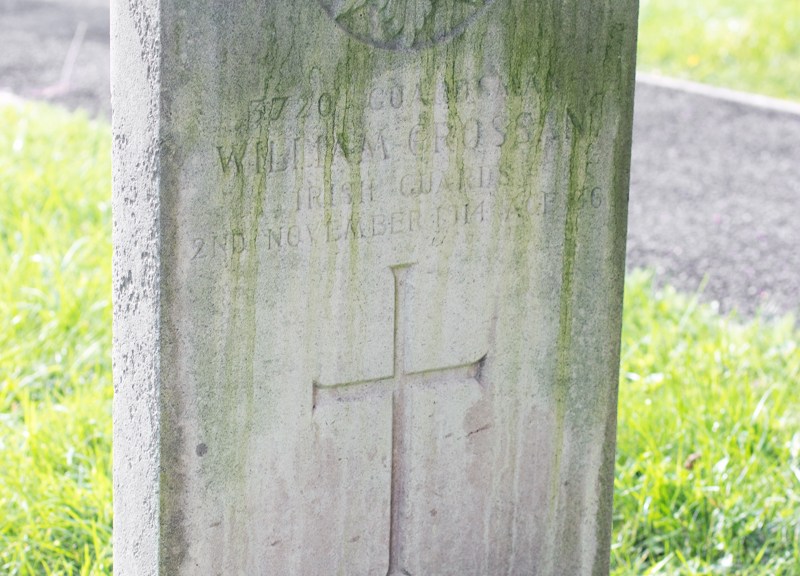
Guardsman William Crossan

Guardsman William Crossan

William Crossan was born in 1892 in Ballinamore, Ireland. He was the fourth of five children to Patrick and Catherine Crossan.

William disappears from the 1911 Census of Ireland, but has joined the Irish Guards by the time war broke out.

Guardsman Crossan’s battalion was involved in the Battle of Mons, but it was during the fighting at Ypres that he was injured.

Shipped back to the UK for treatment, William passed away on 2nd November 1914. While details are scarce, presumably he died at one of the Red Cross Hospitals in the Sherborne area, as this is where he was buried.

Guardsman William Crossan lies at rest in Sherborne Cemetery.

Private Richard Elcocks

Private Richard Elcocks

Richard William Elcocks was born in Wellington, Shropshire, the second son of foundryman Thomas Elcocks and his wife Emma. Born in June 1883, he was one of nine children.

After initially becoming a printer’s apprentice, he enlisted in the Royal Welsh Fusiliers in May 1903. After his initial training and service, Private Elcocks was transferred to the Army Reserve in 1911.

In January 1914, Richard married Charlotte Shenton. Charlotte was a widow ten years his senior, and had two children, Albert and Fred.

When war broke out, Private Elcocks was again called up and shipped to France as part of the British Expeditionary Force. His records confirm that he received a gunshot wound to the left arm on 31st October 1914; the injury was enough for him to be shipped back to the UK for treatment.

He was treated in the Yeatman Hospital in Sherborne, Dorset, and appears to have been there for some time. His records state that he died on 26th June 1915 from an ‘intestical [intestinal?] obstruction following gun shot wound of left humerous’. He was 32 years of age.

Private Richard Elcocks lies at rest in Sherborne cemetery.

Driver Walter Colchin

Driver Walter Colchin

Walter George Colchin was born in 1884 in Borden, Kent. His parents, Herbert and Frances, moved the family – three sons, including Walter, and a daughter – to the village of Iwade, where they ran the Woolpack Inn.

There isn’t a great deal of information about Walter’s life. He married Bertha Sparks from the neighbouring village of Milton in 1916.

Walter joined the war effort at some point after that – I have been unable to find an exact date – and enlisted in the Royal Army Service Corps, before transferring to the Agricultural Company Labour Corps.

Private Colchin was on active service in Steyning, West Sussex, when the war came to a close. On 23rd December 1918, he suffered a cerebral haemorrhage and died. He was 34 years old.

Walter Colchin is buried in the graveyard of All Saints Church in his home village of Iwade.

Private Osbourne Winch

Private Osbourne Winch

Osbourne Ethelbert Winch was born in Kent in 1888, one of three sons to Ernest and Ann Winch. Being the eldest, he inherited his unusual combination of names from his grandfathers – Osbourne on his mother’s side and Ethelbert on his father’s.

Osbourne had moved out of the family home by the time of the 1911 census, and, when war broke out, was quick to enlist. His records show that he was a tall man – standing at 5ft 10ins (1.78m) and he was declared fit for territorial service.

Private Winch joined the 45th Provisional Battalion, before moving to the Royal East Kent Mounted Rifles (also known as the Buffs) in 1916. Soon to be posted to the Front Line, Osbourne married Elsie Taylor in March that year, and he was posted in April.

Along with the move to the Buffs, Private Winch received promotions, first to Lance Corporal and then to Corporal. He again transferred to the Base Depot at Etaples in December 1916 and, for some reason, he reverted to being Private. His records confirm this was “under Para 12.VV.W.L.9/Geb No 5080 (AGI)”, although I have not been able to established what this means. There is no mention of disciplinary behaviour in his records, so whether this was because of the transfer to the depot, I cannot say.

Either way, he was transferred to the Front again on 13th December 1916, and remained on the Cavalry rate of pay.

Private Winch remained at the Front for a number of months. On 19th April 1917, possibly while involved in the Nivelle Offensive, he received gunshot wounds to the head and right hip. He was moved to a hospital in Béthune in northern France, where his hip was operated on.

Osbourne was transferred back to the UK on the Hospital Ship Cambria for medical treatment. His medical report from the UK hospital makes for grim reading:

Private states that he lay out for 2 days before being brought in. Gun shot wound head and right hip 19.4.17. Op on hip at Béthune – bad cough on admissions and moist sound in chest. Large septic wound over right hip exposing iliac crest and much comminution of ilium [breakage of the hip bone]. Acute pneumonia developed and patient grew steadily worse.

Medical Report: E Hamilton-Browne, Military Hospital, Endell Street, London WC

Private Osbourne Winch died at 4pm on 30th April 1917. He was 28 years old. He lies at peace in the graveyard of St Bartholomew’s Church in his home village of Bobbing in Kent.

Private Henry Thurley

Private Henry Thurley

Henry Edward Thurley was born in 1895, the tenth of twelve children to George and Charlotte Thurley. George was a brickmaker from Enfield, Middlesex, and the family moved around to follow his work.

Born in Sheerness, Kent, by the 1901 census, Henry was living with his family in Shoeburyness, Essex. Ten years later, the family had relocated back in Kent, and Henry had joined his father in the brickmaking business, while also working as a waterman – working on boats in the nearby Medway estuary.

When the Great War came, Henry was quick to enlist. He joined the East Kent Regiment – also known as “The Buffs” – in August 1915. After his initial training, Private Thurley was sent to France as part of the British Expeditionary Force.

Private Thurley was wounded on 6th March 1916, receiving gunshot wounds to his right foot, head and eyes. He was sent home to recover, but within a couple of months, he was back on the front line, serving for King and country again.

Henry was wounded again on 16th January 1917; this time is was his right eye that was affected, and he was shipped back to the UK and admitted to Merryflats War Hospital in Glasgow. His wounds appeared more serious this time, and he succumbed to them at 3:50pm on 1st February 1917. He was just 21 years old.

Private Henry Thurley was buried in the churchyard of St Mary the Virgin in his home village of Upchurch in Kent.

Private Walter Apps

Private Walter Apps

Walter Apps was born in 1896 in Kent. He was one of thirteen children to Richard Apps, a shepherd, and his wife Emeline. By the age of 14 he was listed as working on the farm the family lived on; his older brother Bertie was also helping out.

In February 1916 Walter was called up; his enlistment papers show he worked as a horseman, and that he joined the Royal East Kent Regiment (also known as the Buffs because of the colour of their tunic).

Private Apps was posted to the Western Front as part of the British Expeditionary Force in October 1916, and was soon transferred to the Royal West Kent Regiment.

He saw active service, and was wounded on 17th July 1917, receiving a gun shot wound to the face, which resulted in him losing the sight in his left eye.

Private Apps was repatriated on 8th August 1917, and remained there. He was discharged from the army as being no longer medically fit to serve at the beginning of the following March, but sadly passed away on 27th March 1918. He was just 22 years old.

Walter Apps lies at rest in the graveyard of St Bartholomew’s Church in Bobbing, Kent.

Corporal Louis Townsend

Corporal Louis Henry Townsend

Louis Henry Townsend, also known as Henry, was born in the spring of 1881 in Leytonstone, Essex.

Much of Louis’ life remains elusive, he first appears on the census in 1911, and from this we know that he married Florence Annie Ridley (known as Annie) in December 1906. The couple had three children, Thomas, Florence and George.

Louis’ marriage record suggests his father’s name was Thomas Clark, although he also remains a bit of a mystery.

Again, Louis’ military service appears lost to time. He enlisted in the Lincolnshire Regiment, and fought on the Western Front.

The Western Chronicle (26th March 1915) confirms that Corporal Townsend was brought to the Greenhill Voluntary Aid Detachment Hospital in Sherborne, suffering from “a shot through the brain, and from the first was in an extremely precarious condition”.

Louis passed away from his wounds on 20th March 1915, aged 34. He lies at rest in Sherborne Cemetery.


Bombardier Albert Packham

This image has an empty alt attribute; its file name is img_4688s.jpg
Bombardier Albert Packham

Albert Thomas Packham was born in the Kent village of Milton in 1874. The fourth of nine children to George and Mary, he quickly followed into his father footsteps, becoming a general labourer.

In September 1903, he married Ellen Amelia Manktelow; their first child – Ernest – was born in November of that year. By the time of the 1911 census, the couple had three further children – Albert, Ellen and Sydney – and the family had set up home in the village of Bobbing, near Sittingbourne.

Albert received his call up papers in late 1915, by which time sons Stanley and William had joined the family group. Enlisted to the Royal Field Artillery (Reserve), Bombardier Packham undertook his service on home soil. His records show that he was “not to be compulsorily posted for service under Military Service (Review of Exceptions) Oct 1917”.

Bombardier Packham was discharged as physically unfit for service on 15th June 1918; his pension records show that he was suffering from mitral aortic cardiac disease. His papers records that he was a “steady, sober and industrious” individual.

Ellen gave birth to their sixth son – and seventh child – in November 1918. Less than three months later, however, Albert had died. He was 44 years old.

Albert Thomas Packham lies at peace in the graveyard of St Bartholomew’s Church in the village of Bobbing.


Albert was not initially commemorated with a Commonwealth War Grave – presumably as he had been discharged from the RFA. This oversight was subsequently rectified, and a gravestone erected in his honour. However, this was only done many years after his passing, by which time his original burial place had been lost. His stone therefore bears the inscription “Buried elsewhere in this churchyard”.