

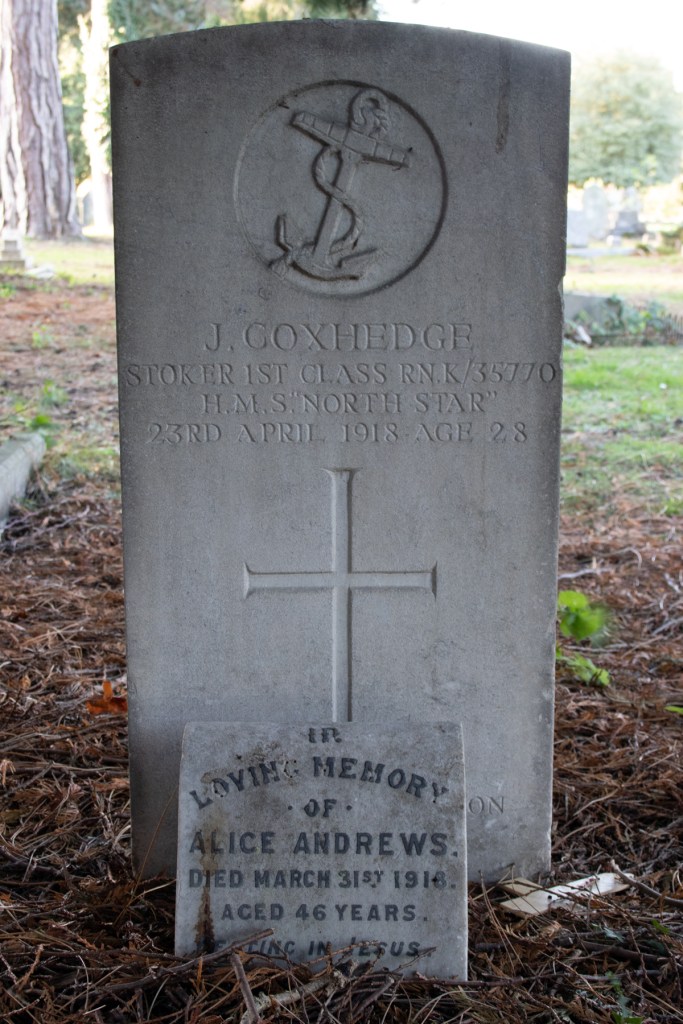
John Coxhedge was born on 28th October 1889 in Faversham, Kent. It seems that he and his siblings were brought up by an aunt and uncle, Mr and Mrs John Hodge, although why this was the case is lost to time. John attended Davington School, to the north of the town, and, for four years, was a chorister at his local church.
When a youth, [John] went to America and worked in some steel works, but after a year or so he returned home, and for a while prior to joining the Navy he was working at the Cotton Powder Works.
Faversham News: Saturday 27th April 1918
John married a woman called Louisa, and they went on to have five children. He enlisted in the Royal Navy as a Stoker 2nd Class on 21st August 1916. His service records show that he was 5ft 6ins (1.68m) tall, had fair hair, hazel eyes and a fresh complexion.
After his initial training at HMS Pembroke, the Royal Naval Dockyard in Chatham, Kent, Stoker Coxhedge was assigned to the boom defence vessel HMS Wallington. He served on board for nine months, gaining a promotion to Stoker 1st Class, before returning to HMS Pembroke.
While back in Chatham, in the summer of 1917, he would have been involved in the German Air Raid on the Dockyard. Unlike dozens of his colleagues, however, he seems to have escaped unscathed.
On 3rd October 1917, Stoker Coxhedge was given another assignment, this time at HMS Attentive, the Dover Patrol. In April 1918, the patrol was involved in some raids on Ostend and Zeebrugge. The local newspaper again picked up John’s story:
No operation in the present war, distinguished though it has been all along by the indomitable heroism of the sons of Britain, has so thrilled the Empire as that of last week – an exploit, which, as has been remarked, recalls some of the undying deeds of the days of Drake and Nelson.
Stoker Coxhedge… was one of the crew of a vessel detailed for covering duty. This vessel got on a sandbank and could not get off, and so in the brilliant light of star shells, which made the night as bright as day, it became a target for the enemy’s guns and a heavy fire was concentrated upon it. It was during this fire that Stoker Coxhedge was badly wounded. Later he, with others of the ship’s complement, was transferred to another vessel, and his death took place in hospital ashore.
Faversham News: Saturday 4th May 1918
John Coxhedge had died of his injuries on 23rd April 1918. He was 28 years of age. He was laid to rest in Faversham Borough Cemetery, not far from where his widow and family lived.

 Death and Service