Category Archives: Somerset Light Infantry

Private George Taylor

Private George Taylor

George William Taylor was born on 14th July 1884 in Holcombe, Somerset. He was one of ten children, and his parents were John and Martha Taylor. John was a coal miner and for a while after finishing school, George followed his father to the pit. But he wanted bigger and better things, and was drawn to a career in the army.

On 16th September 1901, George enlisted in the Somerset Light Infantry. His service records confirm that he was 5ft 7ins (1.69m) tall, and weighed 131lbs (59.4kg). It was also noted that he had brown hair, grey eyes and a fresh complexion, and that he had a scar on his right shin and another on his left arm.

Private Taylor was assigned to the 2nd Battalion, and spent the next ten months training on home soil. In July 1902, however, he set off on his first big adventure, travelling to South Africa with his troop. He returned home in the spring of 1903, and spent the remainder of his seven years’ term of service on British soil.

On Christmas Day 1906, George married Ellen Hitchcock. She was the daughter of a blacksmith from Bath, and their marriage certificate adds further details to George’s life. He was living in Plymouth, Devon, when they married, and he gave his trade as a Bugler in the Somerset Light Infantry.

During the rest of his army contract, George had a number of admissions to hospital, for recurring conjunctivitis, a sprained ankle in November 1905 and a bout of scabies in January 1908. That autumn, having served for seven years, he was stood down to reserve status.

By the time of the 1911 census, George had settled back into civilian life. The young couple set up home in Holcombe, and George took up work back in the colliery there, where he was employed as a carter. A boarder helped them bring in a bit more money, but the document shows evidence of tragedy as it notes that Ellen had given birth to two children, but that both had died.

When war came to Europe in 1914, George was called back into active service. Initially assigned to the 1st Battalion of the Somerset Light Infantry, he arrived in France in July 1915. He only remained there for a matter of months, however, and, by October Private Taylor was back in Britain and reassigned to the 3rd Battalion.

It appears that his repatriation may have been for health reasons. On 31st January 1916, George was admitted to the 4th Southern General Hospital in Plymouth. The handwriting in the notes for this admission is difficult to read, but the basic headline is starkly clear: ‘bronchitis and subsequently mental’.

Private Taylor remained in hospital for a couple of weeks, before being moved to the Wells Asylum in Somerset. He was assessed by the military doctor after a couple of months’ treatment, and was declared unfit to continue in active service, due to ‘general paralysis of the insane’ or shellshock/PTSD as it is known today. His illness was wholly attributed to his military service, and sheds some light on what he must have gone through during his short time in France, compared to his previous seven years’ service. George’s last day in the army was on 13th April 1916, and he had served for a total of 14 years, 211 days.

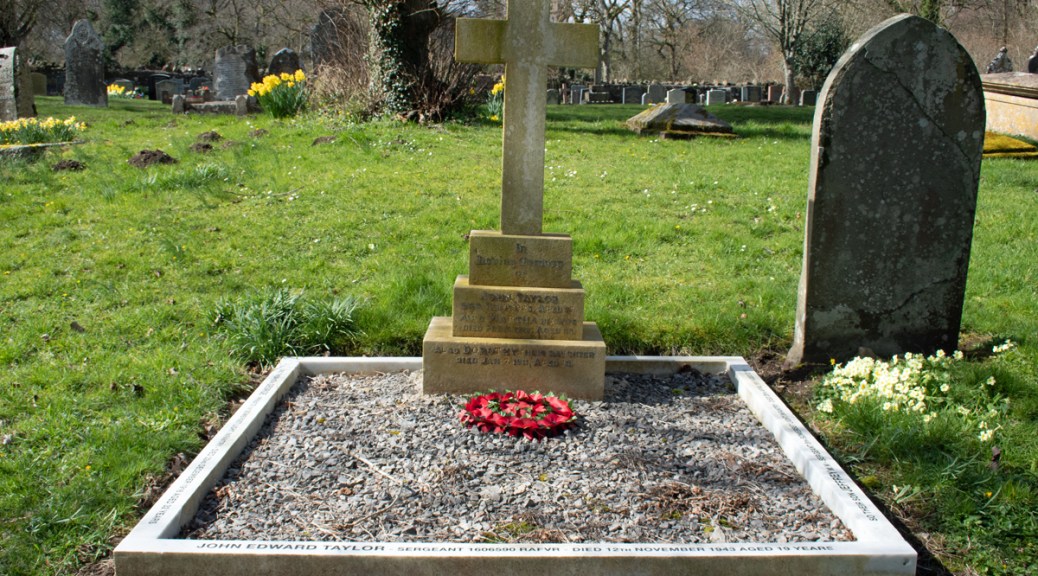
George’s trail goes cold at this point. He passed away on 22nd December 1916, at the age of 32 years old. Although records do not confirm this, it seems likely that he died while he was still admitted to the asylum, as his death was recorded in Wells.

George William Taylor was brought back to Holcombe for burial. He was laid to rest in the family plot in the graveyard of St Andrew’s Church.


Private Albert Taylor

Private Albert Taylor

Albert Edward Taylor was born in the autumn of 1887 and was the fifth of eight children to John and Mary Taylor. John was a mason and both he and Mary came from Crewkerne, Somerset, which is where they raised their family.

Albert worked as an errand boy when he left school, but he sought a career and, enlisted in the Army Service Corps in July 1904. He lied about his age to join up, suggesting he was nearly 22, where he was actually just 17 years of age.

Driver Taylor’s service records confirm that he was 5ft 3ins (1.6m) tall and weighed 115lbs (52.2kg). He was noted as having brown hair, blue eyes and a fresh complexion. He had a mole between his shoulder and the back of his neck, and his religion was recorded as Baptist.

Albert’s contract was for two years’ service, followed by ten years in the Army Reserve. While a military career was what he sought, he seems to have had a disregard for rules, and regularly had run ins with authority, as his Regimental Defaulter Sheet testifies.

On 19th December 1904, while based in Woolwich, Surrey, he was absent without a pass from 6am until 12:15am on 30th December. He was confined to barracks for eight days.

The following year, Driver Taylor had moved to Bordon in Hampshire. On 28th November 1905, he was absent without a pass, from midnight until 8:30am on 1st December. He was again confined to barracks, this time for ten days.

A third offence came on 29th May 1906, by which time Albert had moved to Aldershot, Hampshire. He was found in neglect of duty ‘in allowing dirty pudding cloths to be deposited in the cupboards of the cookhouse’ and being ‘absent from work from 1:30pm till found in his barrack room at 9:20pm.’ For these, he was confined to barracks again, this time for eight days.

Within a matter of weeks, he was found in neglect of duty again, having broken out ‘of barracks after tattoo and remaining absent till apprehended by the Military Police at about 10:50pm’ and being ‘drunk and improperly dressed.’ This time the punishment was more severe and he was detained in prison for 96 hours.

Unsurprisingly, Albert’s military career didn’t go much further than this. When his two-year contract came to an end, he returned to Somerset and found employment as a mason.

In July 1910, Albert married Mabel Wallbridge, the daughter of a carman, also from Crewkerne. The couple set up home on the outskirts of the town, and went on to have a son, Frederick, who was born later that year.

The 1911 census found the young family living in a cottage in Lye Water, with Albert listing himself as a ‘mason (army pensioner)’. While the military reference may have been added with a sense of pride, irony or bloody mindedness, Albert was not to fully leave his army career behind. When war came to Europe in 1914, he was still within his reserve status, and was called up to play his part.

Private Taylor was to leave his family behind: son Frederick had now been joined by daughters Kathleen and Joyce, and Mabel pregnant with another daughter, Rosaline, who was born in January 1915. Albert was assigned to the 1st Battalion of the Somerset Light Infantry and, in contrast to his previous tenure on the Home Front, he soon found himself in the thick of things.

Albert’s regiment was involved in some of the fiercest opening skirmishes of the First World War, and he would have been caught up on the Battles of Le Cateau, the Marne, the Aisne and Armentières. By the spring of 1915, the battalion was entrenched at Ypres, and it was here during the Battle of St. Julien that Private Taylor was injured.

Albert has received a gun shot wound to the left side of his skull and was medically evacuated to Britain for treatment. He was admitted to the Beechfield House Hospital in Southampton, but his wounds proved too severe, and he passed away on 14th May 1915, at the age of 27 years old.

The funeral of Private Albert Edward Taylor, of the Somerset Light Infantry… who died from wounds received at the Front, took place with military honours at the Cemetery [in Crewkerne] on Tuesday afternoon, and attracted a large attendance. As a mark of respect to the memory of the deceased soldier blinds were drawn at the private and business houses en route to the Cemetery, while the flag erected outside the Victoria Hall for the children’s Empire-day celebration was lowered to half-mast.

Rev. J Street (Unitarian Minister)… spoke of the painful circumstances and the heroic conduct of the deceased, who had sacrificed his life for others. Although death was attended with pain and sorrow, yet in after years deceased’s children would look back with pride to the part their father took in the present war.

Taunton Courier and Western Advertiser: Wednesday 26th May 1915

Albert Edward Taylor was laid to rest in the cemetery of his home town, Crewkerne.


Private Albert Taylor (from findagrave.com)

Albert’s headstone gives his initials as AC Taylor. They should be AE Taylor.

Private Edward Horwood

Private Edward Horwood

Albert Edward Horwood was born in Bath, Somerset, in the spring of 1864. The middle of five children, his parents were Joseph and Agnes Horwood. Joseph was a stone mason and, when Agnes passed away in 1872 he married again, this time to a woman called Elizabeth.

When he left school Albert – who became better known as Edward – found work in a local foundry. Joseph died in 1888, and just two years later, Edward married Emily Wheeler. She was the daughter of labourer from North Bradley, Wiltshire, and it was in the parish church that the couple exchanged vows.

The couple set up home in the Lyncombe area of Bath, and went on to have nine children, all but one of them girls. Edward continued with labouring work for the next twenty years, as his children grew in the family home in Cheltenham Street.

Despite his age, when was broke out in Europe, Edward stepped up to play his part. He enlisted in the Somerset Light Infantry on 6th November 1914, and was assigned to the 4th Battalion. His service records show that he was 44 year of age and 5ft 11ins (1.8m) tall.

Attached to one of the regiment’s supply companies, Private Horwood remained on the Home Front. He remained on active duty for more than eighteen months until, in June 1916, he was medically discharged because of a large ulcer and epithelioma (lesion) on his tongue. Edward’s medical notes suggest that he was offered an operation to remove the potentially malignant growth, but that he had declined.

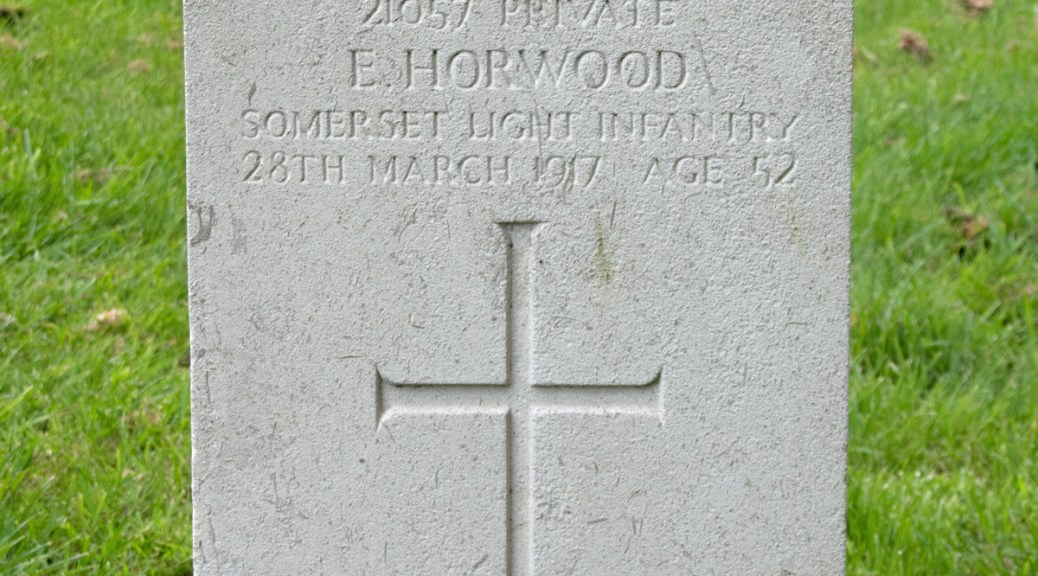
At this point Edward’s trail goes cold. He returned home, and passed away on 28th March 1917 and, while the cause is not publicly documented, it seems likely to have been related to the growth in his mouth. He was 52 years of age.

Albert Edward Horwood was laid to rest in the St James Cemetery in his home town of Bath.


Lance Corporal Alfred Sowden

Lance Corporal Alfred Sowden

Alfred Edward Sowden was born in the autumn of 1883, in Bath, Somerset. He was the youngest of seven children to Robert and Mary Sowden. Robert had died by the time of the 1891 census, and Mary turned to charring to bring in money for the family.

In the summer of 1904, Alfred married Harriet Sumsion, a baker’s daughter also from Bath. The couple set up home in a small cottage on the main road to Bristol, and had a son, William, who was born the following year. Alfred was working as a house painter by this point, and the young family had a lodger, William Gabb, who was a local chef.

When war came to Britain’s shores, Alfred stepped up to play his part. He may have had some previous military experience, because he joined the Somerset Light Infantry as a Lance Corporal. Assigned to the 2nd/4th Battalion, by August 1915, he was on his way to India. His troop remained there for two years, before moving to Egypt in the autumn of 1917, then on to France the following June.

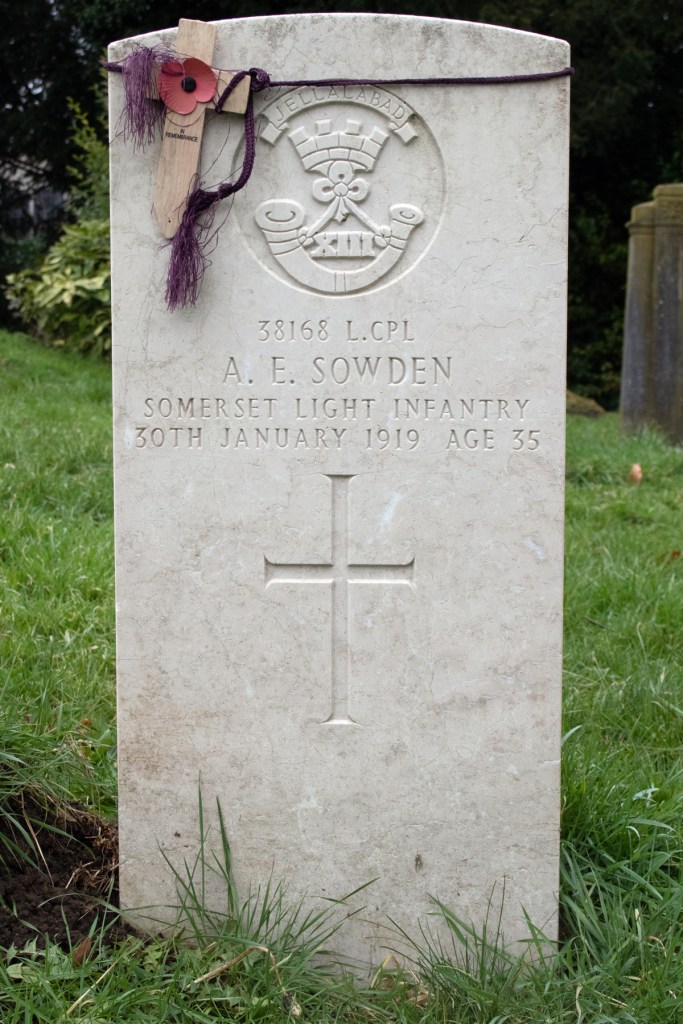
With the end of the conflict, the Empire’s forces were slowly demobbed. While he was waiting to be stood down, Lance Corporal Sowden fell ill. He developed influenza and septic pneumonia, and the combination was to prove fatal. He passed away on 30th January 1919, at the age of 35 years old.

Alfred Edward Sowden’s body was brought back to Bath for burial, where he was laid to rest in the city’s St James’ Cemetery.


Alfred’s widow had had a tragic few years. Her father, Walter, had passed away in February 1916, and her mother died just three months after Alfred.

Harriet never remarried after her husband’s passing. She remained in the family home for the rest of her life and, by the time of the 1939 Register, had a boarder, billiard marker James Jones. She was close to family, however, as her brother William lived just three doors away.

Harriet died in September 1941 at the age of just 56. She was laid to rest near her husband, reunited after 22 years.


Private Albert Townsend

Private Albert Townsend

Albert Henry Townsend was born on 7th November 1890 in Bath, Somerset. One of thirteen children, his parents were George and Annie Townsend. George was a painter by trade, but when he died in the autumn of 1895, Annie was left to take in laundry to earn money to support her and the four of her children still living at home.

By the time of the 1911 census, Albert was 21, and had found work as a baker. He was still living with his mother, two siblings and a nephew in a house in the centre of the city. All but Annie’s grandson were earning money by this point, and, with five rooms, the family were in a better position than some of their neighbours. Next door was Albert Smith, a coal carter, who had to support a family of ten people.

In the summer of 1914 war broke out, and within months, three of the Townsend brothers – Albert and his older brothers Arthur and Charles – had enlisted.

Arthur Townsend had joined the Duke of Cornwall’s Light Infantry earlier in the year, and within weeks of conflict being declared, he was on the Western Front. He was to be one of the early casualties of the conflict, and was killed in action during the Battle of the Marne on 9th September. He was just 29 years old and, while his body was never identified, he was commemorated on the La Ferte-sous-Jouarre Memorial.

Albert’s service records have been lost to time, so it is not possible to identify when he enlisted. He joined the Somerset Light Infantry, and was assigned to the 4th Battalion, who set sail for India in October 1914. Private Townsend was not to travel with them, however as he had contracted septicaemia while camped on Salisbury Plain, Wiltshire. He was transferred to the Royal United Hospital in Bath for further treatment, but his condition was to prove too severe. He passed away while still admitted on 19th October 1914. He was just 23 years of age.

Albert Henry Townsend was laid to rest in the St James’ Cemetery in his home city, Bath.


Annie Townsend had now been a widow for nearly twenty years and, within a matter of weeks, had lost two of her sons. Tragically, the war was not done with her family yet.

Charles Townsend was still serving, having enlisted in the 8th Battalion of the Somerset Light Infantry. He arrived in France in July 1915, and over the next year, wascaught up in some of the fiercest fighting of the conflict. On 1st July 1916, the Battle of the Somme began, the darkest day in history for the British Army. Twenty thousand soldiers were killed, and Private Charles Townsend was amongst the fallen. He was just 30 years of age. He was commemorated on the Theipval Memorial.

Annie had lost a third son to the conflict in a little under two years, and her pain must have been unimaginable. She lived on until 1923, when she died at home in Bath. She was laid to rest close to her husband and Albert, a family partly reunited once more.


Private Sidney Warren

Private Sidney Warren

Sidney Charles Warren was born in the spring of 1894, and was one of a dozen children to William and Eliza Warren. William was a farm labourer and shepherd from Somerset, and it was in the village of Combe Florey, near Taunton, that Sidney was born. The Warrens’ sons all followed William into farm work, and the 1911 census found the family – then eight strong – living in a three-room cottage in the village.

When war broke out, Sidney was quick to enlist. He joined the 5th Battalion of the Somerset Light Infantry on 16th December 1914, and which was based in Prior Park, near Bath.

The following month, Private Warren became unwell. His father later reported that he had “from childhood… suffered from his chest, and if he caught the slightest cold he became very short of breath. He could not run and jump about like other boys.” [Bath Chronicle and Weekly Gazette: Saturday 6th February 1915]

On 27th January, Sidney reported sick to Captain Brimblecombe of the Royal Army Medical Corps. He was suffering from a cold, and was given quinine. He reported sick again on the 28th, and the medical officer, gave him more quinine. The following day, Private Warren returned to duty.

That afternoon, after drill duties, Sidney and a couple of friends, George Berry and George Lewis, went into Bath for a few hours. They went to the White Hart Public House and had a drink and a meal. The two of them then made their way back to Priory Park around 8pm.

On the way up the hill [Sidney] called to [his friends]… “Come quick.” They went back, and caught hold of him, and he said “I’m dying.” They laid him down on the road, and [George Berry] went up to Priory Park for a doctor. A Red Cross man came down with a stretcher, and [Sidney] was conveyed to the Police Station and then to the Hospital.

Bath Chronicle and Weekly Gazette: Saturday 6th February 1915

Private Warren passed away while at the hospital. A post mortem was held, which found that all of his organs were healthy, and that his lungs were “voluminous, but showed no signs of disease. The heart appeared perfectly healthy.” The coroner attributed Sidney’s passing to syncope after “a large undigested meal and walking up-hill”. He was just 20 years of age when he passed.

Sidney Charles Warren was laid to rest in the St James’ Cemetery in Bath, the city in which he passed away.


Private Sidney Warren
(from britishnewspaperarchive.co.uk)

Private Joseph Viles

Private Joseph Viles

Joseph Viles was born at the end of 1886 in Bath, Somerset. One of seven children, his parents were collier-turned-general labourer Joseph Viles and his wife, Sarah.

When he left school, Joseph found work as an errand boy, but, in reality, there is little documented about his life. There are only really two records that give an insight into the man he became.

The first is the 1911 census, which confirms he was a Private in the 2nd Battalion of the Somerset Light Infantry. The return gives his location as the St Andrew’s Barracks in Malta.

The second document dates from 29th June 1909, and is a court martial for Private Viles’ for the use of insubordinate language towards a senior officer, in this case a Major. The trial was held in Portland, Dorset, and Joseph was sentenced to 30 days’ imprisonment.

Sadly, a lot of the service records for the Somerset Light Infantry have been lost over time, and those relating to Joseph are amongst them. The only other confirmed detail for Joseph is that of his passing, but even this raises questions.

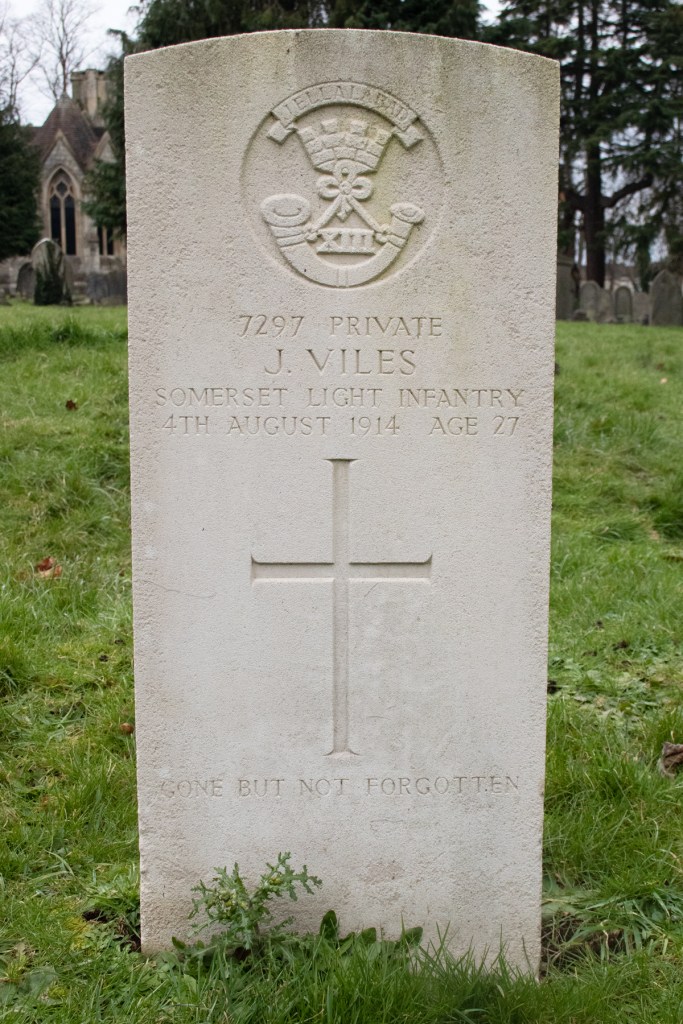
Private Joseph Viles died on 4th August 1914 – just seven days after war was declared. His regiment was actually based in Quetta, India, at this point, so it is likely that he was at home on leave at the time he died. No cause for is death is noted, and it is likely to have been from an illness of some description, as nothing unusual was reported in the newspapers of the time. Joseph was 27 years of age.

Joseph Viles was laid to rest in Bath’s St James’ Cemetery, where his parents would also be buried, Joseph Sr in 1948, and Sarah in 1958.


Private Alfred Stoyle

Private Alfred Stoyle

Details of Alfred Lawrence Stoyle’s life a challenging to piece together. Most of the information comes from his service records, but even that is limited.

The Somerset Light Infantry records suggest that Private Alfred Stoyle was born in March 1890 in Widcombe, Bath. Physically, he was 5ft 8ins (1.73m) tall, and weighed 109lbs (49.4kg). He had blue eyes, brown hair, a tattoo of crossed flags on his right forearm and a scar above his right eye.

According to the document, Alfred’s parents were Alfred and Ellen Stoyle, and he had been working as a mason’s labourer before he enlisted on 13th February 1909. Early records for the Stoyles are hard to come by, The 1891 census found Alfred and Ellen living in Walcot, Somerset, with their eight children. They have a son, Alfred, although he is noted as being 19 at the time, which does not match the service records for the Alfred who enlisted. They have another son, Albert, who was born in 1886, and it seems that he may have used the name Alfred when enlisting (indeed, those service records note not only Alfred’s parents, but his older siblings Nellie, Ada, Henry and Alfred).

The next census, in 1901, recorded Alfred Sr as being a pauper in the Bath Union Workhouse. He was also listed there in the 1911 census, while that document recorded Ellen living in two rooms in the centre of Bath with Albert/Alfred and her youngest son, William.

Alfred Jr was recorded as being a general painter. By this time, he had enlisted in the Somerset Light Infantry, and was on reserve status, allowing his daily life to continue. He undertook annual training, and, when war broke out in August 1914, he was formally mobilised.

Private Stoyle was sent to France the following month, and ended up spending four months there. In January 1915 he returned home, and there appears to have been a medical reason for doing so. Within a matter of months, he was discharged from the army as he was no longer physically fit. The service records do not give a reason for his dismissal.

At this point, Alfred’s trail goes cold. He seems to have returned home to Somerset, and passed away on 21st August 1915. Based on his service records, he was just 25 years old, although his true age is debatable.

Alfred Lawrence Stoyle was laid to rest in St James’ Cemetery Bath.


Sapper Albert Colston

Sapper Albert Colston

Albert Edward Colston was born in the spring of 1887 in Bath, Somerset. The oldest of seven children, his parents were Thomas and Elizabeth Colston. Thomas was a carpenter and the family were raised in Lyncombe, to the south of the city centre.

Elizabeth died in 1905, by which time Albert had left school. He worked with Thomas and, by the time of the 1911 census, the family – father and four children at home – had moved to a terraced house in the suburbs of Twerton.

During this time, Albert volunteered with the Somerset Light Infantry. When war came to Europe, however, he was enlisted into the Royal Engineers. He joined on 28th February 1916, and was assigned to the Wessex Field Company. His service record show that he was 5ft 8ins (1.73m) tall, of normal physical development and with good vision.

A few months after enlisting, Albert married Alice Selway. She was a groom’s daughter from Bath who, at the time of their marriage, was working as a housemaid in a boarding house in the centre of the city.

Sapper Colston spent the next year on home soil. In March 1917, however, he was discharged from the army as he was deemed no longer medically fit for active duty. Sadly, the records do not confirm the complaint that led to his dismissal.

It is likely that he returned home when he was discharged. He died in Bath just weeks later, on 4th April 1917. He was thirty years of age.

Albert Edward Colston was laid to rest in St James’ Cemetery in his home city, the same location as Elizabeth, mother and son reunited again.


Alice married for a second time in May 1919. He husband was William Keepen, and the couple went on to have a son, Reginald, who was born in 1920. Reginald died in 1937, while Alice lived until 1918. The couple were buried in Haycombe Cemetery on the outskirts of Bath.


Private Edgar Cox

Private Edgar Cox

Edgar Albert Cox was born in Wanstrow, Somerset, in the spring of 1897. The youngest of five children, his parents were railway packer Herbert Cox and his wife, Orpha.

When he left school, Edgar found employment as a live-in farm hand in Upton Noble, a mile from where his parents lived. When war came to Europe, however, he felt a pull to serve, and enlisted in the Somerset Light Infantry.

Full details of Private Cox’s military service are lost to time, but he was assigned to the 8th (Service) Battalion, and arrived in France towards the end of July 1915. He certainly saw action at the Somme, where his troop was involved in the battles of Bazentin Ridge, Flers-Courcelette and Morval.

It was in the battle of le Transloy, however, that Edgar was injured. His wounds were severe enough for him to be medically evacuated to Britain for treatment, and he was admitted to the 1st Southern General Hospital in King’s Norton, Birmingham. Sadly his wounds were too much for his body to bear: he passed away on 9th October 1916, at the age of just 19 years old.

The body of Edgar Albert Cox was brought back to Somerset for burial. He was laid to rest in the quiet graveyard of St Mary’s Church in his home village of Wanstrow.