Category Archives: Bandsman

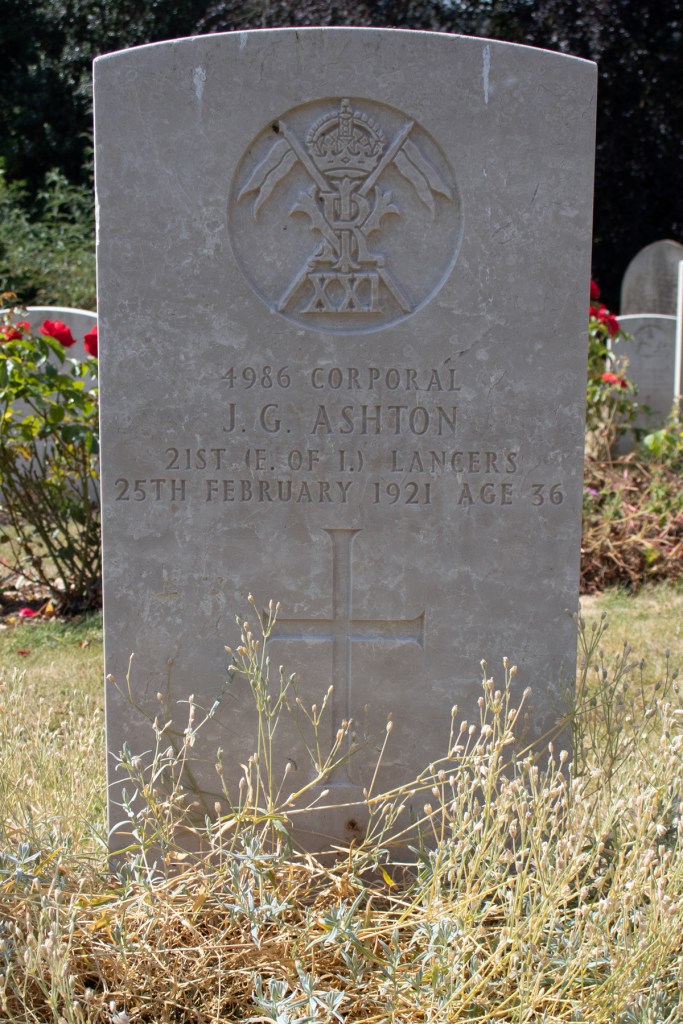
Corporal John Ashton

Corporal John Ashton

John Gordon Ashton was born at the start of 1885, and was one of at least two children to John and Elizabeth. Little information is available about his early life, although later records confirm that he was born in Newcastle-upon-Tyne, and that the family were living on Elswick Road, leading west out of the city, by 1900.

John found work as a musician, but sought a bigger and better career for himself. On 3rd October 1900, he enlisted in the army, joining the 21st (Empress of India’s) Lancers. His service records show that, at not yet sixteen years of age, he was just 5ft 1in (1.55m) tall, and weighed 101lbs (46kg). He had brown hair, grey eyes and a dark complexion, and two moles on the front of his left shoulder.

Private Ashton joined up for a period of 12 years’ service, and spent most of it on home soil. The army seemed to suit him, and he steadily rose through the ranks. By August 1901, John was promoted to Bandsman; five years later, he took the rank of Trumpeter; the start of 1908 brought with it a promotion to Lance Corporal.

In September 1910, John’s unit was sent to Egypt: the move brought him a further promotion. Corporal Ashton spent two years in Cairo, before returning to Britain in the autumn of 1912. He had completed his contract of service with the 21st Lancers, and was formally discharged from service on 4th October.

Back on civvy street, John once again found work as a musician. Life outside of the army seemed not to suit him, however, and he joined the reserve forces in March 1913. The now Lance Sergeant’s service records show the man he had become: he now stood 5ft 9ins (1.75m) tall, and bore a large oval scar on the underside of his right knee.

When war was declared the following summer, John was formally mobilised once more. He was attached to the 9th (Queen’s Royal) Lancers and, by 27th August 1914, was in France. Lance Sergeant Ashton’s time overseas was not to last long, however; he returned to Britain just before Christmas that year, and was based at Tidworth Camp in Wiltshire.

John’s military record was not without its hiccups. On 11th March 1910, while based in Canterbury, he was severely reprimanded for being in neglect of his duty whilst in charge of a barrack room. In 1915, however, he received a more severe punishment: on 23rd January, he was found guilty of using insubordinate language to his superior officer – in front of six ranking witnesses – and was demoted to Corporal.

It would seem that John’s health was beginning to suffer, and, after a career of nearly sixteen years, he was medically discharged from the army because of a heart condition.

At this point, his trail goes cold. He remained in the Wiltshire area, and seems to have been receiving ongoing medical treatment. At some point, he married a woman called Mary, although no other information is readily available for her.

Early in 1921, John was admitted to the Pensions Hospital in Bath, Somerset, having contracted pneumonia. He passed away there on 25th February following an aneurysm of the heart. He was 36 years of age.

John Gordon Ashton was laid to rest in the sweeping Locksbrook Cemetery in Bath.


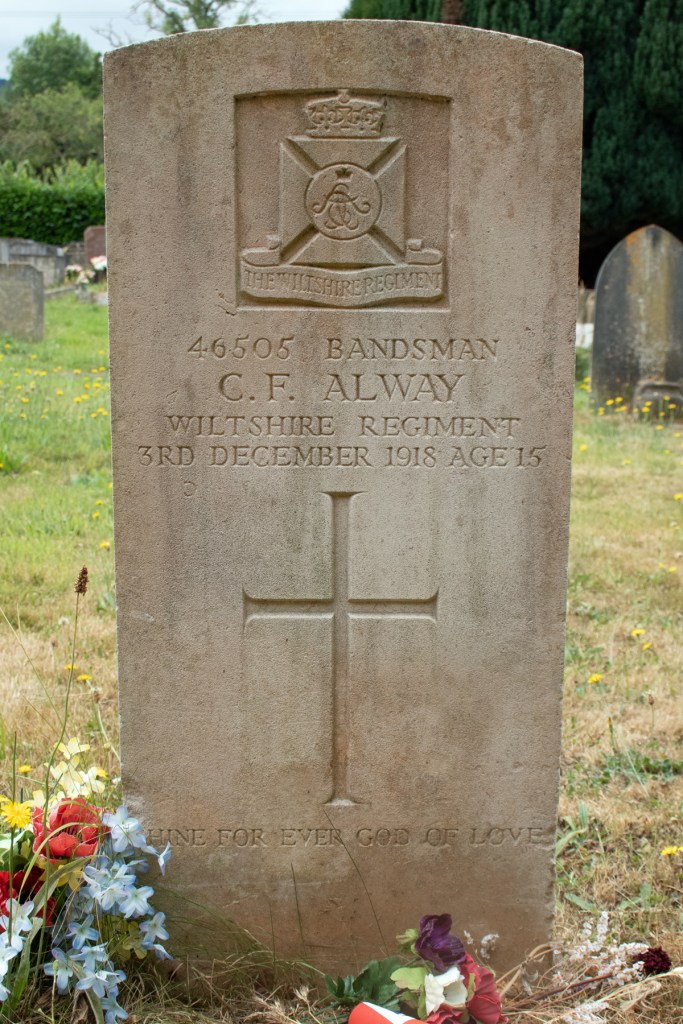
Bandsman Clifford Alway

Bandsman Clifford Alway

Clifford Frederick Alway was born on 2nd February 1903 in Wellington, Somerset. He was the fifth of fourteen children to Samuel and Ann Alway. Samuel was a farm labourer and butcher and, when war broke out, he stepped up to play his part, enlisting as a Driver in the Royal Field Artillery.

Clifford also seemed keen to be involved, and it can only be assumed that one or both of his older brothers – William (born 1898) and Wyndham (born 1901) – had joined up. By the summer of 1918, Clifford enlisted in the Wiltshire Regiment. It seems likely, given that he was only fifteen years old, that he had lied about his age, as so many young men did.

He joined the 3rd (Reserve) Battalion of the Wiltshire Regiment as a Bandsman. This was a territorial force, and Clifford was posted to Kent, as part of the Thames and Medway Garrison.

It was here, where it was billeted in crowded barracks, that Bandsman Alway contracted influenza and pneumonia. Admitted to hospital in Aylesford, the conditions proved too much for his system, and he passed away on 3rd December 1918. Tragically, Clifford was just 15 years of age.

Clifford Frederick Alway was brought back to Somerset for burial. He was laid to rest in Wellington Cemetery, not far from where his family still lived.


Samuel survived the war, spending more than three years in France – he was overseas when his son passed away, and so was unable to attend the funeral.


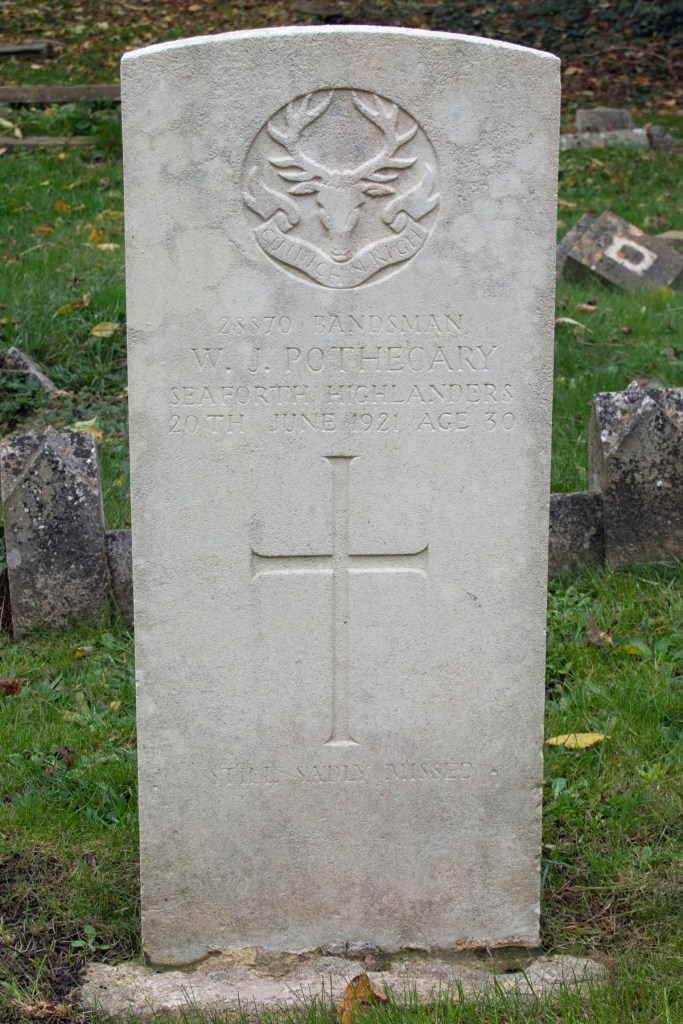
Bandsman William Pothecary

Bandsman William Pothecary

William James Pothecary was born in Frome, Somerset, on 24th April 1891, one of six children – and the only boy – to Francis and Annie Maria Pothecary. Francis was a groom, and the couple raised the family in Pilly Vale (now Willow Vale) which ran alongside the River Frome in the centre of the town.

Little further information on William’s early life is available, although it seems he was a keen musician, and took up the oboe at an early age. He joined the 2nd Seaforth Highlanders in 1909 as a Bandsman, and, from later reports, was a talented player.

When was broke out, William was sent to the front, but in 1915, while caught up in the Second Battle of Ypres, he was buried and seriously wounded by a bomb. He was sent to a convalescent home in Ireland, recovered reasonably well and returned to France, where he served until the end of the war.

Bandsman Pothecary was demobbed in July 1919 and returned to Somerset. The following year, he needed an operation following the recurrence of the issues he encountered following his injury, and all seemed to be going well for a long-term recovery.

William had a relapse in the summer of 1921, and was admitted to Bath Hospital. Sadly, however, he was not to recover this time, and he passed away on 20th June. He had just turned 30 years old.

William James Pothecary was laid to rest in the graveyard of Christ Church in his home town of Frome.


The Somerset Standard gave a glowing obituary for young William:

Death of an “Old Contemptible”

The was, through the fighting is over, still claims victims from the ranks of survivors. On Monday, Mr William James Pothecary, one of the “Old Contemptibles”, died in the Pensions Hospital at Bath from the effects of wounds which he received in 1915. He was the only son of Mr and Mrs FW Pothecary, of Bath Street, and very deep sympathy is felt with the parents and sisters in their great bereavement. Mt WJ Pothecary was an old Regular.

Nearly twelve years ago he joined the 2nd Seaforths. He was a talented player of the oboe, and it was his love of music which prompted him to become a bandsman in the 2nd Seaforths. He had previously been a bugle boy in the old Volunteers, and afterwards a member of the Territorial Band. And at the time of his death he was one of the most valued players in the Frome Town Military Band.

He went to France with his regiment in 1914. In 1915 he was seriously wounded and buried by a bomb. His condition was critical for a long time, but he slowly recovered and was sent to a convalescent camp in Ireland. He remained there for a considerable time, and when he was deemed medically fit he was sent to France a second time. He continued to serve in France until after the Armistice. He was discharged from the Army in July 1919.

Last year it was necessary for him to undergo a very serious operation in hospital. The operation was successful, and it was hoped there would be a permanent recovery. But on Thursday last there was a recurrence of an old trouble, and he was removed to Bath Hospital, where he died on Monday morning.

He was a talented and promising young fellow, and his death is deeply deplored by his many friends, and not least by his fellow members of the Frome Town Military Band.

Somerset Standard: Friday 24th June 1921

Bandsman Hubert Campbell

Bandsman Hubert Campbell

Hubert Stephen Buck was born on 18th October 1887, in Stepney, East London. His father, Edgar Buck, started to use his grandmother’s maiden name – Campbell – from the 1880s, and, by 1901, the family had formally changed their name.

At the time of his marriage to Hubert’s mother Alexandra Stephen in 1885, Edgar was working as a ostrich feather manufacturer. The couple went on to have six children, all boys, of which Hubert was the second oldest.

By the time of the 1901 census, Edgar and Alexandra has moved the family south of the river, from Mile End to Lambeth. By now, Hubert’s father was working as a musician, but there is little further information about his trade.

The next census – from 1911 – found the family living in Lewisham. Edgar was now listed as a band leader, while Hubert, who was the oldest child still living at home, gave his profession as musician, presumably in his father’s band.

War was imminent and, while Hubert was definitely involved, there is little specific information about his military service. He enlisted in the Irish Guards, and was assigned the role of Bandsman.

In August 1917, Hubert married Alice Johnson in Sutton, Surrey. He listed his profession as Musician in HM Irish Guards, so must have enlisted before that point. Interestingly, the same document identifies Edgar’s profession as Bandmaster in the 1st City of London Regiment, so it seems he also enlisted.

The marriage certificate shows Alice was two years older then her new husband, and that she was the daughter of warehouseman Alfred Johnson, who had, by that point, passed away.

Bandsman Campbell survived the war, but there is no indication as to whether he served abroad, or was part of a territorial force. He and Alice moved to Worthing in West Sussex, but there is no confirmation on when the move took place. The 1921 census, taken in June of that year, records the couple as living at 151 Lyndhurst Road in Worthing, where he was noted as being a totally disabled pensioner. There is little further information about him, other than the fact that he died on 4th August 1921, at the age of 35.

Hubert Stephen Campbell was laid to rest in the Broadwater Cemetery in Worthing.


While Hubert’s trail went cold, there is further information on Alice. An advert in the Worthing Gazette offers musical training by her:

Musical Training on Modern Methods

Pianoforte (Matthay), Voice Production, Singing, Theory, Harmony, Aural Culture, Musical Appreciation, and Art of Teaching.

Thorough preparation for all Examinations, Elementary to Diploma Grades, Special Courses for Teachers for the study of the Matthay system and the Art of Teaching.

MADAME ALICE CAMPBELL (Member of the Musical Councils of the London and East London Musical Festivals. Registered Teacher: Teachers’ Registration Council.

Worthing Gazette: Wednesday 31st August 1921

Digging a little deeper, and there are similar advertisements in the newspaper from late 1917, through to at least the 1930s, by which time, Alice was running the Worthing School of Music.

The advert suggests a couple of points. It certainly suggests that a love of music is what brought Hubert and Alice together in the first place. There was a definite musical connection in the household, initially driven by Hubert’s father, and continued with his widow.

Given that the advert above is dated a matter of weeks after Hubert’s death, it also seems likely that his passing was not unexpected. There is nothing in the local media relating to his death, and, with regular students to teach, Alice obviously felt is unnecessary to take any significant time away from her work in grief. It is supposition on my part, but it would suggest that Hubert died from a chronic condition, possibly one of the lung diseases that were rife across Europe in the aftermath of the Great War.

The last advert for the Worthing School of Music ran on 12th September 1934. Beyond that date – when Alice would have been 49 – there is no further clear record of her or the school.