
Category Archives: Cook’s Mate

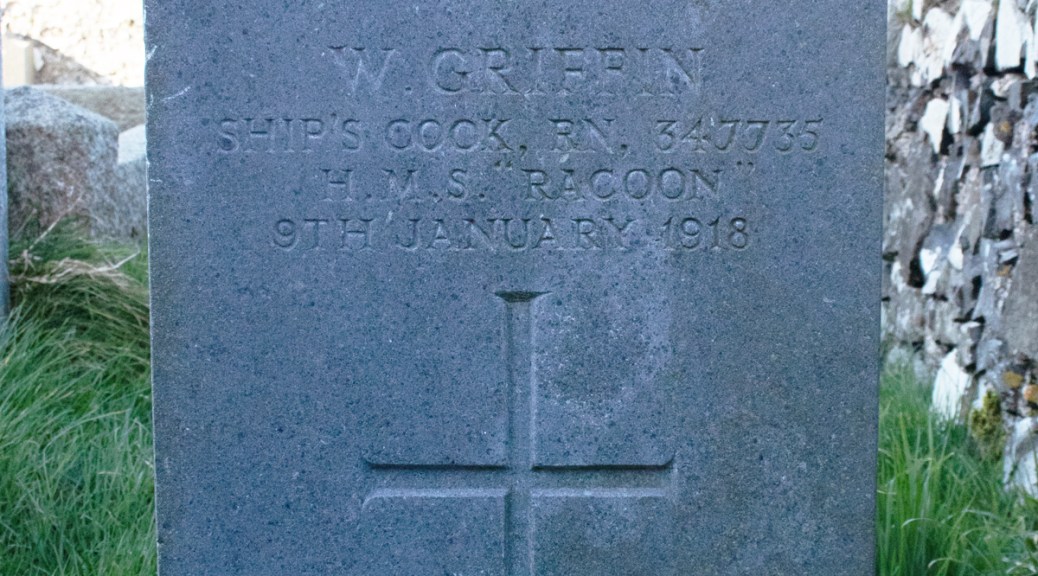
Ship’s Cook Walter Griffin

Ship’s Cook Walter Griffin

Walter Griffin was born on 15th December 1886 in Woolwich, Kent. Details of his early life are lost to time, but, by the time of the 1901 census, he was working as a cooper’s mate at a cement factory in Higham, Kent.

Walter sought bigger and better things for himself, and, on 19th June 1907, he enlisted in the Royal Navy as Cook’s Mate 2nd Class. His service records confirm that he was 5ft 4ins (1.62m) tall, with brown hair, grey eyes and a fresh complexion.

Walter was initially sent just down the coast to the Royal Naval Dockyard in Chatham, Kent, for his training. He remained there for nine months, and was promoted to Cook’s Mate 1st Class for his service.

In January 1908, he was given his first posting, on board HMS Wildfire, and, over the next nine years, he served on a further four ships, returning to Chatham in between postings. Walter was obviously dedicated to the work he was doing: in January 1910 he was promoted to Leading Cook’s Mate, and by 1917, he was promoted again, to the ran of Ship’s Cook.

This promotion coincided with a transfer to what would be his last assignment, on board HMS Racoon. This Beagle-class destroyer patrolled the waters between Scotland and Northern Ireland, and he spent the winter of 1917/18 on board.

On 9th January 1918, there were storm conditions off the Irish coast: high seas and blizzard limited limited vision. At 2am, the Racoon struck rocks, and foundered: in the treacherous conditions, all hands were lost. Shio’s Cook Griffin was 31 years of age.

Walter Griffin’s body washed ashore near the village of Ballintoy, Country Antrim, the following day. He was laid to rest in the parish church, next to two other crew members, Ordinary Seaman Frank Green and Stoker 2nd Class Frederick Sarell.

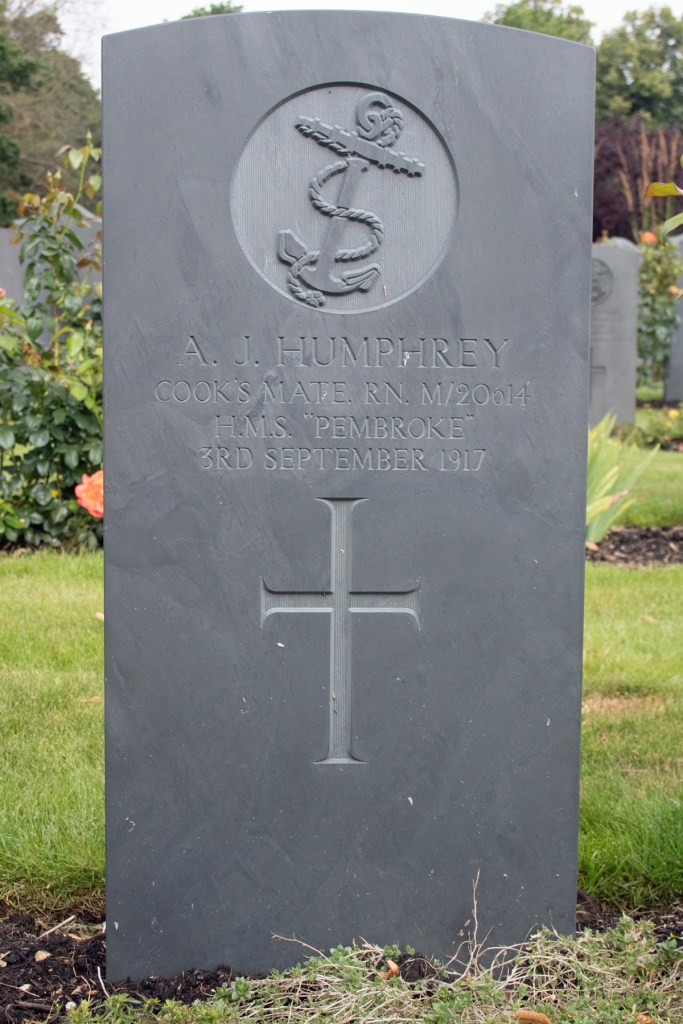
Cook’s Mate Arthur Humphrey

Cook’s Mate Arthur Humphrey

Arthur John Humphrey was born on 22nd December 1880 in the Surrey village of Horne. One of seven children, his parents were agricultural labourer Thomas Humphrey and his wife Eliza.

When he left school, Arthur also found labouring work. By 1899 he had moved to the town of Redhill, where he met tailor’s daughter Kate Wilson. The couple married in St Matthew’s Church that year, and went on to have six children.

With a family to look after, Arthur found additional work to help bring money in, and he became a carter for a local bakery. This seems to have spurred him on, and by the time war broke out, he had become more hands on with the baking side of things.

The hostilities brought new opportunities, and the chance of more permanent, better played employment became available. On 25th May 1916, Arthur enlisted in the Royal Navy as a Cook’s Mate. His service records show that he stood at 5ft 5ins (1.65m) tall, had brown hair, grey eyes and a fresh complexion.

Cook’s Mate Humphrey’s service was wholly at HMS Pembroke, the Royal Naval Dockyard in Chatham, Kent. While he would have been billeted in the barracks themselves, by the summer of 1917, the dockyard was becoming a very crowded place. The Drill Hall was brought in as additional accommodation and, that summer, this is where Arthur was moved to temporarily.

The German Air Force was suffering significant losses during the daylight raids it was carrying out. In an attempt to stem the flow of casualties, they decided to trial night time raids and, on 3rd September 1917, Chatham found itself in the midst of a bombing raid. The Drill Hall that Cook’s Mate Humphrey was sleeping in received a direct hit, and he was killed. He was just 36 years old.

The 98 servicemen who perished during the Chatham Air Raid that night were buried in a mass funeral at the Woodlands Cemetery in nearby Gillingham. This, too, is where Arthur Humphrey was laid to rest.


Cook’s Mate Harry King

Cook’s Mate Harry King

Harry George King was born in Somerset in December 1894, one of nine children to John and Sarah King. John worked as a cabinet maker in Wells, and Harry followed in a similar vein to his father, becoming an upholsterer.

When war broke out, Harry – who stood at 5’3″ (1.6m) tall – enlisted in the Royal Navy as a Cook’s Mate. He trained on HMS Victory I in Portsmouth, before transferring to the HMV Vernon, a land-based ship, also in Portsmouth.

While on leave in 1917, Harry married Alice Trickey, who had also been born in Wells.

Harry’s first sea-going assignment was on the HMS Hermione, which was a guard ship off the Southampton coast. After two years on board, Cook’s Mate King was transferred to another vessel.

The HMS Glatton was a monitor vessel requisitioned by the Royal Navy from the Norwegian fleet at the outbreak of the First World War. After a lengthy refit, she was finally ready for service in the autumn of 1918, and positioned in Dover in preparation for a future offensive across the Channel.

At 6:15 on the evening of 16 September, there was a small explosion in a 6-inch magazine below decks, which then ignited the cordite stored there. Flames shot through the roof of one of the turrets and started to spread. The fire was not able to be brought under control, and there were concerns that, if the ship’s rear magazine exploded, the presence of the ammunition ship Gransha only 150 yards (140 m) away risked a massive explosion that would devastate Dover itself. The decision was taken to torpedo the Glatton, in the hope that the incoming flood water would quash the fire.

In the event, sixty men aboard the Glatton were killed outright, with another 124 men injured, of whom 19 died later of their injuries. This included Cook’s Mate King.

While the incident wasn’t reported in the media of the time, Harry’s funeral was; it gives a little more insight into the tragedy.

News reached Wells… that 1st Class Cook’s Mate Harry George King… was lying in a hospital at Dover suffering from severe burns caused through an internal explosion on the ship on which he was serving. His wife (…to whom he was married 12 months ago) and his sister at once proceeded to the hospital, where they arrived only a few minutes before he died.

The unfortunate young man had sustained shocking injuries and was conscious for only two hours on Friday. He lost all his belongings in the explosion.

Wells Journal: Friday 27th September 1918.

Harry George King was only 27 years old when he died. He lies at rest in Wells Cemetery, Somerset.


Harry’s widow, Alice, did not remarry; the couple had not had any children, and she passed away in their home town of Wells, in January 1974.