Category Archives: Gunner

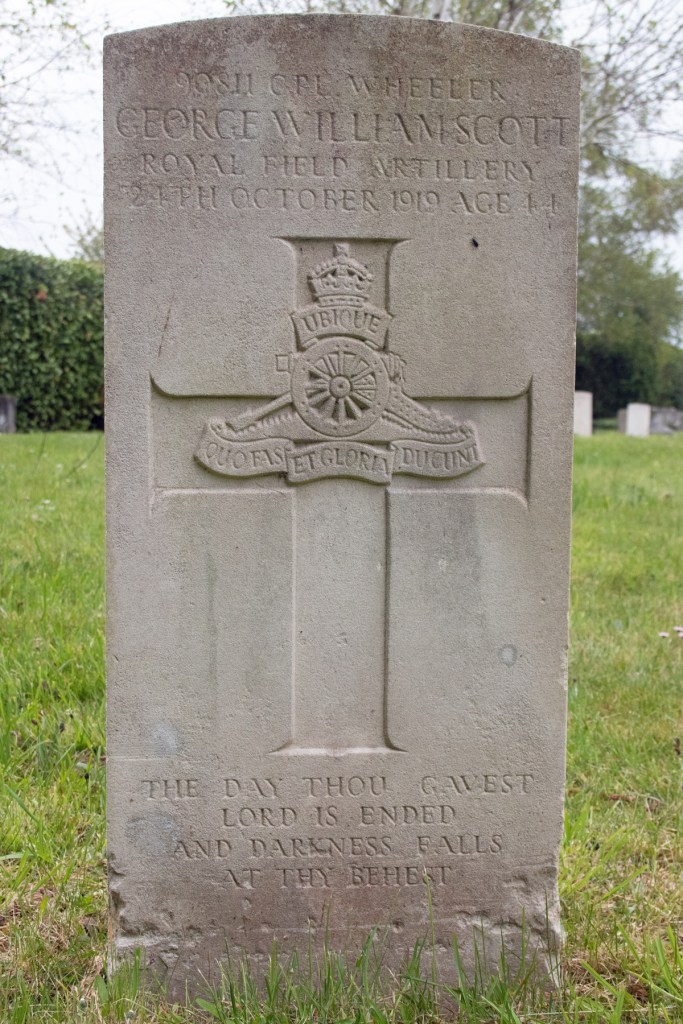
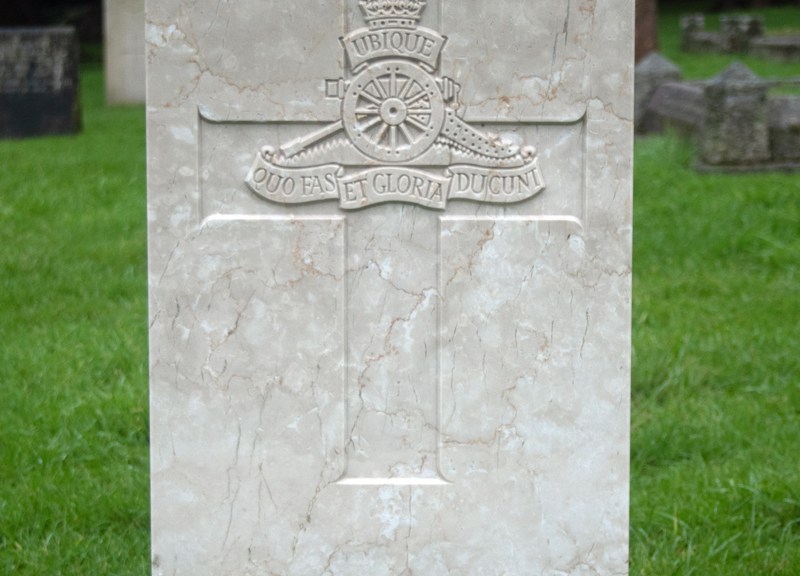
Corporal Wheeler George Scott

Corporal Wheeler George Scott

George William Scott is destined to be one of those names who is sadly lost to time. While there is information relating to him, there is not enough detail to flesh out a concrete history around him.

The facts that we do know about George are that his parents were John and Mary who, at the time that his grave was commemorated, were living in County Tyrone in Northern Ireland.

George enlisted in the Royal Field Artillery in November 1914. He was assigned to the 5th Battery of the 45th Brigade, and given the rank of Wheeler – one of the positions in a team of horses, pulling the artillery.

During his service, George was awarded the 1914 Star, as well as the Victory and British Medals. He seems to have been in a bit of trouble to begin with, however, as he was reverted down to Gunner because of misconduct. This may only have been temporary, as he ended with the rank of Corporal Wheeler.

And that is it, that is all the concrete information available for George Scott. How he died is a mystery, lost to time.

George William Scott lies at rest in St Mary’s Cemetery in Taunton, Somerset.


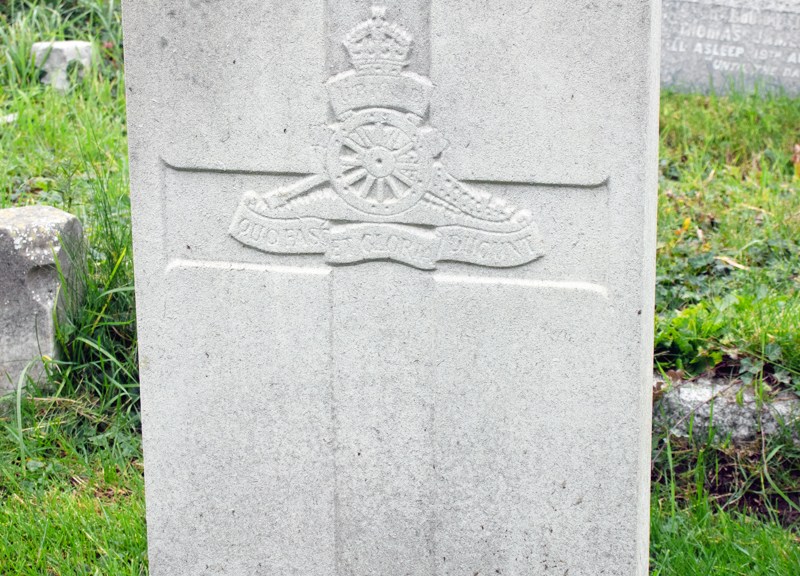
Gunner William Pearn

Gunner William Pearn

William Henry Pearn was born in January 1896, one of two children to Richard and Selina Pearn from Bridgwater in Somerset. Selina had been married previously, and had been widowed, and so William had a further four half-siblings. Richard was a lath renderer – a plasterer in today’s terms – and he was not the only one of the household to be working. According to the 1901 census, Selina was a collar maker and William ‘s two older half-brothers were a landscape gardener and a bookshop assistant.

When William left school, he went to work for a local coal yard as a porter. The next census finds him living with his mother and his older brother, Wallace, who was a labourer in a brickyard. Richard is noticeable in his absence, but Selina is having been married for 18 years.

Sadly, though, at this point William’s trail goes cold. His military records are sparse, but we know that he enlisted as a Gunner in the Royal Field Artillery, although I have been unable to identify when he enrolled. The only other information I have I have been able to locate for him are his pension records, that confirm that he passed away from pneumonia on 19th October 1918. Gunner Pearn was just 24 years old.

William Henry Pearn lies at rest in St John’s Cemetery in his home town of Bridgwater in Somerset.


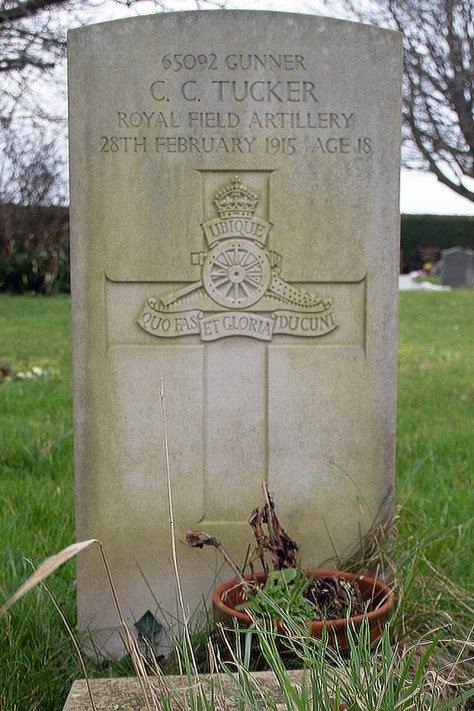
Gunner Clifford Tucker

Gunner Clifford Tucker

Clifford Charles Tucker was born in 1896, one of five children to John and Ellen Tucker. John was a shoemaker in the Somerset village of Othery, while Clifford became a farm labourer when he left school.

There is little documented of Clifford’s life, and what I have been able to identify about his military career has come from a newspaper article.

Much regret is felt in Othery at the new of the death of Clifford Tucker, one of the young fellows who volunteered for the service of their King and Country. Deceased, who was only 18 years of age… enlisted in the Royal Artillery about six weeks ago and was stationed at Brighton.

He was taken ill with pneumonia and died, his father arriving in time to see him before he breathed his last.

Taunton Courier and Western Advertiser: Wednesday 17th March 1915.

Gunner Tucker passed away on 28th February 1915, aged just 18 years old.

He lies at rest in the cemetery of his home village of Othery.


Serjeant Ernest Morris

Serjeant Ernest Morris

Ernest George Morris was born in September 1879, one of six children to John and Eliza Morris. John was a carter for the railways, and this was a trade his son was to follow.

Ernest married Sarah Garrett in Bristol on Christmas Eve 1904, and the young couple went on to have two children, Charles and William.

Ernest’s father died in 1907, and Ernest became head of the family. He moved them in with him in Bristol, and by the 1911 census, the household consisted of Ernest, his mother Eliza, his brothers Frank and William, sister Lily and his own son William.

The census also lists Ernest as a widow; I have not been able to track down any records of when Sarah died. Their eldest boy, Charles, passed very early on, however, so this is likely why Ernest set up home with his family.

By this time, Ernest was working as a carman in the Bristol Goods Yards, and it appears that had a strong character. In September 1912, he was cautioned for “smoking whilst on duty and refusal to give an undertaking to refrain from doing so in future.” He cited his reason that the rulebook “did not prohibit men from smoking when not with a load.”

Ernest was suspended for two days, and was only allowed back to work when he promised to follow instructions in the future. This, it seemed he may not have done, as he was dismissed just three months later.

Ernest’s military service records are hard to piece together. He enlisted in the Rifle Brigade as a Gunner, going on to achieve the rank of Serjeant. He was awarded the Victory and British medals – the standard awards for men involved in the Great War.

Serjeant Morris survived the war, but there is little information for him after that. He passed away on 28th June 1920, aged 40 years old, although there is no record of how he passed. His war pension was awarded to his mother, who was acting as guardian for his son William.

Ernest George Morris lies at rest in the cemetery of his home town of Langport.


Gunner Alfred Richards

Gunner Alfred Richards

Alfred Henry Richards was born in 1891, the oldest of five children to William Henry Richards and his wife Jane. William (who was known as Henry) worked in the local paper mill, and this is a trade that his two sons – Alfred and Leslie – were to follow as well.

Paper making was a driving force in this part of Somerset during the Victorian era, employing a large number of people in Wells and the nearby village of Wookey, which is where Alfred and his siblings were born.

Details of Alfred’s military service are sketchy. He enlisted as a Gunner in the Royal Horse Artillery, although when during the war this happened is unknown.

His troop – the 18th Brigade, 1st Somerset Royal Horse Artillery – was stationed in the UK for the first couple of years of the war, before serving in the Middle East. Again, I have not been able to confirm how much of this service Gunner Richards was involved in.

Alfred returned to Somerset after being demobbed, but within a few months of the end of the war, he succumbed to double pneumonia. He passed away on 1st March 1919, aged just 28 years old.

Alfred Henry Richards lies at rest in the cemetery in Wells, Somerset, not far from his home.


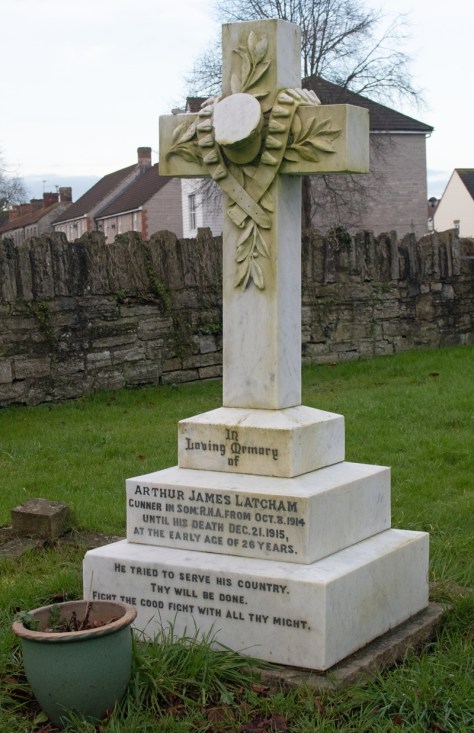
Gunner Arthur Latcham

Gunner Arthur Latcham

Arthur James Latcham was born in 1889, the oldest of five children – all boys – to Walter and Matilda Latcham. The family lived in Street, Somerset, where Walter worked as a carpenter in the Clark’s shoe factory.

Initially following his father into shoemaking, Arthur was quick to enlist when war broke out. Details of Gunner Latcham’s military service is scarce, but documents confirm that he joined the Somerset Royal Horse Artillery on 8th October 1914. He did not see active service abroad, but had been stationed on the east coast for his training.

While little remains of his service records, contemporary media of the day includes a lot of information about both his passing and his subsequent funeral.

On Sunday, December 5th, having a few hours’ leave, he visited his parents at Street, and while at home complained that he was feeling unwell. On the following Wednesday, December 8th (which, by a coincidence, was his twenty-sixth birthday) Mr and Mrs Latcham received a post-card from him from Taunton [where the Somerset RHA was based] stating that he was very ill. They immediately engaged a motor car, and went to Taunton, where they found him in an extremely weak state, and on the point of collapse, he having had to walk to a hospital nearly a mile away three times a day for his medicine. Having obtained the captain’s permission, they brought him home in the motor car, and at once put him under the care of Dr MacVicker. He was then found to be suffering from pneumonia and congestion of the lungs… In spite of the greatest care, and best of nursing, however, he gradually grew worse, and never rallied.

Central Somerset Gazette: Friday 24th December 1915.

The following week’s newspaper included nearly a whole column on Gunner Latcham’s funeral, including two tributes, one from his captain and another from the local MP.

I am writing to tell you how very sorry all the officers of this battery are at your loss. Your son was the first member of the Somerset RHA to give his life for his country, and although he did not have the satisfaction of being killed in action, the honour is the same. I’m afraid the last few months he was in this battery were not very happy ones for him, owing to his trouble with his finger; but he bore the trouble and pain well. I had him with me for more than a year, so I can fully appreciate what a good fellow he was and how great your loss is.

Captain M Clowes (Central Somerset Gazette: Friday 31st December 1915)

I am very sorry indeed to learn of the sad loss you have suffered through the death of your son. I know that he was a fine fellow, an example of what an Englishman should be, and respected by all who knew him. I am sure you must feel proud to know that he has done all that a man can do, and has died serving his country.

Ernest Jardine MP (Central Somerset Gazette: Friday 31st December 1915)

Arthur James Latcham lies at rest in the graveyard of Holy Trinity Church in his home town of Street.


Arthur was the third son Walter and Matilda had lost. Their second-born, Herbert, passed when a little over a year old. Their third son, William, died a year before Arthur, when he was just 15 years old.


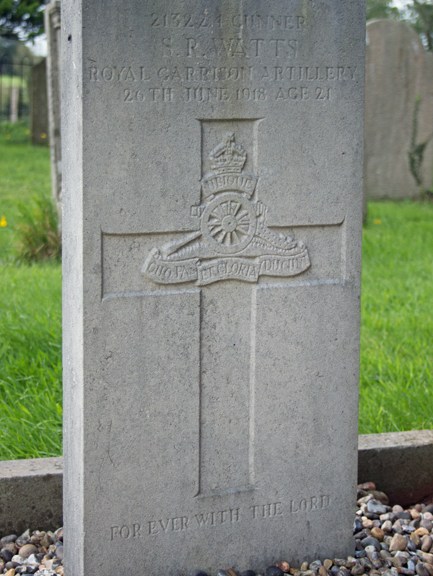
Gunner Samuel Watts

Gunner Samuel Watts

Samuel Reginald Watts was born in 1897, the seventh of eight children of Samuel and Augusta Watts.

He followed his father and brothers into the main industry in the area – coal mining – and was certainly working down the pits by the time of the 1911 census.

Samuel enlisted on 21st April 1918, and joined the Royal Garrison Artillery, which focused on heavy, large-calibre guns and howitzers that were positioned some way behind the front line. He was 5’5″ (1.65m) tall and weighed 144lbs (65kg). According to his war records, he had brown hair, hazel eyes and a fresh complexion.

His service started the very next day, when he was transferred to the Citadel in Plymouth for training.

After feeling unwell, complaining of headaches and a sensitivity to light, Gunner Watts was admitted to the Netley Hospital in Southampton on 18th June 1918. He was diagnosed with cerebrospinal fever, more commonly known as meningitis, and was treated over the next week.

Sadly, the treatment did not work, and Gunner Samuel Watts passed away on the evening of 26th June 1918. He had been in the army for a little over two months and had not seen active service.

Samuel Watts lies at peace in the graveyard of St John’s Church, Farrington Gurney.

Gunner Samuel Hayes

This image has an empty alt attribute; its file name is img_4069s.jpg
Gunner Samuel James Hayes

Samuel James Hayes was born in the Somerset village of Milverton in May 1879. He was the eldest son of James and Harriet.

James was an agricultural labourer, but Samuel wanted more than this; he enlisted in the Royal Marine Artillery in February 1897, three months before his 18th birthday.

The 1901 census finds Gunner Hayes in the Eastney Barracks in Portsmouth, while ten years later, he was on board the HMS Swiftsure in the Mediterranean.

In May 1912, he married Annie Thorne, also from Milverton, in his home village. Two years later, just before Christmas 1914, their first – and only – child, Lionel, was born.

I have struggles to find anything specific relating to Gunner Hayes’ wartime service. He certainly continued to serve, and by the time of his death had clocked up more than twenty years’ service in the Royal Marine Artillery.

Samuel passed away on 6th July 1919, at the age of 38. One record I have located suggests that he died in a military hospital in Malta, but whether he passed there or in the UK, he was buried back in Somerset.

Gunner Samuel James Hayes lies at rest in St Michael & All Angel’s churchyard in Milverton.

Gunner Thomas Holloway

Gunner Thomas Holloway

Thomas Charles Holloway was born in Chatham, Kent in 1893. The fourth of five children, his parents were Joseph, a domestic coachman, and Caroline Holloway.

By the time of the 1911 census, Thomas had left school and was working in a corn warehouse.

Thomas presented a bit of a challenge when I was researching his history.

His military records show that he enlisted on 31st December 1914, signing up to the Royal Field Artillery. However, Gunner Holloway’s service records show that he was posted on 9th January 1915, before being discharged as medically unfit just a week later. The records confirm that he served for 16 days.

The medical attestation states that he was discharged because of cardiac dilation and hypertrophy, a systolic murmur and dyspnoea, all heart-related conditions.

Despite only serving for just over a fortnight, he was afforded a Commonwealth War Grave when he died.

Searching the local newspapers of the time, a bigger story was unveiled.

The death of Bombardier Thomas Holloway, aged 24, of the RFA… occurred in a hospital at Cambridge. He was kicked by a horse in the course of his training, nearly two years ago, and had practically been on the sick list ever since. On recovering from the effects of the accident, he was seized with spotted fever at Seal, and ultimately succumbed to paralysis of the brain.

East Kent Gazette: Saturday 21st July 1917

The discrepancies between the original discharge and the newspaper report are intriguing. Either way, this was a young life cut far too short: he was 24 years old.

Gunner Thomas Holloway lies at rest in St Margaret’s Churchyard, in his home town of Rainham in Kent.

Gunner Frederick Brooks

Gunner Frederick Brooks

Frederick Brooks was born in the spring of 1897, the ninth of eleven children to Stephen and Grace Brooks. Stephen worked as a woodsman in Bredhurst, Kent, a trade his eldest sons followed him into.

Yewtree Cottages in Bredhurst, home to the Brooks Family

Frederick’s service records show that, when he enlisted in nearby Rainham, he was working as a fence maker. He was 5ft 6ins (168cm) tall, weighed 143lbs (65kg) and had fair physical development. He joined up in September 1915 and was assigned to the 2/1 Company Kent Royal Garrison Artillery.

Gunner Brooks’ early service was on home soil as part of the Territorial Force. However, he was transferred overseas as part of the British Expeditionary Force on 10th March 1917, where he served for nearly two years.

Frederick fell ill in January 1919, and was brought back to the UK for treatment. He was admitted to the Weir Red Cross Hospital in Balham, London, with bronchial pneumonia. He succumbed to heart failure just a few days later, on 4th February 1919. He was just 21 years old.

Gunner Frederick Brooks lies at rest in a peaceful corner of the secluded graveyard of St Peter’s Church in his home village of Bredhurst.


Frederick’s life throws a couple of coincidences my way. I used to live within spitting distance of his village, Bredhurst, and, indeed, have driven past his family home countless times. I also happened to have been born in the same hospital – the Weir in Balham – where Frederick had passed away 53 years earlier.