Category Archives: Lance Serjeant

Serjeant Charles Flower

Serjeant Charles Flower

Charles Franklin Flower was born in Walcot, Bath, at the end of 1879. The middle of five children, his parents were stonemason John Flower and his dressmaker wife, Elizabeth.

John died when his son was only eleven years old, and Elizabeth passed away just two years later, leaving Charles an orphan at just 13 years of age.

He disappears off the radar for a time, only reappearing again when, in the summer of 1895, he enlisted in the 13th Battalion of the Somerset Light Infantry. Charles’ service records show that he stood 5ft 7ins (1.69m) tall, weighed 121lbs (55kg) and had grey eyes, light brown hair and a fair complexion. He was also noted as having a tattooed ring on his left ring finger.

After eighteen months on home soil, Private Flower was sent out to the East Indies, where, apart from a short stint back in England, he spent the next twelve years. He was promoted to Lance Corporal in May 1898, but though his own volition, reverted to the rank of Private seven months later. Charles was destined for bigger things, though, and was again promoted to Lance Corporal in September 1900. Over the next few years, he received further promotions – to Corporal in September 1905 and Lance Serjeant eighteen months later.

In the autumn of 1908, Charles returned to home soil, but his military service continued. On 12th April 1909, he married Elizabeth Ann Wills, a gamekeeper’s daughter from Cannington, Somerset. They set up home in Portland, Dorset, where Charles was based, and went on to have a son, Herbert, a year after they married.

By 1910, Charles had again been promoted, and was now a Serjeant. In the next couple of years, the family moved from the Dorset coast to the Somerset town of Frome. Serjeant Flower’s service continued, but he remained on home soil, even when war broke out.

All was not well with Charles’ health, however, and by the summer of 1915, he was admitted to hospital. He was thin and anaemic, with an enlarged liver and an ‘enormously swollen’ spleen. This was discovered to be a malignant growth, and Serjeant Flower was discharged from military service on medical grounds on 20th December 1915. He had been in the Somerset Light Infantry for more than two decades.

Charles Franklin Flower was not to recover from his illness. He passed away at home on 27th February 1916, at the age of just 37 years old. He was laid to rest in the graveyard of Holy Trinity Church in Frome.


Serjeant Charles Flower
(from ancestry.co.uk)

Corporal Cyril Allen

Corporal Cyril Allen

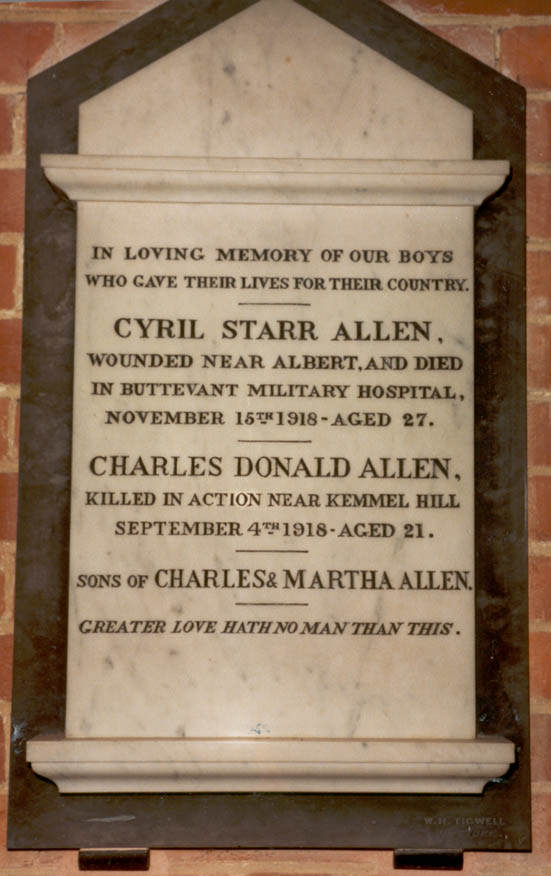
Cyril Starr Allen was born on 15th June 1891 in the village of Baughurst, near Tadley in Hampshire. He was the second youngest of five children to Charles and Martha Allen. Charles was a rate collector, and the family moved around the county during Cyril’s early years.

By the time Cyril left school, Charles had become an assistant bursar in Wootton, near Basingstoke. Cyril, meanwhile, had found similar administrative employment and was working as a clerk for a local land agent.

At the start of 1911, Cyril enlisted in the British Army. He joined the 4th Battalion of the Wiltshire Regiment as a Private and was soon based on Salisbury Plain. His service records confirm that he was 19 years and 7 months old, and stood at 5ft 5ins (1.65m) tall. Private Allen served for his initial term of four years, before being remobilised.

In November 1915, Cyril married Mabel Young. She was a printer’s daughter from Wiltshire, and the couple married in Salisbury, before settling down in Frome, Somerset. They went on to have a child, a daughter they called Kathleen.

Remobilised in the autumn of 1915 Private Allen received a series of promotions – to Lance Corporal, Corporal, Lance Sergeant and Sergeant, and, by June 1917, he found himself at the Front.

On 22nd April 1918, Cyril was injured, sustaining gunshot wounds to his shoulder and left arm. He was invalided back to England for treatment, and was hospitalised in the north of the country. He was then transferred to the Royal Welch Fusiliers with the rank of Corporal and sent to Ireland to continue his recovery and work light duties.

While in Ireland, Corporal Allen contracted influenza and was admitted to the Buttevant Hospital in County Cork. Sadly, in his weakened state, it was something he was to succumb to, and he passed away, with Mabel at his bedside, on 15th November 1918. He was just 27 years of age.

Cyril Starr Allen’s body was brought back to England; he was laid to rest in the graveyard of Christ Church in Frome, Somerset.


Corporal Cyril Allen (from ancestry.co.uk)

After the loss of her husband, Mabel went on to live her life. In 1923, she married James Burr, a draughtsman from Frome; they went on to have a child – a brother for Kathleen – called James.


Cyril’s two brothers, Winthrop and Charles, also fought in the First World War.

(from ancestry.co.uk)

Winthrop had emigrated to North America in 1911, but returned to Europe as part of the Canadian Expeditionary Force when war broke out.

Lance Corporal Charles Allen served with the 15th Battalion of the Hampshire Regiment. He fought on the Western Front and was killed near Kemmel Hill in Belgium on 4th September 1918. He was just 21 years old. Charles is commemorated at the Tyne Cot Memorial in Zonnebeke, Belgium.


Major Stanley Payne

Major Stanley Payne

Stanley James Payne was born towards the end of 1882, one of eleven children to Stephen and Elizabeth Payne. Stephen was a leather salesman from Essex, who had moved his family to Weston-super-Mare in Somerset in around 1880.

Stanley seems to have been drawn in to a military life from an early age. In January 1900, he enlisted as a Private in the Somerset Light Infantry, and the 1901 census listed him as living at the Raglan Barracks in Devonport, near Plymouth.

Military service took Private Payne to India, where he served for six years. His success and ambition were clear; in 1906 he was promoted to first to Corporal and then to Sergeant. By 1911 – and now back in England – as a Lance Sergeant, Stanley was working as a military clerk at the Royal Horse Artillery Barracks in Dorchester, although he was still attached to the Somerset Light Infantry.

Stanley’s ambition and sense of adventure continued; by July 1912 he had made the transfer over to the newly-formed Royal Flying Corps, as a Sergeant.

It was while he was based in Dorchester that he met Winifred Bell. She was the daughter of a local council worker, and the couple married in the town in September 1912. Stanley and Winifred went on to have a daughter, Doris, who was born in July 1914.

War had arrived in Europe, and on 7th October, the now Warrant Officer Payne was shipped to France. During his nine months on the Western Front, he was mentioned in despatches and received the Croix de Guerre for his gallantry. The local newspaper also reported that he:

…had also the honour of being presented to the King on the occasion of His Majesty’s last visit to the front, and at a home station had also been presented to Queen Mary.

Western Daily Press: Saturday 8th March 1919

Returning to England on 1st June 1915, he was again promoted to Lieutenant and Quartermaster, although here his military records dry up. By this time, he had been in the armed forces for more than fifteen years, but his military records seem to confirm this as the last day of his service.

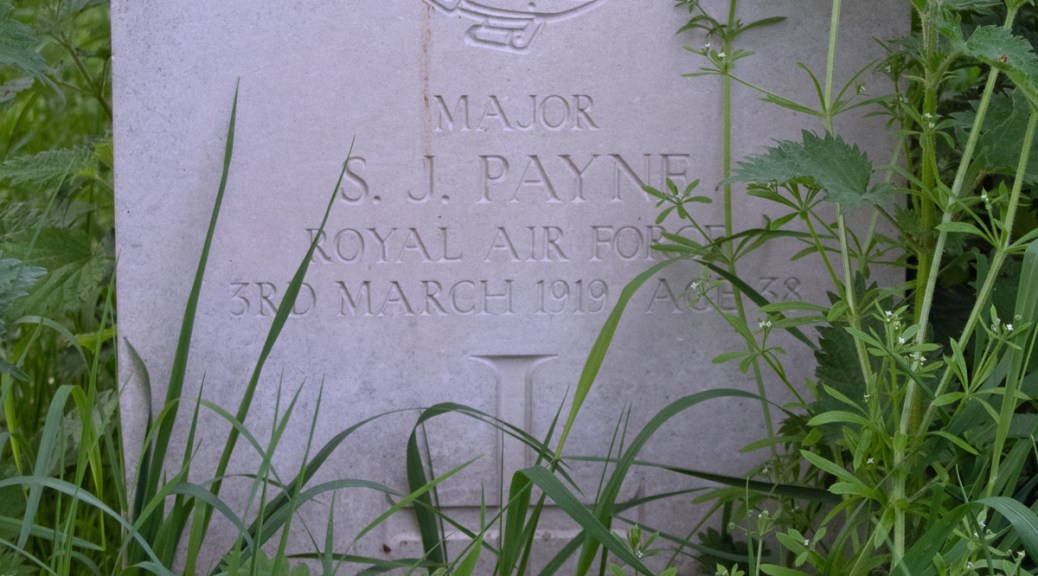
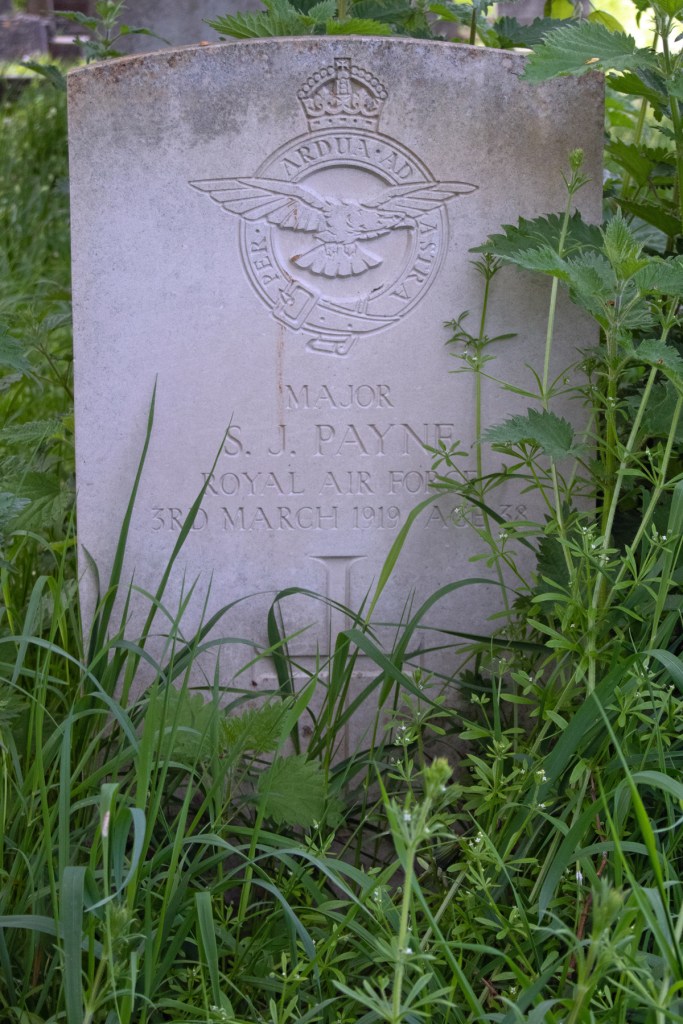
The next record for Stanley confirms his passing. Admitted to the Central Air Force Hospital in Hampstead with a combination of influenza and pneumonia, he died on 3rd March 1919. He was just 36 years of age.

Brought back to Weston-super-Mare, where his now widowed father was still living, Stanley James Payne was laid to rest in the Milton Cemetery in his home town.


Stanley’s gravestone gives his rank as Major. While there is no documented evidence of any additional promotions after June 1915, the rank is the equivalent of Quartermaster in the Army Reserve. It seems likely, therefore, that the end date of his military service marked the start of his time in the reserves.


Lance Serjeant Frederick Rapson

Lance Serjeant Frederick Rapson

Frederick Ernest Rapson was born in the spring of 1888, one of nine children to Francis and Susan Rapson. Francis was a Serjeant in the 18th Hussars, and the family lived in Dulverton, a village on the edge of Exmoor.

Francis had served in the armed forces for 26 years, but passed away after a short illness in February 1891. According to a local friend and supporter, he had been in charge of the local yeomanry in Dulverton for a number of years and had been ‘in the prime and flower of life’. [West Somerset Free Press: Saturday 28th February 1891]

Susan was left widowed with nine children, the eldest of whom was only 13 years old. Frederick was only three at the time, and had lost his father at a very early age.

In 1895, Susan married a Frederick Howard, who was a painter and carpenter. The family moved to Taunton in Somerset, and Frederick and Susan went on to have three children of their own.

On 6th February 1910, Frederick Rapson married Lucy Knight; by this time, he was working as a compositor for the local newspaper. The couple set up home in the middle of Taunton, and went on to have three children, Francis, Frederick and Ronald.

War was coming, and, while Frederick did not actively seek military service in the same way as his father had done, it was not something he was able to avoid. While his full military records are not available, it’s clear that he enlisted in the Somerset Light Infantry at some point early on in the conflict.

Private Rapson was assigned to the 1st Battalion, who were based on the Western Front for the duration of the conflict. During his time there, he was awarded the Victory and British Medals, but not the 1915 Star, so that would narrow down his enlisting to some point in 1916.

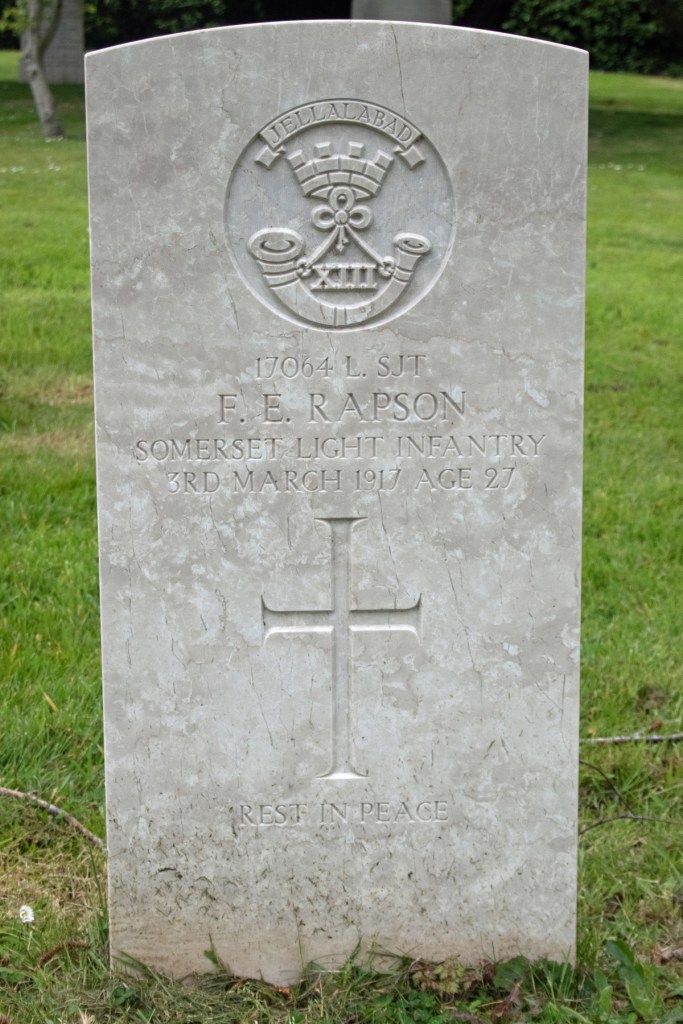
While he was promoted to the role of Lance Serjeant, his service was to be a short one. At the start of 1917, he contracted pneumonia and was admitted to hospital. Sadly, the condition was to get the better of him, and he passed away on 3rd March 1917. He was just 27 years of age.

Frederick Ernest Rapson was buried in a quiet corner of St James’ Cemetery in Taunton, Somerset.