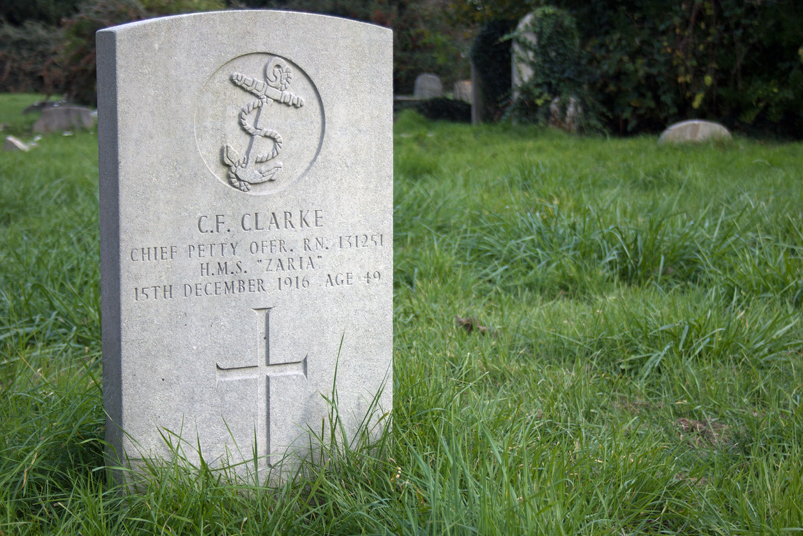
Charles Frederick Clarke was born on the 14th April 1869 to James and Jane Clarke. James was born in Suffolk, but moved to London, where he found work as a watchman (guarding the city streets at night). Jane was from Essex, and the couple went on to have five children, of whom Charles was the middle child.
Charles was set on a life of adventure, joining the Royal Navy in 1887, for a period of twelve years. During this time, he served on eleven vessels, working his way up through the ranks from Boy to Ordinary Seaman to Able Seaman, Leading Seaman and eventually Petty Officer.
In October 1895, he married Lydia Rogers, a sailor’s daughter from Portsmouth. The couple would go on to have nine children, eventually settling in Sussex.
When his naval service ended in 1899, Charles enlisted again. Within six years, he had achieved the rank of Chief Petty Officer, and in March 1909, after 22 years’ service, retired from active duty. He was obviously well respected, however, and was selected to serve on the staff of the Royal Naval Recruiting Office in Portsmouth. His service records suggest that he resigned from this role on 14th April 1914.
It seems that Chief Petty Office Clarke took on a role on the vessel HMS Zaria. This was a ship that was requisitioned by the Royal Navy, which acted as a patrol ship, guarding the coastal waters around the UK. While details are scant, Charles certainly served on board for a couple of years, and he died on board, from causes undisclosed, on 16th December 1916, at the age of 47 years old.
Brought back to West Sussex, Charles Frederick Clarke was laid to rest in the Broadwater Cemetery in Worthing. This was where Lydia was now living; she was buried in the same grave, when she passed away eight years after her husband.
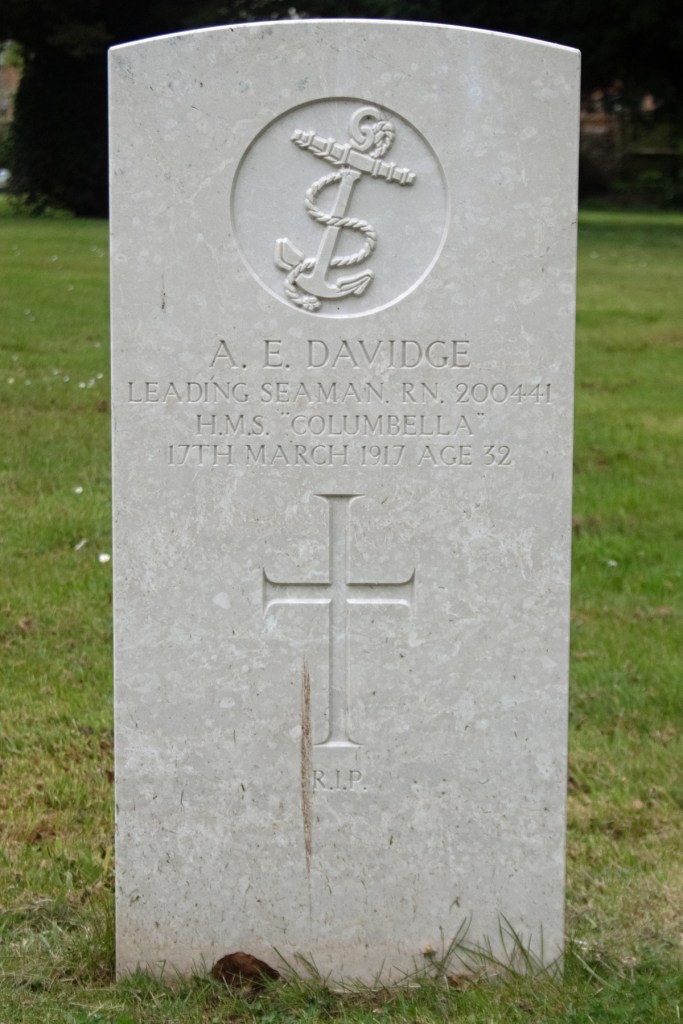
Alfred Ernest Davidge was born on 22nd July 1882, one of six children to Richard and Ermina. Richard was a boilermaker from Bristol, but brought his family up in the Wiltshire town of Swindon.
Alfred was keen on adventure, and sought out a live on the open seas. In August 1898, at the age of sixteen, he joined the Royal Navy. After serving two years at the rank of Boy, he officially enlisted for a term of twelve years.
Starting as an Ordinary Seaman, Alfred had worked his way up to Leading Seaman by 1905. He continued in this role until 7th June 1909, when he was knocked back a rank for misconduct. He evidently realised the error of his ways, however, as, just over a year later, he was promoted again.
Leading Seaman Davidge’s term of service came to an end in July 1912, and, having been assigned to seventeen vessels during that time, he became part of the Royal Naval Reserve.
Back on home soil, and Alfred set up home in Taunton. He found work as a labourer and, in October 1913, married local lady Louisa Pomeroy. The couple went on to have a daughter, Hilda.
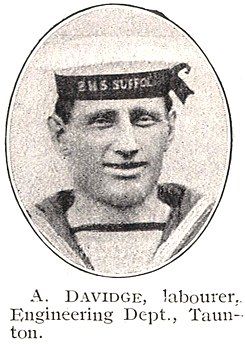
Storm clouds were gathering over Europe by now, and Alfred was soon recalled to the Royal Navy. He took up his previous role, and, after a period of training at HMS Vivid in Plymouth, he was assigned to HMS Suffolk.
Leading Seaman Davidge spent eighteen months aboard HMS Suffolk (during which time the photo below was taken), before being transferred to HMS Columbella in November 1916. His time there was short, however, as he became unwell.
Admitted to the Royal Infirmary in Glasgow with influenza, Leading Seaman Davidge sadly succumbed to the condition on 17th March 1917. He was 34 years old.
Alfred Ernest Davidge was brought back to Taunton for burial. He lies at rest in the St James Cemetery in the town.
Gerald Montague Brine war born in October 1897, the youngest of seven children to John and Annie Brine. John was a potter, and, while the children were born in Dorset, the family soon moved to the Somerset village of Binegar.
Gerald’s three older brothers all went to work in a local stone quarry, as an engineer, breaker and foreman respectively. When Gerald left school, he found work with the local blacksmith as a striker. It was while employed there, in 1912, that his mother Annie passed away, aged just 50 years old.
War was on its way however, and where his brothers enlisted in the army, Gerald was bound for the sea. He enlisted in the Royal Navy on 3rd November 1915 and, as an Ordinary Seaman, was assigned to HMS Iron Duke. He was aboard the vessel when it became embroiled in the Battle of Jutland in May 1916, and was subsequently transferred to HMS Discoverer.
Promoted to Able Seaman in April 1918, the Discoverer headed back to Chatham a couple of months later. A Somerset newspaper picks up on Gerald’s sad tale from there.
When one of His Majesty’s ships was returning to port, and her crew were looking forward to “leave”, an unfortunate tragedy occurred by which Gerald Montague Brine, a young Able Seaman [and] a native of Binegar, lost his life. It appears that in the course of storing gear, a loaded revolver was removed by mistake to the armourer’s room, instead of to the officer’s cabin, and was placed on a table.
Curiosity led Peter Macfarlane, another able seaman, to handle it, and as he was bringing it to his side from an upward position, he, to use his own words, unconsciously pulled the trigger. It fired, and the bullet entered Brine’s body just under his left shoulder, fracturing his spine and producing paralysis of his lower limbs.
Wells Journal: Friday 12th July 1918
Gerald’s parents had a telegram to say that he was seriously wounded and in the Royal Naval Hospital, Chatham. They travelled at once to Chatham and found him very ill, but conscious. They remained with him until he died a week later, on 1st July 1918. He was just 20 years of age.
At the inquest, Macfarlane described Brine as his best chum, and all witnesses agreed that “the best possible relations existed between the members of the crew.” According to the doctor’s evidence at the inquest, Gerald was unable to be saved. The jury reached a verdict of Accidental Death.
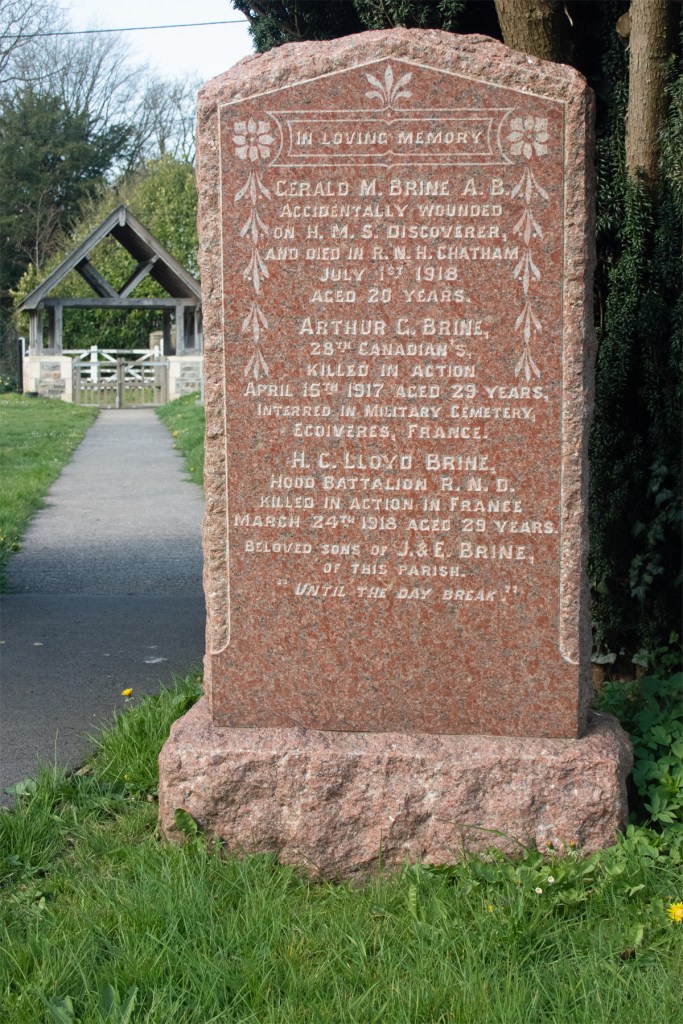
Able Seaman was brought home to Binegar, and lies at rest in the graveyard of Holy Trinity Church.
Gerald’s grave also acts as a memorial to two of his older brothers.
Arthur Brine, who had been the stone breaker in the quarry, emigrated to Canada after his mother had died, finding work there as a fireman. The Great War brought him back to European shores, however, and he enlisted in the Canadian Expeditionary Force, joining the 188th Battalion.
Private Brine arrived in England in October 1916; he transferred to the 28th Canadians, and set off for France the following January. He was caught up in the Battle of Arras and was hit and killed by a piece of shrapnel on 15th April 1917. He was just 29 years old.
Arthur Brine lies at peace in the Ecoivres Cemetery to the north west of Arras in Northern France.
Herbert Brine had been the foreman at the stone quarry He married Sarah Lucy James shortly before his mother’s death in 1912; the couple went on to have two children, Arthur and Kenneth.
Herbert was mobilised in July 1917, initially joining the 3rd Reserve Battalion. He was drafted, as an Able Seaman, to the Hood Battalion, Royal Naval Division (RND) in November 1917, before re-joining his RND Battalion at Flesquières, near Cambrai, two months later.
In early March 1918, the Germans started bombardments in preparation for a major offensive. For ten days from 12th March, the Flesquières salient was drenched with nearly a quarter of a million (mostly mustard) gas shells, There were over 2,000 resultant casualties in the RND. After this preparatory shelling, the Germans attacked in enormous numbers.
By the end of the day, the situation was precarious and the Division was forced to retreat in steps, through Bertincourt, Ytres and the Metz lines, through the old Somme battlefields.
Able Seaman Brine was first reported missing on 24th March, but was only accepted as having been killed in action on that date nine months later. As such, Herbert is commemorated by name on the Arras Memorial; his name also resides on Gerald’s gravestone back home in Binegar.
The Great War took its toll on the Brine family. Three of the four brothers died during those tumultuous years, leaving only John’s oldest son, Wallace, to carry on the family name. John himself died in 1942, aged 84, and lies with his wife and youngest boy in the small Binegar churchyard.
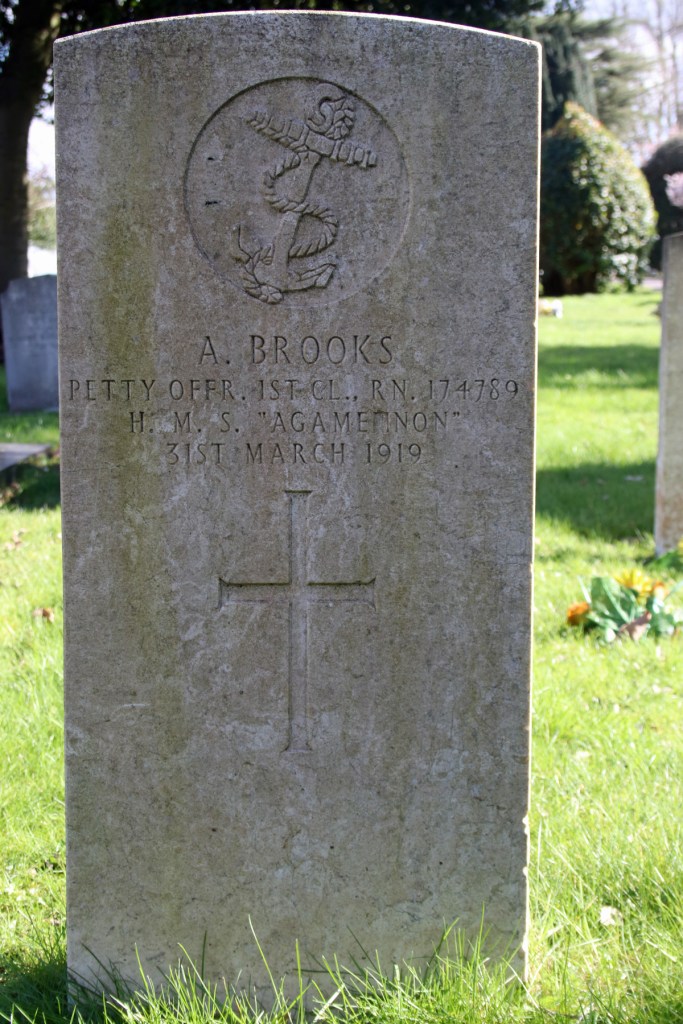
Albert Brooks was born in February 1877 in Cambridge. Sadly, a lot of the documentation for his early life is lost to time, but he enlisted in the Royal Navy in July 1893, at the rank of Boy 2nd Class.
He formally enrolled in naval service in February 1895, initially for a period of twelve years. Beginning as an Ordinary Seaman aboard HMS Thunderer, during his initial time in the navy, he was promoted to Able Seaman and then Petty Officer 2nd Class, while serving on vessels including Hawke, Wildfire, Eclipse and Vernon.
In 1904, Albert married Rosina Wise. A couple of years younger than her new husband, she had been born in Camberwell, South London. The couple had a daughter, Gwendoline, and they set up home in Gillingham, Kent, where Albert was based when not at sea.
War was on the horizon, however, and Petty Officer Brooks’ naval service was extended until the end of the conflict.
Albert was promoted to Petty Officer 1st Class, and continued his service on vessels that included Andromache, London and Hibernia. He transferred to what would be his final ship, HMS Agamemnon, in November 1917.
Petty Officer Brooks served aboard Agamemnon for eighteen months, but it was while stationed at the Naval Dockyard in Chatham that he fell ill. He passed away from aortic disease of the heart – more than likely a heart attack or cardiac arrest – on 31st March 1919. He had just turned 42 years of age.
Albert Brooks lies at rest in the Woodlands Cemetery in Gillingham, Kent.
Cecil Henry Bowyer was born in October 1900, the oldest of four children to Harry and Bessie Bowyer. Harry was a carter and, at the time of the 1901 census, the family lived in a small house in the middle of Bridgwater, with Harry’s sister, Bessie’s mother and an additional boarder.
Bessie was keen to earn her way, becoming a musical instrument dealer, while her husband moved on to work as a foreman for a coal merchant. By this time, the family had moved round the corner from their former home, and Harry and Bessie lived there with Cecil, his younger siblings Leslie, Henry and Doris, and another boarder.
Harry found himself before the Bankruptcy Court in 1913. By this time, he was carrying on business as a gramophone and cycle agent, as well as his carter business. Bad debts and living expenses were his downfall, however, and he found himself with a deficiency of £83 15s 5d. The examination was declared closed, according to the Wells Journal, but no outcome was reported.
War was looming, and the family did their bit. Harry joined up, enlisting in the Royal Engineers as a sapper. He was shipped to Salonica, Greece, where he served for much of the war.
Cecil, however, chose the seafaring route. He had to wait until he came of age before enlisting, however, and so it was late September 1918 before he joined the Royal Naval Voluntary Reserve. He started his training at the training base in Crystal Palace, but was only there for a couple of weeks before he fell ill.
Contracting pneumonia, Ordinary Seaman Bowyer was admitted to hospital, but sadly this took him quickly, and he passed away on 11th October 1918 He had just turned 18 years old.
Cecil Henry Bowyer was brought back to Bridgwater to be buried; he lies at rest in the Wembdon Road Cemetery there.
Harry Kick was born in August 1900, the oldest of six children to George and Georgina Kick from the small village of Middlezoy in Somerset. George was an agricultural labourer, while his wife helped with the dairy side of Jones Farm, where he worked.
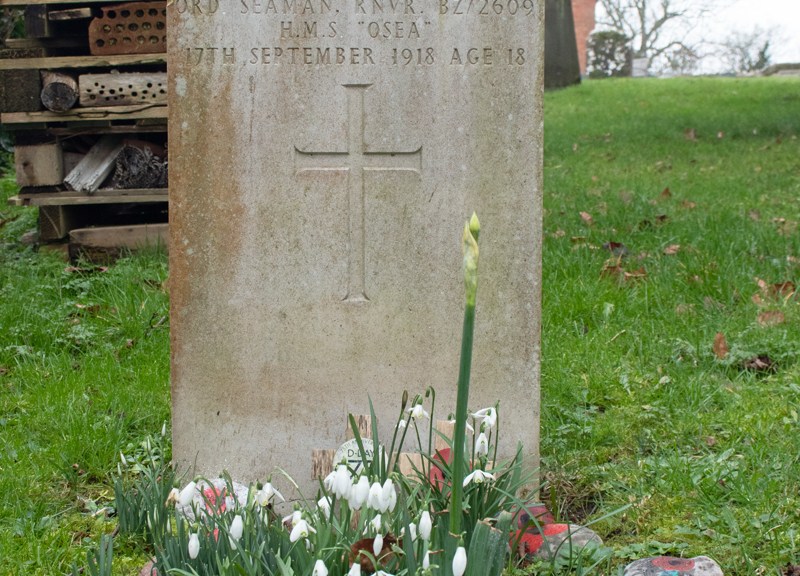
Details of Harry’s military service are scarce, but, based on his age, it is likely to have been the second half of the war when he enlisted. He joined the Royal Navy and was assigned to HMS Osea, a naval base in Essex.
Sadly, there is little evidence of Harry’s time in the navy. His pension records confirm that he passed away on 17th September 1918, having been suffering from pneumonia. He was just 18 years old when he died.
Harry Kick lies at peace in the churchyard of Holy Cross Church in his home village of Middlezoy, Somerset.








 Death and Service