Category Archives: Private

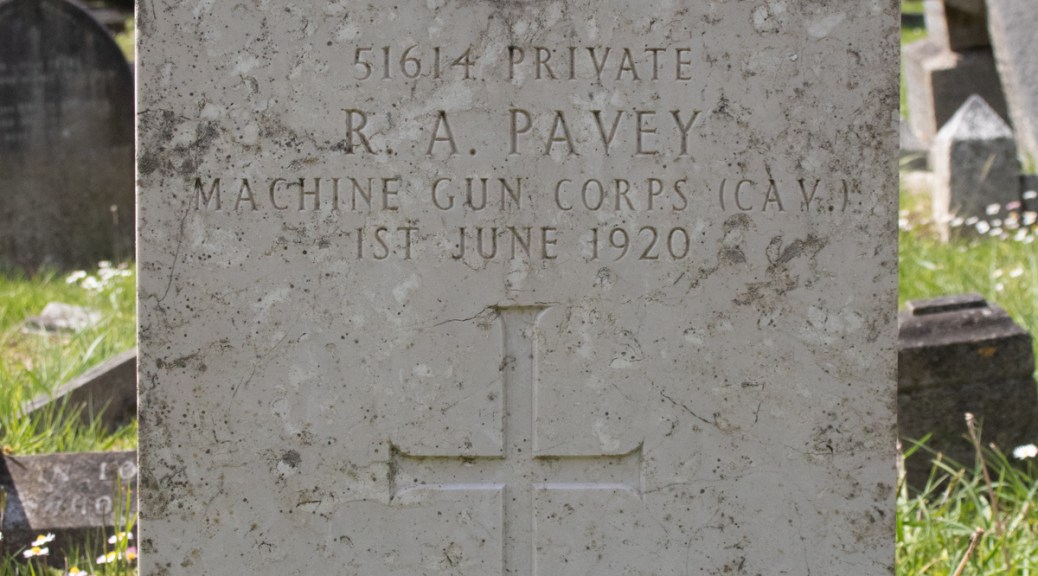
Private Roland Pavey

Private Roland Pavey

Roland Adams Pavey was born in the summer of 1891, the youngest of three children to Anthony Pavey and his wife, Mary. Anthony was a painter, and both he and his wife were born in the Somerset town of Cheddar. Their life took them travelling, though, with their first child, Edward being born in Cheddar, while their middle child, Ada, was born in Oxford, and Roland born in Bath .

Anthony passed away in 1910, leaving Roland living with his widowed mother, earning a living as a draper’s clerk. War was coming, however, and new opportunities lie in store.

Roland enlisted in the army in January 1915. Initially joining the North Somerset Yeomanry, he soon transferred across to the Cavalry Division of the Machine Gun Corps. Sadly, Private Pavey’s military records are lost to time, but he definitely saw action on the Western Front, gaining the Victory and British Medals and the 1915 Star for his efforts.

The next record for Roland comes in the form of a newspaper article from South Wales.

SAD CASE OF NANTYGLO GIRL

Behind the untimely death of Mr Roland A Pavey, a popular young ex-Service man, and secretary of the Weston-super-Mare Federation of Discharged Soldiers and Sailors, lies a pathetic story of the double bereavement of a pretty Welsh girl, Miss Dorothy Morgan of Nantyglo.

Prior to the war, Miss Morgan was engaged to a compatriot of her own, who answered his country’s call and, like so many thousands of others, made the great sacrifice. Time rolled on and the old wound was eventually healed. Then Miss Morgan went on a visit to Weston last year, and there met young Roland Pavey, just demobilised from the Army.

A mutual attraction soon ripened into affection, and the couple became engaged, and they were to have been married towards the end of the present month, but Fate intervened.

Pavey’s long war service impaired his constitution, though how seriously was probably not realised until the damage was done. Returning from a Whitsuntide visit to Exeter, Mr Pavey was so ill that he was compelled to take to his bed. He rapidly became worse, and though his fiancée was hurriedly summoned, he passed away before she arrived at Weston.

Thus, within a short time, Miss Morgan has been twice bereaved as a result of the war.

Merthyr Express: Saturday 12th June 1920

Roland Adams Pavey was just 29 years old when he died. He was laid to rest in the Milton Cemetery in Weston-super-Mare, where his mother then lived.


Sadly, Dorothy Morgan is too common a name in South Wales to confirm much more information on her life. We are unlikely ever to discover if she ever found a lasting love.

Private Peter McDonald

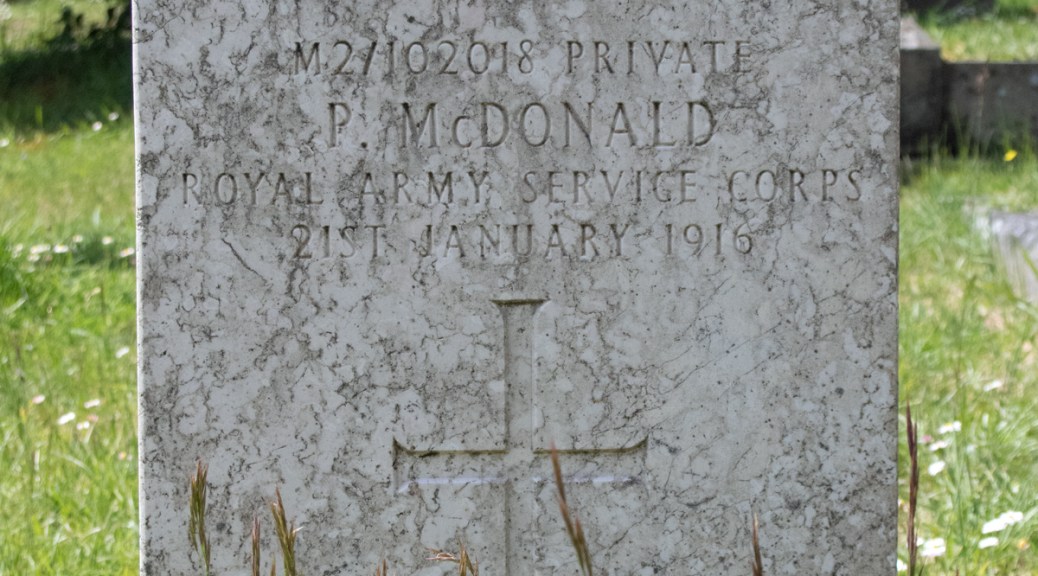
Private Peter McDonald

Peter McDonald was born in Tullamore, King’s County (now Offaly County), Ireland, on 28th May 1893 and was one of eight children to Michael and Mary McDonald. Michael had been in the army, and this seems to have been the route that Peter wanted to follow as well.

When he left school, however, he found work as a domestic servant at St Stanislaus College in his home town. War, by this time, was on the horizon, and so Peter was called on to other things.

Unfortunately, a lot of the documentation around Peter’s military service is no longer available. He enlisted in the Royal Army Service Corps; while an exact date for his enrolment is not available, this would appear to have been at some point in the first year of the conflict.

Private McDonald was assigned to the 341st Mechanical Transport Company. This was formed in May 1915, and was designated an Ammunition Park (which was in essence a fleet of lorries and a workshop for maintaining them). While full details of his time with the RASC is not available, Peter certainly came to be based in Weston-super-Mare, Somerset.

Considerable sensation was created at Weston-super-Mare on Friday evening, by a rumour which prevailed that a member of the Army Service Corps billeted in the town had been shot and another man wounded.

Inquiries revealed the fact that the rumour had some foundation, and it appears that some half-dozen members of the corps were attending their motor-bicycles in a shed at headquarters in Beach Road, when Lance Corporal Goldsmith produced an automatic Colt pistol, which he handed to Private McDonald for inspection.

In the course of the examination the weapon went off, and Goldsmith was shot in the leg. He at once took the revolved from McDonald, observing that he was unaware that it was loaded, and was apparently in the act of unloading it when it was again discharged, the bullet entering the lower part of McDonald’s abdomen, severing the main arteries.

Medical aid was at once procured. The unfortunate man died as the result of internal haemorrhage about an hour later.

Goldsmith was removed to hospital, but his injuries are not regarded as serious.

Somerset Standard: Friday 28th January 1916

Private Peter McDonald has passed away from a gunshot wound on 21st January 1916, at the age of just 22 years old. His body was laid to rest in the Milton Cemetery in Weston-super-Mare, where he had met his fatal accident.


Private McDonald’s pension record gives his cause of death as ‘explosion’, something of a misinterpretation of the evening’s events.


Private Arthur Lavender

Private Arthur Lavender

Arthur Reginald Lavender was born in Bath on 17th January 1889, the second of two children to George Charles (or Charles George) Lavender and his wife, Elizabeth. George raised the family in Bath and seems to have been a jack of all trades, finding work where he could, as a porter in a warehouse according to the 1891 census and a stationary engine driver ten years later.

On 1st December 1907, at the age of just 18, Arthur married Kate Pearce, a painter’s daughter from Weston-super-Mare. The young couple went on to have a son, Sidney, who was born the following year.

By 1911, Arthur was working in Weston-super-Mare as a warehouseman at a local laundry and, on the day of that year’s census, was staying with his father-in-law. Kate, meanwhile, had taken Sidney to see her brother, Frank, who lived in Bristol.

War was coming to Europe, and, in November 1915, Arthur signed up, joining the Royal Army Medical Corps as a Private. After initial training – including a course on First Aid, he was sent overseas on 11th April 1916, where he was assigned to the 27th Casualty Clearing Station.

Private Lavender’s time in the RAMC seems to have been a complicated one. He was admitted to a field hospital within a month of arriving in France with a double inguinal hernia, a condition that continued to dog him over the coming months.

Arthur was eventually shipped to England in March 1917 for an operation at the Metropolitan Hospital in London. The operation itself seemed to have been a success, but, while admitted, he contracted pneumonia, and it was this lung condition that was to end his life. Private Lavender passed away on 7th May 1917, aged just 28 years old.

Arthur Reginald Lavender was laid to rest in the Milton Cemetery in Weston-super-Mare.


Private Charles Dyer

Private Charles Dyer

Charles William Dyer was born on 12th May 1895, the youngest of seven children to Harry and Mary Dyer.

Harry was a farmer, who brought his family up in the village of Kewstoke, just to the north of Weston-super-Mare, Somerset. He seems to have been keen to try new things because he and Mary lived for a while in Australia, and their first two children were born there. They then moved back to the UK in around 1887, settling back in Somerset.

By the time of the 1911 census, Charles was 16 years old, and all of the family were helping out on the farm. He seemed to share his father’s sense of adventure; in 1913, he emigrated to Canada, setting himself up as a farmhand in Winnipeg.

War was coming to Europe, however, and Charles joined up. He enlisted in October 1917, joining the Canadian Infantry. Leaving Canada on a troop ship on 19th February 1918, he arrived back in England on 4th March.

Private Dyer was soon installed at the Canadian Infantry camp at Bramshott in Hampshire. Within weeks of arriving in England, however, he had contracted influenza; this developed into pneumonia, and was admitted to the camp’s Military Hospital on 22nd May. Sadly, a week later, Private Dyer was dead. He was just 23 years old.

Charles William Dyer was taken back to Weston-super-Mare and laid to rest in the Milton Cemetery there.


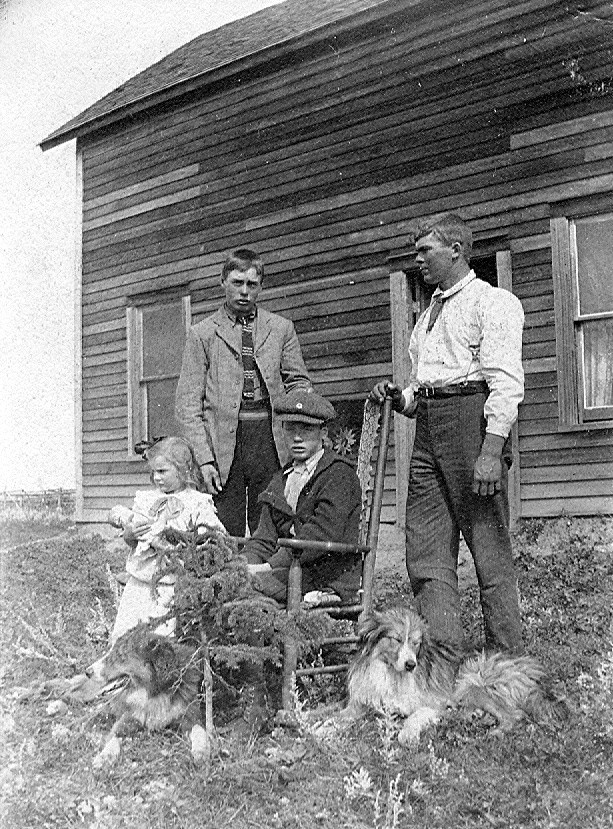
Charles Dyer (on right) in Canada
(Courtesy of ancestry.co.uk)

Private John Stainton

Private John Stainton

John Stainton was born in the Cumbrian village of Ambleside in January 1871. He was one of seven children to George and Mary Stainton, a labourer and his wife. John followed in his father’s footsteps as a labourer, as they took him to where the work was – by the time John was ten, the family were living in Barrow-in-Furness.

The 1911 census found John married to a woman called Mary. The couple wed in 1909 and were boarding with Maybrooke Cole, a fellow labourer, and his family.

The next record for John comes in the form of his enlistment papers. He joined up on 31st August 1914, but the document throws up a couple of anomalies.

To the question “Are you married?” John marked “No”. The fact that he didn’t confirm he was a widower presents more questions than answers.

The document also confirms that he has previous military experience. He served with 2nd Battalion King’s Own (Royal Lancaster Regiment), which fought in the Second Boer War, and was involved in Battle of Spion Kop in January 1900.

John re-enlisted in the same battalion on 31st August 1914, and remained part of a territorial force for the best part of a year. It was during this time that he married Rhoda Selina Cooper. She was born and brought up in Clevedon, Somerset, and it can only be assumed that John was stationed in the county at this time.

Private Stainton seemed to have a bit of a rebellious streak, and his service records identify three times when he was pulled up for dereliction of duty. In December 1914, he was admonished for overstaying his leave pass; in June 1915 he was reported for being absent from the base; a year later, he was admonished again, this time for losing a pair of handcuffs.

The battalion were sent to France in July 1915, and, in the end, Private Stainton served on the Western Front for just over a year. On 27th July 1916, he was sounded by shrapnel in the right shoulder, face and thigh, and was evacuated back to England for treatment. Admitted to the English General Hospital in Cambridge, sadly his wounds proved too much for him. Private Stainton died on 11th August 1916, at the age of 45 years old.

John Stainton’s body was brought back to his widow; he lies at rest in the picturesque churchyard of St Andrew’s in Clevedon, Somerset.


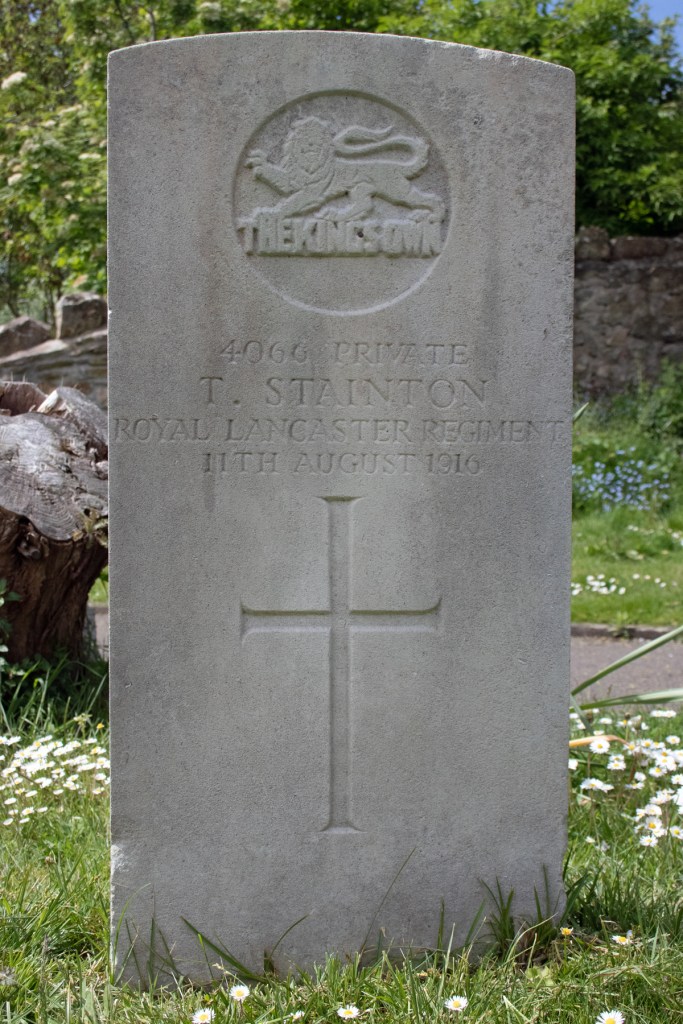
The Commonwealth War Grave for John Stainton incorrectly gives his name as T Stainton.


Private Alfred Wheeler

Private Alfred Wheeler

Alfred Wheeler was born in Binstead, on the Isle of Wight, in the summer of 1886. One of three children, his parents were John, a labourer from the Isle of Wight, and his wife Emily.

When he left school, Alfred found work at the London City Mission in Ventnor. By this point, tragically, both of his parents had passed away, and the young siblings were finding their own ways in life.

The 1911 census found Alfred living with his uncle back in Binstead. His trade was given as a Motor Car Driver for the local Carriage & Motor Works; while he was obviously brought up with a spiritual side, he seems to have had a sense of adventure too.

When war broke out, Alfred was keen to do his bit. He enlisted in the Gloucestershire Regiment and was attached to the 1st Battalion. Sent to France within weeks of the war commencing, Private Wheeler was awarded the Victory and British Medals and the 1914 Star.

With his background with cars, Alfred subsequently transferred over to the Royal Army Service Corps in the 615th Motor Transport Company. While full dates are not readily available, the 615th were formed in January 1916, so it was likely after this that Private Wheeler moved across. The company were based in Dublin, and it was in Ireland that he saw out the remainder of the conflict.

On 11th July 1919, Alfred married Rose England. She was the daughter of an organ tuner from Bristol, although there is no obvious connection to Clevedon for him. It seems likely, therefore, that the couple may have met around through the church, possibly as Private Wheeler was travelling between Ireland and Hampshire.

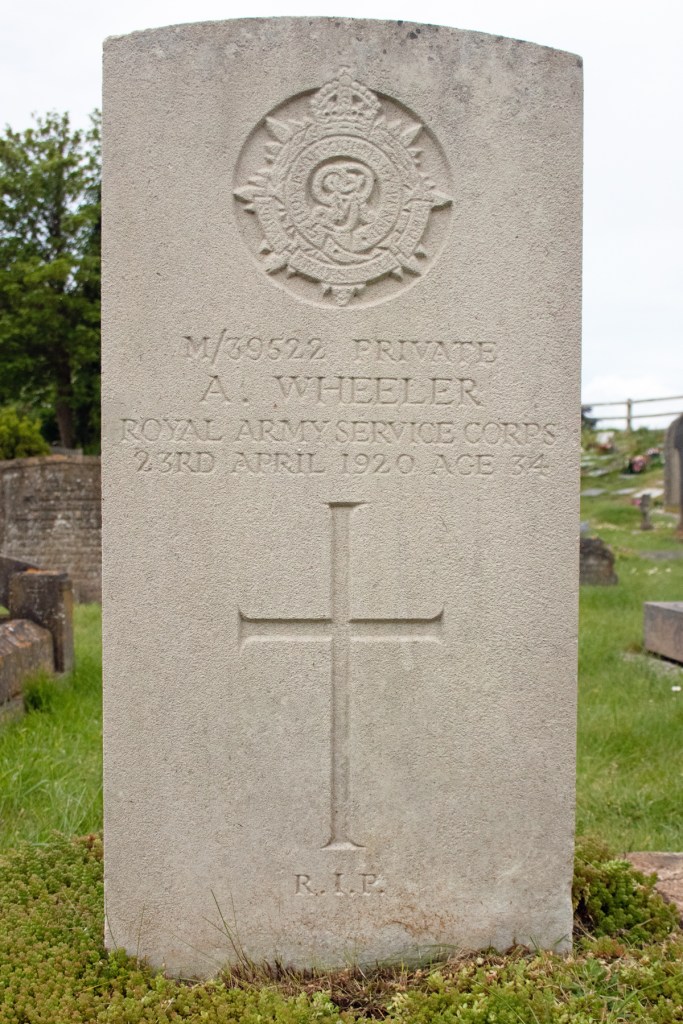
Alfred wasn’t demobbed as soon as the war ended, remaining part of the Royal Army Service Corps through until 1920. It was while he was in Ireland that he contracted influenza. Admitted to hospital in Dublin, he sadly succumbed to the condition on 23rd April 1920. He was 34 years old.

Alfred Wheeler’s body was brought back to England. He lies buried in St Andrew’s Churchyard in Clevedon, Somerset.


Private Bertram Coates

Private Bertram Coates

Bertram Noel Coates was born in the sleepy Somerset village of Walton-in-Gordano in the spring of 1890. He was the middle of three children to Herbert and Florence Coates. Herbert was a solicitor, and clerical work seemed to have been in the Coates blood.

While he did not follow in his father’s exact footsteps, by the time of the 1911 census, Bertram had found work as a bank clerk, and was boarding with his employer, James Barry, in Chipping Sodbury, Gloucestershire.

Bertram was obviously made very welcome in Chipping Sodbury, as, on 27th May 1914, he married his employer’s daughter, Mary Barry. The couple would go on to have a daughter – Eileen – who was born in February 1916.

By the time of his wedding, Bertram had moved to London, and was working as a bank clerk in South Woodford, so was obviously showing an ambitious streak.

War was beckoning, however, and in December 1915, Bertram enlisted. Placed in the Army Reserve, he was finally mobilised in January 1917, and assigned to the 28th Battalion of the London Regiment, which was also known as the Artists Rifles.

Tragically, Private Coates’ military service was to be a short one. While training, he contracted measles, which turned septic with additional complications. He sadly passed away on 31st March 1917, less than three months after being mobilised. He was just 27 years old.

Bertram Noel Coates was brought back to Somerset. He lies at peace in the churchyard of St Mary’s in Walton Clevedon, near his parents’ home in Somerset.


Private Robert Voisey

Private Robert Voisey

Robert Voisey was born towards the end of 1891, one of six children to Richard and Sophia. Richard was a tailor and, while both he and Sophia had been born in Cullompton, Devon, by the time Robert was born, they had moved to the Somerset town of Taunton.

When he left school, Robert followed his father’s trade and, by the time of the 1911 census, he was living with his parents and two of his sisters in a terraced house not far from the town’s station.

With the outbreak of the Great War, Robert was keen to do his bit. While full details of his military service are not available, it seems that he initially enlisted in the Somerset Light Infantry, but was subsequently transferred to the Royal Warwickshire Regiment. Joining the 6th Battalion as a Private, he saw action on the Western Front, and was wounded in April 1918.

Evacuated to England for treatment, Private Voisey was admitted to the 5th Northern General Hospital in Leicester. He seemed to be recovering well from his injuries, but then contracted influenza.

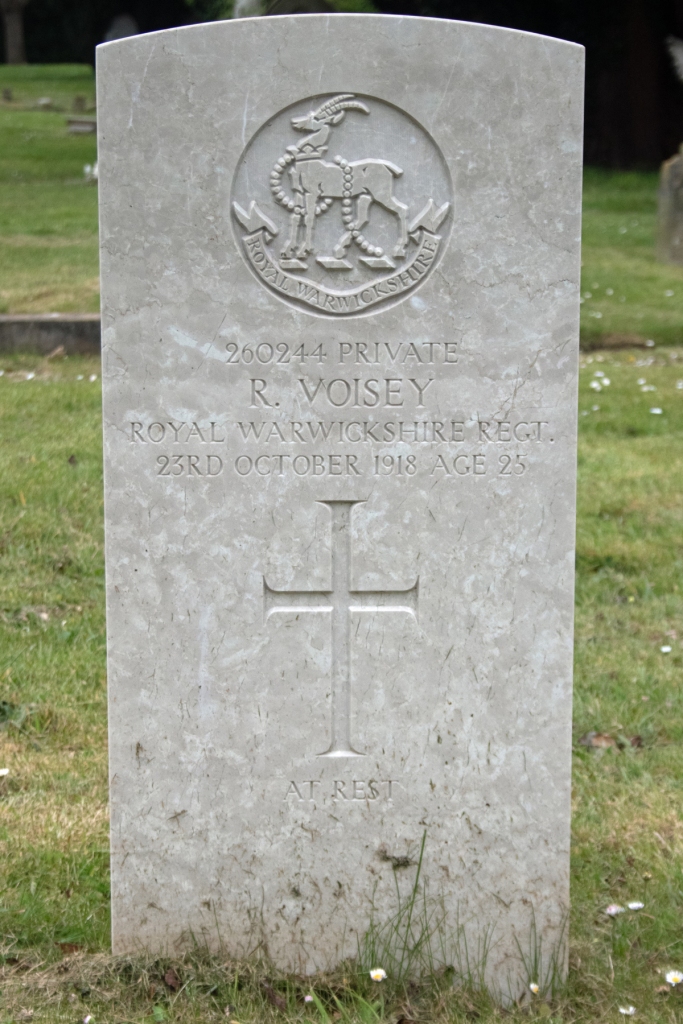
Sadly, this developed into pneumonia and Private Voisey subsequently died on 23rd October 1918, at the tender age of 25 years old.

Robert Voisey’s body was brought back to Somerset and he was laid to rest in the St James’ Cemetery in the town.


Robert’s funeral was written up in the local newspaper, and the report sheds more of a light on the Edwardian attitude towards some medical and mental health conditions than it does on the actual service.

The very fact of [Robert] ever having been a soldier, considering the great disability he was afflicted with through an incurable impediment in his speech, testifies abundantly to his high and noble interpretation of duty and patriotism.

Had he insisted he could at any time have evaded military service, but so eager was he to serve his country that it was not until he had actually been four times rejected as “physically unfit for military service” was he eventually accepted.

To the writer o this brief notice, who was his friend and fellow shop-mate for a long while, but who was at the time doing duty at Castle Green Recruiting Office, he often time used to express his indignation at not being accepted, and on the last occasion he spoke to the writer, it was to emphatically declare himself “as fit to be a soldier as anyone who had yet left Taunton.”

He dreaded the thought of being considered a shirker, and his opinion of many who have, even up till now, successfully evaded service, though far more physically fit than he was, was contemptuous to the bitterest extreme.

He was a true Britisher, a faithful friend and shop-mate, and a courageous soldier of whom no fitter epitaph could be written than “he gave himself in defence of home, country and liberty.”

Taunton Courier and Western Advertiser: Wednesday 6th November 1918

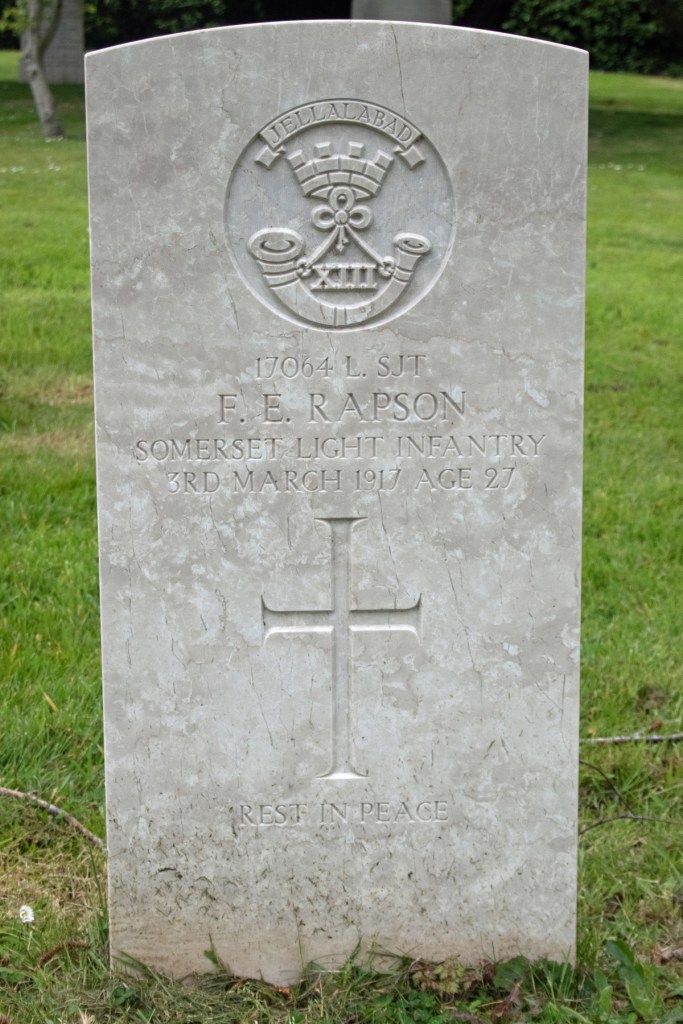
Lance Serjeant Frederick Rapson

Lance Serjeant Frederick Rapson

Frederick Ernest Rapson was born in the spring of 1888, one of nine children to Francis and Susan Rapson. Francis was a Serjeant in the 18th Hussars, and the family lived in Dulverton, a village on the edge of Exmoor.

Francis had served in the armed forces for 26 years, but passed away after a short illness in February 1891. According to a local friend and supporter, he had been in charge of the local yeomanry in Dulverton for a number of years and had been ‘in the prime and flower of life’. [West Somerset Free Press: Saturday 28th February 1891]

Susan was left widowed with nine children, the eldest of whom was only 13 years old. Frederick was only three at the time, and had lost his father at a very early age.

In 1895, Susan married a Frederick Howard, who was a painter and carpenter. The family moved to Taunton in Somerset, and Frederick and Susan went on to have three children of their own.

On 6th February 1910, Frederick Rapson married Lucy Knight; by this time, he was working as a compositor for the local newspaper. The couple set up home in the middle of Taunton, and went on to have three children, Francis, Frederick and Ronald.

War was coming, and, while Frederick did not actively seek military service in the same way as his father had done, it was not something he was able to avoid. While his full military records are not available, it’s clear that he enlisted in the Somerset Light Infantry at some point early on in the conflict.

Private Rapson was assigned to the 1st Battalion, who were based on the Western Front for the duration of the conflict. During his time there, he was awarded the Victory and British Medals, but not the 1915 Star, so that would narrow down his enlisting to some point in 1916.

While he was promoted to the role of Lance Serjeant, his service was to be a short one. At the start of 1917, he contracted pneumonia and was admitted to hospital. Sadly, the condition was to get the better of him, and he passed away on 3rd March 1917. He was just 27 years of age.

Frederick Ernest Rapson was buried in a quiet corner of St James’ Cemetery in Taunton, Somerset.


Private Henry Oaten

Private Henry Oaten

Henry Oaten was born in 1876, the second youngest of seven children to Henry and Mary Ann Oaten. Henry Sr was an agricultural labourer, who raised his family in his home village of Pitminster, to the south of Taunton in Somerset.

When he left school, Henry Jr followed in his father’s footsteps as a farm worker. Sadly, however, there is very little further documentation to expand on his life.

Henry married a woman called Emily; this is likely to have been at some point around 1900, although there is nothing to confirm an exact date. The couple went on to have four children – John, Albert, William and Howard.

When war broke out, Henry joined up. Again, dates for his military service are not available, but he enlisted in the Devonshire Regiment as a Private. He was assigned to the 13th (Works) Battalion, which was a territorial force, based in Plymouth.

Little further documentation exists in relation to Private Oaten. The next time he appears is on his pension record, which confirms that he passed away on 20th February 1917, having been suffering from bronchitis. He was just 40 years old.

Henry Oaten was brought back to Taunton and laid to rest in the St James’ Cemetery in the town.


As an aside to this story, while researching Private Oaten, an additional piece of information about his father came to light. A record confirms that, on the 1st October 1851, at the age of just 16, Henry Oaten was admitted to gaol. Sadly further details – including that of his crime and his sentence – are lost to time, but it adds an interesting footnote to his son’s background.