Francis Jesse Stone – known as Frank – was born in 1899, one of five children to William and Sarah Stone. William was a general handyman – his census records record him variously as a labourer, carpenter and carman (or carter) – and the family lived in the village of Bishop’s Hull, on the outskirts of Taunton, Somerset.
Given when he was born, documentation for Frank’s early life is limited to the 1901 and 1911 censuses. We are restricted, therefore, to the information provided by the medal rolls.
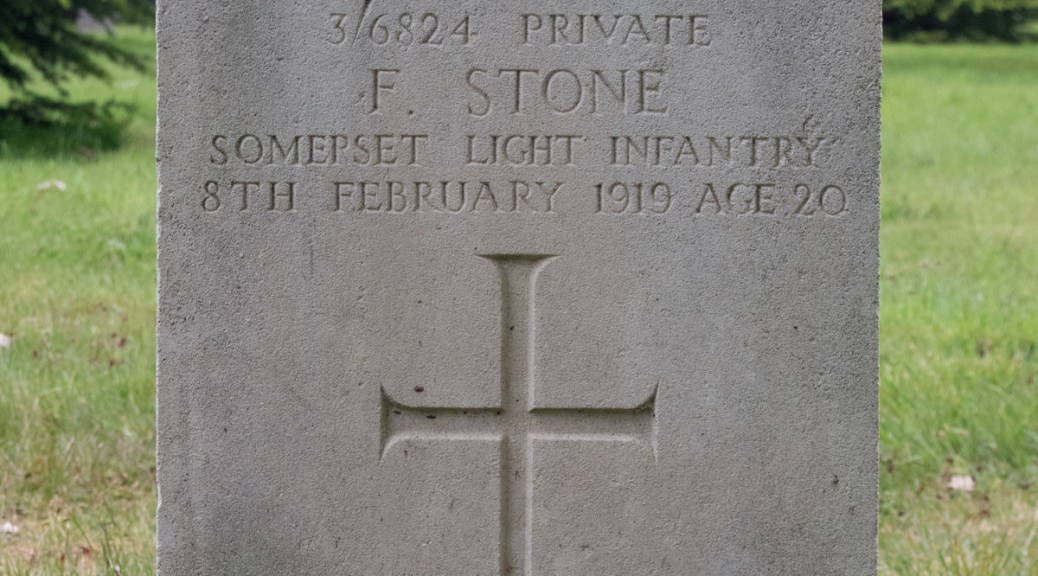
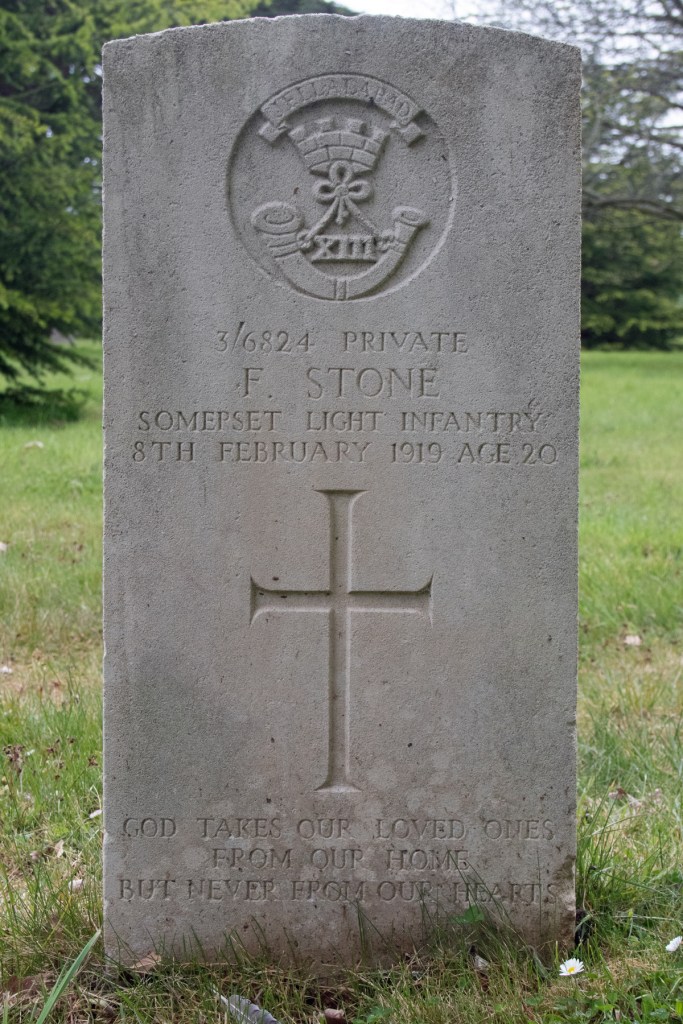
Frank was under age when he joined up. He enlisted in the Somerset Light Infantry on 27th December 1914, when he could only have been 15 years old. He was assigned to the Depot Battalion, and was shipped to France the following year.
Sadly, there is little other information about Private Stone. He survived the war and returned to England, but passed away on 8th February 1919. No cause of death is evident, but it seems likely to have been one of the lung conditions running rampant across the country at the time, probably influenza, tuberculosis or pneumonia. When he died, Frank was just 20 years old.
Frank Jesse Stone lies at rest in St Mary’s Cemetery in his home town of Taunton, Somerset.
Robert William Mayers – also known as Bob – was born in 1888, one of nine children to Charles and Louisa Mayers from Taunton in Somerset. Charles was a solicitor’s clerk, whose work changed direction in the 1890s, and who became a general labourer.
When Robert left school, he became a carpenter, while his older brother became a motor mechanic, and other siblings became messengers, collar machinists and housemaids.
With war on the horizon, Robert enlisted. His full service records no longer exist, but he enrolled in the Bedfordshire Regiment and joined the 3rd Garrison Battalion. While there is no evidence of Private Mayers’ time in the army, it is likely that he saw some service in India and Burma during and after the Great War.
Robert returned to England after being demobbed, but, having survived the war, was suffering from tuberculosis. Sadly, the condition was to get the better of him, and he passed away at his parents’ home on 2nd May 1921. He was 34 years old.
Robert William Mayers lies at rest in St Mary’s Cemetery in Taunton, Somerset.
Ernest Baker’s early life is a bit of a muddle; Born in 1878 in Somerset, it’s a challenge to unpick specific details, as there are two Ernest Bakers, both of whom have parents of the same name – Henry and Sarah – and have siblings with similar names too. Was Ernest’s father, therefore, a thatcher from Meare near Glastonbury or a travelling draper from Taunton.
In fact, it was a newspaper article from April 1915 that helped unlock the confusion.
The Taunton Courier and Western Advertiser confirmed that Ernest’s full name was Ernest Bond Baker, and that his father – who had passed away by the time of Ernest’s death – was from Bishop’s Hull, a village near Taunton.
This would seem to confirm, therefore, that his father was a travelling draper.
Ernest was one of ten children. His father died when he was only fifteen years old, by which time Ernest had left school and found employment as a basket weaver, a trade which was prevalent on the Somerset Moors.
Sarah, a widow at only forty, took in laundry to make ends meet. Of Ernest’s two older brother, one had passed away as a teenager, while the other had gone on to have a wife and family of his own. It was left to Ernest, therefore, to remain at home and support his mother and younger siblings.
Ernest met and married local butcher’s daughter Bessie Glover in 1900, and the couple went on to have seven children. After a spell living in Wiltshire, the young family moved back to Somerset, settling in Bridgwater, where Ernest continued to ply his trade.
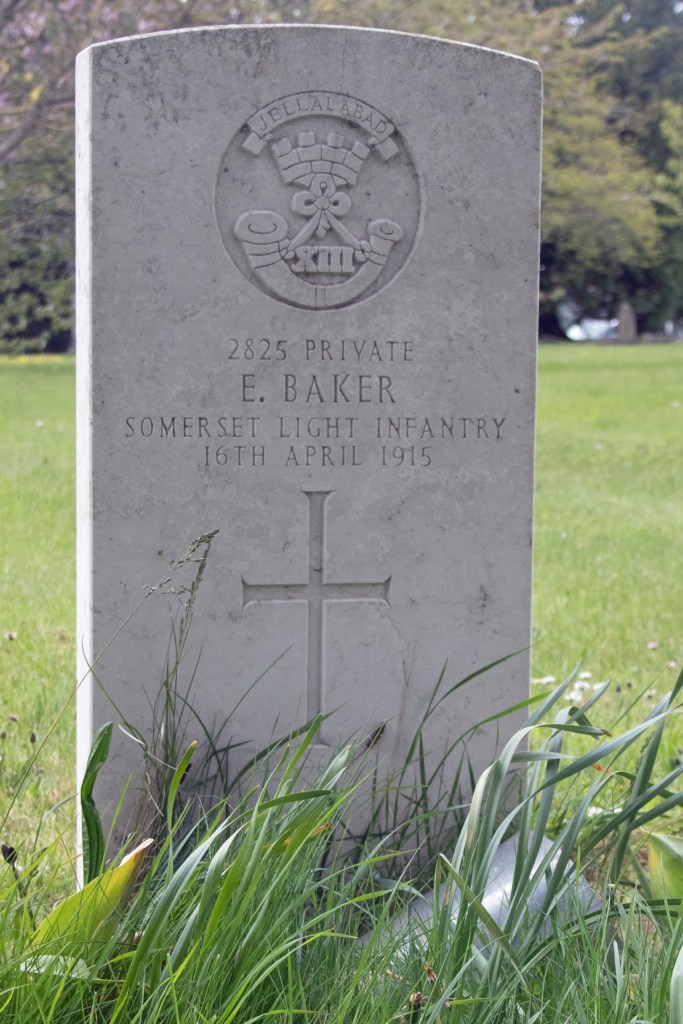
Ernest’s military service records are lost to time; he enlisted in the Somerset Light Infantry, joining the 5th Battalion at some point early in the war (certainly before October 1914). Private Baker’s battalion seems to have been part of a territorial/reserve force, and he was based in his home town of Taunton.
In early April 1915, Ernest fell ill, and was admitted to the Voluntary Aid Detachment Red Cross Hospital in Yeovil, suffering from bronchitis and pneumonia. Sadly, the lung conditions were such that he was succumb to them, and he passed away on 16th April 1915. He was just 36 years old.
Ernest Bond Baker lies at rest in St Mary’s Cemetery in his home town of Taunton, Somerset, the same cemetery where his father and brother were buried.
William Gulliford was born on 8th November 1877 in the village of Thurloxton, just to the north of Taunton, Somerset. William’s father – also called William – was an agricultural labourer who, with his wife Charlotte, had nine children in total.
William Jr found work as a labourer for a brewery and, by 1899, had moved to Staffordshire, met and married a local woman called Elsie Sutton. The couple settled down in Burton-on-Trent, and went on to have a daughter, also called Elsie.
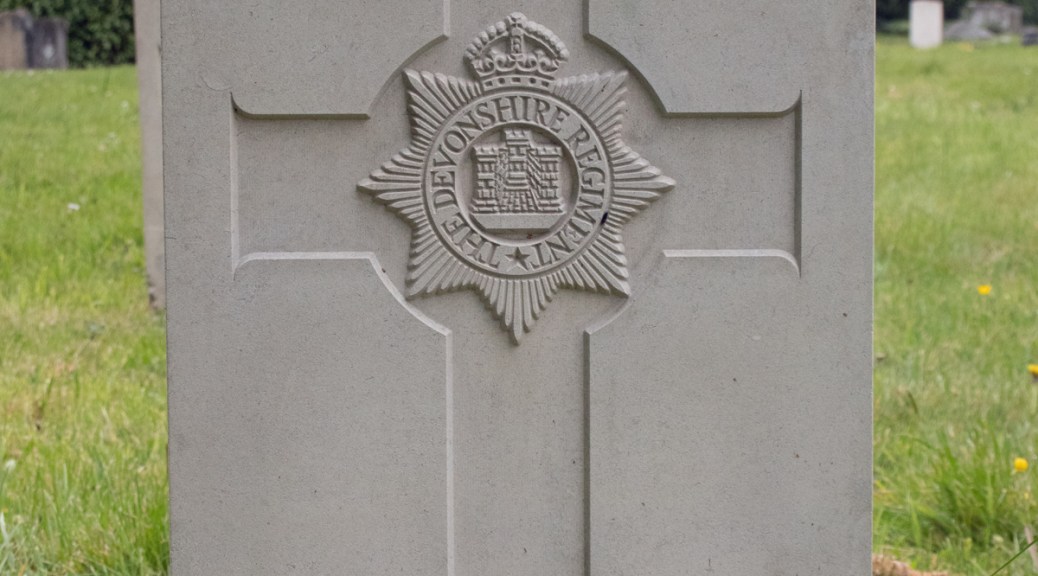
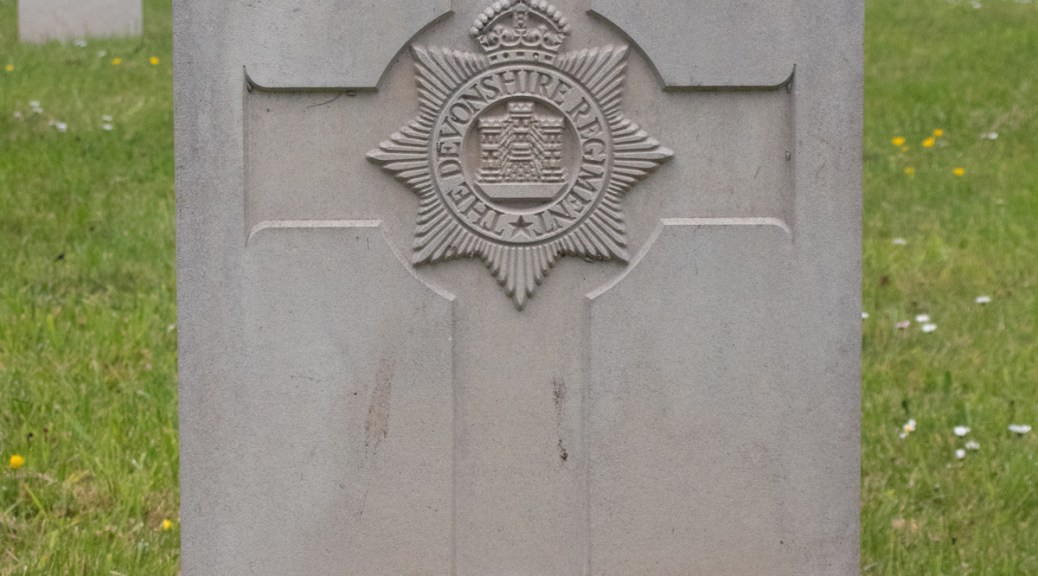
War was coming, however, and, in August 1916, William enlisted. Initially assigned as a Private in the 14th Devonshire Regiment, he was soon moved to the Labour Corps, and within a couple of months was on the Western Front as part of the British Expeditionary Force.
In November 1917, Private Gulliford was shipped back to England, suffering from ill health. He was admitted to the Military Hospital in Taunton with heart failure, and sadly passed away from this a month later. He had just turned 40 years old.
William Gulliford lies at rest in St Mary’s Cemetery in Taunton, Somerset.
John Thomas Alston, also known as Jack, was born in Chorley, Lancashire, in 1865 and was one of thirteen children to Richard and Elizabeth Alston. Before he died in 1878, Richard was a stripper and a grinder in a cotton mill, and it was millwork that the majority of his and Elizabeth’s children went into.
When he left school, Jack and his siblings worked as cotton piecers in the mills, tying together any threads that broke on the machines. This was a job aimed at children, whose hands were often the only ones small enough to reach into the equipment.
By 1895, Elizabeth too had passed away. Jack, who was 30 by this point, had moved from Chorley to nearby Oswaldtwistle, and met Mary Ellen Wilcock. She was a widow with two children, and the couple married on 14th February 1897. Their marriage certificate shows that she was the daughter of a weaver, while Jack was working as a furnace man in the mill. The couple went on to have a child together, Amy, who was born in 1900.
The couple settled into if not a comfortable life, then a continued existence. While Mary and her two older children were working in the cotton mill, Jack began labouring at the local chemical works. The family lived in a small, two up, two down cottage right next to Mary and the children’s place of work, and life continued apace.
War was coming however, and Jack volunteered to do his bit. His service records no longer exist, but it can only be assumed that he joined of his own accord; he would have been 50 when hostilities commenced, and so exempt from the initial call-up.
Private Alston was assigned to the Somerset Light Infantry, and was based at their Depot in Taunton. Little information about his time there is available, and sadly, the next accessible document is his pension record. This confirms that he died on 7th April 1916, from “shock caused by a fall while on duty”. There is no other reference to what or how this happened, so the circumstances will remain a mystery. He was 51 years old when he passed away.
It seems that his widow may not have had the funds to bring Jack back home; instead he lies at rest in St Mary’s Cemetery in Taunton, Somerset, close to the depot where he was based.
Thomas Henry Winter was born in 1887, one of six children to James and Mary. James was a farmer, and the family lived in Milverton, in the Somerset countryside to the west of Taunton.
James died in 1900, and Thomas found his way into farm work as well. He met and married a local woman called Ada Thynne in February 1909, and the couple went on to have five children: Beatrice, James, Charles, Frank and Thomas.
There is little confirmed information about Thomas’ military career. When he joined up, he enlisted in the 13th Battalion of the Devonshire Regiment, although, as his service records no longer exist, it is not possible to identify when this was.
Private Winter later transferred to the Labour Corps – again there are no records to confirm the dates – and this is the division in which he remained.
Illness was to dog Thomas, however; in early 1918, he contracted enteric fever (known nowadays as typhoid), and was hospitalised. Sadly, he succumbed to the disease, and passed away on 14th February 1918. He was 30 years of age.
Thomas Henry Winter lies at rest in St Mary’s Cemetery in Taunton, Somerset.
An additional tragic turn to Thomas’ story is that Ada was pregnant when he passed away. His youngest son, whom Ada named after him, would never know his father.
Alfred Blackmore was born on 25th October 1868 in the village of Thurlbear, near Taunton. Documentation varies and names cross over, but it appears that he was one numerous children to farm labourer William Blackmore and his wife, Mary Ann.
Details of Alfred’s early life are a bit hazy – again, in a rural location, names often cross over, so it is a challenge to totally confirm that they relate to the right person. His mother appears to have passed away by the time of the 1881 census, and Alfred was living with his father and three of his siblings and working as a farm hand.
Alfred again disappears off the radar for a while; in July 1894, he married Lucy Charlotte Yard, and the couple went on to have two daughters, Lucy and Beatrice. By 1901, the young family were living in the village of Frampton Cotterell, just to the north of Bristol, and Alfred had found employment as a marine fireman.
Ten years later, Lucy and the girls were still living in Frampton Cotterell, but Alfred was back in Taunton, lodging with a 75-year-old widow called Mary Croker and working as a labourer. This separation may have signalled the beginning of the end for the couple’s marriage.
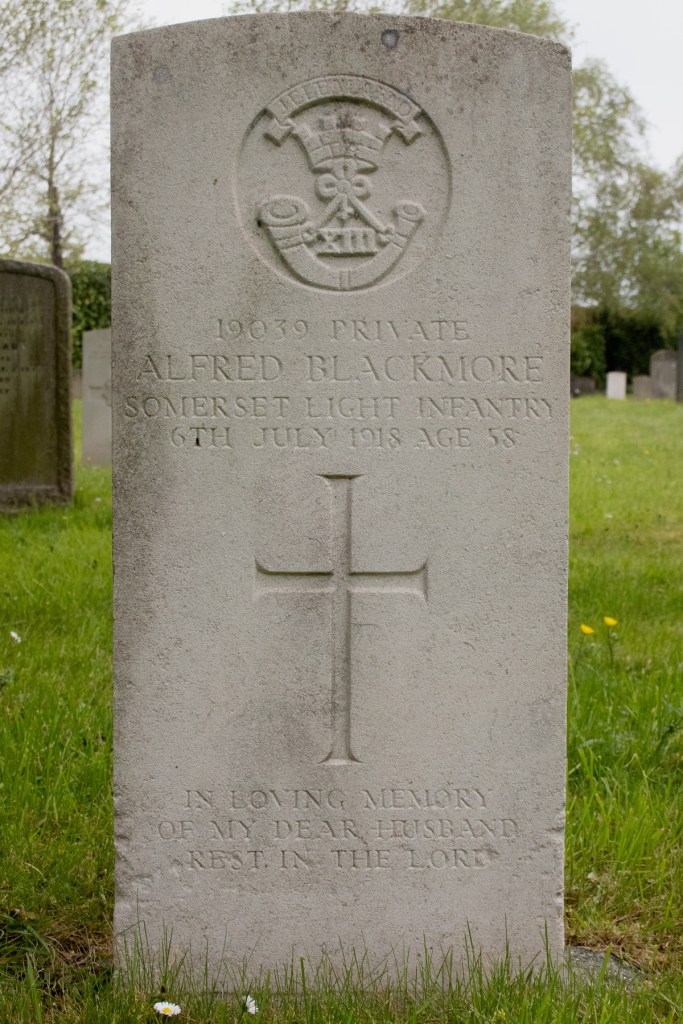
War broke out, and it is evident that Alfred enlisted as a Private in the Somerset Light Infantry. Sadly, his service records are lost to time, but it appears that he served for at least three years.
The next time Alfred appears in documentation, it is a newspaper report on his passing, under the heading “Taunton Soldier’s Death”.
FOUND DROWNED AT BLACKBROOK
Mr F Foster Barham, coroner for West Somerset, held an inquest at the Blackbrook Inn, Ruishton, on Monday, relative to the death of Alfred Blackmore, aged 49, a private in the Labour Company at Taunton Barracks, whose body was found in the stream at Blackbrook on Saturday morning.
William Cozens, farmer… gave evidence of identification, and stated that on Friday he saw the deceased sitting by the hedge… about 400 yards from where the body was found.
William Richard Radnidge, butcher… stated that on Saturday morning he found the body in the stream dividing Ruishton from Taunton St Mary’s… His cap, belt and cape were on the bank. The deceased was lying face downward, his face and arms being in the mud below the surface.
PC Jenkins stated that at 10:45am on Saturday he received a communication from PC Wathen, in consequence of which he proceeded to Blackbrook, where he found the body lying under a hedge. He searched the body, and on it found a summons, returnable at Taunton on 29th June, for having failed to comply with a maintenance order obtained by his wife, Lucy Blackmore, on 25th September 1915, the sum of £2 13s [approx. £300 today] being due. On the back of the summons was written: “This is what my old cow has done for me.”
There was also the following letter: “When my body is found, don’t you give a farthing to my old cow. What I have got to come give to my brother, Edward Blackmore… Signed A Blackmore.” At the back of the letter was written: “Goodbye to all that I love.”
The deceased had left his lodging at nine a.m. on June 29th to attend the Taunton Police Court, but did not do so.
An officer stated that the deceased’s conduct during the three years he had been in the army had been satisfactory.
The Foreman of the jury said that according to the evidence they found that the deceased met with his death by drowning whilst temporarily insane.
Taunton Courier and Western Advertiser: Wednesday 10th July 1918
Alfred Blackmore took his own life on 6th July 1918. He was 49 years old [the war grave gives a different age].
Alfred lies at peace in St Mary’s Cemetery in Taunton, Somerset.
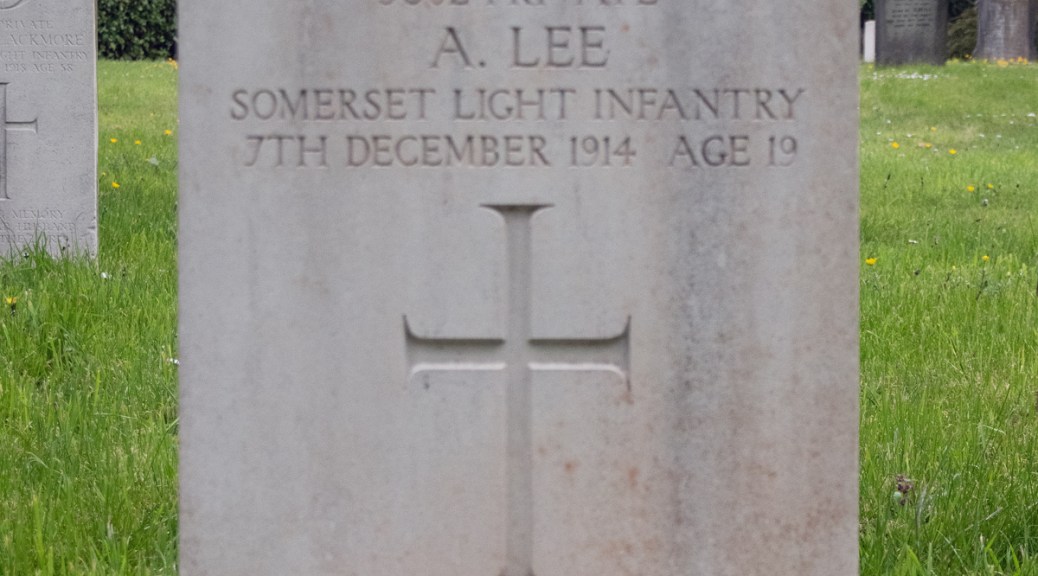
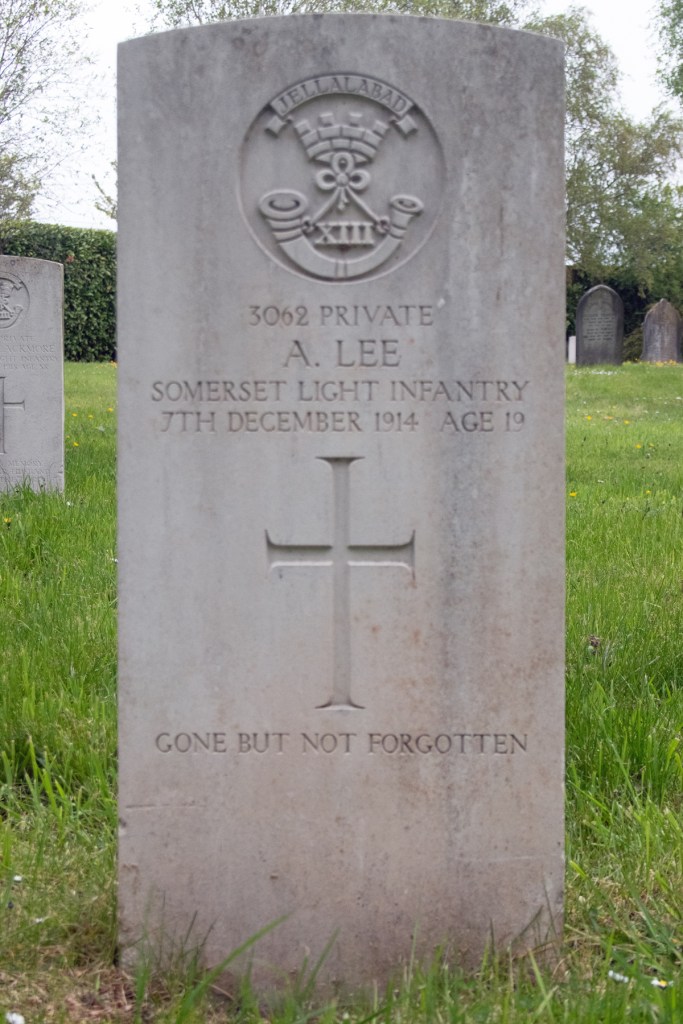
Arthur Henry Lee was born in April 1895, and was one of five children. His parents were Arthur and Hannah (or Annie) Lee, and the family lived in the Chard area of Somerset. Arthur Sr worked as a ‘twist hand’, operating the machines in a lace factory and, when his son left school, he too found work in the same factory.
There is little documented about Arthur’s early life. When war broke out, however, he was quick to enlist, and joined the Somerset Light Infantry as a Private. He was assigned to the 5th (1st Reserve) Battalion, and was stationed at Mansfield House.
Sadly, Private Lee’s military service was not to be a long one. As happened with lots of young men from different parts of the country coming together in large numbers, illness and disease spread quickly in the military encampments,
Arthur was not immune to this and was admitted to the Military Hospital in Taunton with meningitis. He passed away on 7th December 1914, aged just 19 years old.
Arthur Henry Lee lies in St Mary’s Cemetery in Taunton, Somerset.
Henry Thomas Underhill is one of those people whose lives are lost to time. Details of his early life were difficult to track down, but snippets helped unlock some of the mystery.
In late October 1914, a number of Somerset newspapers gave the following report:
Soldier’s Sudden Death
The West Somerset Coroner held an enquiry at Taunton Barracks on Saturday afternoon relative to the death of Private Henry Thomas Underhill, aged 44, of Street, which took place on Wednesday [14th October 1914].
Deceased was talking to Private TF Davis on a landing in the barracks, when he reeled and, throwing up his arms, fell heavily to the ground, his head striking the floor.
Major Stalkartt, RAMC, was at once summoned, but he found that life was extinct. He afterwards made a post mortem examination, which revealed fatty degeneration of the heart, with a fracture of the bae of the skull. The doctor considered that death was due to heart failure, and that the skull was fractured in falling to the ground.
The deceased was accorded a military funeral at St Mary’s Cemetery the same afternoon. He was an old member of the Somerset Light Infantry, which he recently re-joined on account of the war.
Wells Journal: Friday 23rd October 1914
Private Underhill’s pension record confirms that he was married to a woman called Mary Ann and that the couple had had a daughter, Beatrice Kate Lavinia Underhill, who had been born in December 1906. While searching for Henry directly drew too many variables to provide any certainty, his daughter proved the key to unlock his story.
Henry Thomas Underhill was born in the summer of 1860. One of nine children, his parents were William Underhill and his wife Elizabeth, who was also known as Betsy. William worked as a clerk for a button maker, and the family lived in Birmingham, which, at the time, was in Warwickshire.
When he left school, Henry found work as a ‘brass tube drawer’, making the metal tubes, using a die. He found love too, and, on 13th March 1881, aged just 20, he married Emma Howner. The couple went on to have a son, Ernest, in 1889 although, from the documentation about him, it seems likely that he passed away when only a toddler. Further tragedy was to strike Henry, when Emma also died in 1890, aged just 30 years old.
It may have been around this time that Henry found a focus in military service; he does not appear in the 1891 census and the next set of documentation for him dates from 1900.
It’s at this point that Henry married for a second time. Mary Ann Kelly was seventeen years younger than her new husband, and was the daughter of a carpenter from Solihull. Her father, Michael, had died when she was only a teenager, and she lived with her mother, Lavinia, helping to support her.
Henry’s previous experience with metalwork – and probably his time in the military – found him employment making gun components. The 1901 census finds him and Mary living in Yardley, to the east of Birmingham, with Lavinia and Mary’s younger brother William.
This was obviously a suitable and convenient arrangement; the next census, in 1911, shows the family still living together. By this time, Lavinia was still the head of the household, and shared her home with daughter Mary, Henry and four-year-old Beatrice; son William, his wife Ada and their new-born son, William. Making up the household on Census Day was a visitor, Amy.
War was on the horizon, and this is where we return to the initial news report about Private Underhill. It is likely that Henry had re-enlisted – or at least been called back up – as soon as hostilities broke out. Sadly, his service was not to be a long one, as he suffered the fatal heart attack within a couple of months of the start of the war. Private Underhill was 54 years old at the time of his death.
Henry Thomas Underhill’s body was buried in St Mary’s Cemetery in Taunton, Somerset.
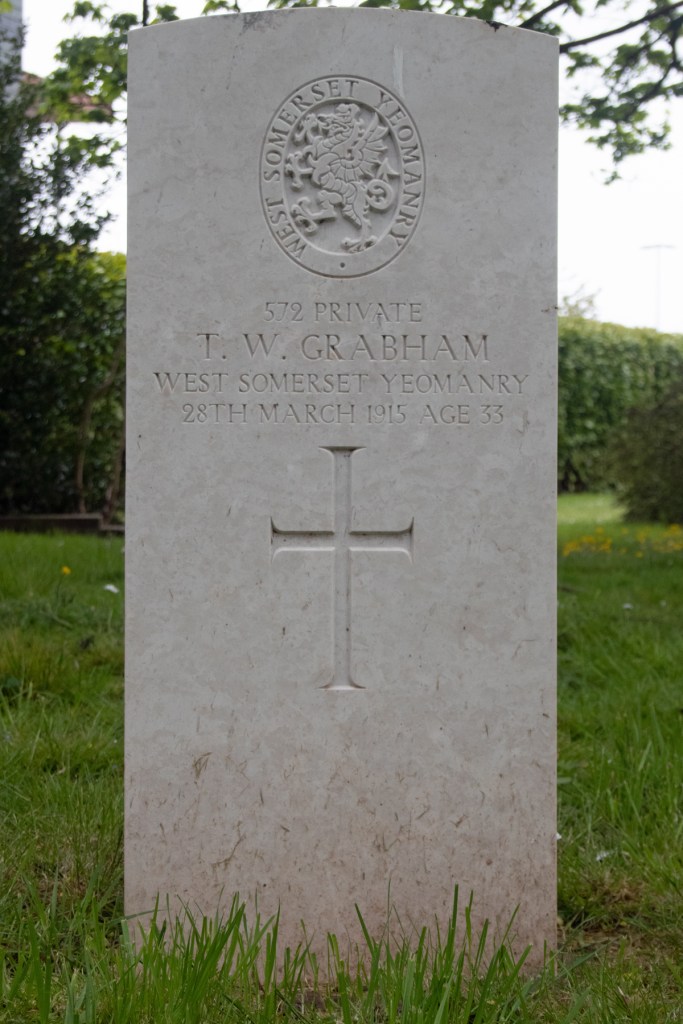
Thomas William Grabham was born in September 1883, one of six children to Thomas Richard Grabham and his wife Emma. Thomas Sr was a labourer and drayman for a brewery and the family lived in Taunton, Somerset.
When Thomas Jr left school, he found work as a grocer’s porter, before he too found work in a brewery, working as a maltster. He married a local woman, Maria Rowsell, and the couple went on to have a son, who they named after Thomas’ father.
Details of Thomas’ military service are sketchy; he enlisted in the West Somerset Yeomanry, but there are no details of when this was.
Sadly, Private Grabham’s period of service was short; his pension records show that he passed away from a perforated gastric ulcer on 28th March 1915. He was just 32 years old.
Thomas William Grabham lies at peace in St Mary’s Cemetery in his home town of Taunton.
Sadly, the tragedy for the young Grabham family was not to end there. Maria, Thomas’ widow, died just five months after her husband.
Young Thomas was just eight years old when his parents died; he seems to have been brought up by a Mrs Kate Barnes, possibly a maternal aunt. Here, however, the family’s trail goes cold.