Category Archives: Rifleman

Rifleman William McMullan

Rifleman William McMullan

William McMullan was born in Okaihau, on New Zealand’s North Island, on 10th May 1896. One of three children, his parents were James and Rose McMullan.

There is little concrete information about William’s early life. By the beginning of 1916, he was working as a bushman and volunteering for the local militia. The First World War provided an opportunity to put his skills to use, and he enlisted in the New Zealand Rifle Brigade on 15th January 1916.

Rifleman McMullan’s service records show that, at 19 years and 8 months of age, he was 6ft (1.83m) tall and weighed 12st 6lbs (79kg). A Roman Catholic, he had brown hair, blue-grey eyes and a medium-dark complexion.

William left New Zealand in May 1916, bound for Britain. The journey took ten weeks and, after disembarking in Devonport, Devon, his unit marched to Sling Camp, near Bulford, Wiltshire, arriving there on 29th July. Just a few weeks later, however, Rifleman McMullan was on the move again, and he found himself on the Western Front towards the end of September.

On 16th November 1916, while fighting at the Somme, Rifleman McMullan received a gunshot wound to his thigh. A blighty wound, it saw him medically evacuated to Britain for treatment, and he was admitted to the No. 1 New Zealand General Hospital in Brockenhurst, Hampshire. A few weeks later, he was moved to Codford, Wiltshire, for recuperation at the No. 3 NZ General Hospital.

William would spend the next few weeks in Wiltshire, but after initially being discharged from hospital, he was re-admitted on 25th January 1917. He had contracted broncho-pneumonia, and this would be the condition to which he would succumb. Private McMullan passed away on 13th February, at the age of just 20 years old.

Thousands of miles away from home, William McMullan was laid to rest in the ANZAC extension to St Mary’s Churchyard in Codford, close to the camp he had most recently called home.


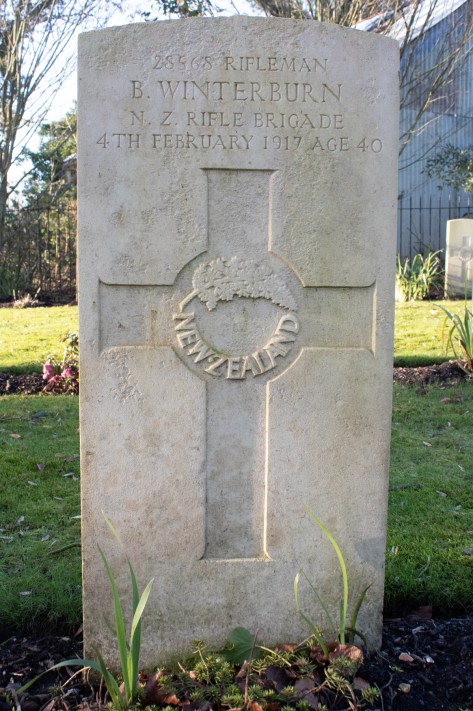
Rifleman Bertram Winterburn

Rifleman Bertram Winterburn

Bertram Winterburn was born in the city of Hutt, on New Zealand’s North Island, on 23rd April 1877. The oldest of eleven children, his parents were Arthur and Ada Winterburn. Arthur was a postmaster from South Island, and it would be here that he and Ada would raise their family.

There is little concrete information about Bertram’s life. The 1913 Post Office Directory records him as working as a labourer, and living in Otaki, a town back on North Island. He seems to have moved wherever the work took him, however, and, by the time war broke out, he was living in Hunterville, 110km (68 miles) further north.

Bertram stepped up to serve the empire when the call came. He enlisted in Trentham on 27th June 1916, and was assigned to the New Zealand Rifle Brigade.

Rifleman Winterburn left from Wellington on board the steam ship Willochra on 16th October 1916. His unit – H Company, 18th Reinforcements – would not arrive in Devonport, Devon, until 29th December. They were then marched to their base at Sling Camp near Bulford, Wiltshire.

The journey from New Zealand, would take its toll on the new recruits, with many falling ill before, or shortly after, they arrived. Bertram would not be immune from this and, at the end of January 1917, he was admitted to the 3rd NZ General Hospital in Codford, suffering from influenza. His condition worsened, developing into bronchitis, and this would take his life. Rifleman Winterburn died on 4th February 1917: he was 39 years of age.

Thousands of miles from his home, Bertram Winterburn was laid to rest in the newly extended graveyard attached to St Mary’s Church in Codford.


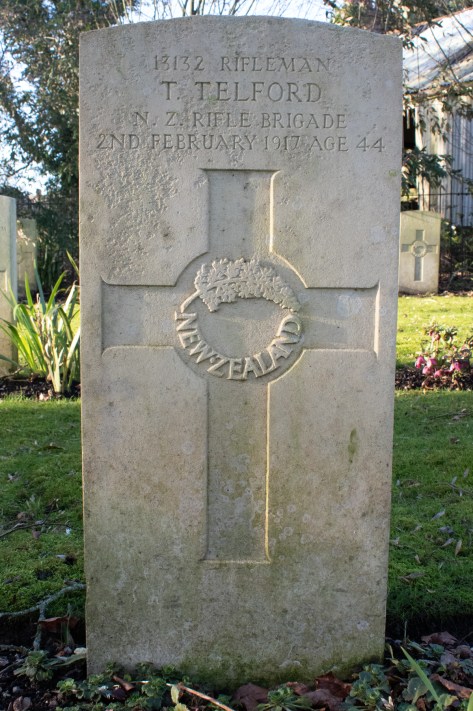
Rifleman Thomas Telford

Rifleman Thomas Telford

Thomas Telford was born in Bacchus Marsh, Victoria, Australia, on 31st July 1873. The fifth of eleven children, his parents were James and Mary Telford.

There is little additional information about Thomas’ early life. By the time war broke out, he had moved to New Zealand, and was working as a bushman, based out of Whanganui on the south coast of North Island.

Thomas enlisted on 18th January 1916, and would be assigned to the New Zealand Rifle Brigade. His service records show that, at 42 years of age, he was 5ft 5ins (1.65m) tall, and weighed 149lbs (67.6kg). A Roman Catholic, he had iron grey hair, blue eyes and fair hair.

Rifleman Telford’s unit left New Zealand in the spring of 1916. After five weeks in Egypt, he arrived on British soil on 7th August, marching from Southampton, Hampshire, to the Sling Camp in Wiltshire.

By 20th August, Thomas was in France, fighting on the front line. He was injured less than three weeks later and, after initial treatment in France, he was medically evacuated to Britain at the end of September.

Rifleman Telford spent time convalescing in a military home in Hornchurch, Essex, before being transferred to the ANZAC base in Codford, Wiltshire. That winter he contracted pneumonia, and he was admitted to the No. 3 New Zealand General Hospital on the outskirts of the village.

Sadly, the lung condition was to prove the better of Thomas. He passed away on 2nd February 1917, at the age of 43 years old.

Thousands of miles from home, Thomas Telford was laid to rest in the graveyard extension to St Mary’s Church in Codford, not far from where he had breathed his last.


Rifleman Alexander Shaw

Rifleman Alexander Shaw

Alexander Richardson Shaw was born in Sandhurst, Victoria, Australia, on 10th February 1884. The second of seven children – although two of his younger siblings died when just babes-in-arms – his parents were Thomas and Elizabeth Shaw.

Little is known about Alexander’s early life. Thomas passed away in 1890, and Elizabeth was left to raise the family alone.

The next document for Alexander is his army service record, confirming that he enlisted on 27th June 1916. By this point he had moved to New Zealand and settled in Wellington. He was employed as a labourer and working for a GG Holmes.

It seems that Alexander had tried to enlist before: his records show that he had previously been turned down because of poor eyesight. At this point, however, with the war raging in Europe, and thousands of New Zealanders being called upon, he was taken on. His service records show that he was 5ft 8ins (1.72m) tall, and weighed 12st 6lbs (78.9kg). Alexander was also noted as having fair (reddish) hair, blue eyes and a fresh complexion.

Rifleman Shaw was sent to Trentham, outside Wellington, for his basic training. His time there was not without incident, however, and on 21st July he was confined to barracks for three days for failing to comply with an order.

On 16th October 1916, Rifleman Shaw’s unit – the New Zealand Rifle Brigade – set sail from Wellington on the SS Willochra for their ten-week voyage to Europe. Discipline remained tight on board and, as the ship was nearing the end of its journey, Alexander was again pulled up. His records simply state that his offence was ‘for clothing issued’, and he was stopped the sum of 3d 6d from his pay.

The Willochra arrived in Devonport, Devon, on 29th December 1916 and, while the rest of his unit was sent to their base at Sling Camp near Bulford, Wiltshire, Rifleman Shaw was admitted to the port’s military hospital. His condition is unclear, but by 10th January he was well enough to be moved to the No. 3 New Zealand General Hospital in Codford, Wiltshire.

Private Shaw was suffering from influenza, and this quickly developed into pneumonia. He passed away on 15th January 1917, just five days after being admitted. He was 32 years of age.

Thousands of miles from home, the body of Alexander Richardson Shaw was laid to rest in the peaceful graveyard extension to St Mary’s Church in Codford, not far from where he had died.


Rifleman William Garlick

Rifleman William Garlick

William Garlick was born in Whakatane, New Zealand, on 18th October 1888. The oldest of seven children, his parents were Wiltshire-born Charles and New Zealander Maria Garlick. There is little information about William’s early life, but it is clear that by the outbreak of war he was working as a shearer in Gisborne.

William enlisted on 19th November 1915, and was assigned to the New Zealand Rifle Brigade. His service records show that he was 5ft 9ins (1.75m) tall, and weighed 168lbs (76.2kg). He was noted as having black hair, brown eyes ad a dark complexion. He had a tattoo of an anchor on his upper right arm and a few boil scars on his leg.

Rifleman Garlick spent most of the next year training in the army camp at Trentham. On 25th September 1916 his unit finally left for Europe, and he set foot on British soil two months later. From Devonport, Devon, the battalion made its way to Sling Camp in Wiltshire. William was not to spend much time there, however, and within a fortnight he had fallen ill.

Admitted to the No. 3 New Zealand General Hospital in Codford, Rifleman Garlick had contracted pneumonia, and this was to get the better of him. William passed away on 13th December 1916: he was 28 years of age.

Thousands of miles from home, William Garlick was laid to rest in the ANZAC extension to St Mary’s Churchyard in Codford, not far from the medical facility in which he had breathed his last.


Rifleman Alfred Glastonbury

Rifleman Alfred Glastonbury

Alfred George Glastonbury – who was better known as Jack – was born on 26th June 1882 in Canvastown, New Zealand. The oldest of fourteen children, he was one of nine sons to Alfred and Matilda Glastonbury.

There is little concrete information about Jack’s early life. He found work with New Zealand Railways, and married Eliza Taylor on 30th January 1904. The couple had a son – also called Alfred – on 2nd December 1908, but Eliza passed away just a couple of weeks after he was born.

Jack married a second time in July 1914, to Ann Leeks. Setting up home in Ohingaiti, they went on to have three children: John, Norah and Harold.

When war came, men of the Empire were called upon to play their part. Jack enlisted on 30th May 1916, and was assigned tot he New Zealand Rifle Brigade. His service records show that he was 5ft 4ins (1.63m) tall, and weighed 182lbs (82.6kg). He had light brown hair, blie eyes and a fair complexion: he was also recorded as never being absent from his job as a surfaceman through sickness or accident, but did have signs of varicose veins in his left leg.

Rifleman Glastonbury’s unit departed from Wellington on 25th September 1916. The troop ship Devon arrived in Devonport, England, two months later, and the regiment marched to Sling, near Bulford, Wiltshire, where they would be based.

Jack’s time there would be brief, however. He was admitted to the No. 3 New Zealand General Hospital in Codford on 3rd December, suffering from gastritis. He would succumb to the condition quickly, passing away on 5th December 1916: he was 34 years of age.

Alfred George ‘Jack’ Glastonbury was laid to rest in the ANZAC extension to St Mary’s Churchyard, Codford, cloe to the hospital in which he had breathed his last.


Rifleman Alfred Glastonbury
(from findagrave.com)

Rifleman Edward Foster

Rifleman Edward Foster

The early life of Edward Foster is destined to remain lost in the mists of time. Born in Sydenham, Christchurch, New Zealand on 16th May 1883, the only family connection available is Arthur Norman, a half-brother.

By 1916, Edward was working as a labourer and living in the British Empire Hotel in Gisborne. At this point, however, war was raging across the world, and New Zealanders were being called upon to serve their King.

Edward stepped up to play his part, and his service records confirm the man he had become. At 32 years of age, he stood 5ft 9ins (1.75m) tall and weighed 11st 4lbs (71.7kg). He had light brown hair, blue eyes and a fair complexion and, interestingly, his medical report notes that, while he was fit to serve, he was of very deficient intelligence. Edward’s papers also report that in around 1906 he had spent two months in a Wanganui prison.

Assigned to the New Zealand Rifle Brigade, Rifleman Foster’s unit set sail from Wellington on 19th August 1916. Their ship, the SS Aparima, would arrive in Devonport, Devon towards the end of October. Edward spent nearly three weeks of the of the voyage in the ship’s hospital, suffering from influenza.

When the brigade arrived in Britain, they were marched to camp in Sling, near Bulford, Wiltshire. Rifleman Foster’s health was still causing issues, however, and, on 10th November 1916, he was transferred to the No. 3 New Zealand General Hospital, near the Codford ANZAC base. He was suffering from bronchial pneumonia, and this was to take his life. He died on 14th November 1916, at the age of 33 years old.

Edward Foster was laid to rest in the new extension to St Mary’s Churchyard in Codford. Thousands of miles from home, he was surrounded by tens of his army colleagues.


Rifleman John Delaney

Rifleman John Delaney

Little information is available on the early life of Rifleman John Delaney. Born in Launceston, Ausrtalia, on 31st January 1888, by the summer of 1916 he was working as a shepherd in the New Zealand settlement of Whatatutu.

It was here that he enlisted in the country’s Expeditionary Force, and was assigned to the Rifle Brigade. His service records note that, at 28 years of age, he was 5ft 9ins (1.75m) tall and weighed 143lbs (64.9kg). The record confirms that he had fair hair, grey eyes and a fair complexion. He had tattoos on both forearms, and a scar on his left foot. The service docmentation also gives his next-of-kin as his friend, Mr G Garrett of Springbank, near Canterbury, on New Zealand’s South Island.

John’s unit boarded the TSS Maunganui in Wellington on 15th November 1916, embarking on the ten week voyage to Britain. Arriving in Devonport on 29th January 1917, Rifleman Delaney arrived at the ANZAC camp in Codford, Wiltshire, a few days later.

The journey had taken its toll on a lot of the newly arrived troops. John was admitted to the No. 3 New Zealand General Hospital on the outskirts of the camp with pneumonia on 10th February. His condition was to prove too severe, however, and he passed away just seven days later. He was 29 years of age.

John Delaney was laid to rest in the specially extended graveyard of St Mary’s Church in Codford.


Across the available documentation, John’s rank is given as both Private and Rifleman. I have used the latter rank, as this is what is provided by the Commonwealth War Graves Commission.


Rifleman John Delaney
(from findagrave.com)

Rifleman Frederick Keys

Rifleman Frederick Keys

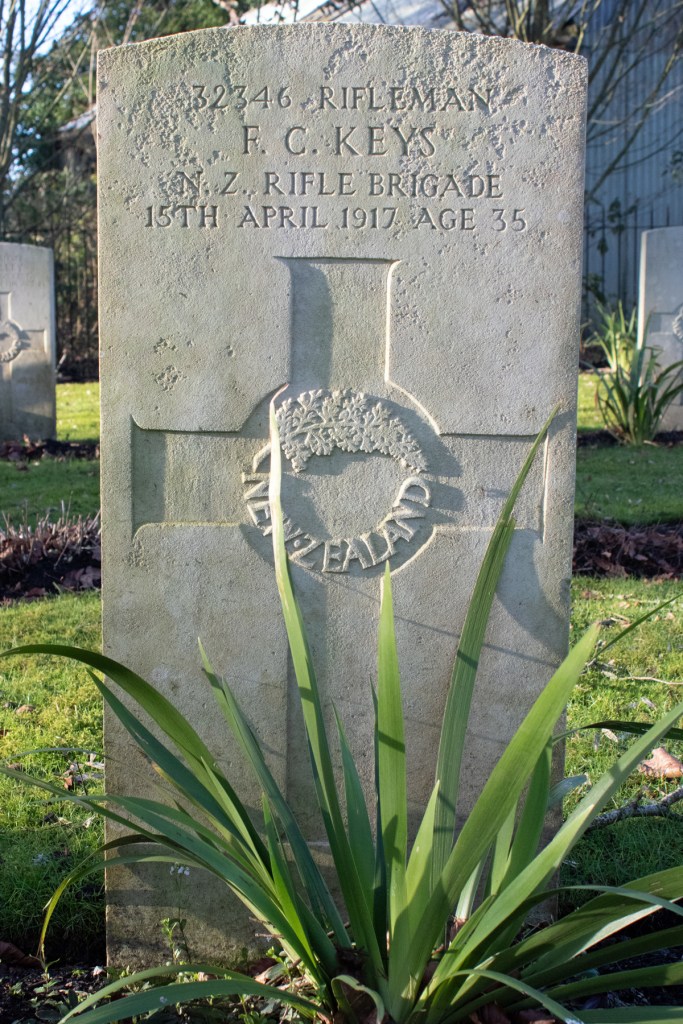
Frederick Charles Keys was born in Dunedin, New Zealand on 15th January 1882. The third of eight children, his parents were Benjamin and Annie Keys.

There is little information about Frederick’s early life. When he finished his schooling, it is likely that he found work as an agricultural labourer, and this is the job he was doing when war broke out.

As so many of his countrymen were to be, Frederick was called upon to serve his empire. He signed up in Christchurch on the country’s South Island, enlisting on 27th July 1916. He have his job as a farm hand, and his address as Silver Grid, a boarding house and billiard saloon on the city’s Manchester Street.

Frederick’s medical report confirms that he was 5ft 6ins (1.68m) tall and weighed 136lbs (61.7kg). He had fair hair, blue eyes, and a fair complexion. He was noted as being a very suitable man for the army.

Assigned to the New Zealand Rifle Brigade, Rifleman Keys embarked for Europe from Wellington on 15th November 1916. Two-and-a-half months later, his ship – the Tahiti – arrived in Devonport, Devon, and the New Zealand troops marched on to their final destination, the ANZAC camps just outside Codford, Wiltshire.

Frederick would spend the next few months training in the camp, although his time there was not without incident. On 31st March 1917, he was docked two days’ pay for ‘being in a crowd some members of which were gambling’. It is not clear whether Frederick himself was gambling, but given his last residence in New Zealand, it is unlikely that he wasn’t immune to chancing the odds.

Two weeks later, Rifleman Keys was admitted to the 3rd New Zealand General Hospital near the camp. He was suffering from pleurisy, but any treatment was to prove too late. He passed away from the condition on 15th April 1917: he was 35 years of age.

Frederick Charles Keys was laid to rest in St Mary’s Churchyard, Codford, in a new extension added for the fallen ANZAC troops.


Rifleman Henry Banks

Rifleman Henry Banks

The early life of Henry Ernest Banks is destined to remain lost to time as there is little documentation available to corroborate details. The first concrete documentation for him is his marriage certificate, and this sheds lights onto the man he had become.

The wedding took place on 7th August 1905, and confirms that Henry was 19 years of age. His father was recorded as being James Banks who, by this point was deceased. He had been a chairmaker, and his son had followed in a similar type of work, being employed as a French polisher.

Henry’s bride was 19-year-old Blanche Hearnden, who was noted as being the daughter of deceased traveller William Hearnden. At the time of their marriage, the newlyweds were living at 13 Busby Street, Bethnal Green, London. Now long since gone, the road led directly to St Matthew’s Church, which is where their nuptials took place.

By the time of the 1911 census, Henry and Blanche were living with her mother in Whitechapel. They had had a child, son Ernest, the previous year, and the mixed household included Blanche’s three sisters and their children. Money must have been tight, but four members of the household were bringing in some money, Henry working as a French polisher, with two of his sisters-in-law working as a cigarette packer and a printer’s assistant. Blanche and her other sister were listed as housewives, while her mother, who was also called Blanche, was noted as being a charwoman.

When war broke out, Henry was called upon to play his part. Details of his military service are sketchy, but it is clear that he enlisted in the London Regiment, and was attached to the 17th (County of London) Battalion, which was also known as the Poplar and Stepney Rifles.

Rifleman Banks’ unit was sent to France on 9th March 1915. Within a matter of weeks, however, he was back in the UK, and appears to have been admitted to a hospital in Paignton, Devon.

Henry died on 2nd May 1915, and one record – his entry on the Grave Registration Form – that sheds a little light on Henry’s passing. It is noted being as a result of a strangulated hernia, although this is the only document that gives any details about his death. Henry was 28 or 29 years of age.

Henry Ernest Banks was laid to rest in Paignton Cemetery, Devon.