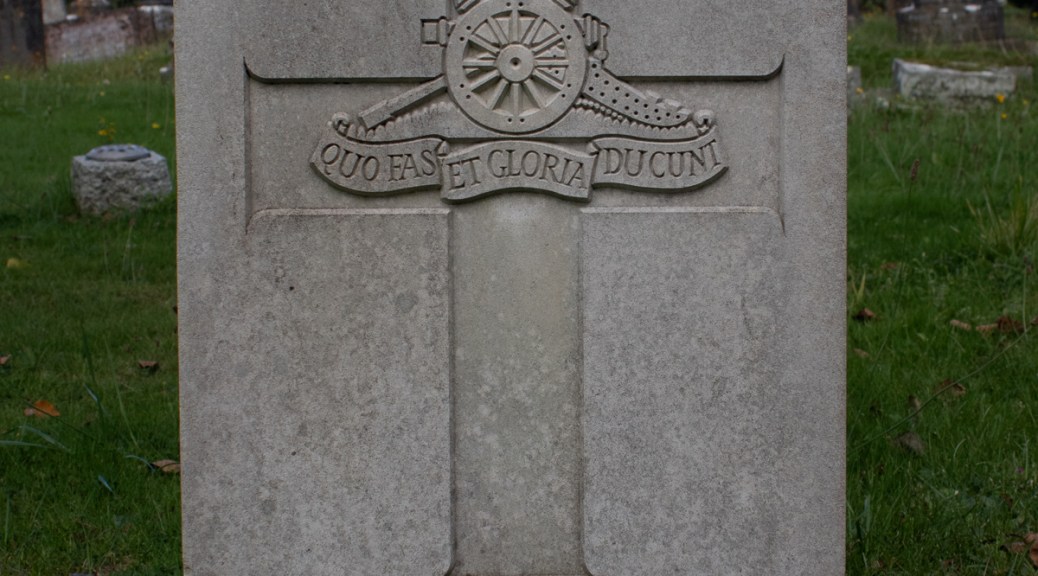
The death of Driver G Messenger, aged 20, of the 18th Divisional Ammunition Column, stationed at Heytesbury, took place at the Red Cross Military Hospital on Friday, the 11th inst. Messenger was a native of Lower Braithwaite, Carlisle, and was admitted to the hospital in the middle of May suffering from consumption. Deceased joined upon the commencement of the war.
[Salisbury and Winchester Journal: Saturday 19th June 1915]
George Messenger was born in 1895 and was the third of seven children. His parents, George and Sarah, were farmers, and the family grew up in Mealsgate, on the edge of the Lake District. Sarah died in 1901, and by the time of the 1911 census, George Jr and his siblings were helping their father on the farm.
When war broke out, George Jr was quick to enlist. Details of his military service are sparse, but what does remain confirms that he had enlisted no later than December 1914, which backs up the details in his obituary.
Driver Messenger joined the Royal Field Artillery, but it seems unlikely that he spent any time overseas. He seems to have been sent to a camp on Salisbury Plain, Wiltshire, for training and this is where he became ill. Contracting tuberculosis, probably from the cramped environment of the army barracks, George was admitted to the Voluntary Aid Detachment Hospital in the town of Mere. He passed away from the lung condition on 11th June 1915: he was just 20 years of age.
Rather than being taken back to Cumbria, George Messenger was instead laid to rest in Mere Cemetery.
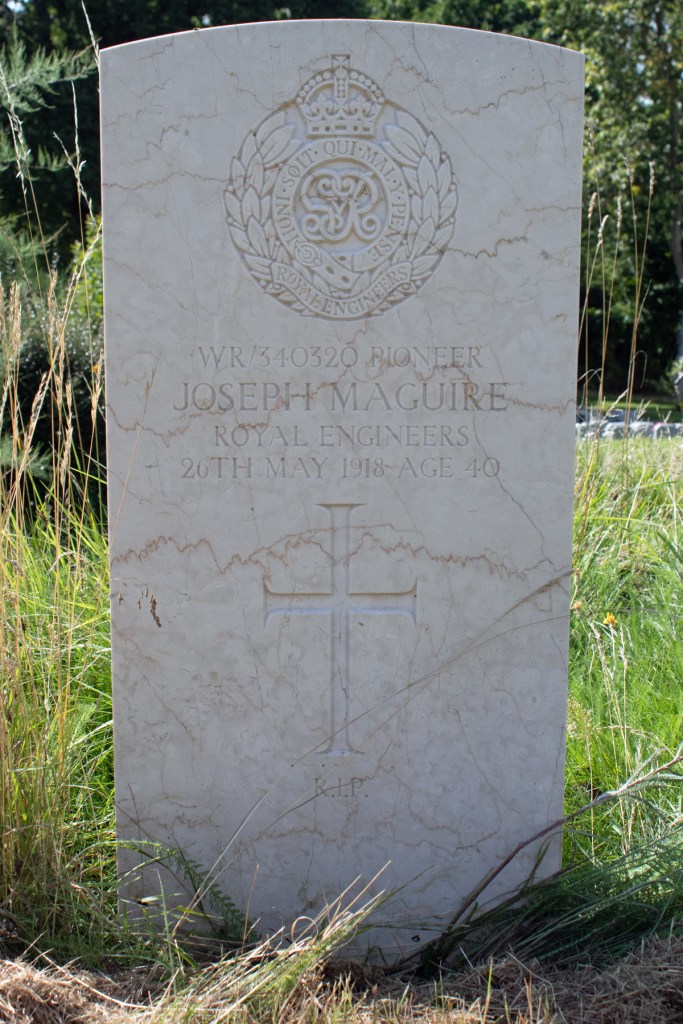
The early life of Joseph Maguire is challenging to decipher. Born in Dublin in 1878, his name is sadly too common to pin down any specific family relationships. Later records suggest that he had a sister, Jane, but again, this does not help narrow down documentation.
It would appear that he had moved to England for work by the time war broke out: he enlisted in the Royal Engineers in Carlisle by November 1917. As a Pioneer, he was attached to the Inland Water Transport Battalion, although it is not possible to ascertain whether he served on the Home or Western Fronts.
Pioneer Maguire died at the Second Southern General Auxiliary Hospital in Weston-super-Mare, Somerset. The cause of his passing is not freely documented, but it seems likely to have been the result of an illness. He was 40 years of age.
Joseph Maguire was laid to rest in the sweeping ground of Minehead Cemetery. Commonwealth War Grave Commission records note that he is interred in the Roman Catholic section of the grounds, and that, when it was erected, his CWGC headstone was paid for by the Honourable Secretary of the British Legion.
In St James’ Cemetery, Bath, is a headstone dedicated to one William Parry, once a Private in Devonshire Regiment. A lot of his life is lost to time, but his death highlights the length to which soldiers returning from the Great War were often left to fend for themselves.
On 4th November 1919, Private Parry “was found in an exhausted state lying under an arch in a suburb of [Bath], and told the police he had been there for 17 days. Crawling there to rest, he found himself afterwards too weak to move owing to trench feet” [Western Gazette: Friday 14th November 1919]
On 18th November, having been admitted to the Royal United Hospital in Bath, he passed away from pneumonia. “The police are endeavouring to ascertain something as to the man’s antecedents. He stated to them that he had no home.” [Western Gazette: Friday 21st November 1919]
An inquest into William’s death was held, and a miserable tale unfolded.
Parry was described as a seaman, and his address was given as 36 Catherine Street, Exeter…
[He had] said he was born at Swansea, had served in the 2nd Devons, and was demobilised at Exeter last March. He got into the arch because his feet were aching. He had come from Bristol. He did not say where he was going.
[When he died] Parry’s belongings… included a ration book, issued to him for the address in Exeter, his insurance card, and his out-of-work book. Parry had 10s 8d [approximately £11 in today’s money] in cash on him; but 10s 6d of this sum was given him by a lady since his arrival at the hospital. Parry had received various other gifts sent him by ladies from all over the country, who had read of the account of his discover in the Press. The last out-of-work donation received by him was on June 26th, and the ration book was issued at Exeter on March 24th. The address at Catherine Street, Exeter, as which Parry had stayed was that of a Church Army Home. He had also with him a card indicating membership of the Comrades of the Great War. The entries on his insurance card showed he was last employed on September 8th.
Inspector Lovell… gave the Coroner the result of exhaustive enquiries which he had made… regarding Parry’s antecedents… By the Exeter police he was informed that Parry registered at the Labour Exchange there as a seaman on March 25th. He then produced a certificate showing him to be a member of the Mercantile Marine. He had apparently served with the 2nd Battalion of the Devon Regiment for 2½ years. On May 16th, 1919, he obtained work as a painter in Exeter. He retained this employment till June 21st. A week later he obtained similar employment with another Exeter firm at 1s 3d [approx. £1.68] an hour and his earning averaged £2 [around £87] or more a week. He lest the Church Army Home on September 12th, explaining that he was going to Barrow-in-Furness, where he expected to obtain employment with Messrs Vickers, Sons, and Maxim. While staying at the Church Army Home he appeared to have been regarded as of a morbid disposition…
Inspector Lovell added that the members of the Exeter branch of the Comrades of the Great War had assisted him… and he was able to furnish the Court with a letter from Mr FW Drew, with whom Parry had lodged at the Church Army Home. The writer said he had met Parry in the latter part of April, and their friendship lasted until ten weeks ago, when deceased left Exeter. As they were two ex-Service men they became intimate friends, but apparently before the war he belonged to London.
After enlistment he had served in France, and was taken prisoner by the Germans. He was in their hands for three months; and acted as interpreter between his captors and the other British prisoners. He could speak German and other foreign languages, and undoubtedly was a man of superior education. Apparently, so far as his relations were concerned, he was “one of England’s lonely soldiers.” He said he was badly treated by the Germans, and suffered from a bad cough, the result of a wound in the chest. He was liable to depression when out of work, and the writer well remembered how pleased he was to think that he had obtained work at Barrow-in-Furness… “I deeply regret,” concluded the writer, “that he has come to such an untimely end. He was a good fellow, and would do anyone a good turn, if possible.”
In summing up, the Coroner remarked that exhaustive enquiries had been made into the case. There was no doubt from the medical evidence that the cause of death was pneumonia. It would appear that Parry had been on the road for some time when he crawled under the arch where he was found…
Bath Chronicle and Weekly Gazette: Saturday 22nd November 1919
Private William Parry died on 18th November 1919, aged around 44 years old. The British Federation of Discharged Soldiers and Sailors and the Comrades of the Great War jointly made arrangements for, and funded, his funeral, at which he was given full military honours. He was laid to rest in St James’ Cemetery, Bath.
Funeral of William Parry (from britishnewspaperarchive.co.uk)
John Stainton was born in the Cumbrian village of Ambleside in January 1871. He was one of seven children to George and Mary Stainton, a labourer and his wife. John followed in his father’s footsteps as a labourer, as they took him to where the work was – by the time John was ten, the family were living in Barrow-in-Furness.
The 1911 census found John married to a woman called Mary. The couple wed in 1909 and were boarding with Maybrooke Cole, a fellow labourer, and his family.
The next record for John comes in the form of his enlistment papers. He joined up on 31st August 1914, but the document throws up a couple of anomalies.
To the question “Are you married?” John marked “No”. The fact that he didn’t confirm he was a widower presents more questions than answers.
The document also confirms that he has previous military experience. He served with 2nd Battalion King’s Own (Royal Lancaster Regiment), which fought in the Second Boer War, and was involved in Battle of Spion Kop in January 1900.
John re-enlisted in the same battalion on 31st August 1914, and remained part of a territorial force for the best part of a year. It was during this time that he married Rhoda Selina Cooper. She was born and brought up in Clevedon, Somerset, and it can only be assumed that John was stationed in the county at this time.
Private Stainton seemed to have a bit of a rebellious streak, and his service records identify three times when he was pulled up for dereliction of duty. In December 1914, he was admonished for overstaying his leave pass; in June 1915 he was reported for being absent from the base; a year later, he was admonished again, this time for losing a pair of handcuffs.
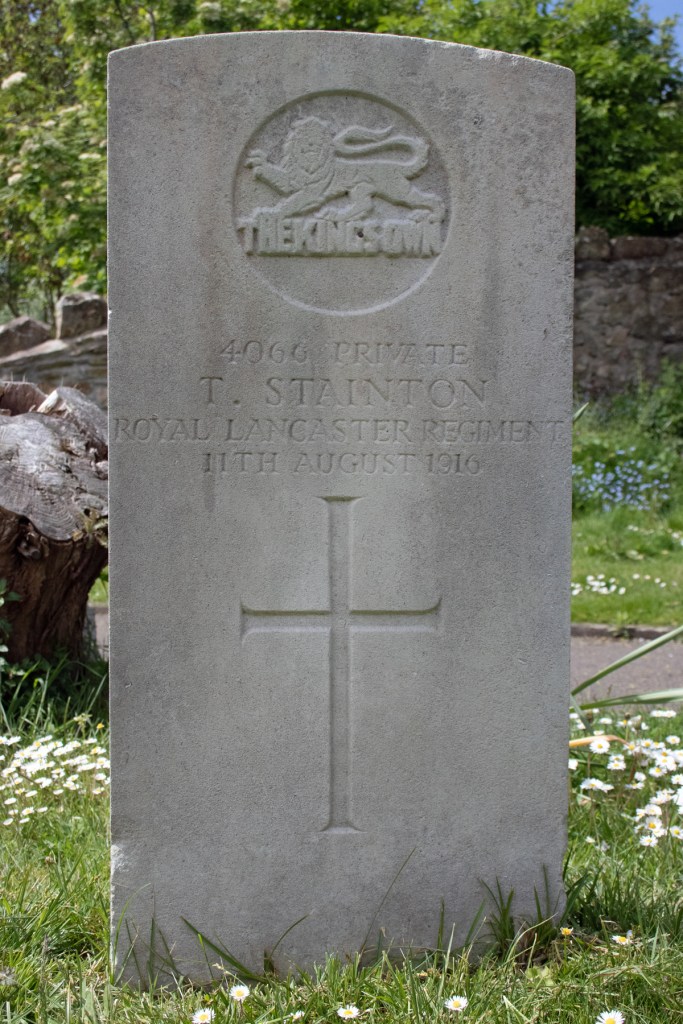
The battalion were sent to France in July 1915, and, in the end, Private Stainton served on the Western Front for just over a year. On 27th July 1916, he was sounded by shrapnel in the right shoulder, face and thigh, and was evacuated back to England for treatment. Admitted to the English General Hospital in Cambridge, sadly his wounds proved too much for him. Private Stainton died on 11th August 1916, at the age of 45 years old.
John Stainton’s body was brought back to his widow; he lies at rest in the picturesque churchyard of St Andrew’s in Clevedon, Somerset.
The Commonwealth War Grave for John Stainton incorrectly gives his name as T Stainton.
William John Neads was born on 16th December 1892, the middle of three children to cab driver and groom William Neads and his wife Ellen. Both William Sr and Ellen were from Somerset, although William Jr and his brother Charles – who was eleven months older – were both born in the Monmouthshire village of Cwmcarn.
William’s parents soon moved the family back to Clevedon in Somerset, and, when he left school, he found work as a farm labourer. He was eager to see more of the world, however and, in April 1913, he emigrated to Canada.
After working as a labourer there for a year or so, back in Europe war was declared. Keen to do his bit for King and Country, William enlisted in the 1st Battalion of the Canadian Infantry in January 1915. He soon found himself caught up on the Front Line.
In October 1916, he was involved in the Battle of the Somme – either at Le Transloy or The Battle of the Ancre Heights – and received a shrapnel wound to his left shoulder. Initially admitted to the Canadian General Hospital in Etaples, he was subsequently evacuated to England and the Northern General Hospital in Leeds. He spent three months recovering from his injuries, and was back on the Western Front in January 1917.
Later that year, William – now a Lance Corporal – was involved in the fighting at the Second Battle of Passchendaele (part of the Third Battle of Ypres). He was wounded again, this time receiving a rather unceremonious gunshot wound to the right buttock. Treated at the scene, he was evacuated back to England and admitted to the Fusehill War Hospital in Carlisle on 17th November.
Sadly, despite treatment, Lance Corporal Neads’ health deteriorated, and he passed away from his injuries on 16th December 1917, his 25th birthday.
William John Neads was brought back to his family’s home of Clevedon, and buried in the clifftop churchyard of St Andrew’s, overlooking the sea.
Tragically, William’s father had died in May 1917, at the age of 51. While no details of his passing are recorded, it meant that Ellen had, in just over a year, seen her son wounded, her husband die and her son wounded again and die as a result.
Joseph Wilkinson was born in the village of Greystoke, Cumbria in the summer of 1888. His parents were John and Margaret Wilkinson, and he had two siblings, also called John and Margaret. Joseph’s father worked as a railway signalman, and the industry employed a large number of people in the village.
Joseph’s life was to take a different turn, however, and it was likely the railway that took him there. He next appears on the 1911 census, boarding in a house in the village of Wedmore in Somerset. At 23 years old, he is listed as a Solicitor’s Cashier.
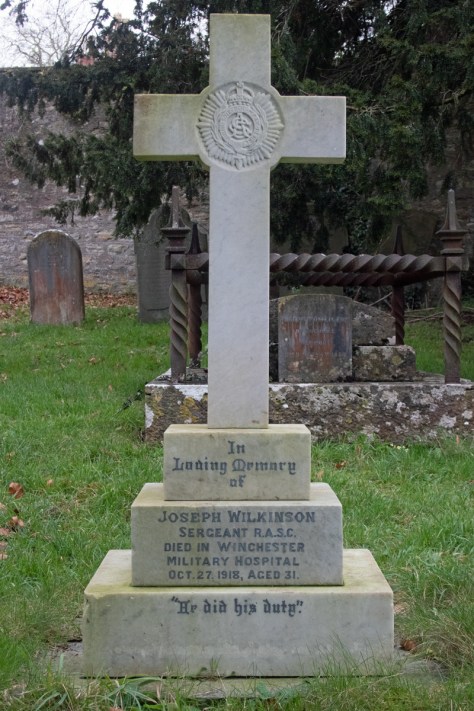
As with so many other fallen men and women, Joseph’s trail goes cold. There is not enough evidence to detail his military career – he joined the Royal Army Service Corps as a Driver and was promoted to Sergeant.
The UK Army Register of Soldiers’ Effects show that he was married to a woman called Ethel, although there are no records of their wedding. The document also confirms that he died at the Union Hospital in Winchester, Hampshire on 17th October 1918, but there is no cause of death given. He was 31 years old.
“He did his duty” says his impressive gravestone, but it is tragic that that duty is lost to time.
Sergeant Joseph Wilkinson lies at rest in the churchyard of St Mary’s in Wedmore, the Somerset village that came to be his home.







 Death and Service