Tag Archives: drowning

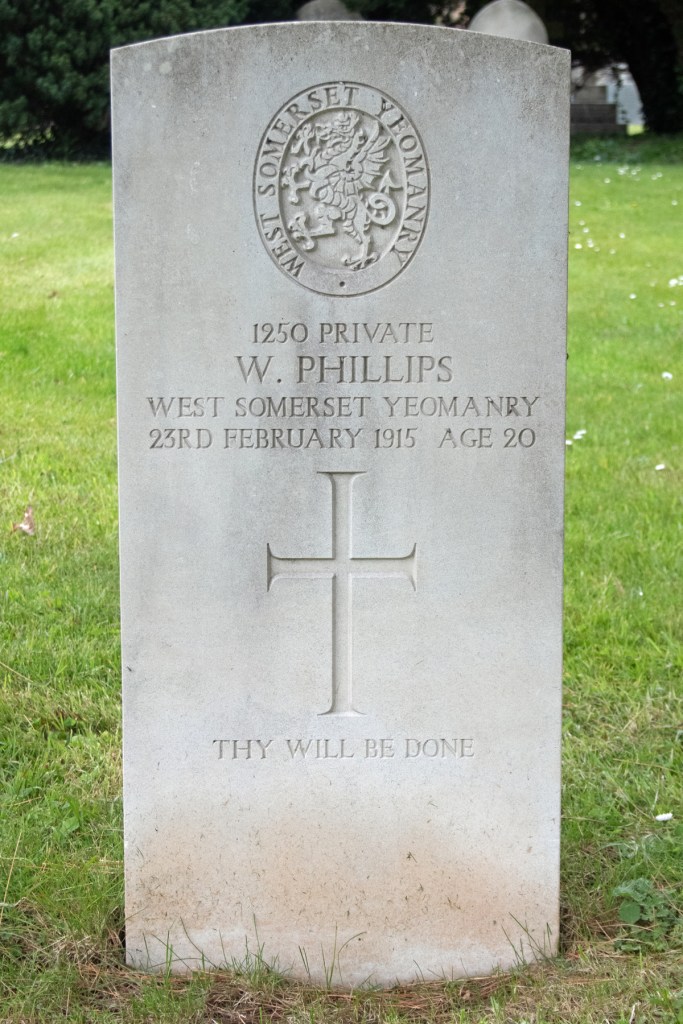
Private William Phillips

Private William Phillips

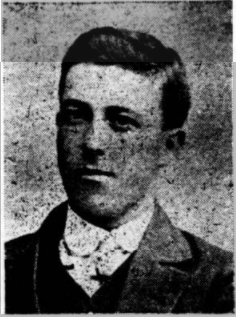
William Phillips was born in 1895, the youngest of seven children to Frank and Emily Phillips. Frank was a joiner and carpenter and, while his young family initially grew up in his home village of Thurloxton, Somerset, he and Emily soon moved them to nearby Taunton, where there would be more work and more opportunities.

By the time of the 1911 census, the young family were all tied up with different jobs. While William had become an office boy for an accountant when he left school, his siblings all had varying different roles: one was a boiler cleaner, another a mason, a third a cellarman and the fourth a shop assistant. With Frank’s own work, this meant that there were five wages coming into the home, albeit on a much smaller scale that we are used to these days.

War was coming, however, and, at the beginning of 1915, William enlisted in the West Somerset Yeomanry. Little information remains of his military service, but it is known that Private Phillips’ experience as a clerk was made use of, and he worked in admin at the reserve depot in Minehead.

William had, by this time, got himself a lady friend, who worked at the hospital in Taunton, and, while they did not see each other a lot, they corresponded regularly.

His new-found freedom from the family home seemed to have led to William being a bit freer with his money than his parents would like, and it appears that he may have run up a few debts He reassured his mother that he did not want to worry them with any business that he had. However, financial matters may well have played on his mind more than he would have liked to admit.

On Saturday 20th February 1915, Private Phillips travelled to Taunton to see his girlfriend; she was working, but he caught up with his sister instead, before returning to the base in Minehead that evening.

The following Tuesday morning, he received a letter from his girl and was last seen heading to breakfast in the hotel digs where he was billeted.

That afternoon, a local engineer was walking along the seafront, when he saw a body lying on the foreshore, about four feet (1.21m) from the high-water mark. The body – which was later identified as William – was wearing some clothing, but other bits were scattered around him. The police were called and Private Phillips’ body was taken to nearby Dunster.

The coroner confirmed William had drowned; the letter he had received was amongst his clothing, but there was nothing in it to suggest that anything was amiss. At the inquest, he suggested that “he could hardly suppose at this time of year that the deceased had taken off his clothing in order to bathe. [His conclusion was that William] got into the water with intent to drown himself.” [Taunton Courier and Western Advertiser: Wednesday 3rd March 1915]

The jury at the inquest returned the verdict of ‘found drowned’. Private Phillips was just 20 years old.

William’s body was brought back to Taunton for burial. He lies at rest in the St James Cemetery there.


William Phillips
(from britishnewspaperarchives.com)

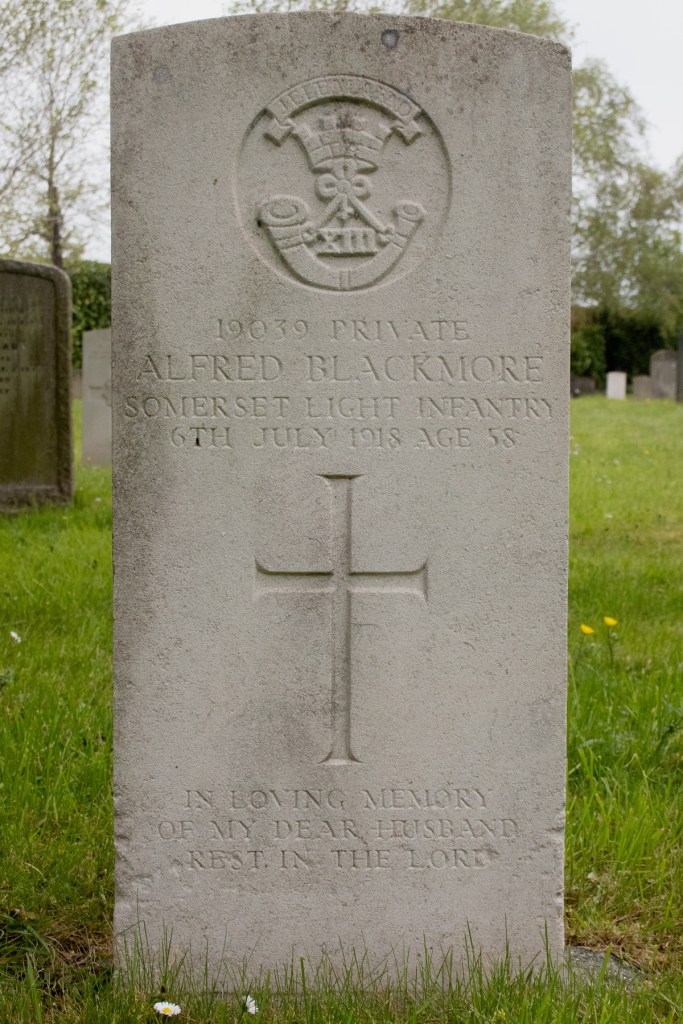
Private Alfred Blackmore

Private Alfred Blackmore

Alfred Blackmore was born on 25th October 1868 in the village of Thurlbear, near Taunton. Documentation varies and names cross over, but it appears that he was one numerous children to farm labourer William Blackmore and his wife, Mary Ann.

Details of Alfred’s early life are a bit hazy – again, in a rural location, names often cross over, so it is a challenge to totally confirm that they relate to the right person. His mother appears to have passed away by the time of the 1881 census, and Alfred was living with his father and three of his siblings and working as a farm hand.

Alfred again disappears off the radar for a while; in July 1894, he married Lucy Charlotte Yard, and the couple went on to have two daughters, Lucy and Beatrice. By 1901, the young family were living in the village of Frampton Cotterell, just to the north of Bristol, and Alfred had found employment as a marine fireman.

Ten years later, Lucy and the girls were still living in Frampton Cotterell, but Alfred was back in Taunton, lodging with a 75-year-old widow called Mary Croker and working as a labourer. This separation may have signalled the beginning of the end for the couple’s marriage.

War broke out, and it is evident that Alfred enlisted as a Private in the Somerset Light Infantry. Sadly, his service records are lost to time, but it appears that he served for at least three years.

The next time Alfred appears in documentation, it is a newspaper report on his passing, under the heading “Taunton Soldier’s Death”.

FOUND DROWNED AT BLACKBROOK

Mr F Foster Barham, coroner for West Somerset, held an inquest at the Blackbrook Inn, Ruishton, on Monday, relative to the death of Alfred Blackmore, aged 49, a private in the Labour Company at Taunton Barracks, whose body was found in the stream at Blackbrook on Saturday morning.

William Cozens, farmer… gave evidence of identification, and stated that on Friday he saw the deceased sitting by the hedge… about 400 yards from where the body was found.

William Richard Radnidge, butcher… stated that on Saturday morning he found the body in the stream dividing Ruishton from Taunton St Mary’s… His cap, belt and cape were on the bank. The deceased was lying face downward, his face and arms being in the mud below the surface.

PC Jenkins stated that at 10:45am on Saturday he received a communication from PC Wathen, in consequence of which he proceeded to Blackbrook, where he found the body lying under a hedge. He searched the body, and on it found a summons, returnable at Taunton on 29th June, for having failed to comply with a maintenance order obtained by his wife, Lucy Blackmore, on 25th September 1915, the sum of £2 13s [approx. £300 today] being due. On the back of the summons was written: “This is what my old cow has done for me.”

There was also the following letter: “When my body is found, don’t you give a farthing to my old cow. What I have got to come give to my brother, Edward Blackmore… Signed A Blackmore.” At the back of the letter was written: “Goodbye to all that I love.”

The deceased had left his lodging at nine a.m. on June 29th to attend the Taunton Police Court, but did not do so.

An officer stated that the deceased’s conduct during the three years he had been in the army had been satisfactory.

The Foreman of the jury said that according to the evidence they found that the deceased met with his death by drowning whilst temporarily insane.

Taunton Courier and Western Advertiser: Wednesday 10th July 1918

Alfred Blackmore took his own life on 6th July 1918. He was 49 years old [the war grave gives a different age].

Alfred lies at peace in St Mary’s Cemetery in Taunton, Somerset.


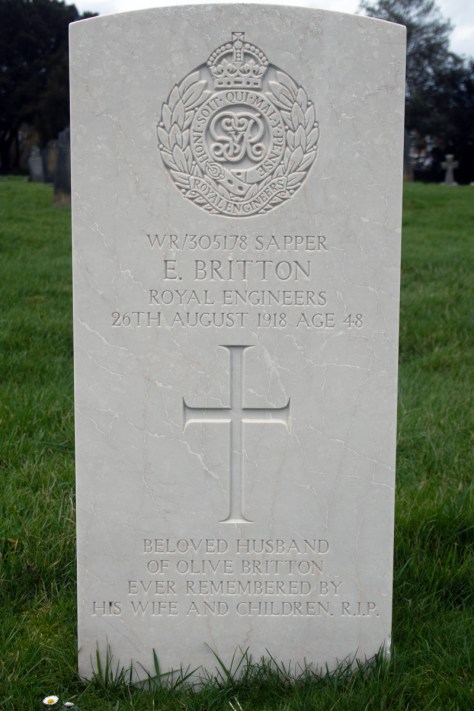
Sapper Edward Britton

Sapper Edward Britton

Edward Britton was born in Bridgwater in 1870, one of nine children to Edward and Eliza Britton. Edward Sr was a mariner, and the family lived on the main road from the town to Bath.

There is a gap in the documentation for Edward Jr; when we next meet him on the 1911 census he is married with children of his own. His wife is Ada Olive Martin, the daughter of a bricklayer from Topsham in Devon. They had eight children, six of them girls, and, according to the document, Edward was working as a ‘deal carrier’, moving wood from the ships arriving in Bridgwater to the timber yard.


A Gloucestershire deal carrier
(from gloucesterdocks.me.uk)

Sadly, Edward’s service records are also sparse. He enlisted in the Royal Engineers as a Sapper and, given his age, it is likely that this was not early in the conflict. He was involved in the Inland Water Transport division – given his father’s work as a mariner, this doesn’t come as a surprise.

The Army Register of Soldiers’ Effects provides a surprising insight into Sapper Britton. It gives the date of his death, but notes the cause as “Drowned, River Stour, Kent”.

An inquest was held on Monday by Dr Hardman at the Military Hospital, Stonar, respecting the death of Sapper Edward Britton… who was drowned through the capsizing of a boat… It appeared that Britton was ferrying Lance-Corporal Griggs to a barge which was in tow with three others when a collision occurred, the boat overturned and Britton was drowned.

[Kentish Gazette: Saturday 7th September 1918]

Sapper Britton passed away on 26th August 1918, at the age of 48.

Edward Britton lies at rest in St John’s Cemetery in his home town of Bridgwater, Somerset.


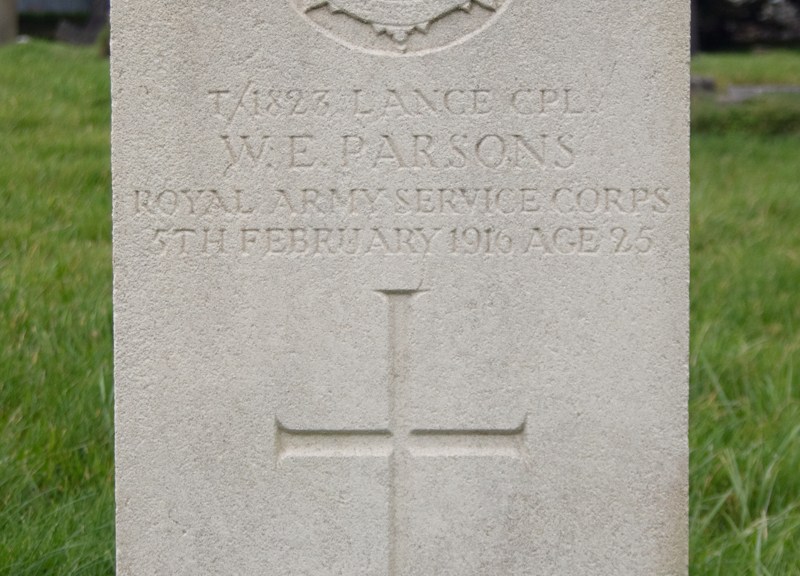
Lance Corporal William Parsons

Bridgwater (St John’s)

William Edward Parsons was born in 1890, one of six children to John and Prudence Parsons. John found work in a number of fields, working as a blacksmith, porter, dock labourer and a hobbler (towing boats along the River Parrett) in his time. Throughout this, he lived with his family in the Somerset town of Bridgwater.

William found work as a collar cutter in a local shirt factory, and went on to marry Matilda Mary Temblett on Christmas Day 1913. The young couple went on to have a son – Leslie William – who was born in February 1915. William was teetotal, and played full back for the local rugby football club, Bridgwater Albion.

Sadly, Lance Corporal Parsons’ military records are sparse; he had enlisted in the Royal Army Service Corps and was based in Fovant, to the west of Salisbury.

It was while he was on leave that William met his sad fate. On the evening of 5th February 1916, he had seen his parents and had set out to organise a football match in the town. He was walking over the town bridge, when a passer-by heard a splash. He saw a man in the water, who was crying for help, and then disappeared.

William’s body was found in the river a fortnight later close to a local brickyard. He was just 25 years old.

William Edward Parsons lies at rest in St John’s Cemetery in his home town of Bridgwater.


Able Seaman Percy Strong

Able Seaman Percy Strong

Percy William Strong was born in April 1897, the youngest of five children to Albert Strong and his wife Elizabeth. The family lived in Shepton Mallet, Somerset, where Albert worked as a mason’s labourer.

Percy was keen to make his own way in the world. By the 1911 census, and having left school, he was working as a farm boy on Kingsdown Farm in Shepton, alongside a couple of other paid, and boarding, employees.

He seemed to have been after adventure in his life too; in January 1913, he enlisted in the Royal Navy, getting his training on a number of vessels, even before the start of the Great War. In his six years of service, he was promoted from Boy to Able Seaman, and served on nine ships.

Able Seaman Strong’s final assignment was at HMS Idaho, the naval base in Milford Haven, Pembrokeshire, which he joined in May 1918. It was while he was stationed at HMS Idaho that tragedy would strike.

A boat belonging to a Government Patrol-boat capsized in Milford Haven, when three members of the crew lost their lives. They were Sub-Lieutenant Lever (20), Birkenhead; Leading Seaman Thomas Palmer (30) Shepton Mallet; and AB Percy Strong (21), Shepton Mallet.

The boat, containing six men, had come ashore in a rough sea. It left Milford Haven Naval stage on return to the ship at eleven am. A sharp squall caught the men when well out on their return journey, and this the craft failed to weather, and was capsized. The six occupants were cast into the sea, and despite the efforts of men in boats from other vessels, the three named were drowned, and the others had a narrow escape.

Western Mail: Friday 11th October 1918

Able Seaman Strong has lost his life on 9th October 1918. He was just 21 years old.

Percy William Strong’s body was returned to Shepton Mallet, the town of his birth, and lies at rest in the cemetery there.


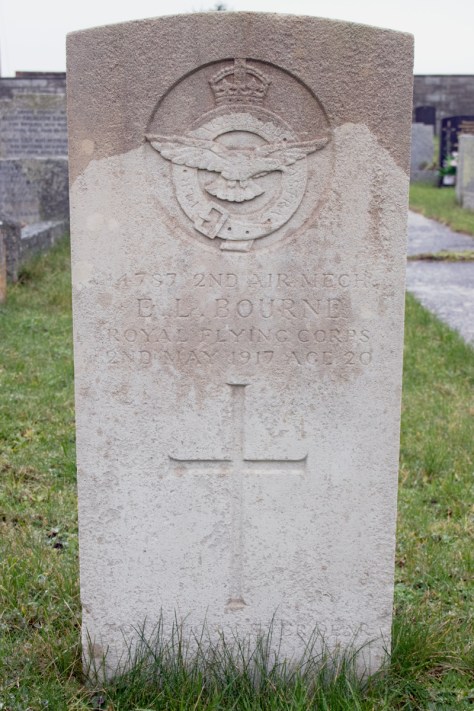
Air Mechanic 2nd Class Eustace Bourne

Air Mechanic Eustace Bourne

Eustace Lionel Bourne was born in 1897, one of six children to Robert and Eve, from Westonzoyland, Somerset. Robert was a wheelwright and carpenter and, after leaving school, Eustace followed in a similar vein, becoming an apprentice to an ironmonger.

When war broke out, Eustace’s interest in engineering led him to join the Royal Flying Corps, where he was appointed as an Air Mechanic. His enlistment papers – dated November 1915 – give his trade or calling as “motor cyclist”, so it is obviously a passion that he had.

Air Mechanic Bourne was assigned to Milton Airfield near Abingdon, Oxfordshire and it was there that he served for nearly eighteen months. He seems to have enjoyed his time off as much as his time working, and boating on the Thames nearby was a hobby. Sadly, it was also to be his undoing.

On 2nd May 1917, he was out on the river at Culham Reach; the local newspaper account picked up the story.

Accidentally drowned was the verdict returned at the inquest last Saturday on Eustace Lionel Bourne, 21 [sic], attached to the mechanical department of the RFC, stationed at Milton.

It appeared that while sculling with a colleague in Culham Reach on May 2nd, he lost a scull. His companion, who had dropped a rudder-line, was turning round at the time. Deceased, in leaning over to pick up the scull, fell into the river and disappeared. It was twilight at the time, and a search was unavailing.

The other man, who could neither swim nor scull, was left in the boat, which was half filled with water.

The body was discovered on Friday morning near Sutton Weirs.

Reading Mercury: Saturday 19th May 1917

Eustace Lionel Bourne was just 20 years old when he drowned. He lies at rest in the cemetery of Westonzoyland, his home village.


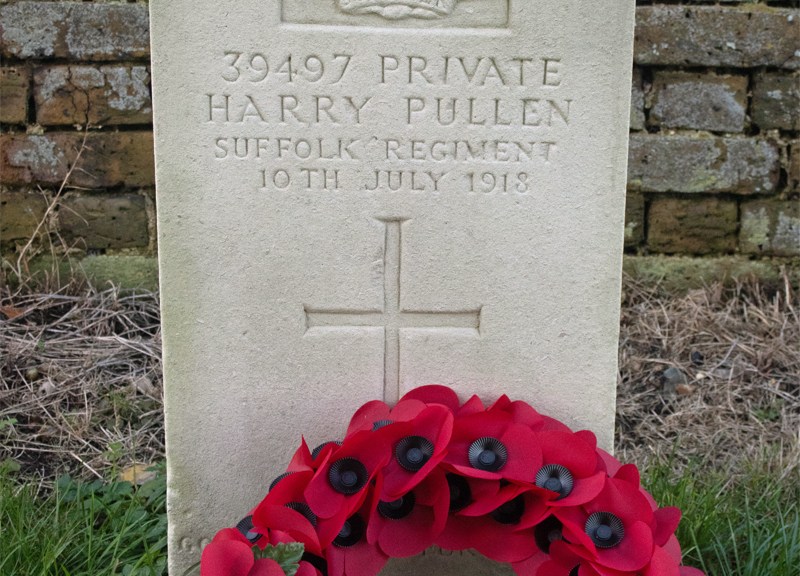
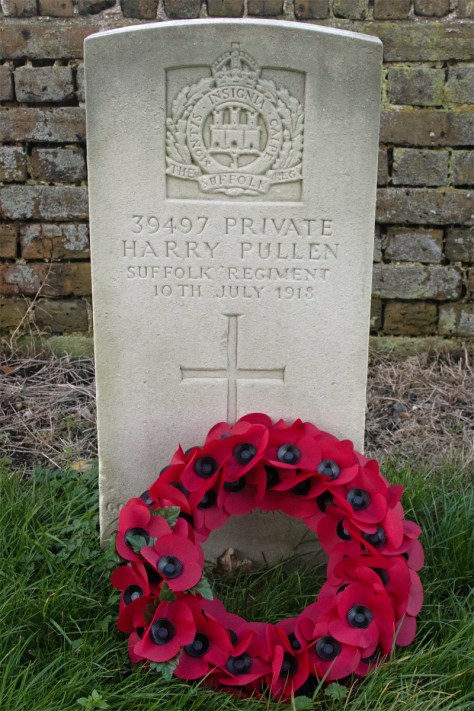
Private Harry Pullen

Private Harry Pullen

What I have discovered while researching the Commonwealth War Graves, is that, despite the general themes I find, the people behind the names always have an individual story to tell. Sometimes that story raises an eyebrow, or produces a gasp.

Such was the story of Private Harry Pullen.

What raised the eyebrow? Two words, written on the Army Records of Soldiers’ Effects.

Accidentally Drowned.


Harry Pullen was born in Shirehampton, Gloucestershire in 1886. His father, Robert Edward Pullen, was a carpenter; he and his wife Hannah Presulga Cissy Pullen had three other children, Gwendoline, Herbert and John.

By the time of the 1901 census, Robert is boarding in a house in Bristol with his three sons; Hannah and Gwendoline are not listed (nor do they appear on any other census records I have been able to locate).

Harry is listed as a Telegraph Boy, as is his brother Herbert, but he seemed to have wanted to take up a trade; by 1910 he had moved up to London.

In March of that year, Harry married Harriet Critchell, a spinster fifteen years his senior. On their marriage records for Christ Church, St Pancras, Harry lists himself as a tradesman. The census a year later confirms this – head of the household, he is an Agent for the Provident Clothing Supply Company. (Founded in Bradford, West Yorkshire, Provident’s mission was to help working-class families provide for themselves through the use of vouchers. These were exchanged for goods in local shops, and paid for in affordable instalments.)

Harry enlisted at some point after 1916. His regiment, the 1st (Reserve) Garrison Battalion of the Suffolk Regiment, was not formed until March of that year, and, after starting in Buckinghamshire, it moved to Tilbury in Essex and Gravesend in Kent. The battalion was finally settled in Grain, North Kent in 1918, and it was here that he served.

Here the trail goes frustratingly cold…

Private Pullen’s enlistment and service records are not available, so research is limited to the Army Register of Soldier’s Effects and the Pension Ledgers.

All we have about his death are those two words – Accidental Drowning. There are no contemporary news reports of his passing, which you might expect given the circumstances, so the circumstances surrounding his death are elusive.

Private Pullen died on 10th July 1918. He was 31 years old.

His records confirm that Harriet was entitled to a weekly pension of 15s for the duration of the war and twelves months after.

Harry Pullen is buried in the graveyard of St James’ Church in Grain, Kent, close to where he was stationed.