Tag Archives: malaria

Sergeant Herbert Rendell

Sergeant Herbert Rendell

Herbert George Rendell was born in the summer of 1886, the oldest of six children to George and Catherine Rendell. George was a twine maker from West Coker, near Yeovil in Somerset, and it was in this village that he and Catherine raised their young family.

While he initially found work as a labourer when he left school, the lure of a better life and career proved too much for Herbert and, in June 1905, he enlisted in the Royal Engineers as a Sapper. He spent three years spent on home soil, working hard and earning a Good Conduct medal for his service. During his tour of duty, he contracted pneumonia, spending five weeks in hospital in Chatham, Kent, over Christmas 1905, but fully recovering.

In September 1908, Herbert was sent to Singapore for a three-year tour of duty with the 21st Company. His body was not accustomed to the different environment, and he was hospitalised three times for malaria and myalgia, as well as two bouts of gonorrhoea in 1908 and 1910.

In December 1911, Sapper Rendell returned home, where he served for a further three years before war broke out in the summer of 1914. Having been promoted to Lance Corporal, and after a short bout in hospital following a reaction to his cowpox vaccination, he was sent to Egypt.

Assigned to the 359th Water Company, he would have been charged with constructing and maintaining the supply pipes to and from the Front Line and for his work was soon promoted to Corporal.

In the spring of 1918, the now Sergeant Rendell was transferred to the 357th Water Company, and found himself in Palestine, where he stayed until the end of the war. He came home on leave in April 1919, and it was here that, once again, he contracted pneumonia.

Sadly, Sergeant Rendell was not to recover from the lung condition for a second time; he passed away at his parents’ home on 9th April 1919, at the age of 32 years old.

Herbert George Rendell was laid to rest in Yeovil Cemetery, not far from the village where he was born.


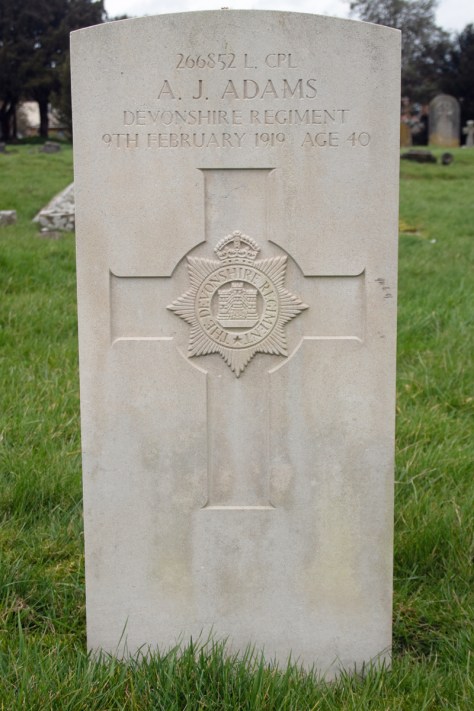
Lance Corporal Albert Adams

Lance Corporal Albert Adams

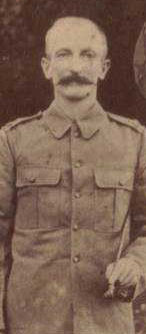
Albert James Adams was born in Somerset in September 1878, the fifth of ten children to Robert and Mary. Robert was a mason, who sadly passed away when Albert was only 11 years old. Mary lived on as the head of the household, and by the 1901 census, she had four of her five sons living with her, three of them also stone masons.

Albert had taken a different route in life, and found work as a postman. He married Annie King, a young woman from Taunton, in 1910, and they set up home in the village of Selworthy near Minehead. Albert was the village postman, and the young couple lived there with their sons – Albert and Robert – and Mary.

When war came, Albert enlisted, joining the 6th Battalion of the Devonshire Regiment. While his military records are scattered, his battalion served in India and Mesopotamia; during their three years in the Middle East, the 6th Battalion lost twice as many men to illness – influenza, pneumonia, malaria – as to enemy action.

Lance Corporal Adams was not immune to sickness; while I have been unable to unearth exact dates for his military service, his cause of death is recorded as malaria and pneumonia. He passed away on 9th February 1919, at the age of 40 years old.

Albert James Adams lies at rest in St John’s Cemetery in Bridgwater, Somerset.


Albert James Adams from Ancestry.com

Driver Stanley Pearce

Driver Stanley Pearce

Stanley Arthur Robert Pearce was born in September 1895, the fourth of five children to Edwin and Rosetta Pearce from Bridgwater, Somerset. Edwin was a painter and sign-writer, and it was in the creative trades that his children followed.

Stanley’s eldest brother Clifford became a gardener; his next oldest Edwin Jr was a mason’s labourer; while his older sister Dorothy became a cardboard box maker. By the time of the 1911 census, when Stanley was 16, he was listed as a painter’s errand boy, presumably helping out his father.

War was on the horizon, and Stanley was keen to do his bit. In October 1914, he enlisted, becoming a Driver in the Royal Army Service Corps. Assigned to the 662nd Heavy Transport Company, he was based in London. There was still time for visits home, however, and the local Bridgwater newspaper reported on an ASC football match in which Driver Pearce was involved in October 1915.

By this time, Stanley had met Flossie Vickery, from nearby North Petherton. The couple married the following year, and had two children, Ada and Geoffrey.

In 1916, Driver Pearce’s battalion was shipped off to Salonica in Greece, as part of the British Expeditionary Force in the Balkans. While there, he contracted malaria and dysentery, and was evacuated back to England for treatment in September 1918.

Driver Pearce recovered well enough to enjoy a month’s recuperation, but fell ill again, with a recurrence of malaria, combined with influenza and pneumonia. He was admitted to the Brook War Hospital in South East London, but sadly not recover, and passed away on 10th November 1918, a day before the Armistice was signed. He was just 23 years old.

Stanley Arthur Robert Pearce lies at rest in the Wembdon Road Cemetery in his home town of Bridgwater.


Stanley’s older sister Dorothy – the cardboard box maker – contracted influenza around the same time as her brother and, tragically, died just five days after him. The siblings were buried in a joint funeral at the cemetery.