Tag Archives: malaria

Able Seaman Jesse Baber

Able Seaman Jesse Baber

Jesse Baber was born on 28th February 1889 and was the youngest of thirteen children to John and Jane Baber. John was a farm labourer from Westcombe in Somerset, and it was in this village that he and Jane raised their family.

Jesse chose not to follow his father and siblings into farm work and instead, on 6th October 1906, he enlisted in the Royal Navy. As he was underage for full service at the time, he was given the rank of Boy 2nd Class and sent to HMS Ganges, a training establishment on the outskirts of Ipswich, Suffolk. His service records confirm that he was 5ft 5.5ins (1.66m) tall at the time of joining. He was also noted as having dark brown hair, grey eyes and a fresh complexion, with a mole on his right cheek being highlighted as a distinguishing mark.

Boy Baber spent six months at HMS Ganges, and was promoted to Boy 1st Class for his commitment. He was then transferred to HMS London, a dreadnaught battleship for a further six months. During his time on board, Jesse came of age, and was formally enrolled in the Royal Navy with the rank of Ordinary Seaman.

Over the next eight years, Jesse served on eleven different vessels, sailing between his British base of HMS Vivid in Devonport and the East Indies. His service seems to have generally been very good – he was promoted to Able Seaman in February 1909 – although he did spend five days in the brig in July 1912 for reasons unrecorded.

When war broke out, the ships that Able Seaman Baber served on patrolled the waters of the Mediterranean. In the summer of 1916, while on board HMS Dartmouth, he contracted malaria. Jesse was admitted to a hospital in Malta, where he remained for six weeks, and was then sent on leave home to recover.

He arrived at Castle Cary [in Somerset] on the evening of the 23rd August, on a visit to his sister, in a very serious condition, being practically in a state of collapse. Medical attention was immediately obtained, but his condition was hopeless, and he lay in an unconscious condition until Friday September 1st, when he expired, death being due to meningitis, following malaria.

[Shepton Mallet Journal: Friday 15th September 1916]

Jesse Baber was 27 years old when he passed away. He was laid to rest in the quiet graveyard of St Mary’s Church in Batcombe, not far from where his mother, who was now 74 years old, was living.


Private William Hughes

Private William Hughes

William Thomas Hughes was born on 4th August 1898 in Llangollen, Denbighshire. One of twins, he was also one of seven children to William and Margaret Hughes. William Sr was a bricklayer and the family lived on Fron Bache, a land to the south of the town, leading into the hills. The Hughes’ baptised their first five children on the same day – 5th October 1904 – in the parish church.

Little further information on young William’s life remains. When war broke out, he stepped up to play his part: details of when have been lost to time, but, according to later records, he had enlisted by December 1917.

Private Hughes joined the Royal Welch Fusiliers, and was assigned to one of their depots, possibly on the North Wales coast. Certainly this is where he was based by the spring of 1918 as, in May of that year, he was admitted to the Red Cross Hospital in Colwyn Bay, having contracted malaria.

Tragically, this condition was to get the better of him: Private Hughes passed away on 7th May 1918, at the tender age of just 20 years old.

William Thomas Hughes was brought back to Llangollen for burial He was laid to rest in the graveyard of the town’s St John’s Church.


Sergeant James Owen

Sergeant James Owen

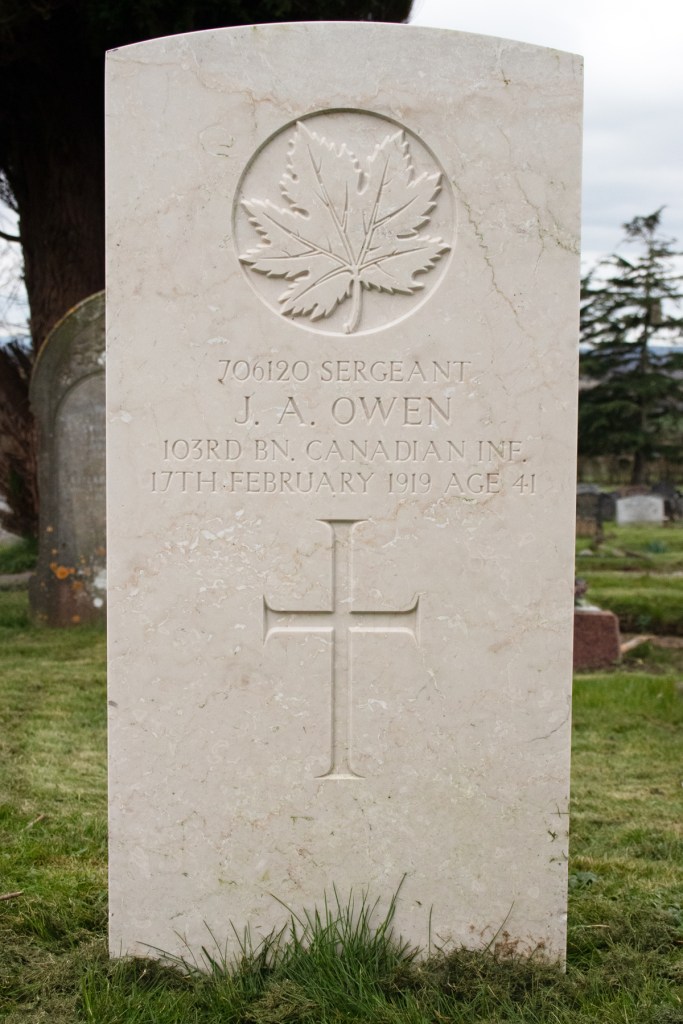
James Alfred Owen was born on 4th August 1877 and was the middle of three children to James and Sarah Owen. James Sr was a woodman from Herefordshire, who had moved the family to Radnor in mid-Wales.

James Jr’s early life has been lost to time, but by the time he turned 30, he had emigrated to Canada. He settled in the west coast town of Prince Rupert and found work as a salesman. On 28th January 1910 he married Hattie Whidden: the couple went on to have three children – Annie, Louisa and Dorothy.

War was coming to Europe, and James wanted to play his part for King and Country. He enlisted on 4th December 1915, joining the 103rd Battalion of the Canadian Infantry. His service records show that he stood 5ft 9ins (1.75m) tall and weighed 156lbs (70.8kg). His physical development was recorded as ‘average’, he had a ruddy complexion, brown hair and brown eyes. It was also noted that he had a birthmark in his left groin and his teeth were poor and required attention.

Private Owen departed for England in July 1916 and was assigned to the Oxney Camp in Hampshire. He was promoted to Corporal and then to Sergeant and, over the next few years, he remained in England. He was primarily based in barracks at Bramshott – also in Hampshire – though did spend time in Seaford in Sussex.

Sergeant Owen survived the war, but was admitted to the Ripon Military Hospital on 8th February 1919, having contracted bronchitis and malaria. The hospital didn’t have any specific expertise in contagious diseases, so it is likely that his move to Ripon was one stage of his move back to Canada.

Sadly, the conditions proved too much for James. He passed away on 17th February 1919, at the age of 41 years of age.

James Alfred Owen’s body was brought to Castle Cary in Somerset, where his sister Eleanor lived with her family. He was laid to rest in the town’s cemetery.


Private William Hammacott

Private William Hammacott

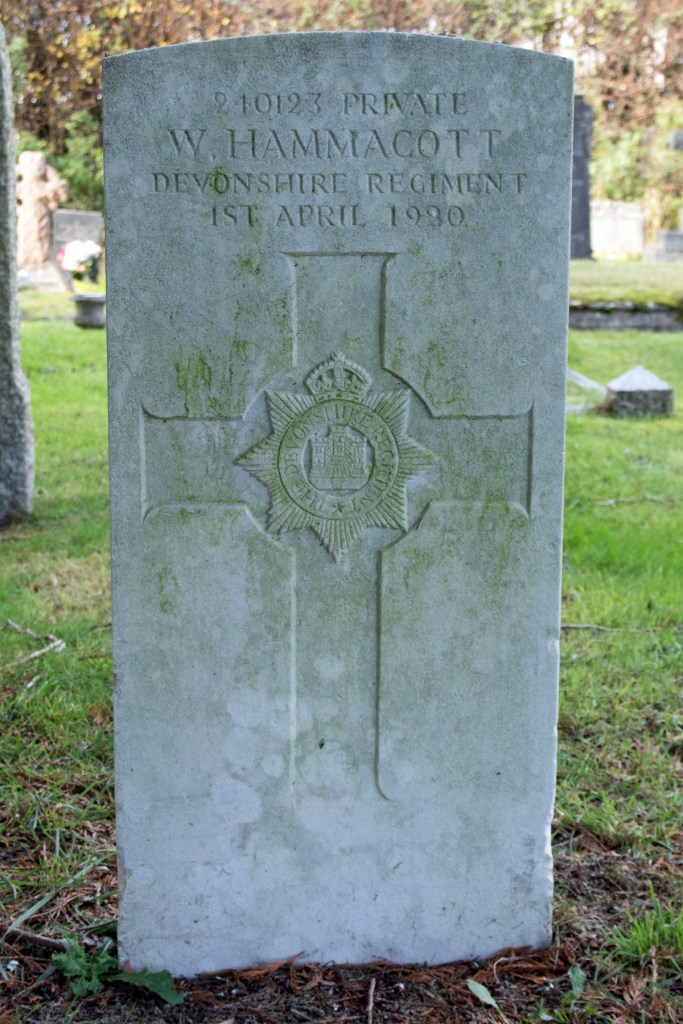
William Henry Hammacott was born on 11th January 1892 and was the oldest of four children. His parents were labourer George Hammacott and his wife Ellen; both were born in Chudleigh, Devon, and this is where they raised their family.

When William left school he too found work as a labourer, but war was coming to Europe, and he was keen to play his part. Full details of his service haven’t survived, but he had enlisted in the 5th Battalion of the Devonshire Regiment by 1915, and served on home soil.

Private Hammacott survived the war and earned the Victory, British and Territorial Force Medals for his service. During his time, he contracted malaria and was discharged from the army on medical grounds on 29th March 1919.

William returned home, and his trail goes cold for the next year. It is likely that his bout of malaria left him particularly vulnerable: he passed away on 4th May 1920, having contracted pneumonia. He was just 28 years old.

William Henry Hammacott was laid to rest in Chudleigh Cemetery.


Sergeant Herbert Rendell

Sergeant Herbert Rendell

Herbert George Rendell was born in the summer of 1886, the oldest of six children to George and Catherine Rendell. George was a twine maker from West Coker, near Yeovil in Somerset, and it was in this village that he and Catherine raised their young family.

While he initially found work as a labourer when he left school, the lure of a better life and career proved too much for Herbert and, in June 1905, he enlisted in the Royal Engineers as a Sapper. He spent three years spent on home soil, working hard and earning a Good Conduct medal for his service. During his tour of duty, he contracted pneumonia, spending five weeks in hospital in Chatham, Kent, over Christmas 1905, but fully recovering.

In September 1908, Herbert was sent to Singapore for a three-year tour of duty with the 21st Company. His body was not accustomed to the different environment, and he was hospitalised three times for malaria and myalgia, as well as two bouts of gonorrhoea in 1908 and 1910.

In December 1911, Sapper Rendell returned home, where he served for a further three years before war broke out in the summer of 1914. Having been promoted to Lance Corporal, and after a short bout in hospital following a reaction to his cowpox vaccination, he was sent to Egypt.

Assigned to the 359th Water Company, he would have been charged with constructing and maintaining the supply pipes to and from the Front Line and for his work was soon promoted to Corporal.

In the spring of 1918, the now Sergeant Rendell was transferred to the 357th Water Company, and found himself in Palestine, where he stayed until the end of the war. He came home on leave in April 1919, and it was here that, once again, he contracted pneumonia.

Sadly, Sergeant Rendell was not to recover from the lung condition for a second time; he passed away at his parents’ home on 9th April 1919, at the age of 32 years old.

Herbert George Rendell was laid to rest in Yeovil Cemetery, not far from the village where he was born.


Lance Corporal Albert Adams

Lance Corporal Albert Adams

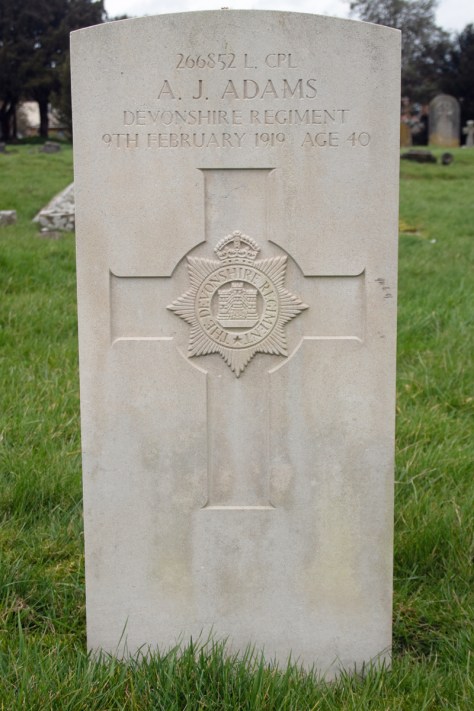
Albert James Adams was born in Somerset in September 1878, the fifth of ten children to Robert and Mary. Robert was a mason, who sadly passed away when Albert was only 11 years old. Mary lived on as the head of the household, and by the 1901 census, she had four of her five sons living with her, three of them also stone masons.

Albert had taken a different route in life, and found work as a postman. He married Annie King, a young woman from Taunton, in 1910, and they set up home in the village of Selworthy near Minehead. Albert was the village postman, and the young couple lived there with their sons – Albert and Robert – and Mary.

When war came, Albert enlisted, joining the 6th Battalion of the Devonshire Regiment. While his military records are scattered, his battalion served in India and Mesopotamia; during their three years in the Middle East, the 6th Battalion lost twice as many men to illness – influenza, pneumonia, malaria – as to enemy action.

Lance Corporal Adams was not immune to sickness; while I have been unable to unearth exact dates for his military service, his cause of death is recorded as malaria and pneumonia. He passed away on 9th February 1919, at the age of 40 years old.

Albert James Adams lies at rest in St John’s Cemetery in Bridgwater, Somerset.


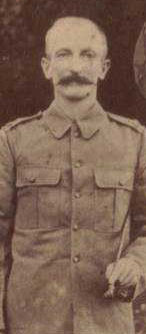
Albert James Adams from Ancestry.com

Driver Stanley Pearce

Driver Stanley Pearce

Stanley Arthur Robert Pearce was born in September 1895, the fourth of five children to Edwin and Rosetta Pearce from Bridgwater, Somerset. Edwin was a painter and sign-writer, and it was in the creative trades that his children followed.

Stanley’s eldest brother Clifford became a gardener; his next oldest Edwin Jr was a mason’s labourer; while his older sister Dorothy became a cardboard box maker. By the time of the 1911 census, when Stanley was 16, he was listed as a painter’s errand boy, presumably helping out his father.

War was on the horizon, and Stanley was keen to do his bit. In October 1914, he enlisted, becoming a Driver in the Royal Army Service Corps. Assigned to the 662nd Heavy Transport Company, he was based in London. There was still time for visits home, however, and the local Bridgwater newspaper reported on an ASC football match in which Driver Pearce was involved in October 1915.

By this time, Stanley had met Flossie Vickery, from nearby North Petherton. The couple married the following year, and had two children, Ada and Geoffrey.

In 1916, Driver Pearce’s battalion was shipped off to Salonica in Greece, as part of the British Expeditionary Force in the Balkans. While there, he contracted malaria and dysentery, and was evacuated back to England for treatment in September 1918.

Driver Pearce recovered well enough to enjoy a month’s recuperation, but fell ill again, with a recurrence of malaria, combined with influenza and pneumonia. He was admitted to the Brook War Hospital in South East London, but sadly not recover, and passed away on 10th November 1918, a day before the Armistice was signed. He was just 23 years old.

Stanley Arthur Robert Pearce lies at rest in the Wembdon Road Cemetery in his home town of Bridgwater.


Stanley’s older sister Dorothy – the cardboard box maker – contracted influenza around the same time as her brother and, tragically, died just five days after him. The siblings were buried in a joint funeral at the cemetery.