Tag Archives: measles

Private Clarence Jennings

Private Clarence Jennings

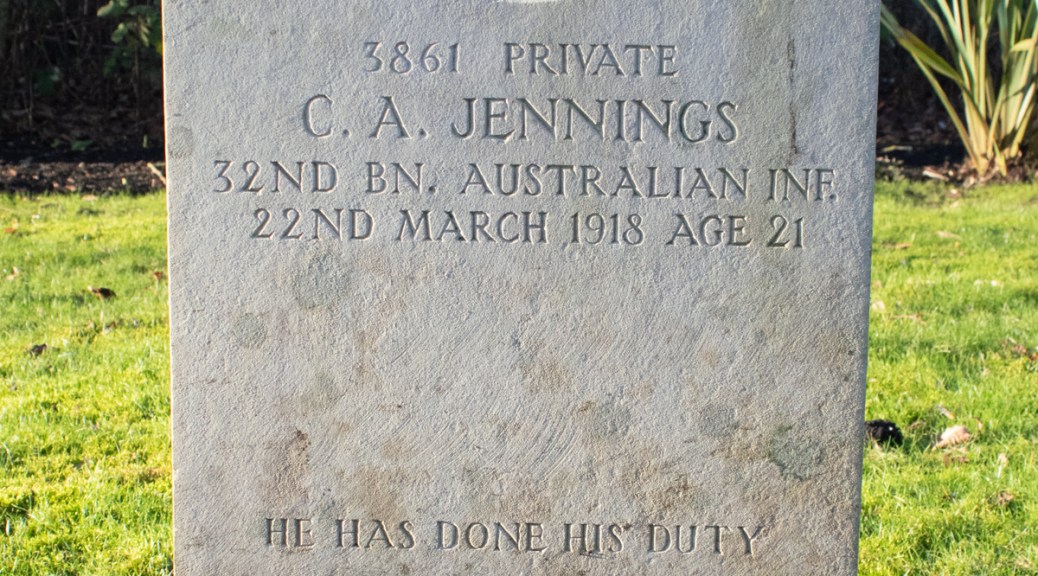
Clarence Albert Carrison was born on 6th June 1896 in Port MacDonnell, South Australia. His early life is a challenge to uncover: his father is noted as being Robert Carrison, while his mother was Mary Jennings. His parents had eleven other children, whose surnames vary between Carrison and Jennings.

Papers confirm that Clarence went to Mount Schank School from 29th July 1902 to 10th November 1904, although his attendance seems to have been a little haphazard. Intriguingly, his parents are not recorded, but Mr H Ulrich, a carpenter, is noted as being his guardian.

When he finished his schooling, Clarence found work as a labourer. War broke out on the other side of the world in the summer of 1914, and he was called upon to play his part. He enlisted in the Australian Imperial Force on 30th June 1917, and, Robert having passed away nine years earlier, he seems to have reverted to his mother’s name, Jennings.

Private Jennings’ service papers outline the young man he had become. He was a little over 5ft 7ins (1.7m) tall, and weighed 168lbs (76.2kg). He was recorded as having brown hair, blue eyes and a medium complexion.

Clarence spent the next three months training. On 30th October 1917, his unit left Australia for Europe, a journey that would take some eight weeks. The voyage was not uneventful for Private Jennings: he spent a night in the ship’s hospital with seasickness, then three weeks back there with mumps. His gratitude to be back on dry land when the HMAT Aeneas docker in Devonport on 27th December is likely to have been palpable.

Private Jennings was marched into camp in Sutton Veny, Wiltshire. Attached to the 33rd Battalion of the Australian Infantry, he moved to the nearby ANZAC base in Codford on 2nd January 1918, and would remain there for the next few months. This was not without its hiccups either, and he went AWOL from midnight on 7th February until 9:30am on 12th February. For this offence, he forfeited thirteen days’ pay.

By the end of that month, Clarence had fallen ill again. He was admitted to the No. 3 New Zealand General Hospital in Codford, suffering from measles and bronchitis. This combination of ailments would prove Private Jennings’ undoing: he passed away on 22nd March 1918, at the age of just 21 years old.

Thousands of miles from home, the body of Clarence Albert Jennings was laid to rest in the newly extended graveyard of St Mary’s Church, Codford.


Interestingly, Clarence’s burial report presents a clean slate to his family. He was noted as being “a keen soldier [whose] conduct was exemplary. He was very popular and his loss is very keenly felt.”


Air Mechanic 2nd Class Jack Gauntlett

Air Mechanic 2nd Class Jack Gauntlett

Jack Wallis Gauntlett was born in Burbage, Wiltshire, in the spring of 1898. The oldest of four children, his parents were George and Florence Gauntlett. On Jack’s baptism record, George gives his trade as a yeoman, while later census records confirm he was a farmer.

Jack was baptised in St Mary’s Church in Stapleford, near Salisbury, some distance south of Burbage, and, given that his parents had no connection to that area, it seems that his father’s work took the family around the county. The 1901 census record found them Gauntletts back in Burbage, but by the time of the 1911 return, they had moved to Middleton Farm in Norton Bavant.

When war broke out, Jack stepped up to serve his country. He enlisted in the Royal Flying Corps in January 1917 and, as an Air Mechanic 2nd Class, was sent to Farnborough, Hampshire, for training.

Much sympathy is felt with Mr and Mrs FG Gauntlett, of Middleton Farm, in the loss they have sustained by the death of their eldest son, JW Gauntlett… He came home three weeks ago on leave before proceeding to France, and was then sickening for measles and had bronchitis. He was taken to Sutton Veny military hospital and died there on Friday from an attack of pneumonia.

[Wiltshire Times and Trowbridge Advertiser: Saturday 19th May 1917]

Jack Wallis Gauntlett was just 19 years of age when he died on 11th May 1917. He was buried in the family plot in All Saints’ Churchyard, Norton Bavant.


Second Aircraftman Albert Jenner

Second Aircraftman Albert Jenner

Albert Jenner was born on 27th April 1887 in the Kent village of Hollingbourne. He was one of nine children to scaffolder and builder’s labourer Thomas Jenner and his wife, Emma.

By the time of the 1911 census, Albert was living with his parents and three of his siblings in a house on Well Street in Loose, near Maidstone. He was employed as a bricklayer’s labourer, while his brothers and father were all doing farm work.

At this point, Albert’s trail goes cold. It is clear that, when war was declared, he enlisted in the Royal Naval Air Service, although the specific dates are unknown. His younger brother Private Arthur Jenner, of the 6th Battalion of the Queen’s Own (Royal West Kent) Regiment died in northern France in July 1916, but it is unclear whether Albert had already stepped up to serve by this point.

Second Aircraftman Jenner was based at the Kingsnorth Air Base, on the Hoo Peninsula in Kent. This was a Royal Naval Air Service training station, which also experimented with air ships. There is little to document Albert’s time there, however, and, given his rank, it is likely that he was not there for very long.

The only other document directly connected to Albert confirms his passing. He died at the base on 3rd April 1917, having contracted measles, which escalated into pyaemia, or sepsis. He was a few days away from his 30th birthday.

Albert Jenner was laid to rest in the Woodlands Cemetery, in Gillingham, Kent.


Private Rondaine Cary

Private Rondaine Cary

Rondaine Tristram Cary was born in Lancashire in the autumn of 1896 and was the oldest of two children to Henry and Wilhelmina. Henry was an insurance agent, and, by the time of the 1901 census, the family had moved to the parish of Linsfort in County Donegal, Ireland. This is near where Wilhelmina had been born, so it seems likely that the draw of family had been partially responsible.

The 1911 census found the Carys living a few miles down the road, in Buncrana. Rondaine was listed as being a scholar, while his younger brother, five year old John, completed the family setup. John was employed as a commission agent, and all four members of the household were listed as being Episcopalian.

When war came to Europe in 1914, Rondaine was keen to play his part. He seems to have enlisted almost at once, joining the Royal Inniskilling Fusiliers. Assigned to the 11th (Service) Battalion (Donegal and Fermanagh), Private Cary was sent to Ballymena, County Antrim, for training.

Rondaine had only been in the camp for a matter of weeks, when he contracted measles. He was admitted to a hospital in Ballymena on 17th February 1915, but his condition worsened, and his father came to visit. Private Cary passed away on 27th February 1915, aged just 18 years of age.

The Cary family seemed unable to afford the cost of bringing their son’s body back to Buncrana. Instead, the local authority paid for Rondaine Tristram Cary’s coffin and funeral at Ballymena Cemetery, while his army colleague funded his headstone.


Private Ivan Day

Private Ivan Day

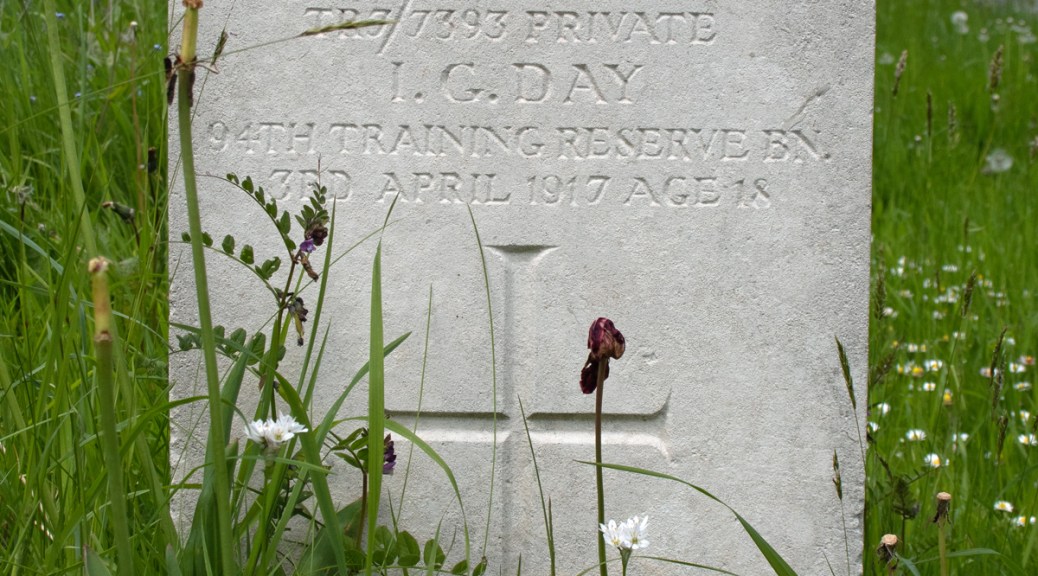
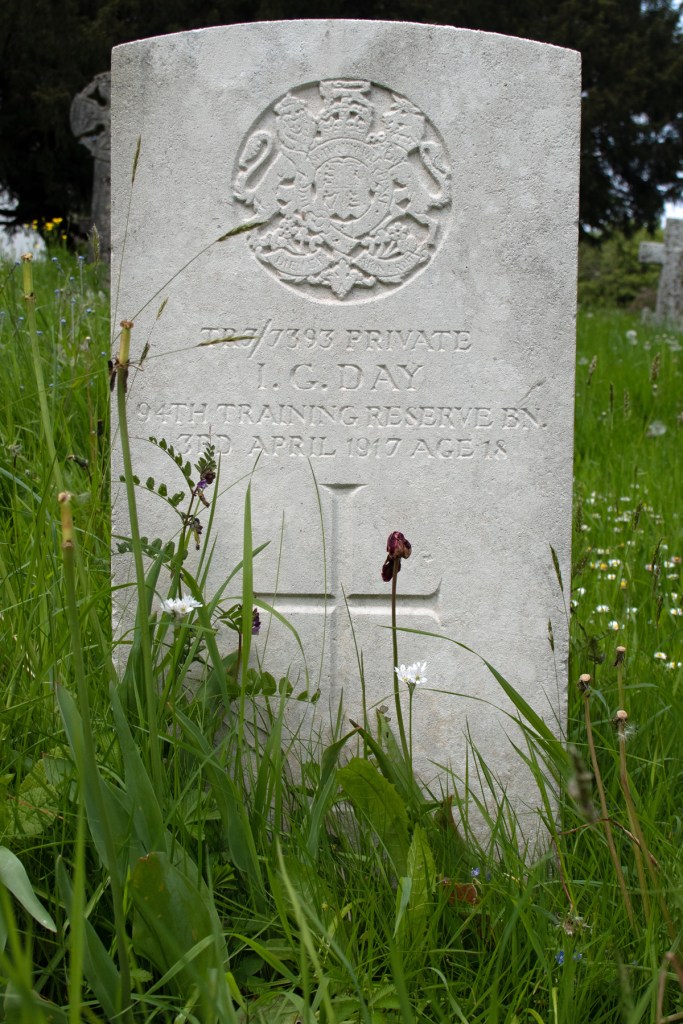
Ivan George Day was born in the summer of 1898, the oldest of three children to George and Emma Day. George was a brick and tile maker from Weare in Somerset and it was here that he and Emma raised their young family.

When Ivan finished his schooling, he found work as a postman, but, with war raging across Europe, he seemed keen to play his part. In February 1917, he enlisted in the army and was assigned to the 93rd Training Reserve Battalion. His service records show that he was just 5ft 3ins (1.6m) tall and weighed 121lbs (54.9kg).

Private Day was sent to Chiseldon Camp, to the south of Swindon in Wiltshire and, tragically, this move to cramped army barracks was to prove his undoing. Within four weeks of arriving, Ivan was admitted to the camp’s hospital, having contracted measles and pneumonia. Less than a week later, the conditions had gotten the better of him. He passed away on 3rd April 1917, at just eighteen years of age.

Ivan George Day’s body was brought back to Somerset for burial. He was laid to rest in the peaceful graveyard of St Gregory’s Church in his home village of Weare.


Tragedy was to strike the Day family again when, George died eighteen months later, aged 51 years old. Emma lived until 89 years old, passing away in Weston-super-Mare in the summer of 1955.


Ivan was not the only Somerset soldier to succumb to pneumonia at Chiseldon Camp that spring. Private Charles Oborne, died from the same condition a few days before Ivan was admitted to the hospital. Private Everett Ferriday, of the 94th Training Battalion, passed away in the same hospital on the same day as Ivan, also from pneumonia.

You can read their stories by following the links above.


Boy 2nd Class Charles Hancock

Boy 2nd Class Charles Hancock

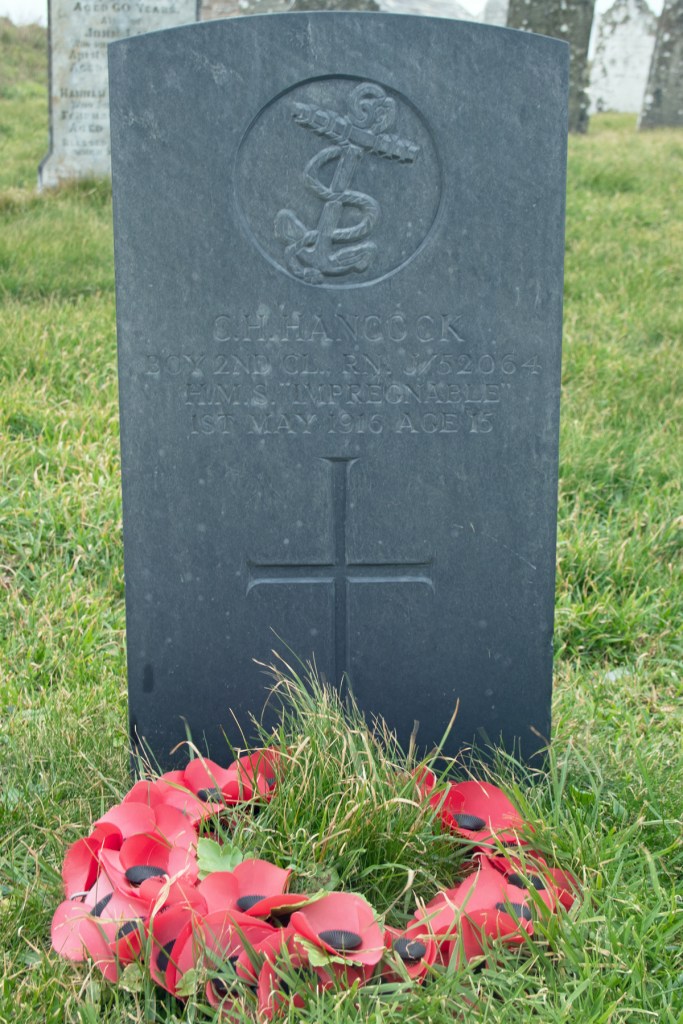
Charles Henry Hancock’s story underlines the innocence and exuberance of youth, and a life cut tragically short.

He was born on 9th July 1900 in Newton Abbot, Devon, the oldest of four children to Edward and Annie Hancock. Edward – who was also known by his middle name of Charles – was a jobbing gardener. By the time of the 1901 census, he had found employment as a groom and gardener with artist and sculptor Frederick Sturge in Tintagel, Cornwall. Annie was also employed by the family as a cook.

Edward passed away in June 1912, aged just 38 years old. Charles stepped up to help his mother, finding work as a farm labourer when he left school. War came to Europe, and while he was only 14 at the start of the conflict, he was drawn to play his part.

On 1st April 1916 Charles enlisted in the Royal Navy, either as a way to a permanent career to help bring in much needed money for his family, or because he was seeing his older peers going of to fight or King and Country. He was still underage, however, and was given the rank of Boy 2nd Class. Charles’ service records show that he was 5ft 2in (1.57m) tall, had fair hair, grey eyes and a fresh complexion.

Boy Hancock was sent to HMS Impregnable, the training ship based in Devonport, for his initial service. Tragically, this service was not to be a long one. Billeted in crowded barracks, he contracted measles and bronchial pneumonia, dying on 1st May 1916, while admitted to the Royal Naval Hospital in Plymouth, Devon. He was just 15 years of age, and had been in service for exactly one month.

Charles Henry Hancock was brought back to Cornwall for burial. He was laid to rest next to his father in the peaceful graveyard of St Materiana’s Church in Tintagel.


Private Sidney Biddiscombe

Private Sidney Biddiscombe

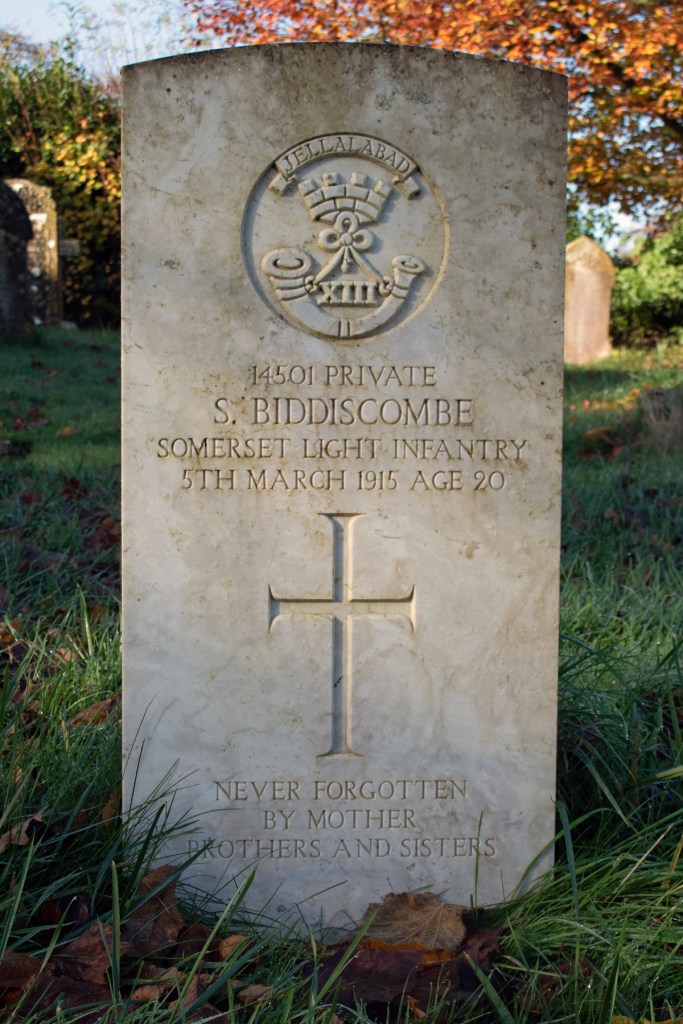
Sidney William Biddiscombe was born in South Cadbury, Somerset, in the spring of 1895. The eighth of sixteen children, his parents were Thomas and Constance Biddiscombe. Thomas was an agricultural labourer, and this is work that Sidney went into when he finished school.

When war came to Europe, Sidney was quick to enlist. Whether this was out of a sense of duty, a keenness to get involved, a need to follow his older brothers, or as an escape from farm labouring is unclear, though. He joined the Somerset Light Infantry in August 1914, and was assigned to the 7th (Service) Battalion.

There is little information available about Private Biddiscombe’s time in the army. He received his training in Hampshire, and was based at Aldershot. The sudden influx of young men from across the country into small, cramped billets meant that illness ran rife, and Sidney, it seems, was not immune. He contracted measles, and was admitted to the camp’s Isolation Hospital.

Sadly, the infection was to get the better of Private Biddiscombe, and he passed away at the hospital on 5th March 1915. He was just 20 years of age.

Sidney William Biddiscombe was brought back to Somerset for burial. He was laid to rest in the graveyard of St Thomas a Becket’s Church in his home village of South Cadbury.


Sidney’s epitaph notes he is “never forgotten by mother, brothers and sisters”. His father, Thomas, died in 1918, at the age of 62, and so was not commemorated on his son’s headstone, which was erected at a later date.


Private Clarence Emmett

Private Clarence Emmett

Clarence Southwood Emmett was born in September 1899 in the Devon village of Ipplepen. The middle of five children, his parents were village butcher Thomas Emmett and his wife, Annie.

There is little information about Clarence’s early life, but when war broke out in 1914, he is evident that he wanted to play his part. He enlisted in the army as soon as he turned 18, and joined the 4th Battalion of the Wiltshire Regiment.

Sadly, full details of his time in the army, although a local contemporary newspaper sheds a little more light onto his health:

He soon contracted measles, and took a chill before he recovered. Since then he has been dangerously ill at different times, and has undergone various operations. He was recently removed to a hospital at Devonport where, until a few weeks ago, it was hoped he might recover.

Western Times: Friday 14th February 1919

Private Clarence Southwood Emmett died in the hospital on 8th February 1919. He was just 19 years of age. His body was brought back to Ipplepen, and he was laid to rest in the graveyard of St Andrew’s Church there.


Private Clarence Emmett

Private Leonard Patch

Private Leonard Patch

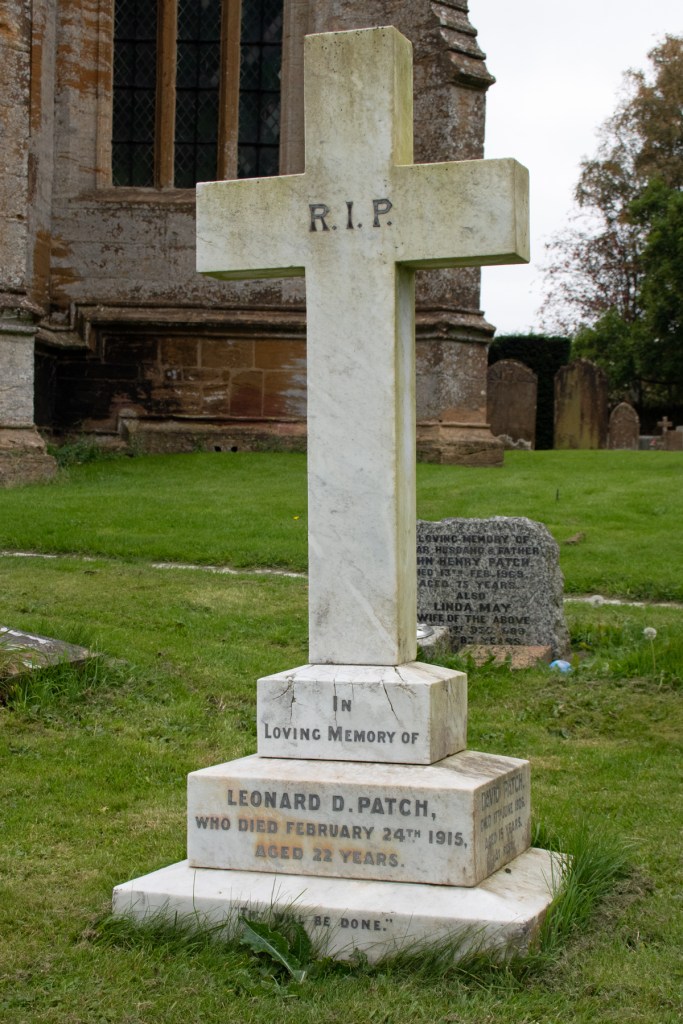
Leonard David Patch was born on 22nd October 1892, the oldest of four children to David and Fanny Patch from Norton-sub-Hamdon in Somerset. David was a stone mason, but when his eldest son left school, he found work as a carpenter.

When war came to Europe, Leonard was one of the first from the village to volunteer. Given the small size of Norton-sub-Hamdon, it seems likely that he would have done so with friends; many of the Pals Battalions were formed like this.

Leonard joined the Somerset Light Infantry as a Private, and was assigned to the 7th Battalion. He was sent to Woking, Surrey, for training and it was while he was billeted there that he contracted measles. Moved to the Military Isolation Hospital in Aldershot, he developed pneumonia, and passed away from the lung condition on 25th February 1915. He was just 22 years of age, and had seen no military action.

Private Patch’s body was brought back to his home village, where he was laid to rest in the graveyard of St Mary’s Church, where he had been baptised two decades before.


Of Leonard’s brothers, two saw active service.

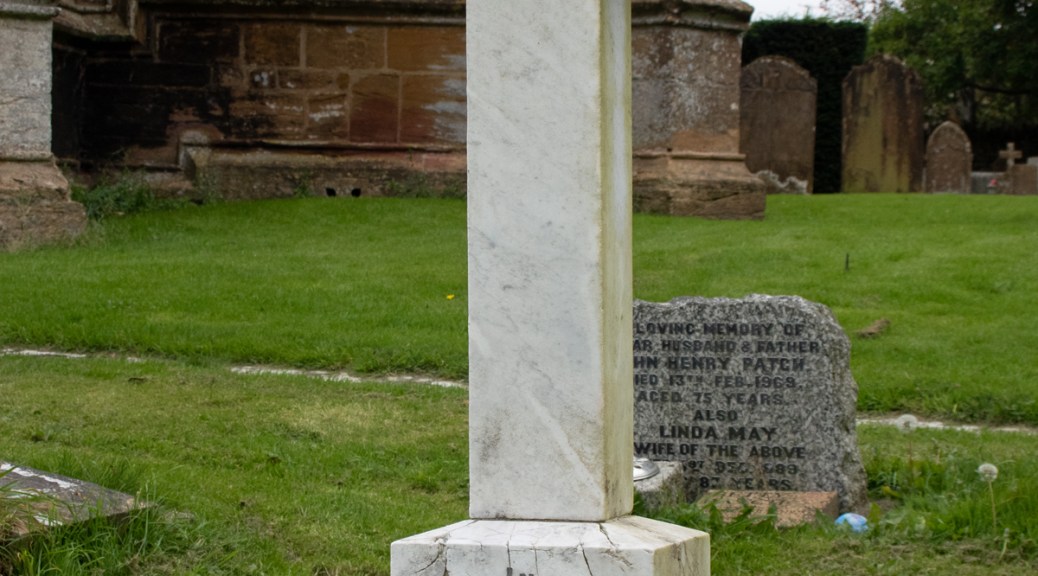
John Henry Patch, the second oldest of the siblings, served in the Royal Engineers, enlisting just ten months after his brother had died. He survived the war, married Linda Turner in Yeovil and went on to have a son, Norman. John passed away in February 1969, a few days after his 75th birthday.

Edward Lionel Patch – the third brother – served with the Devonshire Regiment. He too survived the war, marrying Honor Brown in 1923; they also had a son, called David. Edward passed away in Yeovil in 1966, aged 70 years old.

The youngest of the four brothers, Clarence William Patch, was born in 1899 and was lucky enough not to have seen military service. He married Emily Brown in 1924 and the couple had a daughter, Emmie. Sadly, she passed away as a babe-in-arms, and Emily was to follow soon after. In 1931, Clarence married again, this time to Emily Dyer; they went on to have a son, Douglas Leonard. Clarence passed away in 1945 at the age of just 46 years old.


Private Bertram Coates

Private Bertram Coates

Bertram Noel Coates was born in the sleepy Somerset village of Walton-in-Gordano in the spring of 1890. He was the middle of three children to Herbert and Florence Coates. Herbert was a solicitor, and clerical work seemed to have been in the Coates blood.

While he did not follow in his father’s exact footsteps, by the time of the 1911 census, Bertram had found work as a bank clerk, and was boarding with his employer, James Barry, in Chipping Sodbury, Gloucestershire.

Bertram was obviously made very welcome in Chipping Sodbury, as, on 27th May 1914, he married his employer’s daughter, Mary Barry. The couple would go on to have a daughter – Eileen – who was born in February 1916.

By the time of his wedding, Bertram had moved to London, and was working as a bank clerk in South Woodford, so was obviously showing an ambitious streak.

War was beckoning, however, and in December 1915, Bertram enlisted. Placed in the Army Reserve, he was finally mobilised in January 1917, and assigned to the 28th Battalion of the London Regiment, which was also known as the Artists Rifles.

Tragically, Private Coates’ military service was to be a short one. While training, he contracted measles, which turned septic with additional complications. He sadly passed away on 31st March 1917, less than three months after being mobilised. He was just 27 years old.

Bertram Noel Coates was brought back to Somerset. He lies at peace in the churchyard of St Mary’s in Walton Clevedon, near his parents’ home in Somerset.