William Henry Pearn was born in January 1896, one of two children to Richard and Selina Pearn from Bridgwater in Somerset. Selina had been married previously, and had been widowed, and so William had a further four half-siblings. Richard was a lath renderer – a plasterer in today’s terms – and he was not the only one of the household to be working. According to the 1901 census, Selina was a collar maker and William ‘s two older half-brothers were a landscape gardener and a bookshop assistant.
When William left school, he went to work for a local coal yard as a porter. The next census finds him living with his mother and his older brother, Wallace, who was a labourer in a brickyard. Richard is noticeable in his absence, but Selina is having been married for 18 years.
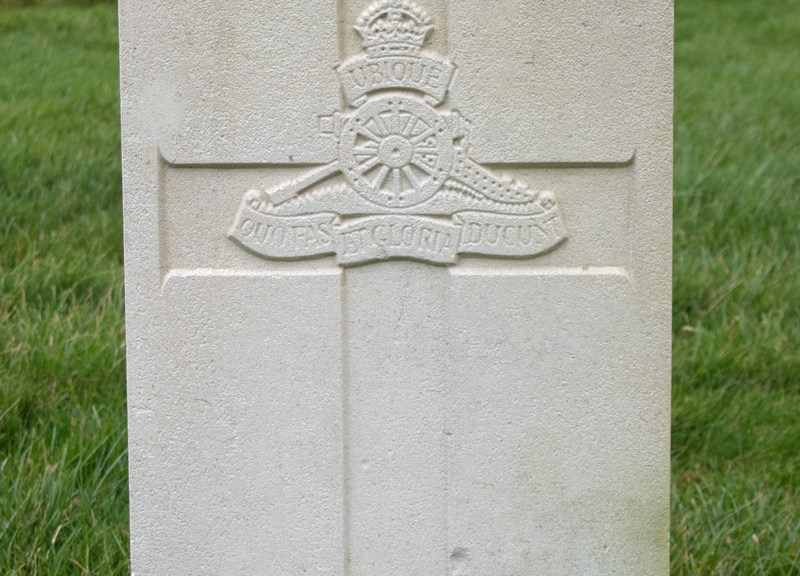
Sadly, though, at this point William’s trail goes cold. His military records are sparse, but we know that he enlisted as a Gunner in the Royal Field Artillery, although I have been unable to identify when he enrolled. The only other information I have I have been able to locate for him are his pension records, that confirm that he passed away from pneumonia on 19th October 1918. Gunner Pearn was just 24 years old.
William Henry Pearn lies at rest in St John’s Cemetery in his home town of Bridgwater in Somerset.
Edward Britton was born in Bridgwater in 1870, one of nine children to Edward and Eliza Britton. Edward Sr was a mariner, and the family lived on the main road from the town to Bath.
There is a gap in the documentation for Edward Jr; when we next meet him on the 1911 census he is married with children of his own. His wife is Ada Olive Martin, the daughter of a bricklayer from Topsham in Devon. They had eight children, six of them girls, and, according to the document, Edward was working as a ‘deal carrier’, moving wood from the ships arriving in Bridgwater to the timber yard.
A Gloucestershire deal carrier (from gloucesterdocks.me.uk)
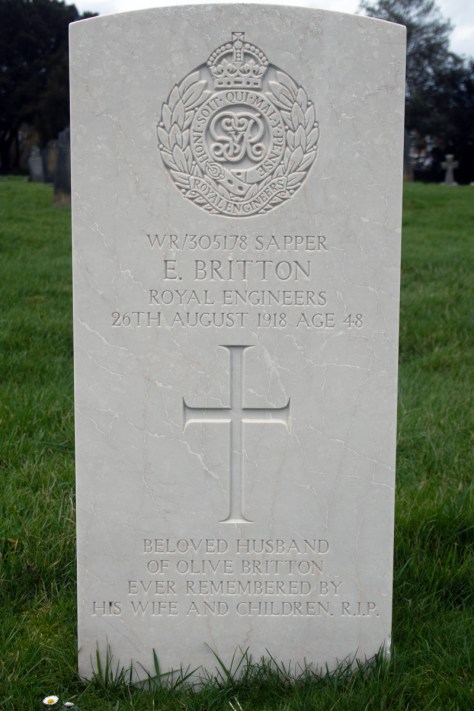
Sadly, Edward’s service records are also sparse. He enlisted in the Royal Engineers as a Sapper and, given his age, it is likely that this was not early in the conflict. He was involved in the Inland Water Transport division – given his father’s work as a mariner, this doesn’t come as a surprise.
The Army Register of Soldiers’ Effects provides a surprising insight into Sapper Britton. It gives the date of his death, but notes the cause as “Drowned, River Stour, Kent”.
An inquest was held on Monday by Dr Hardman at the Military Hospital, Stonar, respecting the death of Sapper Edward Britton… who was drowned through the capsizing of a boat… It appeared that Britton was ferrying Lance-Corporal Griggs to a barge which was in tow with three others when a collision occurred, the boat overturned and Britton was drowned.
[Kentish Gazette: Saturday 7th September 1918]
Sapper Britton passed away on 26th August 1918, at the age of 48.
Edward Britton lies at rest in St John’s Cemetery in his home town of Bridgwater, Somerset.
Albert James Adams was born in Somerset in September 1878, the fifth of ten children to Robert and Mary. Robert was a mason, who sadly passed away when Albert was only 11 years old. Mary lived on as the head of the household, and by the 1901 census, she had four of her five sons living with her, three of them also stone masons.
Albert had taken a different route in life, and found work as a postman. He married Annie King, a young woman from Taunton, in 1910, and they set up home in the village of Selworthy near Minehead. Albert was the village postman, and the young couple lived there with their sons – Albert and Robert – and Mary.
When war came, Albert enlisted, joining the 6th Battalion of the Devonshire Regiment. While his military records are scattered, his battalion served in India and Mesopotamia; during their three years in the Middle East, the 6th Battalion lost twice as many men to illness – influenza, pneumonia, malaria – as to enemy action.
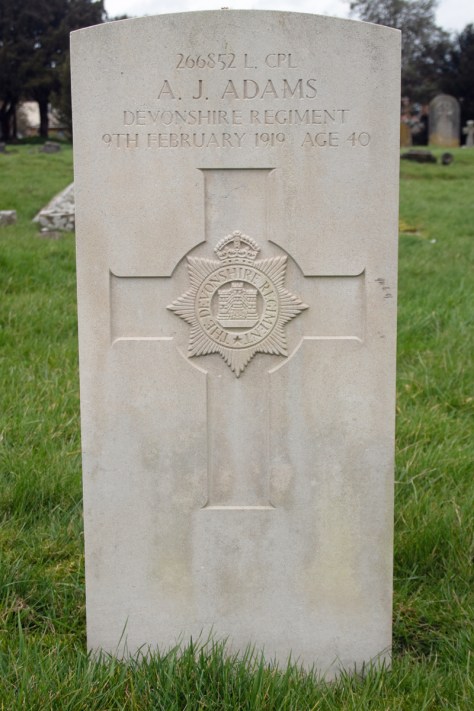
Lance Corporal Adams was not immune to sickness; while I have been unable to unearth exact dates for his military service, his cause of death is recorded as malaria and pneumonia. He passed away on 9th February 1919, at the age of 40 years old.
Albert James Adams lies at rest in St John’s Cemetery in Bridgwater, Somerset.
Sidney Joseph Turner was born in 1888, the oldest of four children to Sidney and Matilda Turner from Bridgwater in Somerset. Sidney Sr was a carter, while his son became a labourer in a local cement works. Sadly, Sidney Sr died in 1903, when Sidney Jr was 15, leaving Matilda with three other children, one of whom was only 18 months old.
Sidney Jr travelled to get work, and had moved to South Wales to work as a miner by 1909. Here he married Rose Shattock, who was born in Bristol, although within a couple of years the young couple had moved back to Somerset.
Sidney and Rose had a son, also called Sidney, although sadly he died when he was only a couple of months old. Tragically for Sidney, the records seem to suggest that Rose may have died in childbirth, or shortly after, as her passing was registered in the same quarter as her son’s birth.
By this time, Sidney was living in Bailey Street, Bridgwater, a short distance from some railway sidings. This might have driven some determination in him as, by the following year, he was listed as an engine driver. In December 1913 he married his second wife, Bessie Sharman. She was the daughter of a mariner, who had become a machinist in a shirt factory by the time of their marriage. The couple went on to have a son, also called Sidney, in April 1914.
When war broke out, Sidney enlisted in the Highland Light Infantry, initially in the 12th (Service) Battalion. They landed in France in July 1915 and were there for the remainder of the war. At some point, Lance Corporal Turner transferred to the 53rd (Young Soldier) Battalion. Very much a training brigade, it seems that Sidney’s experience of the front line may have proved useful for the upcoming recruits.
Lance Corporal Turner was demobbed on 21st March 1919; his pension record shows that, during the course of his service, he had fractured his tibia and had contracted bronchitis. The 1921 census found Sidney back in Bridgwater. He was listed as being a gas engine driver for John Board & Co., although he was, at that point, out of work. He, Bessie and Sidney Jr were living at 1 Price’s Buildings.
Sidney’s health conditions were to prove his downfall, as, within a months of the census return, he had succumbed to pulmonary tuberculosis and exhaustion. He died on 2nd July 1921, aged just 32 years old.
Sidney Joseph Turner lies at rest in St John’s Cemetery in his home town of Bridgwater, Somerset.
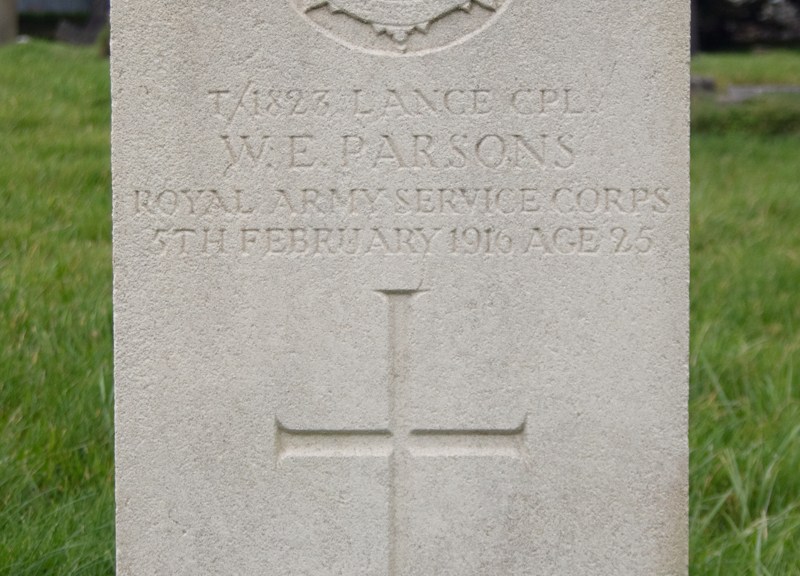
William Edward Parsons was born in 1890, one of six children to John and Prudence Parsons. John found work in a number of fields, working as a blacksmith, porter, dock labourer and a hobbler (towing boats along the River Parrett) in his time. Throughout this, he lived with his family in the Somerset town of Bridgwater.
William found work as a collar cutter in a local shirt factory, and went on to marry Matilda Mary Temblett on Christmas Day 1913. The young couple went on to have a son – Leslie William – who was born in February 1915. William was teetotal, and played full back for the local rugby football club, Bridgwater Albion.
Sadly, Lance Corporal Parsons’ military records are sparse; he had enlisted in the Royal Army Service Corps and was based in Fovant, to the west of Salisbury.
It was while he was on leave that William met his sad fate. On the evening of 5th February 1916, he had seen his parents and had set out to organise a football match in the town. He was walking over the town bridge, when a passer-by heard a splash. He saw a man in the water, who was crying for help, and then disappeared.
William’s body was found in the river a fortnight later close to a local brickyard. He was just 25 years old.
William Edward Parsons lies at rest in St John’s Cemetery in his home town of Bridgwater.
Occasionally I have found that some people are destined to remain hidden. No matter how much research you try and do, details stay lost, and the name on a gravestone will remain just that.
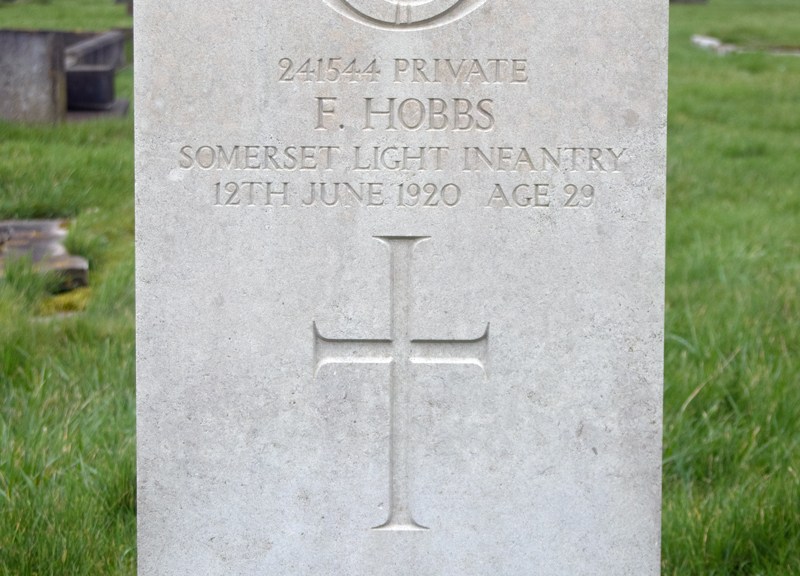
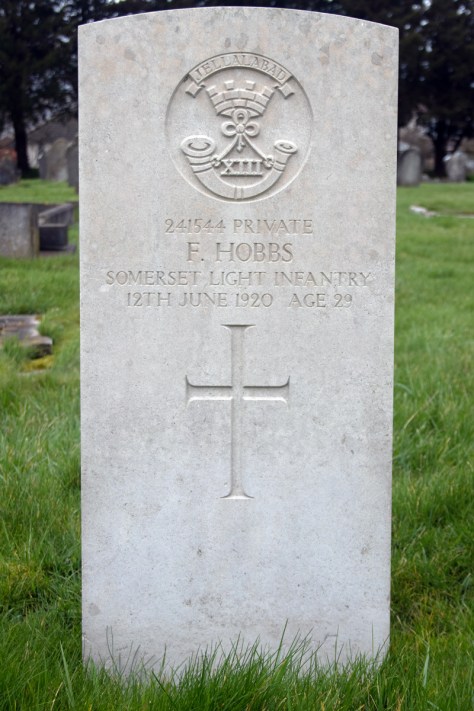
Private Fred Hobbs is one of those people.
He was born in around 1891; he enlisted in the 1st/5th Battalion of the Somerset Light Infantry. Private Hobbs’ service records are not available, but he was awarded the Victory and British Medals for his actions.
His pension record gives Mrs Ellen Louisa Hobbs as his next of kin; there is no confirmation of whether this was his mother or his wife – research has uncovered nothing to identify either.
Private Hobbs does not appear in the contemporary media – this would seem to suggest nothing out of the ordinary about his passing.
All we know for certain is that Fred Hobbs passed away on 12th June 1920, aged 29 years old. He lies at rest in St John’s Cemetery in Bridgwater, Somerset.
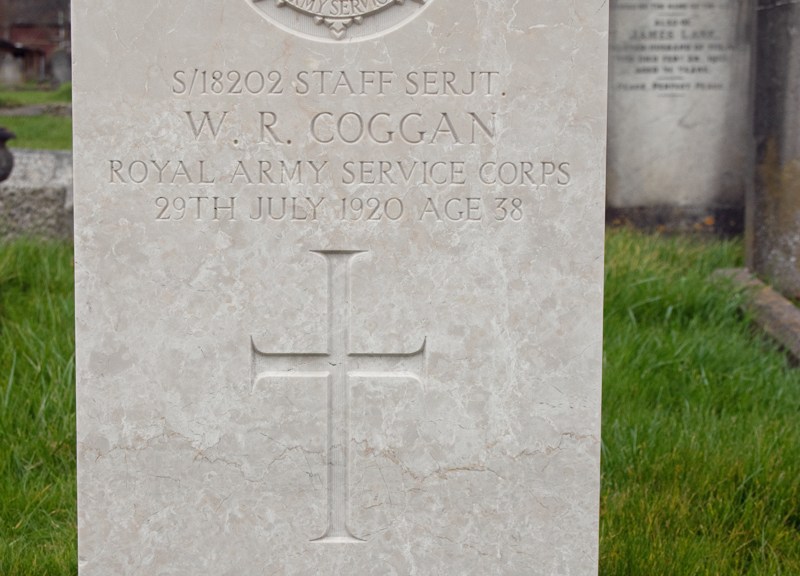
William Reginald Coggan was born in Twerton, near Bath, at the end of 1882. His father, also called William, was a railway guard, and with his mother, Annie, he would go on to raise nine children, six of them girls.
William Jr became known as Reginald, presumably to avoid confusion with his father. He didn’t follow his father onto the railways, but found a way to serve his country. In the 1901 census, he was working as a baker for the Army Service Corps, and was based at the Stanhope Lines Barracks in Aldershot (along with more than 1800 others).
Ten years later – by the time of the 1911 census – William had left the army but continued his trade. He was listed as a baker of confections in Glastonbury, was living above the bakery with his wife of four years. I have been able to find little information about his wife, Kate, other than that she came from Dublin.
William Coggan’s former bakery in Glastonbury, Somerset.
William’s life becomes a little vague after the census. A newspaper report confirms that he had served in the South Africa war (1899-1902), and that he had seen five years’ service in France. The report – and William’s pension records – confirm that he had continued in the Army Service Corps, gaining the rank of Staff Sergeant.
William had died in Ireland, and his death registered in Fermoy, thirty miles to the north of Cork. The report confirmed that:
Nothing is yet known of how he came by his death, although a request was made for a post-mortem examination.
Taunton Courier and Western Advertiser: Wednesday 11th August 1920.
I can find no further information about his death and, unusually, his Pension Record gives the date, but not the cause. Staff Sergeant Coggan died on 29th July 1920, aged 38 years old.
William Reginald Coggan’s body was brought back to England for burial. He lies at rest in St John’s Cemetery in Bridgwater, Somerset.
Walter Henry Taylor is one of those people whose details are difficult to track down. From his pension card, he is recorded as having been married to a woman called Lilla Rhoda, and that they had a daughter, Joan Valeria, who was born in April 1916.
Walter’s war grave confirms that he was a Private in the Essex Regiment; his pension records also support this, showing that he was assigned to the 6th Battalion, then the 10th Battalion. The two troops were positioned in different locations during the conflict – the 6th fought the Turkish, including involvement at Gallipoli, while the 10th was based on the Western Front.
An article in the local newspaper – the Taunton Courier and Western Advertiser – reported his death, confirming that he passed at the War Hospital in Preston, Northampton. He had been in service for more than a year, having previously been employed by Redwood & Sons in Taunton. The newspaper went on to report that Private Taylor had been suffering from ill health and had been hospitalised in both France and England.
The name is a fairly common one, and my usual resource, Ancestry, wasn’t bringing up anything concrete around him. There are no definitive birth or marriage records and the censuses I have been able to locate do not convince me that they relate to the name on the gravestone.
There is a Walter Harry Taylor, who was born in Bridgwater in 1883, one of ten children to Henry John Taylor and his wife Emma; Henry was a sailmaker, while Walter went into boot making.
The 1911 census picks up this Walter in St Pancras, London, where he was working as a boot trade shop assistant, while boarding with a dressmaker called Minnie Adelaide Lloyd.
While these seem likely candidates for Walter, there is nothing to definitively connect the documents to the man being researched. What potentially sways it, is that Redwood & Sons (Walter’s pre-service employer) were a boot and shoe dealer.
Sadly, the only other definitive documentation of Walter’s life is that he passed away on 14th July 1918, from a kidney sarcoma. He was 35 years old.
Walter Henry (Harry) Taylor lies at rest in the St John’s Cemetery in his presumed home town of Bridgwater, Somerset.
Frederick Hobbs was born in December 1886, the fourth of ten children to William and Martha Hobbs, from Bridgwater in Somerset. William was a mason, and all of his children seemed to be good with their hands. Frederick went on to become a plumber’s apprentice, while his siblings worked as a mason, a dressmaker and a carpenter.
The 1911 census found him living in Polden Street, Bridgwater with his mother and youngest sibling, Florrie. William, however, was living round the corner in Bath Road, with three of his other children, Clara, Tom and George. Both of Frederick’s parents are listed as married, which adds to the confusion of them being in separate houses.
Frederick enlisted with weeks of was being declared; he joined the 10th (Service) Battalion of the Devonshire Regiment and, after a year on home soil, his troop was shipped to France. This wasn’t the end of the Private Hobbs’ journey, however as, within a couple of months, he journeyed on as part of the Mediterranean Expeditionary Force, finally arriving in Salonica, Greece, in November 1915.
Private Hobbs has only been serving for a month when he was admitted to the Hospital Ship Asturias in Alexandria, with lacerations to his cheeks and eyelids. The initial report seemed to suggest the wounds were as a result of gunshot, although a more detailed report later confirmed that the injuries were caused by barbed wire.
While in hospital, Frederick’s urine was found to include a high level of sugar. He also confirmed having lost a lot of weight in recent months, but could not confirm when this had begun. He was diagnosed with diabetes, and was evacuated back to England for treatment for both his injuries and his illness.
The damage to his left eye healed, but he was left with significant ptosis, or drooping of the eyelid. When it came to his diabetes, specialists back in England determined that, while it could not be put down to Private Hobbs’ service, it had definitely been aggravated by it. He was deemed no longer fit for military service and furloughed in June 1916, with a follow-up report confirming this three months later.
Sadly, whether Frederick’s life returned to normal is not recorded. It seems likely, however, that the diabetes got the better of him, and he passed away on 25th November 1916, aged just 29 years old.
Frederick Hobbs lies at rest in St John’s Cemetery in his home town of Bridgwater, Somerset.
Frederick’s younger brother Herbert Hobbs also fought in the Great War. He enrolled in the Royal Marines Light Infantry and fought on the Western Front. Caught up in the Battle of Gavrelle Windmill, he was one of 335 Royal Marines to be killed in that skirmish. He lies buried at the Arras Memorial in Northern France.
Wilfred Allen Gillson was born in 1888, the fourth of nine children – and one of eight boys – to George and Emma Gillson. George was a coachbuilder from Cornwall; Emma, whose maiden name was Allen, came from Derbyshire. The family were living in Torquay by the time Wilfred was born.
In 1895, George had moved the family to Bridgwater in Somerset, presumably as railway works had dried up in the coastal Devon town. By this time his oldest son, also called George, was working as a compositor, keying text for a printer. Wilfred was still at school, but his other two older siblings – William and Albert – were both working with their father, working on railway coaches.
Wilfred was also to follow in his father’s employment, and the 1911 census found him living in Bristol, boarding with the Cridland family, earning his keep a a carriage painter.
He joined up within weeks of war breaking out, enlisting in the Worcestershire Regiment on 20th September 1914. Private Gillson readily proved his worth, and was promoted to Lance Corporal after three months, and Corporal within a year of enlisting.
Corporal Gillson’s promotion coincided with his shipment abroad, and he served on the Western Front for eight months. Returning to England in March 1916, he subsequently transferred to the Devonshire Regiment, before being moved to the 4th Reserve Battalion in the spring of 1917.
Things were not right for Wilfred; he was reprimanded for neglecting his post on the night of the 26th May that year, before being medically discharged with neurasthenia in August.
The root of the matter is detailed in his discharge report; he was hospitalised at Neuve Chapelle in February 1916, suffering from shellshock, and it seems that he never really fully recovered.
Sadly, at this point Wilfred’s trail goes cold. He passed away on 10th November 1918, aged 30 years old.
Wilfred Allen Gillson lies at rest in St John’s Cemetery in Bridgwater, Somerset.
There are a couple of additional notes to Wilfred’s life.
During the war, Wilfred’s youngest brother, Thomas, fought with the Oxfordshire & Buckinghamshire Light Infantry. He was involved in the fighting in France, but died from wounds on 10th June 1918. He was just 18 years old, and is buried at Aire-sur-la-Lys, not far from Boulogne.
Given that Wilfred was one of eight brothers, all of whom would have been of fighting age during the war, it is lucky – although still a tragedy – that only he and Thomas died as a result of the conflict.
Sadly, Wilfred’s mother, Emma, passed away in the autumn of 1914, at 57 years of age. It might be a blessing, however, that she was not alive to see two of her sons suffer so.











 Death and Service