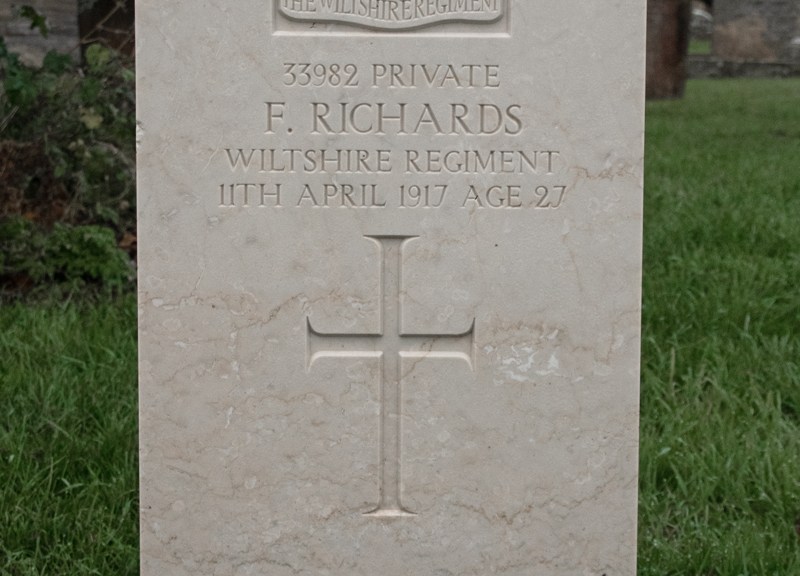
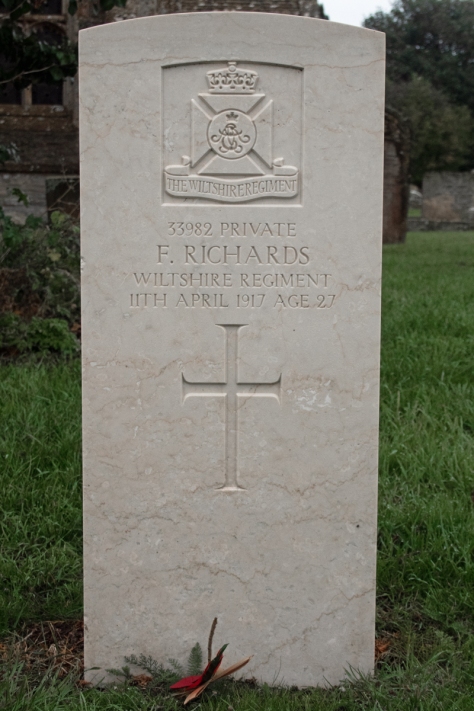
Francis George Richards (or Frank) was born in 1889, the oldest of five children to William and Rhoda Richards. William was an agricultural labourer and the family lived in his home village of Long Sutton in Somerset.
Frank followed his father into agriculture, and, by the 1911 census, was working as a carter.
And that is where the trail of Private Richards goes cold.
What records do exist confirm that he enlisted in the Wiltshire Regiment, serving at its depot in Devizes. This suggests he was part of the 7th (Service) Battalion, raised through the Kitchener Scheme.
The battalion were shipped to France in September 1915, before being moved on to the Balkans, where they fought in the Battle of Horseshoe Hill and the Battles of Dorian. As there are no records of Private Richards’ service, it is not possible to confirm how involved in the fighting in Europe he was, or whether he remained on the Home Front.
Frank’s death also remains a mystery. All that can be said for sure is that he died in hospital on 11th April 1917, in a hospital in England. He was 27 years old. He does not appear to have married, and his pension was assigned to his father.
Frank George Richards lies at rest in the quiet graveyard of Holy Trinity Church in his home village of Long Sutton.
Frank Antell was born in 1880, one of seven children – six sons – to Thomas and Harriett Antell. Thomas was a groom, and Harriett a dressmaker and the family lived in the village of Martock in Somerset.
After Thomas died in 1893, Frank left school and became a carpenter. By the time of the 1901 census, he was living with his mother and youngest brother. Income seems to have been short – there were three other people boarding and lodging with the family.
In August 1904, Frank married Augusta Ring, and together they had five children – Lily, Ada, Leslie, Ronald and Freda.
Frank enlisted in the 13th (Works) Battalion of the Devonshire Regiment; this had been formed in the summer of 1916, so it can only be assumed that he was called up at the start. The battalion was based in Plymouth, so it is likely that Private Antell did not see fighting on the Western Front.
Private Frank Antell’s death is also a bit of a mystery. All that there is to confirm what happened is one stark sentence on his pension ledger:
Wounds self-inflicted during temporary insanity whilst on active service.
This one statement covers a multitude of sins, but does nothing to explain the mystery of what happened. There is no coverage of the incident or funeral in contemporary newspapers, so I have been unable to find any further explanation.
Frank Antell was a man with a young family. His regiment was based in England and was to be so for the duration of the war. One cannot imagine what thoughts were going through his head at the time he took his own life. That the 37 year old felt this was his only option is tragic.
Frank Antell lies at rest in the graveyard of All Saints’ Church in his home village of Martock in Somerset.
Frank’s widow Augusta went on to marry again in 1919, to a Joseph Maunder. She died in 1951 at the age of 73 years old.
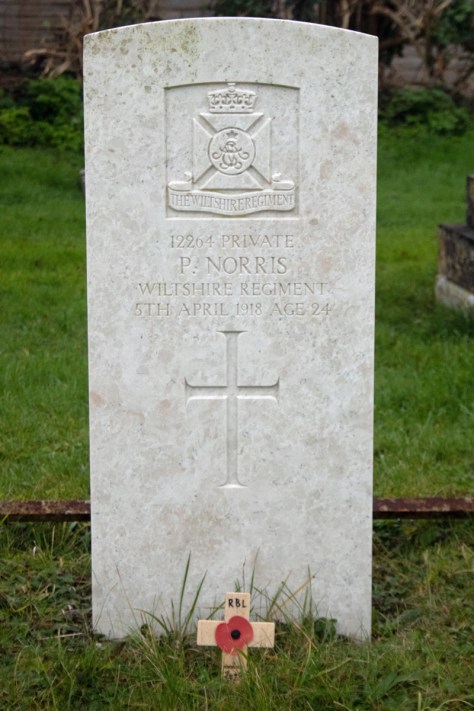
Percy Norris was born in 1894, the youngest of eleven children to William and Julia Norris. William was the caretaker for the water works in Somerton, Somerset, and this is where the family of eleven lived.
By the time of the 1911 census, Percy’s older brother Henry had joined his father at the water works. Julia had passed away five years before, and Percy and three of his siblings continued to live with William. At this point Percy was working as a gardener.
Private Norris’ full military records are not readily available, but it is evident that he enlisted in the 7th Battalion of the Wiltshire Regiment. This was a service troop, formed in 1914, who saw service in France and the Balkans.
It seems that it was during one of the skirmishes that Private Norris was injured. While there is no confirmation of exactly when or where this happened, it is likely to have been at some point in the spring of 1918. Percy was shipped back the England for treatment, and admitted to the Red Cross Hospital in Bridgwater, Somerset.
Sadly, Private Norris did not recover from his injuries. He passed away on 5th April 1918, aged 24 years old.
Percy lies at rest in the cemetery of Somerton, his home town.
Percy’s older brother Henry Norris also died in the Great War. Joining the Royal Naval Volunteer Reserves, Able Seaman Norris was also wounded on active duty, dying of his injuries in January 1918, aged 32. He is buried at the St Sever Cemetery in Rouen, France.
What I have discovered while researching the Commonwealth War Graves, is that, despite the general themes I find, the people behind the names always have an individual story to tell. Sometimes that story raises an eyebrow, or produces a gasp.
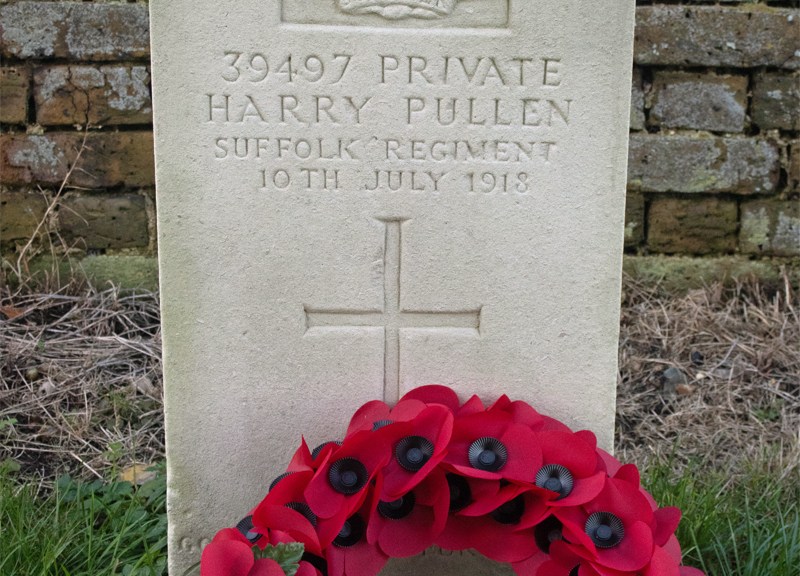
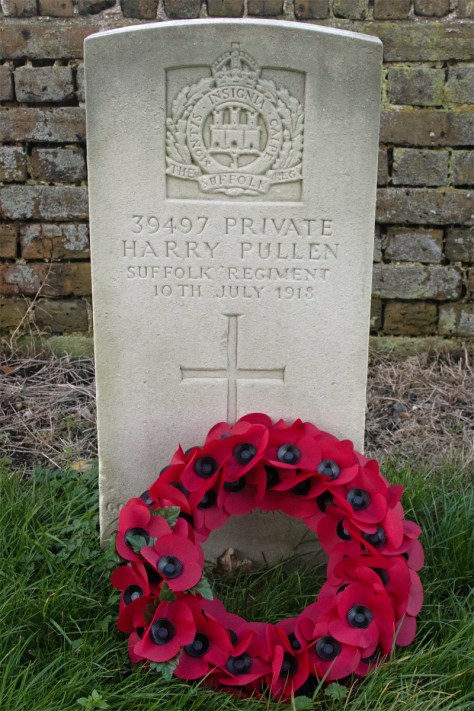
Such was the story of Private Harry Pullen.
What raised the eyebrow? Two words, written on the Army Records of Soldiers’ Effects.
Accidentally Drowned.
Harry Pullen was born in Shirehampton, Gloucestershire in 1886. His father, Robert Edward Pullen, was a carpenter; he and his wife Hannah Presulga Cissy Pullen had three other children, Gwendoline, Herbert and John.
By the time of the 1901 census, Robert is boarding in a house in Bristol with his three sons; Hannah and Gwendoline are not listed (nor do they appear on any other census records I have been able to locate).
Harry is listed as a Telegraph Boy, as is his brother Herbert, but he seemed to have wanted to take up a trade; by 1910 he had moved up to London.
In March of that year, Harry married Harriet Critchell, a spinster fifteen years his senior. On their marriage records for Christ Church, St Pancras, Harry lists himself as a tradesman. The census a year later confirms this – head of the household, he is an Agent for the Provident Clothing Supply Company. (Founded in Bradford, West Yorkshire, Provident’s mission was to help working-class families provide for themselves through the use of vouchers. These were exchanged for goods in local shops, and paid for in affordable instalments.)
Harry enlisted at some point after 1916. His regiment, the 1st (Reserve) Garrison Battalion of the Suffolk Regiment, was not formed until March of that year, and, after starting in Buckinghamshire, it moved to Tilbury in Essex and Gravesend in Kent. The battalion was finally settled in Grain, North Kent in 1918, and it was here that he served.
Here the trail goes frustratingly cold…
Private Pullen’s enlistment and service records are not available, so research is limited to the Army Register of Soldier’s Effects and the Pension Ledgers.
All we have about his death are those two words – Accidental Drowning. There are no contemporary news reports of his passing, which you might expect given the circumstances, so the circumstances surrounding his death are elusive.
Private Pullen died on 10th July 1918. He was 31 years old.
His records confirm that Harriet was entitled to a weekly pension of 15s for the duration of the war and twelves months after.
Harry Pullen is buried in the graveyard of St James’ Church in Grain, Kent, close to where he was stationed.
Charles Cornell was born in July 1885, the youngest of six children to Philip and Martha Cornell, from Ashdon in Essex. Philip was an agricultural labourer, and Charles and his older brother Daniel followed their father into the trade.
Charles was keen to further himself, however, and enlisted in the army. The 1911 census records him as a Private soldier at the Salamanca Barracks in Aldershot.
Private Cornell married Elizabeth Fanny Hoare in Strood, Kent, in October 1913. Beyond this there is little information on either Charles or Elizabeth.
Charles was assigned to the 3rd Battalion of the East Yorkshire Regiment and was promoted to Corporal. This reserve battalion was initially based in the town of Beverley, before moving to Hull and then nearby Withernsea. It seems unlikely, therefore, that Corporal Cornell saw active service on the Western Front.
His passing seems to have been sudden; his pension record shows that he had been admitted to the Military Hospital at Wharncliffe with nephritis (inflamed kidneys). He passed away on 27th January 1918, aged 32 years old.
Corporal Charles Cornell is buried in the graveyard of St Helen’s Church in Cliffe, Kent, the village his widow’s family were from. He is also commemorated in his own family’s village of Ashdon in Essex (where the memorial states he had attained the rank of Sergeant).
The majority of the the Commonwealth War Graves Commission headstones in the UK are made from Portland stone, although, in face, over 50 different natural stones have been used.
Corporal Cornell’s headstone is one of two in St Helen’s Churchyard that have been fashioned from dark grey slate.
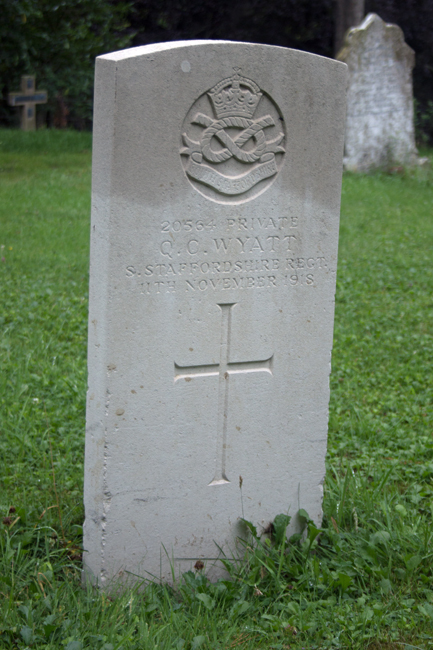
Quinton Charles Wyatt was born in the Gloucestershire town of Northleach in 1893 to William and Elizabeth. His mother died when he was a toddler, leaving William to look after Quinton and his older sister Agnes.
By the time war was declared, Quinton was working as a farm labourer and waggoner in the Gloucestershire village of Hampnett.
Quinton enlisted in the 8th Battalion of the South Staffordshire Regiment on 22nd November 1915. Appointed Lance Corporal just two months later, he was posted to France in March 1916.
Neglect of duty in June meant that Lance Corporal Wyatt was demoted to Private four months later. His battalion was caught up in a German gas attack in the autumn of 1917, and he was injured; ultimately, he was medically discharged from the Army on Boxing Day 1917.
Quinton Charles Wyatt finally succumbed to his injuries on 11th November 1918 – Armistice Day. He was 25 years old.
He is buried in St Mary’s churchyard in the village of Charlton Mackrell in Somerset.
Private Roberts Pretoria Hallett was born in the summer of 1900, to Frank – a shepherd from Charlton Adam in Somerset – and Emily, who came from the neighbouring village of Charlton Mackrell. Roberts (the correct spelling) was the youngest of eleven children.
Roberts was just twelve when his father died, and, when war came, he enlisted in Taunton, along with his brothers, Francis and William.
Private Hallett was assigned to the 5th Battalion Royal Warwickshire Regiment. While his records don’t identify exactly when he saw battle, by the last year of the war the battalion would have been involved in the fighting in northern Italy.
What we can say for certain is that he was shipped home at some point towards the end of the war. He was admitted to the No. 1 Northern General Hospital in Newcastle-upon-Tyne in October 1918. Private Hallett’s records show that he died “of disease” on 16th October.
Roberts Pretoria Hallett lies at rest in the churchyard of St Mary’s in his home village of Charlton Mackrell, Somerset.
The Great War was not kind to Emily Hallett: having lost her husband in 1912, her son William died while fighting in India in 1916 and that is where he was buried. Her other son Francis died in the Third Battle of Ypres in June 1917 and lies at rest in Belgium.
Roberts Hallett, therefore, is the only one of the three brothers to be buried local to her.
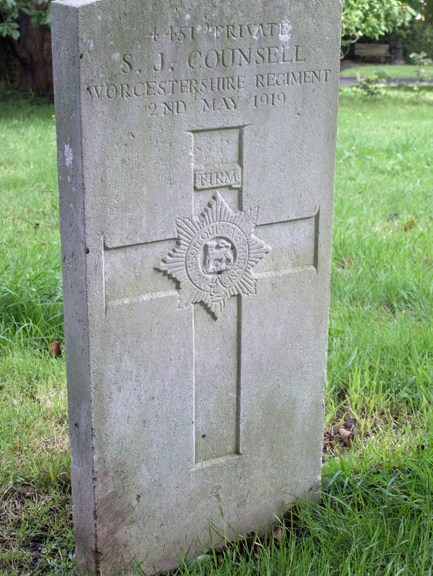
Stanley John Counsell was born in September 1896 to George and Ellen, farmers in Glastonbury.
The youngest of five children, Stanley was an apprentice carpenter by the time he enlisted with his brothers Lawrence and Wilfred.
Private Counsell joined the Worcestershire Regiment in 1915 and was sent into action in France in September 1916.
He suffered medically during the war, succumbing to tonsillitis and diarrhoea during his time in France. A bout of tuberculosis in late 1918 saw Stanley shipped back to the UK and admitted to a hospital in Newcastle-upon Tyne.
The end of the Great War came and went, and Stanley was finally discharged from the army in March 1919, as no longer medically fit for war service.
On 2nd May 1919, less than six weeks after being discharged, Private Stanley Counsell passed away. He was 23 years old and was a victim not of the war, but of the subsequent influenza pandemic, which killed 250,000 people in the UK alone.
Stanley John Counsell lies at peace in the cemetery of his home town, Glastonbury.
Edwin Robert Hann was born in Johannesburg, South Africa, to Albert Edward and Jemima Jane Hann in around 1900. Albert had been born in Glastonbury, Somerset, but had emigrated by the 1890s, where he met and married Jemima.
Research has led me to numerous dead ends regarding Edwin’s life. Hann’s tombstone shows that he enlisted in the 2nd Regiment of the South African Infantry.
The 2nd Regiment served in numerous key battles on the Western Front, including Ypres, Passchendaele, Marrieres Wood and Messines. Their last major engagement was at Le Cateau in early October 1918. Given how soon afterwards Private Hann passed away, it seems possible that he was fatally wounded – or at least suffered trauma – during this battle.
His war pension records suggest that he died at a military hospital in Woking, Surrey. A little research suggests that, unless this was the medical wing of the local army barracks, then it is likely that Hann was treated at the former Brookwood Hospital (at the time known as Brookwood Asylum or the Surrey County Lunatic Asylum).
While I can find nothing concrete to confirm this, other Brookwood records suggest that fellow patients were either suffering the effects of shell shock or mustard gas. It is reasonable to assume, therefore, that Private Hann passed away as an indirect result of the fighting on the front, rather than a direct one.
Edwin Robert Hann died aged just 18 years old. His body was brought back to his grandparents, and he lies at rest in the cemetery in Glastonbury, Somerset.
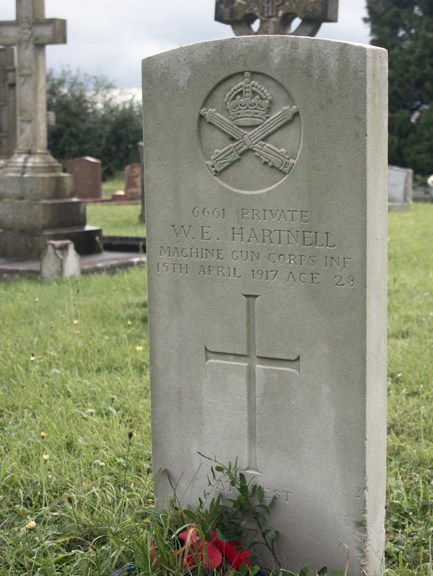
Walter Ernest Hartnell was born in 1888 to William and Jane Hartnell in Charlton Musgrove, on the outskirts of Wincanton in Somerset.
One of eight children, it appears he could have been a bit of a tearaway in his youth; in October 1905, the Shepton Mallet Journal reports on a “Hobbledehoy Nuisance” in Evercreech, when a Walter Hartnell was caught with nine of his friends causing a disturbance close to the church.
They were shouting, racing after each other up and down the road, using obscene language, and smoking cigarettes. This continued till 7.15, about half an hour.
Shepton Mallet Journal – Friday 20th October 1905
Hartnell was fined 5/- and 2/6 costs, or would face ten days in prison.
Things looked up for Walter and, by the time his call to enlist came, he was working on the railways. He joined the Somerset Light Infantry and the Machine Gun Corps (MGC), while his brother Fred fought in the Royal Artillery.
The MGC was a particularly brutal part of the armed forces. Of the 170,500 officers and men who served in the corps, 62,049 became casualties, including 12,498 killed, earning it the nickname ‘the Suicide Club’.
Details of Private Hartnell’s death are sketchy; his company saw action at Ypres and Arras. However, records suggest that he died in Colchester; the Military Hospital there was used to dealing with troops straight from the Front. It is likely that he was injured at Ypres and shipped back home to recuperate, but died of his injuries.
This is all conjecture on my part, of course, but either way, Private Walter Hartnell lies at peace in a quiet cemetery at Evercreech in Somerset.










 Death and Service