Tag Archives: shrapnel

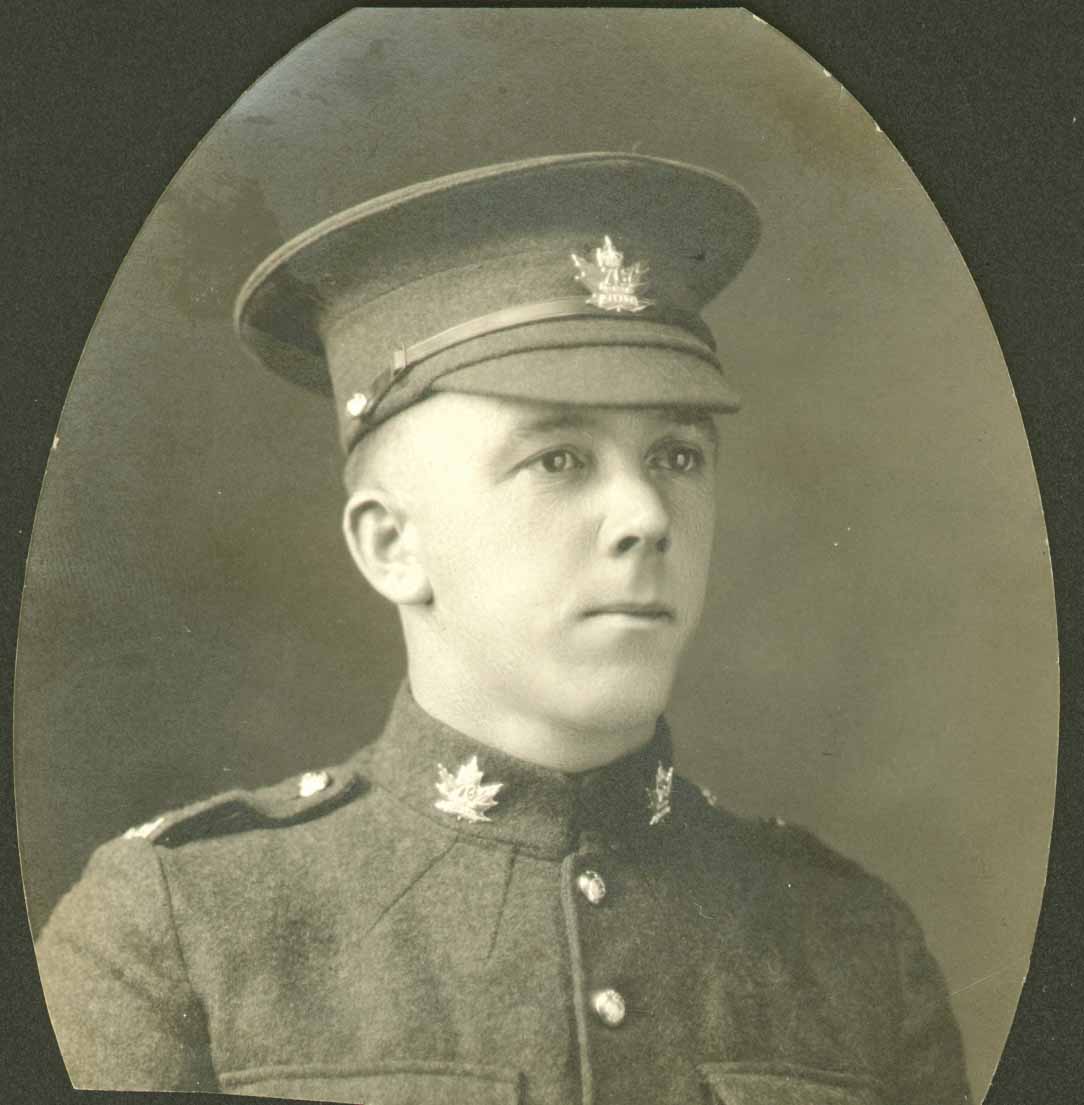
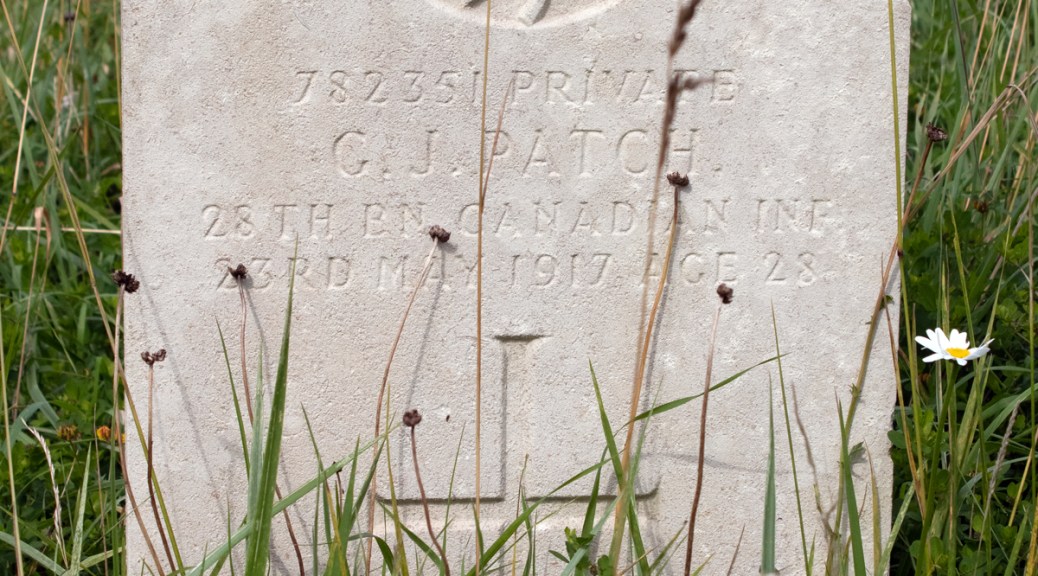
Private Gilbert Patch

Private Gilbert Patch

Gilbert John Patch was born in Winford, Somerset, on 3rd July 1888. The third of seven children, his parents were haulier Robert Patch and his wife Ann.

Gilbert followed his father into carting work, but the opportunity of a bigger and better life presented itself. In the spring of 1913, he emigrated to Canada, to find land and work as a farmer. He settled in the hamlet of Caron, Saskatchewan with a friend from home, Percy Worle.

Gilbert’s time overseas was not to be a length one, however. When Europe went to war, the empire was called upon and, on 1st April 1916, Gilbert enlisted in the Canadian Expeditionary Force. His service records show that he was 5ft 8ins (1.72m) tall, with blue eyes, fair hair and a medium complexion.

After his training, Private Patch arrived in France on 28th December 1916, and was assigned to the 28th Battalion of the Canadian Infantry – the same troop as his friend, Percy. During the Capture of Hill 70 in May 1917, Percy was killed and Gilbert himself was badly injured, receiving shrapnel wounds to his head, left arm and right leg.

Private Patch was medically evacuated to Britain for treatment. He was admitted to the Clopton House War Hospital in Stratford-upon-Avon, and while his wounds were treated, within a couple of weeks, he was dangerously ill with a kidney infection. The combination proved too much for his body to take, and Gilbert died on 23rd May 1917. He was 28 years of age.

Gilbert John Patch’s body was brought back to Somerset for burial. He was laid to rest in the graveyard of the local parish church, St Mary & St Peter’s, in his home village of Winford.

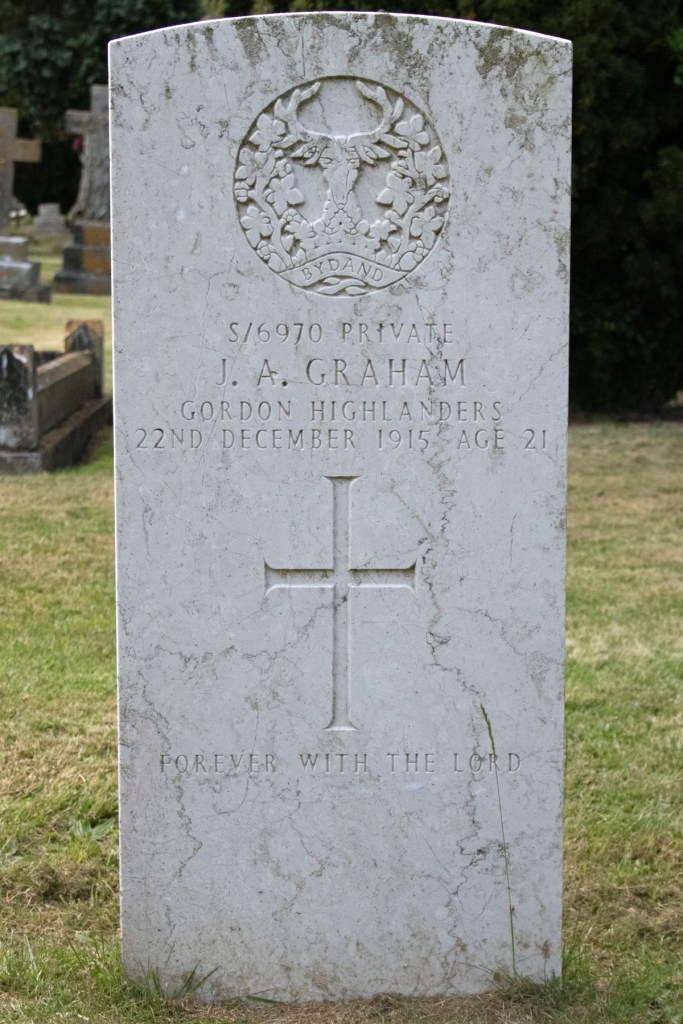
Private Joseph Graham

Private Joseph Graham

Joseph Aitken Graham was born in Kirkmichael, Dumfries, in 1894 and was the son of James and Bella Graham. There is little detail about his early life, but by the time war broke out, he was working with his father as a ploughman.

Joseph enlisted in November 1914, joining the 2nd Battalion of the Gordon Highlanders as a Private. His medical report records that he was 5ft 9.5ins (1.77m) tall, weighed 145lbs (65.8kg), had grey eyes, brown hair and a fresh complexion.

After a short period of training, Private Graham was sent to the Western Front, arriving in France on 2nd February 1915. He was involved in the fighting at Neuve Chapelle and Aubers Ridge. It was at Festubert, however, that things took a turn for the young private.

On the first day of the battle, 16th May 1915, Graham was badly injured, receiving gunshot and shrapnel wounds to his head and legs. He was initially treated at nearby Bethune, before being moved to Rouen. He was then evacuated to England in July, to further his recovery, and admitted to hospital in Wincanton, Somerset.

He was making such good progress that he was able to take a short walk each morning, and it was after one of these walks that he was taken ill. In spite of all that medical skill could do his condition became gradually worse, and it was thought advisable to send to Dumfries for his parents, who at once proceeded to Wincanton.

Dumfries and Galloway Standard: Saturday 8th January 1916

Sadly, nothing could be done for Private Graham: he passed away from a suspected brain haemorrhage on 22nd December 1915, at the age of just 21 years old.

Joseph Aitken Graham was laid to rest in the quiet and peaceful Wincanton Cemetery.


Bombardier Harold Cornall

Bombardier Harold Cornall

Harold William Cornall was born on 16th August 1890 in Kingsteignton, Devon. He was the oldest of six children to William and Elizabeth Cornall. William worked as a carter and labourer for a tannery in the town, and, when he left school, this was where Harold also went for work.

In the autumn of 1912, Harold married Hilda Potter, from nearby Newton Abbot. The couple set up home and went on to have one child, a daughter called Winifred.

War broke out and, on 29th August 1914, Harold enlisted in the Royal Field Artillery. He was assigned to the A-Battery of the 90th (Howitzer) Brigade and was given the rank of Bombardier. He soon found himself in the thick of battle, as the brigade was sent to The Somme.

Bombardier Cornall was injured in the spine by some shrapnel, and medically evacuated to England in June 1916. Sadly, his injuries led to him becoming paralysed, and he passed away at the King George’s Hospital in London on 20th August 1916. He was just 26 years of age.

Harold William Cornall’s body was brought back to Devon; he was laid to rest in the graveyard of St Michael’s Church in his home town of Kingsteignton.


Private William Ridley

Private William Ridley

William Frederick Ridley was born on 7th April 1887 in the New Brompton area of Chatham/Gillingham, Kent, one of eight children to John and Elizabeth Ridley. John was an engine fitter in the nearby naval dockyard and, as the key employer in the area, William followed in his father’s footsteps.

Sadly, John died in 1904, and this seems to have been what spurred his son on to a better life. In 1907 William emigrated to Canada, settling in the town of Wentworth, on the banks of Lake Ontario.

It was in Ontario that William met his future wife. Edith Wass was the daughter of a local labourer; the young couple married on 5th June 1909, and went on to have two children, John, born in 1910, and Wilfred, who was born five years later.

During this time, William was putting his engineering skills to the test; his marriage banns confirm he was a machinist. While there is nothing to confirm any specific trade, given his proximity to the coast, dockyard employment seems probable.

On the other side of the Atlantic, war was breaking out; keen to do his part for King and Country, William enlisted in the Canadian Expeditionary Force on 28th July 1915. Initially enlisting in the 76th Overseas Battalion of the Canadian Infantry, he was shipped to England a year later and transferred across to the 4th Battalion.

Once on the Western Front, Private Ridley was thrown right into the thick of things. His battalion fought at the Battle of Flers-Courcelette – part of the Battle of the Somme – and it was here, on 18th September 1916, that he was wounded.

William received shrapnel wounds to his head, hand and right leg. Initially treated on site, he was quickly evacuated back to England, and admitted to the 2nd London General Hospital in Chelsea. Sadly, however, his wounds appeared to have been too severe; Private Ridley passed away from them on 30th November 1916, aged just 29 years old.

With his widow and children still in Canada, William’s body was taken back to Kent. He lies at rest in the Woodlands Cemetery in Gillingham, close to where his mother was still living.


Larger memorial image loading...
Private William Ridley
(from findagrave.com)

Lance Corporal William Neads

Lance Corporal William Neads

William John Neads was born on 16th December 1892, the middle of three children to cab driver and groom William Neads and his wife Ellen. Both William Sr and Ellen were from Somerset, although William Jr and his brother Charles – who was eleven months older – were both born in the Monmouthshire village of Cwmcarn.

William’s parents soon moved the family back to Clevedon in Somerset, and, when he left school, he found work as a farm labourer. He was eager to see more of the world, however and, in April 1913, he emigrated to Canada.

After working as a labourer there for a year or so, back in Europe war was declared. Keen to do his bit for King and Country, William enlisted in the 1st Battalion of the Canadian Infantry in January 1915. He soon found himself caught up on the Front Line.

In October 1916, he was involved in the Battle of the Somme – either at Le Transloy or The Battle of the Ancre Heights – and received a shrapnel wound to his left shoulder. Initially admitted to the Canadian General Hospital in Etaples, he was subsequently evacuated to England and the Northern General Hospital in Leeds. He spent three months recovering from his injuries, and was back on the Western Front in January 1917.

Later that year, William – now a Lance Corporal – was involved in the fighting at the Second Battle of Passchendaele (part of the Third Battle of Ypres). He was wounded again, this time receiving a rather unceremonious gunshot wound to the right buttock. Treated at the scene, he was evacuated back to England and admitted to the Fusehill War Hospital in Carlisle on 17th November.

Sadly, despite treatment, Lance Corporal Neads’ health deteriorated, and he passed away from his injuries on 16th December 1917, his 25th birthday.

William John Neads was brought back to his family’s home of Clevedon, and buried in the clifftop churchyard of St Andrew’s, overlooking the sea.


Tragically, William’s father had died in May 1917, at the age of 51. While no details of his passing are recorded, it meant that Ellen had, in just over a year, seen her son wounded, her husband die and her son wounded again and die as a result.