Tag Archives: Wiltshire

Private Percy Gerrish

Private Percy Gerrish

Percy Gerrish was born on 22nd August 1890 in Bath, Somerset. The youngest of three children – all boys – his parents were Alfred and Charlotte Gerrish. Alfred was painter and decorator by trade but, by the time of the 1911 census, the family had moved to Batheaston, and he was employed as a school attendance officer.

Alfred and Charlotte had raised their children well: the same census recorded their oldest son, also called Alfred, was employed as a clerk; their middle son, Reginald, was a printer; Percy, then 20 years old, was working as a draughtsman for an engineering company,

War came to Britain’s shores in 1914, and while he did not join up at once, when the Military Service Act of 1916 came in, Percy found himself conscripted. He enlisted on 24th November 1916 and, while he noted a preference for the Royal Field Artillery or Royal Garrison Artillery, his previous employment made him ideal for work as a clerk in the Army Service Corps.

Private Gerrish’s time in the army was spent on home soil. Full details are not available, but he certainly served in camps around Codford, Wiltshire. This may have been how he met a young woman called Ada Cox, who lived in Bemerton, on the outskirts of Salisbury. On 21st July 1917, the couple married in the new Mrs Gerrish’s local church.

Percy’s army career went well, although during 1918 illness was to dog him. He spent a week in a hospital in Fovant, near Salisbury in June, suffering from influenza, before being readmitted for a month just a week later, having contracted pharyngitis – an inflammation of the pharynx.

By the late summer of 1918, Private Gerrish had been moved to Newport Pagnell, Buckinghamshire. His ongoing health conditions were still an issue, however, and on 23rd October he was admitted to the Tickford Abbey Auxiliary Hospital. He had contracted laryngitis by this point, but, as the weeks in hospital progressed, he was soon also bogged down by tuberculosis.

Sadly, this was to prove Percy’s undoing. He passed away on 27th December 1918, aged just 28 years old.

Percy Gerrish’s body was brought back to Somerset for burial. He was laid to rest in the graveyard of St John the Baptist Church, in a plot next to his father, Alfred, who had died seven months before.


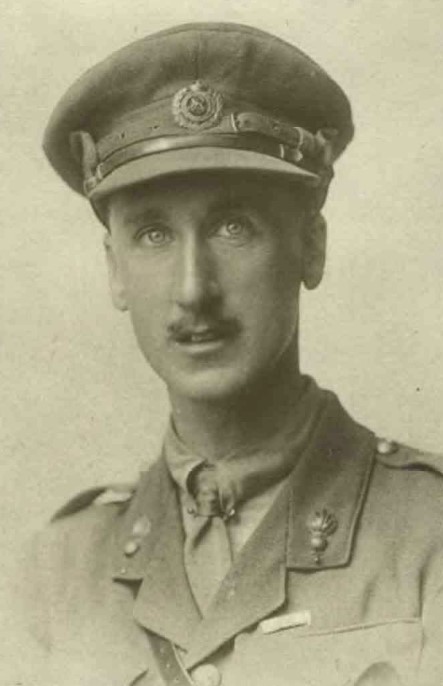
Major Francis Dickinson

Major Francis Dickinson

Francis Arthur Dickinson was born on 5th February 1874 in Lufton, near Yeovil, Somerset. The elder of two children, his parents were banker Arthur Dickinson, and his wife, Alice.

Francis was drawn to a military life. The 1891 census lists him as an army student at a boarding school in Cornwall, and by the end of the decade, he had enlisted in the Duke of Cornwall’s Light Infantry.

Over the next fifteen years, Francis served around the world, fighting in India, South and East Africa and in the Middle East. By the end of his term of service, he had risen to the rank of Major. During this time, he had been awarded a number of decorations, and had been mentioned in dispatches twice for his gallantry.

On 23rd July 1914, Francis married Clare Phipps, the daughter of a man of private means from Dilton Marsh, near Westbury, Wiltshire. The couple married in Clare’s home village, but set up residence in the Dickinson family home in Kingweston, Somerset.

When war was declared in 1914, the newlyweds were on their honeymoon. Francis returned to the army and was offered the rank of Colonel, but turned it down, in order to return to the Duke of Cornwall’s Light Infantry. He soon found himself in the thick of things again, and was caught up in the fighting at Mons, Marne, Aisne and Messines.

In April the following year, Major Dickinson was wounded. Evacuated to a camp hospital in Boulogne, he was not to survive his injuries this time round. He passed away at the hospital on 11th April 1915, at the age of 41 years old.

Due to the masses of servicemen being killed, a decision had been taken by the government of the time to not repatriate the dead to Britain, but to bury them in cemeteries close to where they fell. However, whether because of his family’s connections, or because he passed on the Channel coast, Major Dickinson’s body was, in fact, brought back to Somerset.

Francis Arthur Dickinson was laid to rest with full military honours in the graveyard of All Saints’ Church. He was buried alongside other family members, and in the shadow of the family manor.


Major Francis Dickinson
(from findagrave.com)

Private Ernest Bailey

Private Ernest Bailey

Ernest Stanley Bailey was born in the autumn of 1900 in the quiet Somerset village of Barton St David. The oldest of three children, his parents were stonemason William Bailey and his wife, Fanny.

Ernest was only 14 years old when war broke out, but his time to serve his King and Country came in the summer of 1918. He enlisted in the Devonshire Regiment and was assigned to the 53rd (Young Soldier) Battalion.

Private Bailey was sent to the Rollestone Camp, near Shrewton in Wiltshire for training. With the war in its closing months, army barracks were still places rife with disease, and Ernest was not to be immune from this. He contracted influenza, which then became pneumonia, and was admitted to the camp hospital. Sadly, the conditions were to prove too much for his young body to bear, and he passed away on 6th November 1918. He was just 18 years of age.

Ernest Stanley Bailey was brought back to Somerset for burial. He was laid to rest in the peaceful graveyard of St David’s Church in his home village, Barton St David.


Private George Williams

Private George Williams

George Williams was born in 1887 in Ruthin, Denbighshire. One of thirteen children – of whom sadly only seven survived – his parents were John and Martha Williams. John was a carpenter and joiner and, when the children had grown a little, he and Martha took on the Registered Tramp Lodging House in Church Street, Llangollen.

The 1911 census recorded George living with his parents and working as a carter. His younger brother John was employed as a labourer, while the rest of his siblings were at school. The boarding house was full as Martha’s brother was staying there, along with four lodgers.

George married Catherine Edwards on 27th May 1911. She was an engineer’s daughter, also from Llangollen, and the couple tied the knot in St Collen’s Church, which was on the same street as the Williams’ boarding house. The newlyweds moved to Ruabon, six miles (10km) to the east of Llangollen, and had a daughter, Martha, who was born in 1912.

When war was declared, George was quick to enlist. He joined the 8th (Service) Battalion of the Royal Welch Fusiliers, and was sent to Salisbury Plain for his training. While here, however, Private Williams passed away. The cause of his passing is not readily available, but it seems likely that he succumbed to illness, possibly brought on by the sudden influx of men from across the country suddenly billeted together in the confines of an army camp. He died on 7th December 1914, aged just 27 years of age.

George Williams’ body was brought back to Wales for burial. He was laid to rest in the graveyard of St John’s Church in Llangollen.


Tragically, just six days after George’s death, Catherine gave birth to their second child. George Jr would never know his father.


Corporal de Courcy Raymond

Corporal de Courcy Raymond

de Courcy William Raymond was born in the summer of 1883 in the Somerset village of West Camel. He was one of six children to carpenter George Raymond and his wife, Anne. de Courcy – whose name may have had family connections – followed his father into carpentry and, by the time of the 1911 census, the family had moved to nearby South Barrow, where George had been born.

When war came to Europe, de Courcy was keen to play his part. Sadly, full details of his military service no longer survive, but what can be determined is that he had enlisted by March 1915, joining the North Somerset Yeomanry.

Private Raymond was assigned to the 2nd/1st Battalion, which was a second-line troop, and remained on home soil, moving from Somerset to Wiltshire to Kent by the autumn of 1915. He was evidently good at his job as he was soon promoted to the rank of Corporal for his efforts.

It was while he was based in Kent that de Courcy fell ill. He contracted pneumonia, and was admitted to a military hospital in Canterbury. Sadly, the condition was to prove too much, and he passed away from the condition on 9th October 1915. He was 32 years of age.

The body of de Courcy William Raymond was brought back to Somerset for burial. He was laid to rest in the family plot in the graveyard of St Peter’s Church in South Barrow.


Second Lieutenant Francis Willis

Second Lieutenant Francis Willis

Francis John Henry Willis – who was known as Frank – was born in the summer of 1893 in Totnes, Devon. The youngest of three children, his parents were William Willis – a solicitor’s clerk turned accountant – and Susannah, who was the headmistress of a boarding school.

Education played a strong role in Frank’s upbringing, and, by the time of the 1911 census, he was recorded as being an student of architecture and surveying. (Interestingly, in the same census his older brother, William, was noted as having an infirmity, that of his being “delicate from birth.”)

When he completed his studies, Frank found employment in Newton Abbot, where he worked as an architect for Rowell, Son and Locke. War was coming to Europe, however, and in November 1915, he enlisted in the Royal Engineers.

Frank rose through the ranks, and was given a commission in the Royal Air Force when it was formed in April 1918. Based on Salisbury Plain, the now Second Lieutenant Willis became known as an expert shot, making numerous flights without incident.

On the 20th September 1918, however, that was to change. Taking off on a routine flight, the Avro 504K that he was flying stalled and spun into ground, catching fire. Second Lieutenant Willis was killed instantly. He was just 25 years of age.

Brought back to Devon for burial, Frank John Henry Willis was laid to rest in the cemetery of his home town, Totnes.


Private Robert Cantle

Private Robert Cantle

Robert Cantle’s life is one of hope and of tragedy. There is very little documentation on him, but what there is gives a hint to his life.

The 1911 census recorded him a living on Temple Street in Keynsham, Somerset. The head of the household was 86 year old John Cantle, a retired platelayer for Great Western Railway. His wife, Mary, was 22 years his junior, and they shared the house with their son, stationary cutter Ernest, his wife, Elsie, and their daughter, Madge. Robert was noted as being John and Mary’s adopted son. His age was given as 13, but his place of birth is ‘unknown’.

When war broke out, Robert joined the Wiltshire Regiment. Private Cantle set off for camp in Wiltshire in August 1917, and had been there for just two days when tragedy struck.

There were heavy thunderstorms in the Warminster district on Thursday, and while men of a unit of the Wiltshire Regiment were on the parade ground, three of them were struck by lightning. Pte. Robert Cantle, aged 19 years, whose home is at Keynsham, was killed on the spot, and the other two, Pte. Rowe and Pts Murgatroyd, were severely injured…

Sergeant Major HJ Bennett, of the Wilts Regiment, stated [at the inquest] the deceased lad had only just joined them. About 3pm on Thursday a squad was on the parade ground, when the signal was given to dismiss, as a storm was approaching. Immediately after there was a flash and a crash and it seemed to stagger everybody on the parade ground. Witness was brought to his knees, and when he recovered himself he saw three men, who of whom were struggling, on the ground. Private Cantle was found to be dead, and the other men recovered after being attended by a doctor. The squad consisted of recruits, and none of them were carrying arms.

Major Stocker, medical officer, said the crown of deceased’s cap was ripped off, and the body was burned from head to foot.

The jury returned a verdict of “Death from the effects of lightning.”

Somerset Standard: Friday 17th August 1917

Robert Cantle’s body was brought back to Keynsham for burial: he was laid to rest in the town’s cemetery.


Sapper Albert Headington

Sapper Albert Headington

Albert Edward Headington was born on 5th December 1876 in Keynsham, near Bristol, in Somerset. The ninth of eleven children, his parents were Joseph and Jemima Headington. Joseph was a stonemason and, while he seems not to have had his father’s talents, Albert worked with the same material, becoming a bricklayer’s labourer when he left school.

On 29th May 1899, Albert married Ellen Gray. She was a mason’s daughter from Semley in Wiltshire, and it seems that he was either working there or had some connection with the family through his father’s work. The couple settled down in Keynsham, and went on to have two children, Harold, who was born in 1900, and Edith, who was born in 1912.

By the time of the 1911 census, the family had settled in a small house in the middle of Keynsham. Albert had, by this point, found other employment, and was working for Great Western Railways as a packer.

When war broke out, Albert stepped up to play his part. He enlisted on 22nd June 1915, joining the Royal Engineers as a Sapper. Sent for initial training in Chatham, Kent, he returned home on leave at the end of August. Tragically, he had fallen ill by this point, and died at home on 4th September 1915, having contracted cerebrospinal meningitis. He was 38 years of age.

Albert Edward Headington was laid to rest in the quiet cemetery of his home town of Keynsham.


Ellen went on to live a full life. She and Edith emigrated to Canada in 1921, following Harold, who had made the same move a year earlier. They all settled in the town of Welland, Ontario, not far from Niagara Falls.

Both of Albert and Ellen’s children married and had children of their own. Ellen never remarried, and passed away on 4th November 1956, at the age of 80 years old. She was laid to rest in the Holy Trinity Anglican Cemetery in Welland.


Private Thomas Perrett

Private Thomas Perrett

Thomas William Perrett was born in October 1878, the seventh of eight children to Lewin and Ann Perrett. Lewin was an agricultural labourer from Wiltshire, and it was in Aldbourn, near Marlborough, that the family were raised.

Initially finding work as a farm labourer, Thomas was soon drawn to the bright lights and big city. By the early 1900s he had moved to London, and it was here that he met, and in 1909 married, Mary Sterry, a labourer’s daughter from Middlesex. The couple went on to have three children, Elsie, Rose and Alice.

Thomas, by this point, had found work on the railways: the 1911 census records him as a railway porter, presumably at Paddington Railway Station, which was within a few minutes’ walk of where the Perrett family were living.

War came to Europe, and Thomas was keen to play his part. Full details of his service are not available, but he enlisted in the East Surrey Regiment, where he was assigned to the 2nd/5th Battalion. This was a second line unit, and Private Perrett remained on home soil for the duration of the war.

This territorial role was reinforced when he transferred across to the 696th Agricultural Company of the Labour Corps. Details of his work are not available, but it seems likely that he was assigned to farm work in the mid-Sussex area.

This too is where Private Perrett remained after the war and where, on 24th February 1919, he was to pass away. Details of his death are vague and the cause is unknown, but he was 40 years of age.

Thomas William Perrett was laid to rest in the cemetery in Cuckfield, West Sussex.


Private Cyril Pratt

Private Cyril Pratt

Cyril Robert Pratt was born on 31st October 1899 in the Somerset village of Halse. The younger of two children, his parents were local baker Robert Pratt and his wife, Elizabeth.

Little information about Cyril’s early life remains. He enlisted in the army not long after his eighteenth birthday, joining the Royal Warwickshire Regiment as a Private in November 1917. He was sent to Salisbury Plain for training, and was barracked in Larkhill, just north of Stonehenge.

Sadly, this seems to have been Private Pratt’s undoing. As with numerous other soldiers at the time, being billeted in cramped quarters with other men from across the country meant that disease was quick to spread. During his first winter at the camp, Cyril contracted pneumonia, and was admitted to the local Fargo Hospital. The lung condition was to get the better of him, and he passed away on 28th February 1918, at the age of just 18 years old.

Cyril Robert Pratt was brought back to Somerset for burial. He was laid to rest in the graveyard of St James’ Church in his home village, Halse.