Tag Archives: wound

Private Bert Mayled

Private Bert Mayled

Bert Mayled was born in the autumn of 1889, the fourth of four children – all boys – to Benjamin and Anna Mayled. Benjamin was a butcher from Somerset, who raised his young family in the seaside town of Weston-super-Mare.

The whole family followed in Benjamin’s trade, with all four siblings supporting in one way or another, either through farm work or, in Bert’s case, becoming a butcher as well.

On 6th July 1914, Bert married Catherine Swearse, a builder’s daughter from nearby Axbridge. They married in Catherine’s local church, but settled – albeit briefly – back on the coast.

Bert may even have enlisted by the time of the wedding. While he is noted as a butcher on the marriage banns, within weeks war had broken out across Europe, and he found himself in the North Somerset Yeomanry.

Private Mayled’s regiment was one of the first into the fray – he was soon on the Front Line at Ypres. He was wounded early on, and medically evacuated to England for treatment. Admitted to the 2nd Western General Hospital in Manchester, he succumbed to tetanus, contracted from his wounds. He died on 25th November 1914, at just 25 years of age.

Bert Mayled was brought back to Weston-super-Mare for burial. He lies at rest in the Milton Road Cemetery there.


Private Albert Sparrow

Private Albert Sparrow

Albert Edward Sparrow was born in Frome, Somerset, in March 1880. One of four children, his parents were Albert and Louisa Sparrow. Albert Sr was a labourer at an iron foundry, and the family were raised close to the centre of the town.

When he left school, Albert Jr found work as a labourer. However, after his father passed away in 1895, he sought longer term prospects. On 11th November 1898 he enlisted in the Royal Fusiliers as a Private for a period of twelve years. His service records show that he stood 5ft 6in (1.67m) tall, weighed 115lbs (52.2kg), had brown eyes, curly brown hair and a sallow complexion.

During his time in the army, Private Sparrow served in Gibraltar, South Africa and Burma. He returned home in March 1903, was placed on reserve in November 1906, and then ended his contract four years later.

At this point, Albert’s trail goes cold. However, when war was declared, he was keen to play his part. He re-enlisted on 27th August 1914, and was assigned to the Somerset Light Infantry. Assigned to the 6th (Service) Battalion, he was sent to France in December that year.

In July 1916, while fighting at the Somme, he was hurt when he received a gunshot wound to his right buttock. The injury proved enough for him to be medically evacuated back to England, and he spent the next five months recovering, and then working, on home soil.

In December 1916, Private Sparrow was sent back out to France. Six months later, he contracted bronchitis and was again evacuated back to England. He was admitted to the Royal Infirmary in Liverpool and, after a month there, he was moved to the Plas Tudno Nursing Home in Llandudno to recover.

Albert’s condition meant that he could not continue in military service, and he was discharged from the army on 18th December 1917. He returned home to Somerset, but his lung condition proved too much; he passed away on 19th January 1918, at the age of 37 years old.

Albert Edward Sparrow was laid to rest in the graveyard of Holy Trinity Church in his home town of Frome.


Corporal George Budgett

Corporal George Budgett

George Edgar Budgett was born in Frome, Somerset in the autumn of 1894, and was one of ten children to Joseph and Annie Budgett. Joseph was a labourer on the roads, but Annie and their eight daughters all went into the town’s silk weaving industry. When they left school, George and his older brother Frederick both found labouring work – Frederick at a bell foundry, George in the silkworks.

Conflict was coming to Europe and, within weeks of the war being declared, George enlisted. He was assigned to the Oxfordshire & Buckinghamshire Light Infantry as a Private and his service records show that he stood 5ft 5ins (1.65m) tall, weighed 114lbs (51.7kg), had dark brown hair and brown eyes.

Private Budgett initially served on home soil, but by May 1915 he was sent to France as part of the British Expeditionary Force, receiving a promotion to Corporal in the process. He had been on the front line for a little over a month when he was wounded at Ypres. He received a shrapnel wound to his left hand and had to have his little finger amputated in the camp hospital. He was then medically evacuated back to England for further treatment and recovery.

George was admitted to the City of London War Hospital in Epsom, and needed a further operation, this time the amputation of the third finger. His health recovered, but the injury to his hand resulted in him being medically discharged from the army on 25th August 1916.

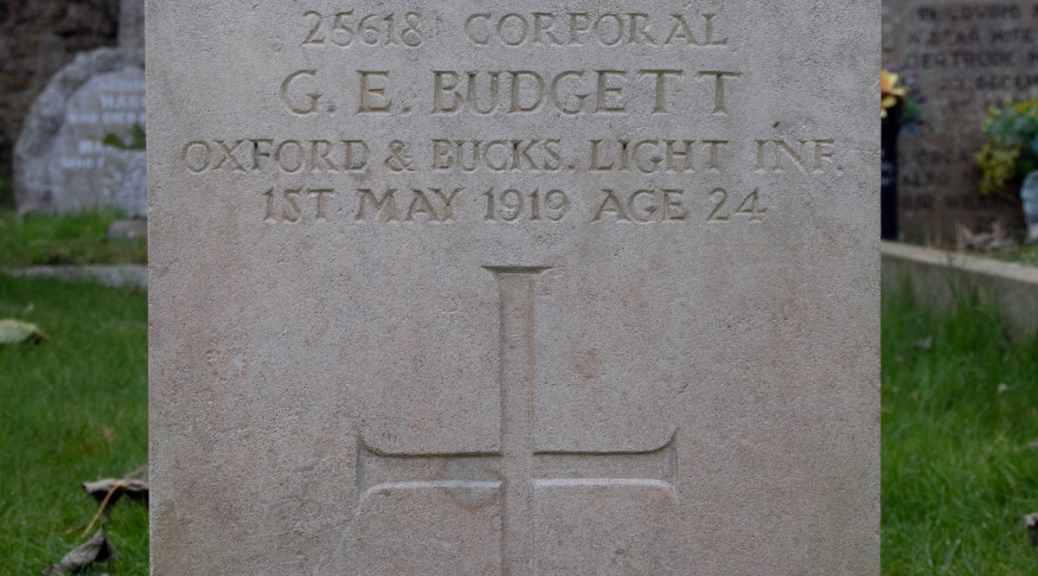
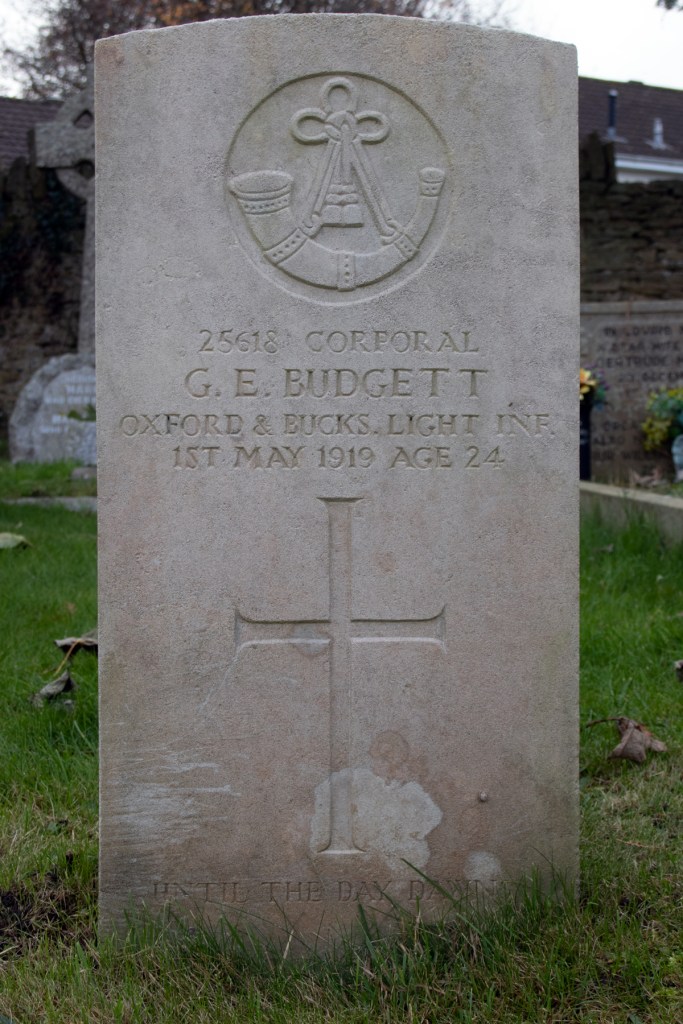
Sadly, at this point Corporal Budgett’s trail goes cold. He passed away at home, through causes unrecorded, on 1st May 1919. He was just 24 years of age.

George Edgar Budgett was laid to rest in the graveyard of Holy Trinity Church in his home town of Frome, Somerset.


George’s brother Frederick – Joseph and Annie’s only other son – also fought in the First World War. He was assigned to the 14th Battalion of the Gloucester Regiment, and was missing in action, presumed dead on 4th April 1918 – possibly during the Battle of the Avre. He was commemorated at the Pozières Memorial in northern France.


Private Percy Coward

Private Percy Coward

Percy Herbert Coward was born in the Wiltshire town of Westbury in the autumn of 1896. He was one of seven children – all boys – to Lily Coward and her weaver husband Charles. Not long after Percy was born, the family moved across the county border to Frome, Somerset, presumably for Charles’ work.

By the time of the 1911 census, the Coward family were living in a five-room end-of-terrace cottage on the outskirts of the town. Charles and Percy were both working as warpers – threading looms – in the cloth industry; two of his brothers were working for a printer in the town. Percy was proving himself an integral part of the community.

[Percy] was very highly esteemed by a large circle of acquaintances… He was a worker with the YMCA and Frome Brotherhood, a member of the band and in other directions showed himself a young man of much promise. He was employed successively at Messrs Houston’s [Woollen Mill] and at the Silk Factory.

Somerset Standard: Friday 26th April 1918

An active member of the town’s territorial force, when the Great War broke out he was mobilised. Initially attached to the Royal Army Medical Corps, he subsequently served with the Royal Army Service Corps and the North Staffordshire Regiment, before obtaining his final transfer to the 42nd Company of the Machine Gun Corps.

During his time in the army, Private Coward would have seen action in some of the fiercest battles of the war – at the Somme, Arras and Ypres. In the spring of 1918, his battalion was involved in the Battles of St Quentin and the Avre, and it was during this last skirmish that he was wounded.

Percy’s injuries were severe enough for him to be medically evacuated back to England and, once there, he was admitted to the Royal Woolwich Hospital in South London. His wounds were to prove too much for him, however, and he passed away at the hospital on 12th April 1918. He was just 21 years of age.

Percy Herbert Coward was brought back to Somerset for burial. He was laid to rest in the Dissenters’ Cemetery, Vallis Road, within walking distance of his family home.


Private Edward Rendell

Private Edward Rendell

Edward Rendell was born in the Dorset town of Corfe Castle in 1894. His parents were Edward and Sophie Rendell, and he had two siblings, William and Agnes.

Sadly, little information on Edward Jr’s early life is available. His father was a farmer – or at least an agricultural labourer – and this is the line of work his son went into.

When war broke out, Edward Jr was quick to play a part, enlisting within a fortnight of hostilities being declared. He joined the 1st Battalion of the Dorsetshire Regiment as a Private and, after initial training, was sent out to the Western Front by March 1915.

Private Rendell’s battalion was involved in the fighting at Ypres and, on 19th April 1915, he was injured, receiving a gun shot wound to his left arm. Initially treated in the field, he was later transferred to a hospital in Boulogne, before being evacuated back to England to recover.

Reunited with his regiment, Edward was then shipped out to Gallipoli, arriving there in September 1915. While he is likely to have been involved in the fighting in Turkey, he did end up in hospital, but was suffering from influenza.

A couple of weeks later, he is recorded as being admitted to a hospital in Malta, although whether this was also because of the lung condition is not clear. Either way, Private Rendell was back in England by mid-December 1915, remaining in the country for six months.

In March 1916, he again returned to the fray and was posted back to the Western Front. Private Rendell spent a couple of months in battle until, on 21st June 1916, he received a gunshot and shrapnel wound to his thigh. The injury was serious enough for him to be medically evacuated back to England, and he was admitted to the Voluntary Aid Detachment Hospital at Norton-sub-Hamdon in Somerset.

Sadly, while his treatment may have bought Private Rendell some time, it seems that his wounds were too severe; he passed away on 30th July 1916 at the age of just 22 years old.

By this time both of Edward’s parents were dead; his next of kin was his sister, Agnes. While she was still living in Dorset, Edward was laid to rest in St Mary’s Churchyard in Norton-sub-Hamdon.


Leading Victualling Assistant George Crossley

Leading Victualling Assistant George Crossley

George Crossley was born on 30th December 1861 in the Stonehouse area of Plymouth, Devon. The oldest of five children, his parents were John and Charlotte. John died when George was only ten years old, leaving his widow to raise the family alone.

Left as the technical head of the family, George sought a reliable career and, in August 1877, aged just 15 years old he joined the merchant navy. After two years at the rank of Boy, he formally joined the crew, working as a Ship’s Steward’s Assistant.

Over the initial ten years of his service, George served on four ships, primarily the Royal Adelaide. In 1889, having seen the world, he signed up for a further decade. This new period of service saw him move up to Ship’s Steward, before working back in the assistant role.

In December 1899, George’s twenty years’ service came to an end. Charlotte, by this time, was in her mid-60s, and perhaps he felt it better to spend time ashore with her, rather than leaving her alone.

His experience did not count for nothing, however, and he found employment as a labourer in the Naval Dockyard in Chatham, Kent. And so another fourteen years passed, before war rose its ugly head.

George was called back into service at the start of the conflict, and resumed his role as a Ship’s Steward’s Assistant. Over the next few years, he served on a couple of ships, but the majority of his time was spent at the shore establishments in Portsmouth, Dover and Chatham. In 1917, George gained the rank of Leading Victualling Assistant, giving him some of the responsibility for the food stores at Chatham Dockyard.

Towards the end of 1918, George seems to have been in the east of the county, when he fractured and dislocated his left ankle. Little specific information is available, but it seems that he was admitted to the Royal Infirmary in Deal, but died of his wounds on 20th December. He was ten days short of his 57th birthday. An inquest later that month reached a verdict of accidental death.

Brought back to Gillingham, George Crossley was laid to rest in the Woodlands Cemetery in the town.