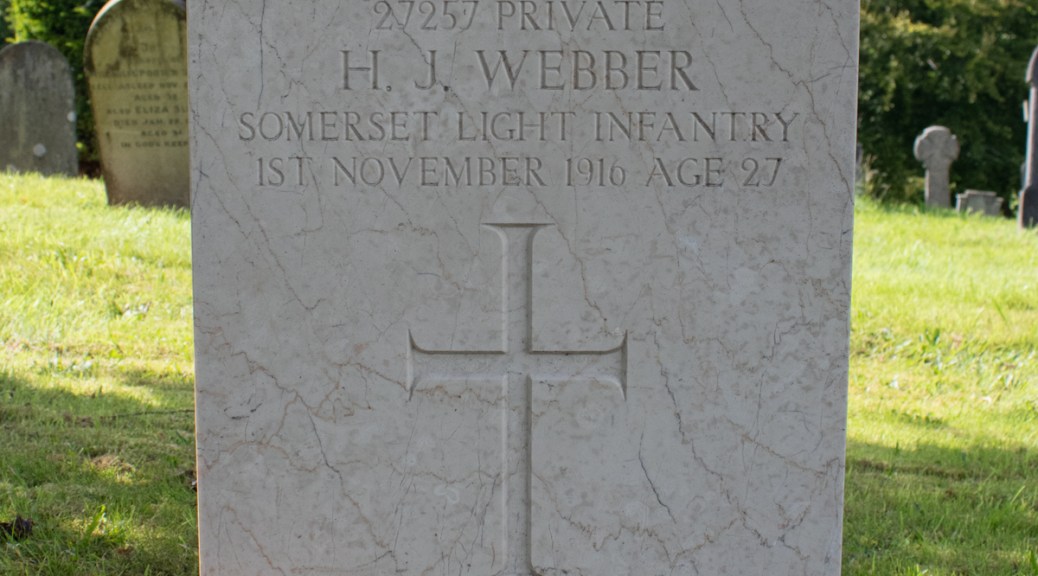
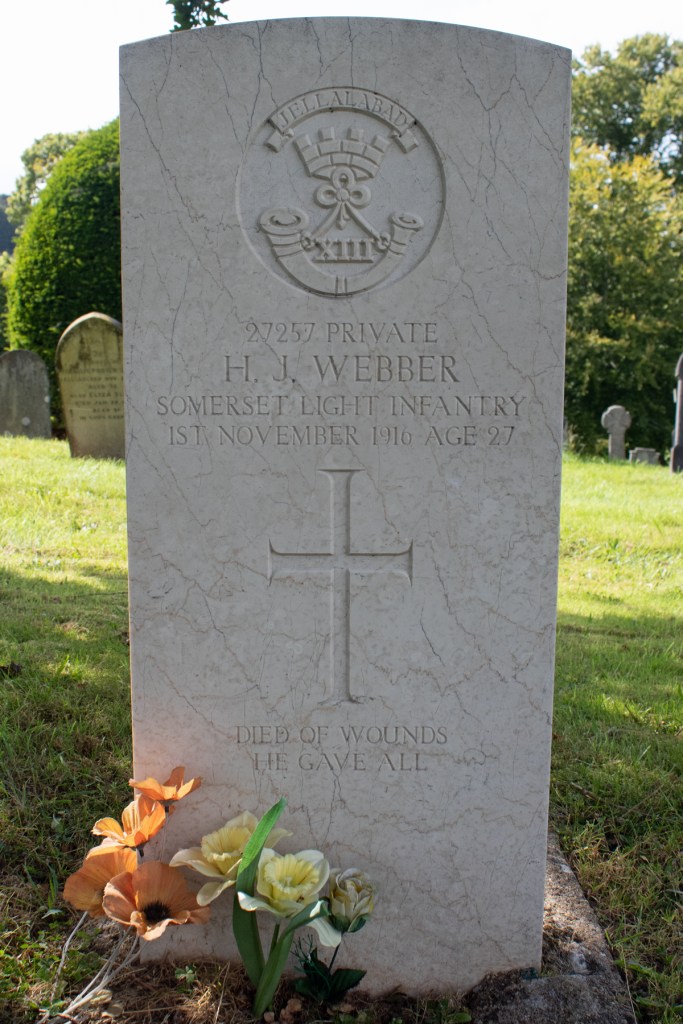
Henry James Webber was born in Plaistow, Essex, in 1889. One of ten children, his parents were Frederick and Etty Webber. Frederick hailed from Somerset, but worked as a sergeant in the Metropolitan Police. By the time of the 1901 census, he had been promoted to Inspector: the family moved to Somerset when he retired in around 1905, settling in Minehead.
Of Henry, there is little information documented. He does not appear on the 1911 census, and there are no military records to confirm his service in the army. He had certainly enlisted by the summer of 1916, joining the Somerset Light Infantry.
Private Webber was attached to the 7th (Service) Battalion and certainly saw action overseas. His troop was heavily involved in the Battles of the Somme in 1916, and it was here that he was injured. Again, full details are not available, but his wounds were severe enough for him to be medically evacuated to Britain for treatment.
Henry was admitted to the 1st Southern General Hospital in Birmingham, but his injuries proved too severe. He died on 1st November 1916, at the age of 27 years old.
Henry James Webber’s body was taken back to Somerset for burial. He was laid to rest in Minehead Cemetery, not far from where his grieving family were living in Cher Street.
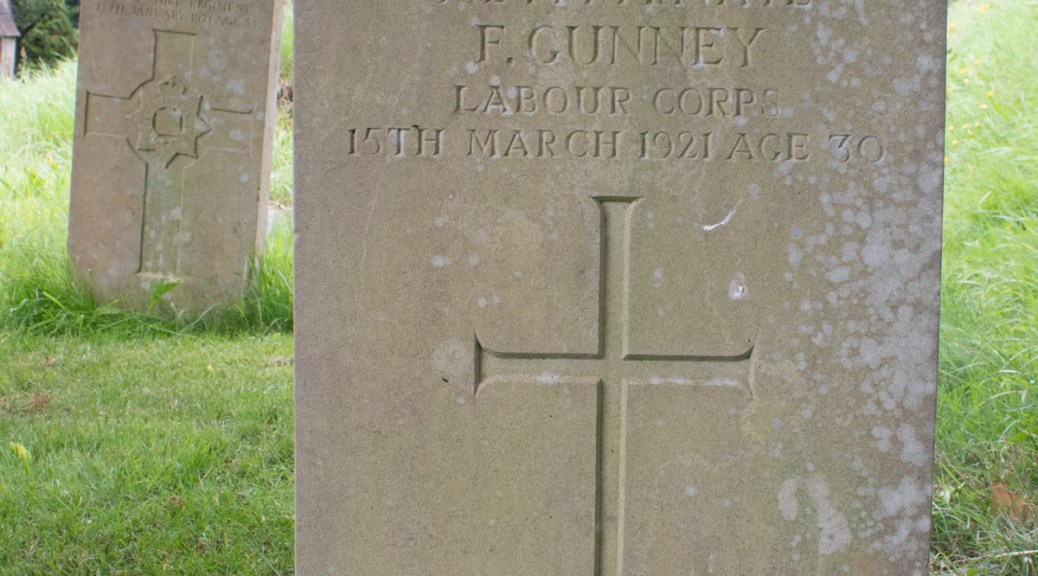
Frank Gunney was born in Brushford, Somerset, in the spring of 1890. The youngest of four children, with two sisters and a brother, his parents were William and Mary. William was a groom-turned-gardener, but when Frank left school, he found other employment: by the time of the 1911 census, he was recorded as being a tailor.
Frank’s older brother, James, followed his father’s trade, becoming a groom when he finished his schooling. His work took him to South Wales, where he met and married Emma Lewis. The couple went on to have two children: Hilda and Kenneth. When war came to Europe, James enlisted, joining the Royal Army Service Corps as a Private.
Frank followed his brother into the army, enlisting in the Somerset Light Infantry on 11th December 1915. This must have proved a tragic time for his mother, Mary, as, just ten days later, William died “after a long and painful illness.” [Western Times: Friday 24th December 1915]
Frank’s service records give little away about the man he had become, but do note that he was 5ft 5ins (1.65m) tall. He was re-assigned to the 1st/21st Battalion of the London Regiment, and was sent to France in June 1916.
Private Gunney’s service papers suggest that he was injured on 9th September 1916, having received a gun shot wound to the head. He appears to have been treated on site, and there seems to be no notable break in his time on the front line.
James was killed in action on 7th April 1917: he was 33 years of age, and was laid to rest in the Warlincourt Halte British Cemetery in Saulty. Mary had lost a husband and a son within eighteen months, and James had left a widow and two children.
In March 1917, Private Frank Gunney had transferred to the Labour Corps, and aside from a six-month period on home soil, would remain in France until September 1919. He then returned to Britain, and was demobbed a month later.
Frank returned to Somerset, but his trail then goes cold. Two documents give an idea as to what happened next, however. The first is a newspaper report about his burial:
The funeral took place in All Saints’ Churchyard, Dulverton… of Mr F Gunney, only don of Mrs Gunney… who died on Tuesday last. Deceased served three years in France, and has been in failing health practically ever since demobilisation, although the end came rather suddenly.
Western Times: Tuesday 22nd March 1921
His army Pension Ledger Card, confirms that he had been discharged from the army because of a ‘septic wound to his left thumb’, which was due to his military service. It appears that this had festered over the ensuing years: Frank Gunney passed away on 15th March 1921, aged 30 years of age.
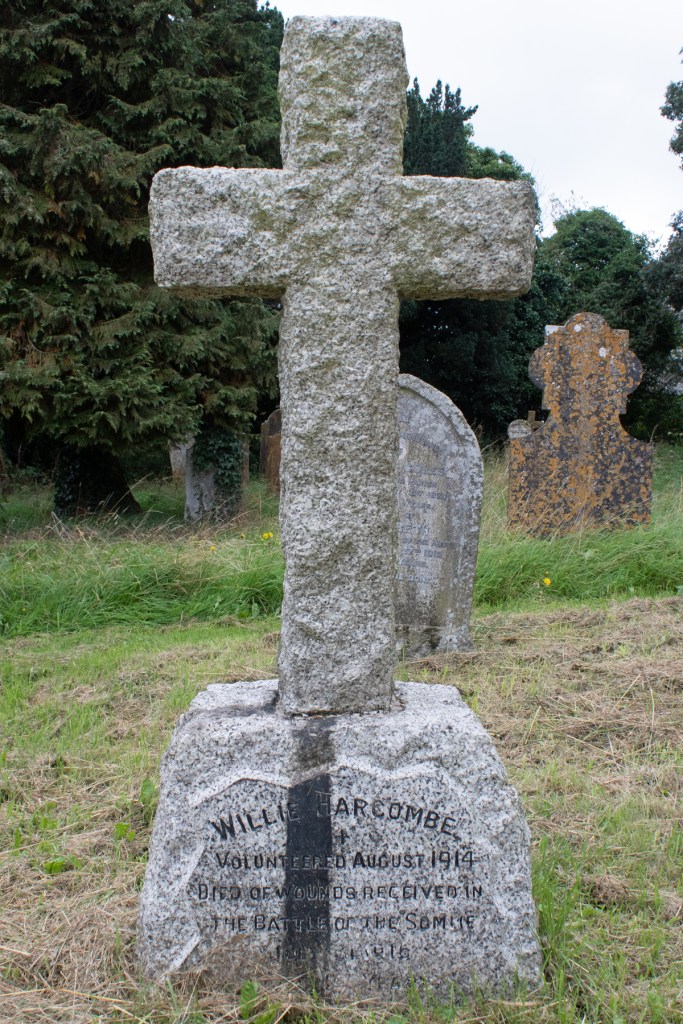
William Harold Harcombe was born on 25th September 1897 in Sampford Arundel, Somerset. One of twelve children, his parents were William and Jane Harcombe. William was an agricultural engine driver who, by the time of the 1911 census, had moved the family five miles north west to Ashbrittle.
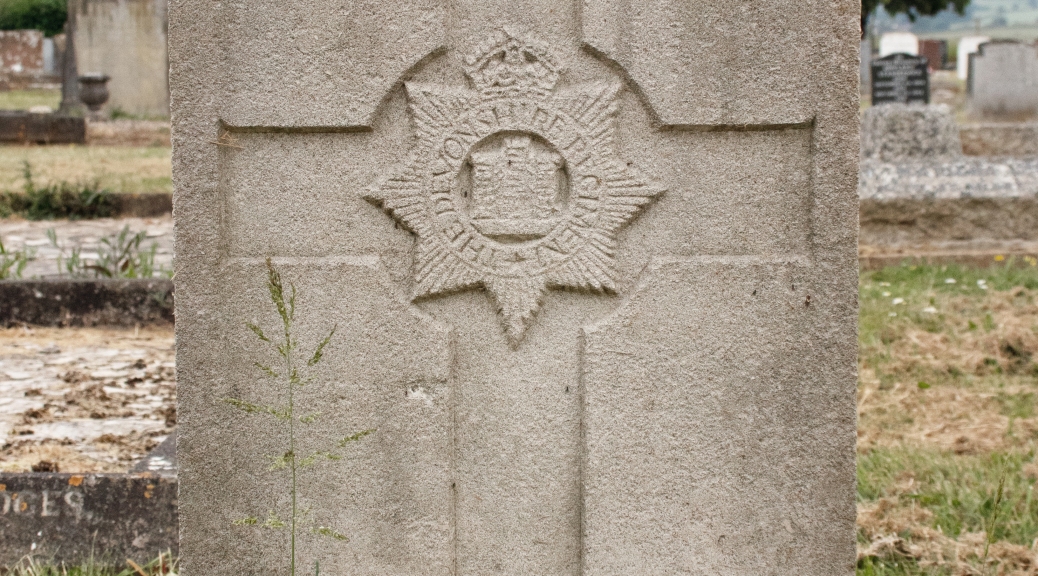
When war came to Europe, William was one of the first to enlist, joining the Devonshire Regiment in August 1914. He was assigned to the 8th Battalion, and after nine months’ training, he found himself in Northern France.
Private Harcombe’s troop was involved in some of the fiercest skirmishes of the conflict, at Loos in the autumn of 1915, and at the Somme the following year. It was during this battle – probably at Delville or High Wood – that he was injured.
William was medically evacuated to Britain for treatment, and was admitted to a military hospital in Mile End, London. His injuries were to prove too severe, however, and he succumbed to them on 31st July 1916: he was just 18 years of age.
The body of William Harold Harcombe was brought back to Somerset for burial. He was laid to rest in the tranquil graveyard of St John the Baptist Church in Ashbrittle.
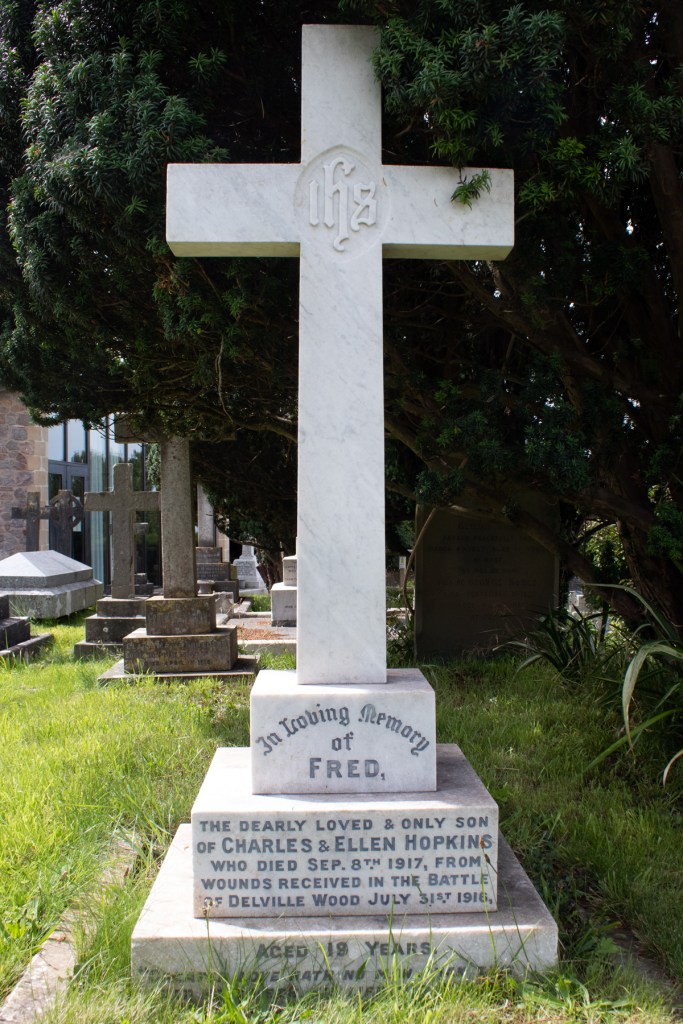
Frederick Charles Hopkins was born in the spring of 1898 in the sleepy Somerset village of Hinton Charterhouse. The younger of two children, his parents were Charles and Ellen Hopkins. Charles was a gardener who, not long after the 1911 census, moved the family west, to the village of Backwell.
When Frederick finished his schooling, he found work as a porter. When war broke out, however, he was keen to play his part, and enlisted at the end of December 1914. His service records note that he was 5ft 4ins (1.63m) tall, and that his apparent age was 19 years and one month. This highlights Frederick’s keenness to fight, as he was actually over two years younger than this at the time he signed the paperwork.
Private Hopkins was attached to the Gloucestershire Regiment, and assigned to the 12th (Service) Battalion. After his initial training on Salisbury, his troop was sent to the Western Front on 21st November 1915.
Frederick would have been involved in a number of the key skirmishes at the Somme, in July 1916, including at Albert and Bazentin. An epitaph on his gravestone suggests that he was injured at Delville Wood, although while his battalion was not actually involved in that specific battle, it is likely that he was injured at around the same time.
Wherever he was wounded, Private Hopkins was sent back to Britain. His service records suggest that he was transferred to the regimental depot but by July 1917, he was medically discharged from the army as being no longer fit for active service.
At this point, Frederick’s trail goes cold. He passed away on 8th September 1917, aged just 19 years old. He was buried in the peaceful St Andrew’s Churchyard in his adopted home village of Backwell.
Reginald John Murdin’s early life is one of contradictions. Born in 1899, his parents were George White and Lily Murdin, and he is recorded with both surnames in documents from the time. George was a iron ore labourer from Northamptonshire, and is was in Woodford, near Kettering, that the family were raised.
When he finished his schooling, Reginald followed George into iron ore and, by the time war broke out he was in the employ of the Islip Iron Company Ltd. Keen to play his part, Reginald enlisted in the King’s Royal Rifle Corps on 29th January 1916.
While it’s not possible to fully identify Rifleman Murdin’s service, he was certainly caught up on the Western Front by the autumn of 1918. It was here that he was injured by “a shell which burst about two yards from him, wounding him severely in the thigh.” [Midland Mail: Friday 15th November 1918]
Reginald was medically evacuated to Britain for treatment, and was admitted to the Bath War Hospital in Somerset. Sadly, his wounds were to prove to severe, and he passed away on 2nd November 1918: he was just 19 years of age.
Reginald John Murdin was laid to rest in the sweeping grounds of Bath’s Locksbrook Cemetery.
Godfrey George Beames was born in the spring of 1891, in Henbury, Gloucestershire. One of eleven children, his parents were Thomas and Minnie Beames. Thomas was in the navy, which meant that Minnie was left to her own devices a lot of the time. While her husband came home often enough for them to build a large family, the 1891 and 1901 censuses record Minnie and the children living with her farm labourer brother-in-law, George Watkins.
The 1911 census gives the same information for Minnie and the children – living with George in Redwick, Gloucestershire. Minnie is, however, noted as a widow, although this seems to be out of convenience, as the now naval pensioner Thomas was living with his wife of eight years, Louisa, in Arundel, West Sussex.
Godfrey, now 21 years old, was working as a farm labourer. In the autumn of 1913, he married a woman called Lily Ball, although little information about her remains today. War was coming to Europe, and things were to change for the young couple.
Godfrey stepped up to play his part. While his full service records no longer exist, what remains paints a picture of his time in the army. He had enlisted by the spring of 1917, joining the Royal Engineers. At some point, however, he moved to the Worcestershire Regiment, and was assigned to the 10th (Service) Battalion.
While it’s not possible to determine exactly where Private Beames fought, he was definitely caught up in the fighting on the Western Front and, by October 1917, was entrenched at Passchendaele. It was here that he was wounded, and he was medically evacuated to Britain for treatment.
Private Beames was admitted to the General Hospital in Nottingham, but his injuries were to prove too severe. He died on 15th November 1917, at the age of just 26 years old.
Godfrey George Beames’ body was brought back to Somerset for burial. He was laid to rest in the graveyard of Ss Mary and Peter’s Church in Winford, where Lily was now living.
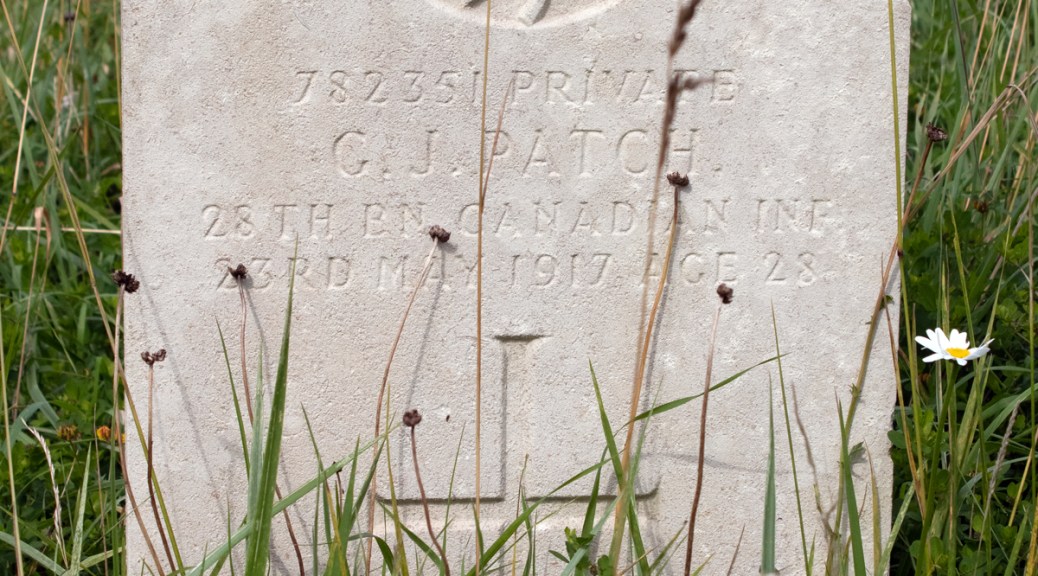
Gilbert John Patch was born in Winford, Somerset, on 3rd July 1888. The third of seven children, his parents were haulier Robert Patch and his wife Ann.
Gilbert followed his father into carting work, but the opportunity of a bigger and better life presented itself. In the spring of 1913, he emigrated to Canada, to find land and work as a farmer. He settled in the hamlet of Caron, Saskatchewan with a friend from home, Percy Worle.
Gilbert’s time overseas was not to be a length one, however. When Europe went to war, the empire was called upon and, on 1st April 1916, Gilbert enlisted in the Canadian Expeditionary Force. His service records show that he was 5ft 8ins (1.72m) tall, with blue eyes, fair hair and a medium complexion.
After his training, Private Patch arrived in France on 28th December 1916, and was assigned to the 28th Battalion of the Canadian Infantry – the same troop as his friend, Percy. During the Capture of Hill 70 in May 1917, Percy was killed and Gilbert himself was badly injured, receiving shrapnel wounds to his head, left arm and right leg.
Private Patch was medically evacuated to Britain for treatment. He was admitted to the Clopton House War Hospital in Stratford-upon-Avon, and while his wounds were treated, within a couple of weeks, he was dangerously ill with a kidney infection. The combination proved too much for his body to take, and Gilbert died on 23rd May 1917. He was 28 years of age.
Gilbert John Patch’s body was brought back to Somerset for burial. He was laid to rest in the graveyard of the local parish church, St Mary & St Peter’s, in his home village of Winford.
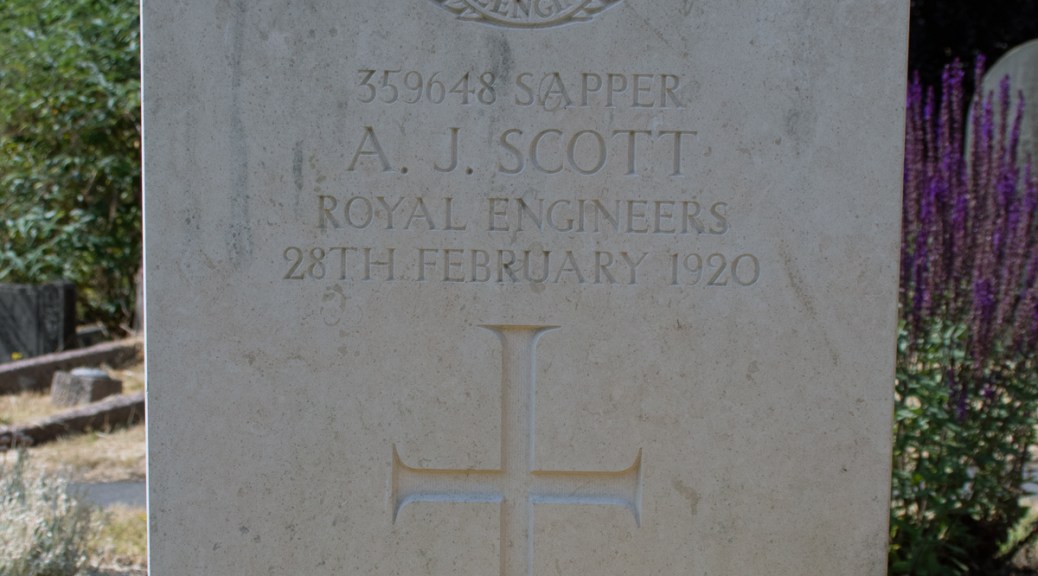
Abraham James Scott was born in Bathford, Somerset, in the spring of 1893. He was one of fourteen children to Abraham and Lucy Scott, and became known as James, to avoid any confusion with his father. Abraham was a shepherd, who travelled where work took him: both he and Lucy were from Wiltshire, but had moved to Somerset by the end of the 1880s. When James was just a babe-in-arms, the family had relocated to Gloucestershire, but by the time of the 1901 census, they were back in Wiltshire once more.
Abraham Sr died in 1910, at the age of just 41 years old. The following year’s census found the now widowed Lucy living in North Wraxhall, Wiltshire, with eight of her children. Abraham Jr is absent, and, indeed, does not appear on any of the 1911 censuses.
Lucy needed options and, on Christmas Day 1912, she married carter William Amblin in the village church. Abraham was, by this time, living in Bath and working as a carter.
When war came to Europe, Abraham felt the need to step up and play his part and, on 15th December 1915, he enlisted in the army. His service records show that he was 5ft 5ins (1.65m) tall and weighed 132lbs (59.9kg). He had a vaccination mark on his left arm which, according to the document’s section on ‘distinctive marks’, has a tendency to rupture.
Private Scott was mobilised in March 1916, and was assigned to the 1st/5th Gloucestershire Regiment. He soon found himself on the Western Front, and, having transferred to the 1st/4th Battalion, served at the Somme.
Abraham was in for a chequered time in Northern France. On 26th August 1916, he was injured when he received a gunshot wound to his scalp. He was admitted to the 1st Canadian General Hospital in Etaples, the moved to Rouen to recuperate. Private Scott rejoined his unit on 21st October 1916.
Just weeks later, however, Abraham was back in a hospital in Rouen, having fractured his ankle. After a couple of weeks in the 1st Australian General Hospital, the injury was deemed severe enough for him to be evacuated back to Britain for recuperation, and he was posted to Ballyvonare Camp in County Cork. Abraham returned to his unit in France in September 1917, nine months after his ankle injury.
On 1st March 1918, Abraham transferred to the Royal Engineers where, as a Sapper, he was attached to the Depot in Rouen. He remained there for more than a year, during which time he was admitted to hospital once more, this time with trench fever. Little additional information is available about this spell in hospital, other than that Lucy had written to the regiment thanking them for informing her of her son’s illness, and confirming a new address for her.
Sapper Scott’s health continued to suffer, however. In May 1919, he was admitted to a camp hospital, suffering from appendicitis. He was operated on, and medically evacuated to Britain for further treatment and recuperation. Abraham was admitted to the Bath War Hospital on 25th July 1919, and remained there for four months.
Abraham’s health seemed to improve, albeit slowly, and he was moved to the Pension’s Hospital in Bath on 27th November. The head wound, broken ankle and bout of trench fever appear to have taken their toll on his body which, by this point, seems to have been too weak to recover. On 28th February 1920, two months after being transferred to the Pension’s Hospital, he passed away there from a combination of appendicitis and pelvic cellulitis. He was just 26 years of age.
Abraham James Scott’s body did not have to travel far after this point. He was laid to rest in the sprawling Locksbrook Cemetery in his adopted home city of Bath.
William George MacPherson was born in the township of Greenway, Huron County, Ontario, on 24th September 1893. The eighth of nine children, his parents were farmer Edmund Macpherson and his wife, Sarah, who was better known by her middle name, Keren (short for Kerenhappuch).
Edmund was the fourth generation of the family to be born in Canada, his maternal great grandfather having emigrated from Scotland to Nova Scotia in the late 1770s. Sarah was the first generation of her family to be born in North America, her parents having moved there in the 1850s.
After he finished his schooling, William followed his father into farming. When war broke out in Europe, the Empire was called upon to serve their King. On 7th January 1916, William enlisted in the Canadian Expeditionary Force. His service records show that he was 5ft 6.5ins (1.69m) tall and weighed 150lbs (68kg). He was noted a having dark hair, brown eyes and a dark complexion.
Private MacPherson set sail from Halifax on 22nd August 1916, and arrived in Liverpool eight days later. His troop was based in Witley, Surrey, and it was here, while attached to the 125 Battalion of the Canadian Infantry, that William spent the winter.
On 23rd May 1917, Private MacPherson was transferred to the 4th Battalion, and set sail for France. He was to spend the summer at Ypres, where he encountered some of the bloodiest fighting of the conflict. William was not to be unscathed, and was wounded in his shoulder and neck on 6th November 1917.
William was initially treated at the No. 2 State Hospital at Abbeville. Dangerously ill, though, he was medically evacuated to Britain, on board the Hospital Ship Essequibo, from Le Havre to Shornescliffe. Private MacPherson was quickly moved to Somerset, and was admitted to the Bath War Hospital. Tetanus set in, and he died of his wounds on 21st December 1917. He was 24 years of age.
With his family thousands of miles away, William George MacPherson was laid to rest in the Locksbrook Cemetery in Bath, not far from the hospital in which he had breathed his last.
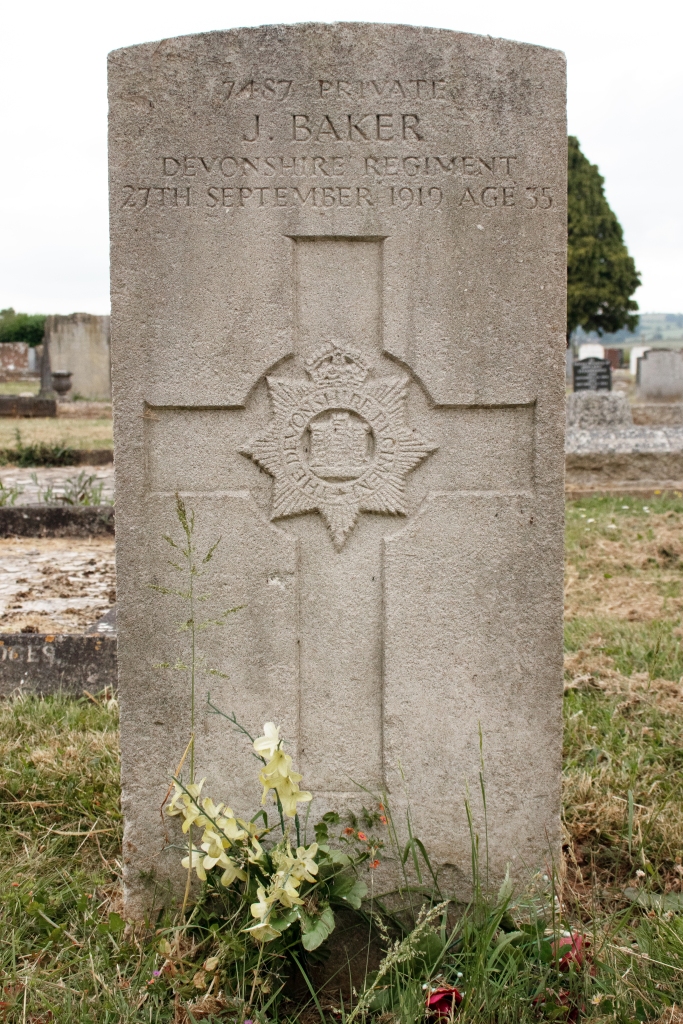
James Baker was born in 1884, and was the youngest of three children to William and Martha Baker. The family were from Kentisbeare in Devon, and tragedy was to strike James early in life, when Martha passed away in 1890, followed by William just five years later.
By the time of the 1901 census, James had moved to the nearby village of Uffculme, where he was employed as a cowman on William Stevens’ farm. At the same time, he was gaining some military experience, volunteering for the Devonshire Regiment. This seemed to offer him a way out, and on 19th October 1903, he formally enlisted in the army.
Private Baker’s service records show that he was 5ft 9ins (1.75m) tall, and weighed 127lbs (57.6kg). He had blue eyes, brown hair and a fresh complexion. James served for 16 months on home soil, but was sent to India in February 1905. He remained there until November 1906, when he returned to England’s shores once more.
James was transferred to the Army Reserve at this point, and returned to farm labouring. He found work in Somerset and, on 31st December 1910, he married Clara Pike. She was the daughter of a farm labourer, and the following year’s census found the newlyweds living with Clara’s widowed father, George, in Tapper’s Lane, North Petherton. James and Clara had a daughter, Clara, who was born in July 1912.
When war came to Europe, James was mobilised once more, and was assigned to the 2nd Battalion in the Devonshire Regiment. Within weeks of conflict erupting, he was in France, remaining there for six months. Over the next four years, Private Baker had two further tours of duty in France, as well as spending considerable time on the Home Front. He had a number of bouts in hospital, suffering from rheumatism, particularly in the winter months.
In the spring of 1918, Private James was caught up in the actions of Villers-Bretonneux, to the east of Amiens. He was badly wounded in the chest and abdomen, and medically evacuated to Britain. He was admitted to the 3rd Western General Hospital in Cardiff, where he spent time recovering. He was declared unlikely to be fully fit for war service, and, on 5th August 1918, he was formally discharged from military duty.
At this point, James’ trail goes cold. He returned to Somerset, and settled back into family life with his wife, daughter and son, Sidney, who had been born in 1915. James passed away at home, through causes unknown, on 27th September 1919, at the age of 35 years of age.
James Baker was laid to rest in the peaceful North Petherton Cemetery, within walking distance from the family home.









 Death and Service