
William Dowsey Magog was born on 23rd March 1898 in Sunderland, County Durham. He was the only child to William and Mary Magog. William Sr was a railway fireman who died when Mary was three months pregnant. He would never know his son, but William was named in his father’s honour.
With a baby to raise, Mary needed support and married for a second time in 1900. Her new husband was Thomas Gardner, who was employed as a chain testing labourer. The extended family set up home on Thomas Street, initially at No. 7, then moving to No. 19 by the time of the 1911 census. By this point, William had three half-siblings, Mary Jr, Elizabeth and Robert.
William followed his stepfather into factory work, taking a job as a moulder. However, he had his sights set on bigger and better things, and on 31st August 1913, he joined the Royal Navy. Too young for formally enlist at this stage, he was given the rank of Boy 2nd Class, and sent to HMS Ganges, the training base near Ipswich, Suffolk.
Boy Magog seemed to impress his seniors, and within nine months had been promoted to Boy 1st Class. He was given his first assignment, on board the cruiser HMS Grafton, in June 1914. That summer, as war broke out, he was sent to HMS Pembroke, the Royal Naval Dockyard in Chatham, Kent.
At the end of October 1914, William was transferred to the battleship HMS Dominion, and she would remain his home for the next three years. During this time, he came of age, and formally joined the Royal Navy. His service papers show that the he stood just 5ft 1/2in (1.54m) tall, and had brown hair, brown eyes and a fresh complexion.
The now Ordinary Seaman Magog was dedicated to his role, although his annual reviews noted a very good (or average) character and a satisfactory (again average) ability. He rose through the ranks, however, becoming an Able Seaman in April 1917.
During this time, Dominion patrolled the North Sea as part of the Third Battle Squadron. She was not involved in many of the major skirmishes of the First World War, although she did take part in the protection of Scarborough during the German raids of 1914, and the Battle of Dogger Bank just a few months later.
By the summer of 1917, Able Seaman Magog had returned to Chatham to await his next assignment. The dockyard was a particularly busy and overcrowded place by this point in the conflict: the sinking of HMS Vanguard had left its replacement crew with nowhere to go, and an outbreak of meningitis had meant that additional accommodation was needed to provide space in the cramped barracks. It was because of this that William found himself billeted in temporary barracks in the dockyard’s Drill Hall.
On the night of the 3rd September 1917, the German air force carried out an audacious night raid on the north Kent coast. The Drill Hall was hit by two bombs, shattering its glass roof, and killing dozens of men who were sleeping below. Able Seaman Magog was badly wounded, and was taken to the Royal Naval Hospital in Chatham. Tragically, his injuries would prove too severe, and he passed away two days after the bombing. He was just 19 years of age.
The body of William Dowsey Magog was taken back to County Durham for burial. He was laid to rest in Sunderland’s Ryhope Road Cemetery, just a few minutes’ walk from where Mary and the family were living.
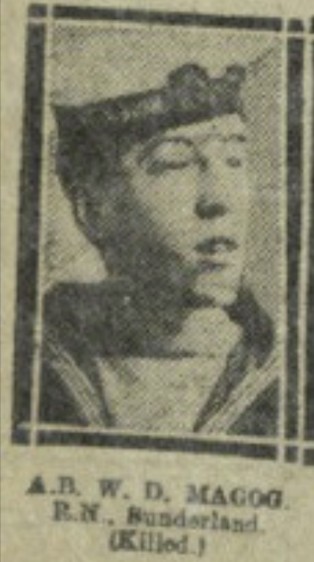
(from findagrave.com)
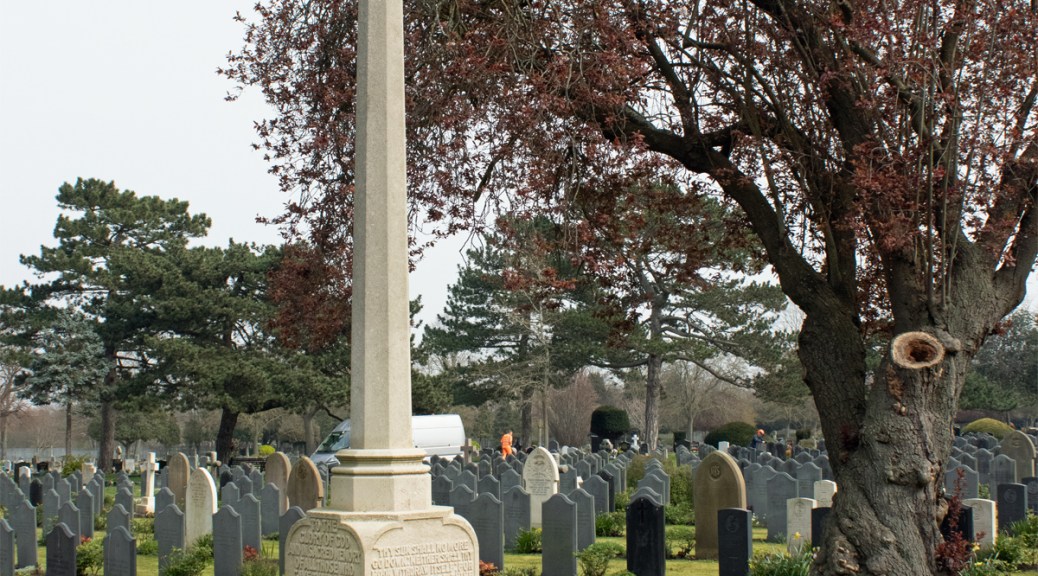
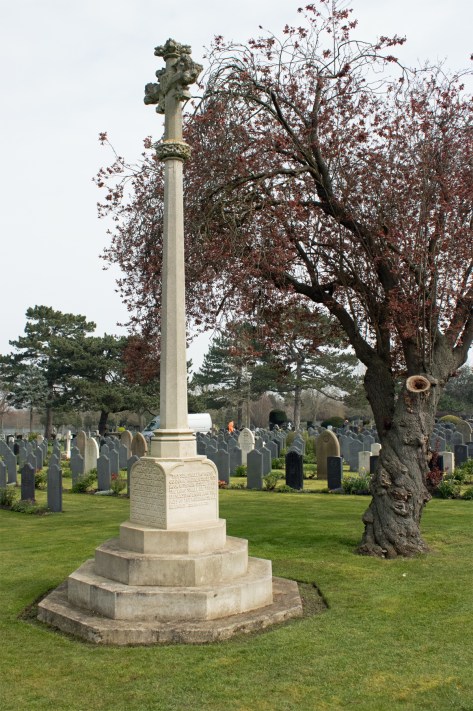
[Note: the photo above is of the memorial to the Chatham Air Raid victims, close to the mass grave for those whose bodies were not identified, in Woodlands Cemetery, Gillingham, Kent.]

