
Neil Moore was born on 17th April 1882 in Glasgow, Lanarkshire. One of twelve children, he was the second son to John and Jane Moore. John was a cabinetmaker and, according to the 1891 census, the family lived in rooms at 13 Melville Street in the city’s Govan district.
Although little is known about Neil’s early life, his enlistment in the Royal Naval Reserve on 26th July 1904 offers the first clear insight into the young man he had become. His service papers describe him as twenty-two years old, 5 ft 4 in (1.63 m) tall, with grey eyes and fair hair.
Over the next decade, Stoker Moore travelled the world, taking in Canada and South America. There were times when he was out of work – he was recorded as seeking a job over the winter of 1912 – but generally his employment appears to have been steady.
Intriguingly, after a stint on the SS Sardinian, Neil left the Royal Naval Reserve on 17th November 1913. He was re-engaged on 17th December, but is then reported as having deserted just three days later. He was then recorded as being assigned to HMS Wildfire – a shore base in Northwood, Middlesex – on 3rd February 1914.
It is possible that it was around this time that Neil got married. His wife was called Elizabeth, but there is little further information about her.
When war broke out, Stoker Moore appears to have been formally mobilised once more. Over the next three years, he served on half-a-dozen vessels, before finally being attached to HMS Pembroke, the Royal Naval Dockyard in Chatham, Kent, in the spring of 1917.
Over the course of that summer, Pembroke was hit by two significant challenges. The battleship HMS Vanguard was sunk in Scapa Flow, leaving its planned replacement crew stuck in the Kent dockyard with nowhere to go. At the same time, a bout of spotted fever broke out and more space was needed to slow the transmission of the contagious disease.
Pembroke’s Drill Hall was brought into use as temporary accommodation, and this is where, in September 1917, Stoker Moore found himself billeted.
On the night of the 3rd September, the German air force carried out an audacious raid on North Kent. Four aircraft bombed Chatham, and two devices landed direct hits on the Drill Hall. The glass roof shattered, raining shards onto the sleeping men below. Stoker Moore was badly injured, and he was transported to the town’s Royal Naval Hospital for treatment. Sadly, this would prove ineffective, and Neil died from his injuries on 8th September 1917. He was 35 years of age.
The body of Neil Moore was taken back to Scotland for burial. He was laid to rest in St Kentigern’s Roman Catholic Cemetery, to the north of the city centre.
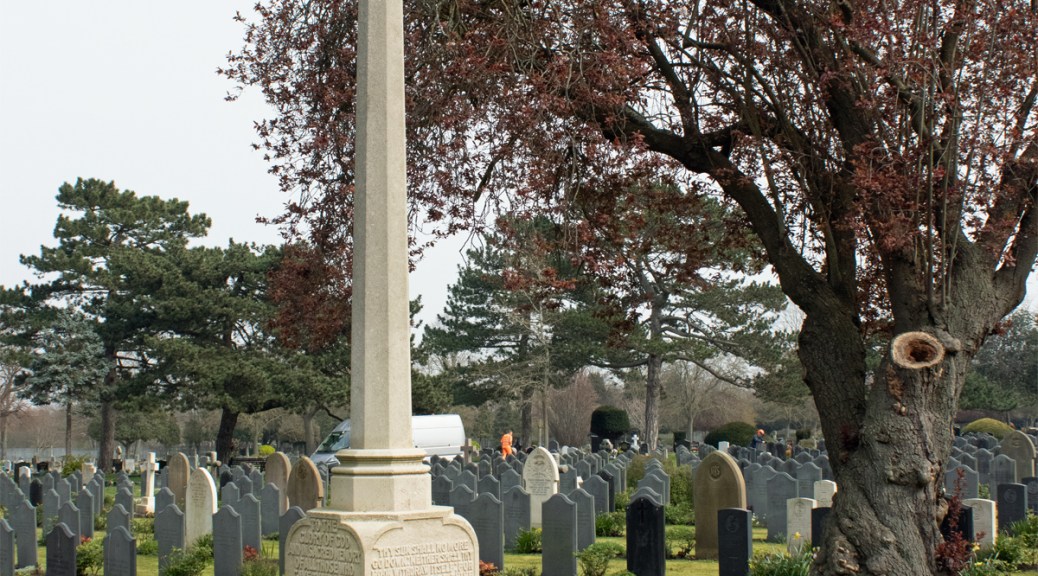
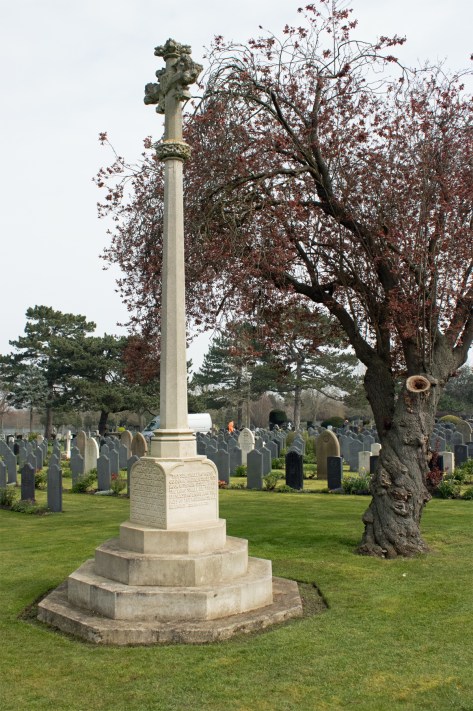
[Note: the photo above is of the memorial to the Chatham Air Raid victims, close to the mass grave for those whose bodies were not identified, in Woodlands Cemetery, Gillingham, Kent.]

