
William Edward Sullivan was born in Newport, Monmouthshire, on the 9th November 1898. He was one of seven children to John and Mary Sullivan. John was an iron dresser at a local foundry, but also worked as a grocer. The 1901 census found the family living at 15 Church Street, to the south of the town centre, but by 1911 they had moved to a larger property, 2 Scard Street.
When William finished his schooling, he took up work as a clerk. War broke out in the summer of 1914, and he would be called upon to play his part. On the 18th September 1916, he enlisted in the Royal Navy, taking the rank of Ordinary Seaman. His service papers show that he was 5ft 6.5ins (1.69m) tall, and that he had light brown hair, brown eyes and a fair complexion.
Ordinary Seaman Sullivan was sent to HMS Victory, the Royal Naval Dockyard in Portsmouth, Hampshire, for his training. By the end of May 1917, however, he had been transferred to HMS Pembroke, which was also known as Chatham Dockyard.
The base was a busy and overcrowded place by this point in the war, with a number of factors leading to temporary accommodation being set up in the dockyard’s Drill Hall. This is where William, who appears to have been waiting for his first formal posting, was billeted.
On the 3rd September 1917, the German air force carried out a daring night time raid on the North Kent coast. Chatham was in the firing line, and two bombs scored direct hits on the Drill Hall. Its glass roof shattered, raining shards down on the sleeping men. Dozens were killed in the explosions, and tens more, including Ordinary Seaman Sullivan, were wounded.
William was taken to the Royal Naval Hospital in Chatham for treatment, but his wounds would prove to be too severe. He passed away on the 4th September 1917, aged just 18 years old.
The body of William Edward Sullivan was taken back to Wales for burial. He was laid to rest in St Woolos’ Cemetery, a short walk from where his family still lived.
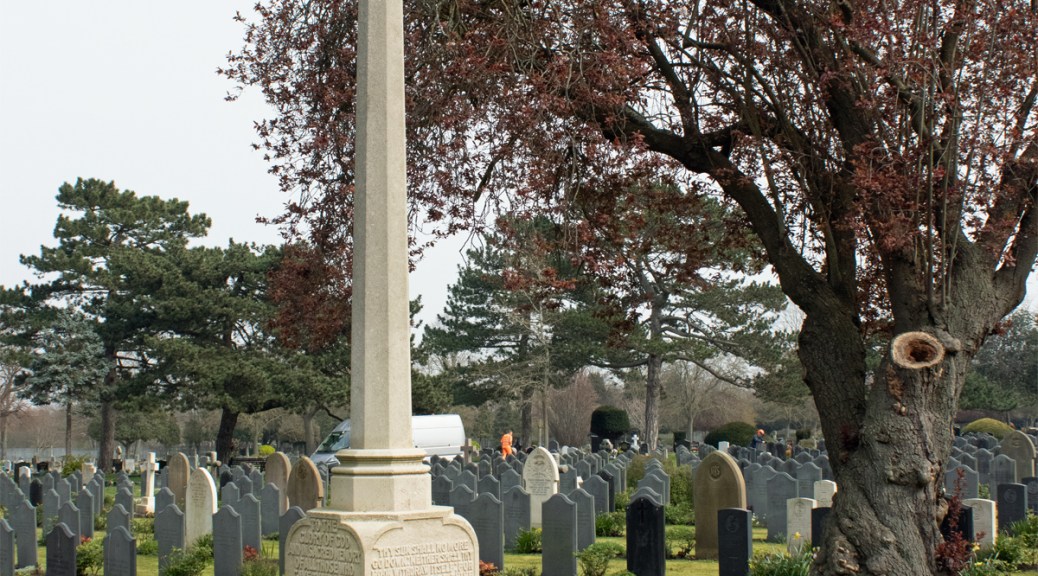
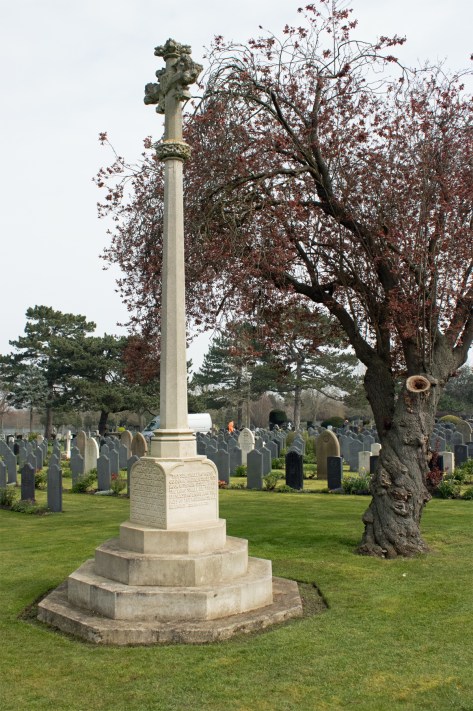
[Note: the photo above is of the memorial to the Chatham Air Raid victims, close to the mass grave for those whose bodies were not identified, in Woodlands Cemetery, Gillingham, Kent.]

