Richard Ezra Baron White was born in the autumn of 1886 in the Cornish village of St Minver. The third of four children, his parents were Joseph and Zillah White. Joseph was a ship’s carpenter by trade, and Richard served an apprenticeship as a woodworker. By the time of the 1911 census, however, the Whites were working as farmers on the outskirts of the village.
When war was declared, Richard stepped up to serve King and Empire. It is unclear when he enlisted, but he joined the Gloucestershire Regiment, and was attached to the 3rd (Reserve) Battalion. Private White was based in Kent during the conflict, his unit being attached to the Thames and Medway Garrison.
Richard survived the conflict, but the winter of 1918/19 was to prove his undoing. He contracted pneumonia, and was admitted to the military hospital in Aylesford. The condition was to get the better of him: he passed away on 20th February 1919, at the age of 33 years.
The body of Richard Ezra Baron White was taken back to Cornwall for burial. He was laid to rest in the peaceful graveyard of St Menefreda’s Church in his home village, St Minver.
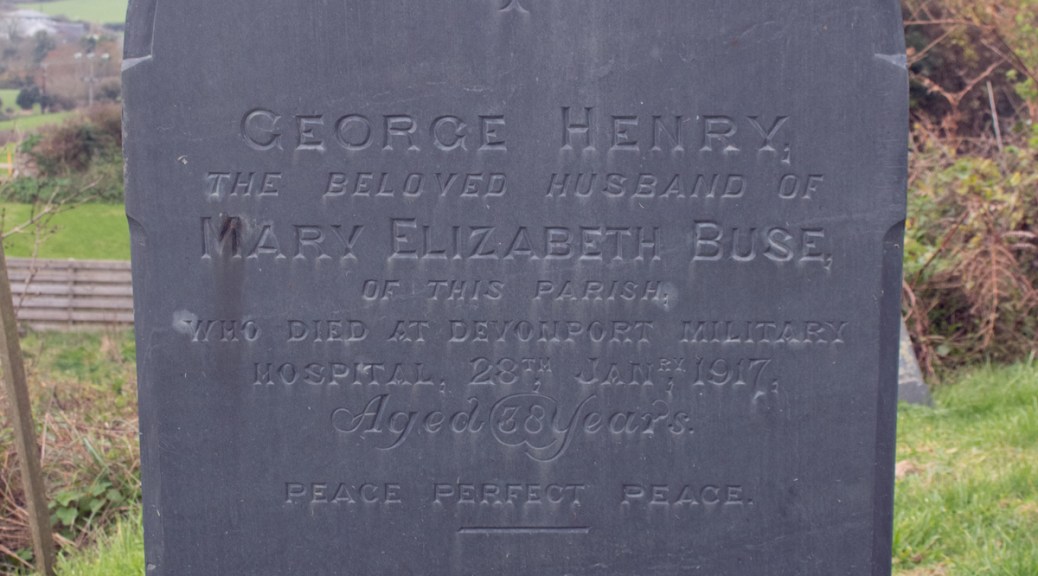
George Henry Buse was born in the Cornish village of St Minver in 1880. One of four children, his parents were Richard and Angelina. Richard was an agricultural labourer, but his son followed a different trade, finding employment as a stonemason.
In the summer of 1904, George married a woman called Mary. They went on to have a daughter, Olive, who was born in 1906, and set up home in Splatt, on the outskirts of the village.
When war came to Europe in the summer of 1914, George stepped up to play his part. He enlisted by the summer of 1916, and joined the 2nd Battalion of the Devonshire Regiment. Private Buse’s unit served on the Western Front, but it is unclear whether he fought overseas.
By the winter of 1916, George had fallen ill. He contracted pneumonia, and was admitted to the military hospital in Devonport, Devon. The condition was to prove too severe, however, and he passed away on 28th January 1917: he was 36 years of age.
George Henry Buse was brought back to Cornwall for burial. He was laid to rest in the peaceful graveyard of St Menefreda’s Church in St Minver.
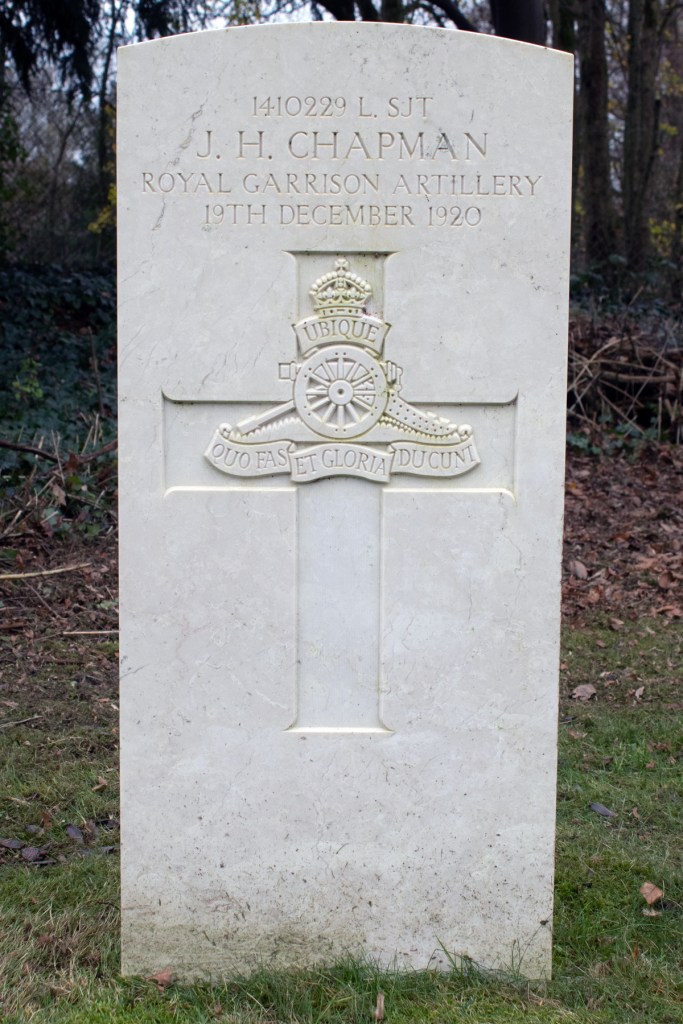
There is little concrete information available on the life of John Henry Chapman. His headstone, in Amesbury Cemetery, Wiltshire, confirms that he was a Lance Serjeant in the Royal Garrison Artillery, and that he died on 19th December 1920.
John’s pension ledger gives his widow’s name, Caroline, date of birth, 25th August 1900, and her address, High Street, New Romney, Kent. It also gives a cause of death for John, who passed away from pneumonia.
The record for Lance Serjeant Chapman’s headstone gives his next of kin as Mrs C Chapman, c/o Mrs Savage, which would suggest that that was Caroline’s maiden name. The Civil Registration Marriage Index records the union of a John H Chapman to someone with the surname of Savage in the summer of 1920: the wedding took place in Richmond, Yorkshire, although there does not appear to be any direct connection between the Lance Serjeant, Caroline and the town.
There are no further clear documents relating to John Henry Chapman. He lies at rest in the peaceful anonymity of Amesbury Cemetery.
William Whaites was born on 12th April 1879 in Milverton, Somerset. One of nine children, his parents were George and Anne Whaites. George was an agricultural labourer, and that is work that all of his sons went into at some point.
By the time of the 1911 census, George and Anne were living at Court Bottom in the village, with three of their adult sons – William included – living with them – and doing farm work.
When war was declared, William was called upon to play his part. He enlisted at some point after October 1915, joining the Somerset Light Infantry. Assigned to the 3rd (Reserve) Battalion, Private Whaites was sent to the unit’s base in Devonport, Devon, for training.
Army barracks were cramped places, and often breeding grounds for illness and disease. William was not to be immune to this, and, in the spring of 1916, he contracted pneumonia. He was admitted to the military hospital in Devonport, but quickly succumbed to the condition. He died on 21st April 1916, having just turned 37 years of age.
William Whaites’ body was taken back to Somerset for burial. He was laid to rest in the graveyard of St Michael’s Church in his home town, Milverton.
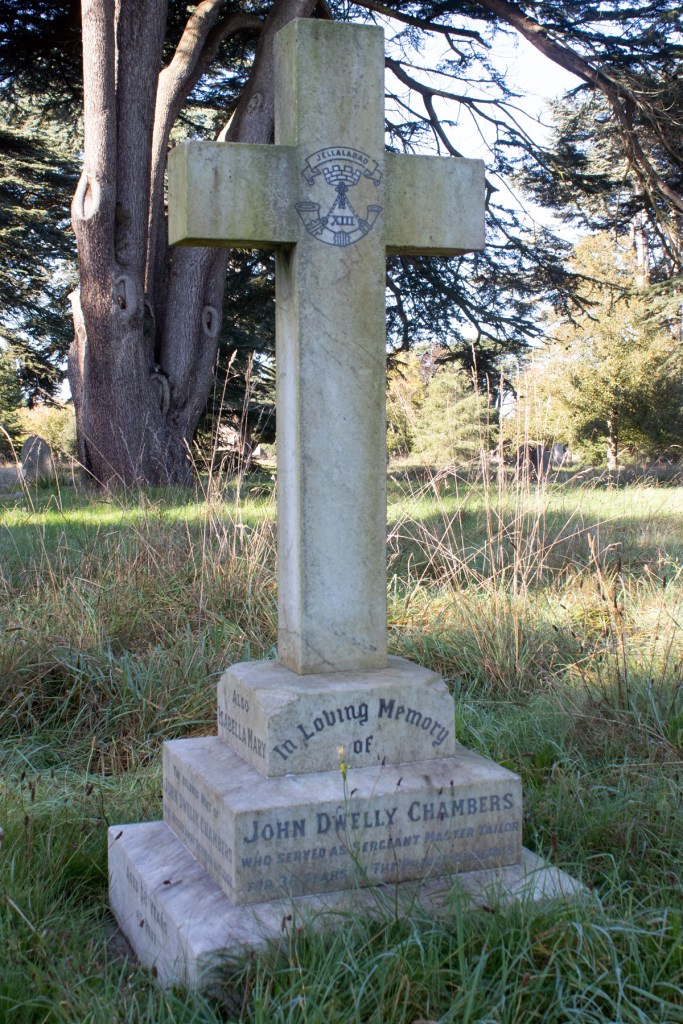
John Dwelly Chambers was born on 21st August 1846, in Holborn, Middlesex. The second of four children, his parents were John and Sarah Chambers. John Sr was a tailor, and this was a trade into which his oldest son followed.
Unusually, John Jr travelled widely with his work and, by the late 1860s, he was based in Devon. It was here that he met and, on 5th March 1870, married Isabella Smith. She was born in Exeter, and couple initially made a life for themselves there.
The 1881 census return shows just how far the family moved in the coming years. John and Isabella were to have nine children: their first, Louise, was born in Exeter a hear after their marriage. The second child, son John, was born in Armagh, Ireland, though; their third, Emily, was born in Glasgow; while their fourth, George, was born in Surrey. It was only by the time their fifth and sixth children, Thomas and Charles, were born that they family returned to Devon. Their youngest three children – Percy, Victoria and Ivor, were all born in Somerset, when the family had settled in Taunton.
The reason for these moves seem to have been because his tailoring work was for the army. The 1891 census found the family living in army barracks, where John was listed as being a soldier. Ten years on, and John was recorded as being a Lance Sergeant in the Somerset Light Infantry, the Chambers’ still being billeted in barrack accommodation in Taunton.
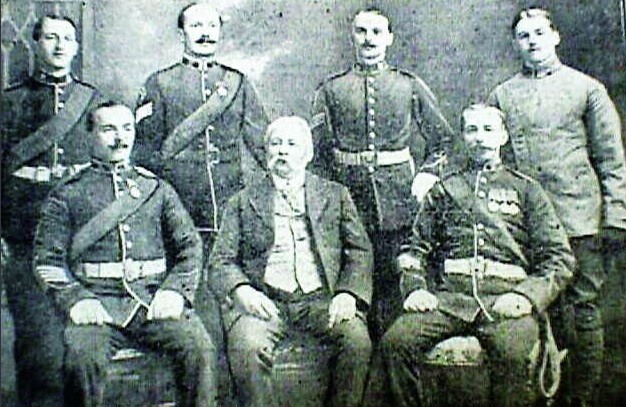
By this point, Percy, now 17 years of age, was employed as a gunsmith, and a later photo suggests that all six of John’s sons went into the army.
Isabella died in 1906, at the age of 58: the following year, John married Elizabeth Dunning, a widow with her own children to raise. The 1911 census found the extended family living in the barracks: John, Elizabeth, Ivor and Elizabeth’s two daughters, Kate and Beatrice. John, by now, was listed as being a master tailor (military), Ivor was now a gunsmith, and the two girls were employed as a book binder and dressmaker respectively.
John had officially been discharged from the army by this point, but it seems likely that the outbreak of war brought him back into service. His life over the next few years is largely undocumented, but it is fair to assume that Serjeant Chambers was called back to the army, possibly to train newer recruits in the trade he had been working in for decades.
John Dwelly Chambers died of a heart attack on 2nd August 1915: he was just short of his 69th birthday. John was laid to rest in the sprawling St Mary’s Cemetery in Taunton, not far from the barracks to which he had devoted his life.
Serjeant John Chambers (seated middle, with his sons) (from ancestry.co.uk)
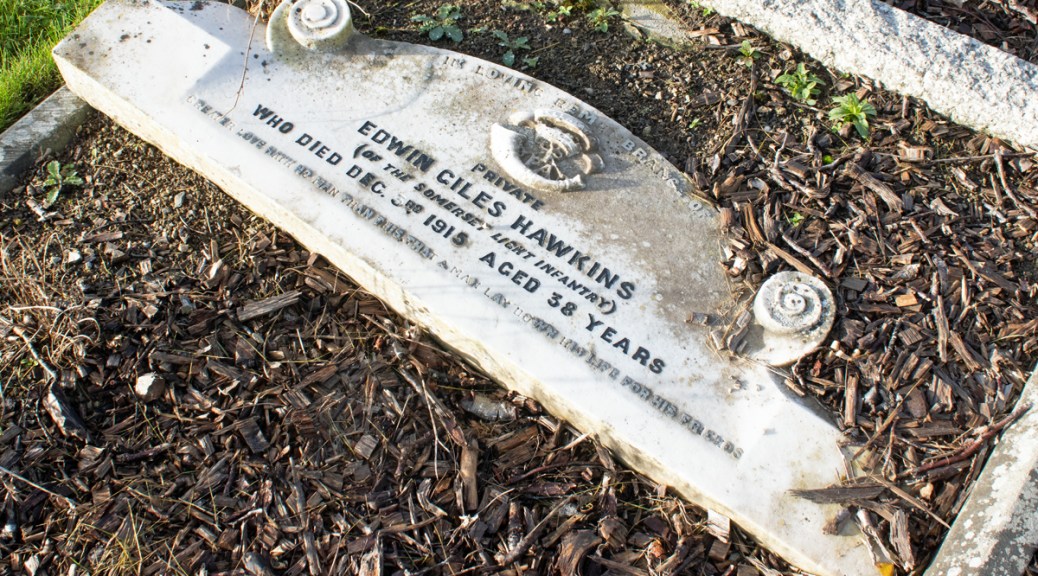
Another sudden death has occurred… when Edwin Giles Hawkins, Divisional Reserve company, 8th Divisional Train, BEF, passed away at the age of 38 years. Deceased… was called up with the National Reserves, and for some time he had been in France. On December 2nd he was granted eight days leave from the Front and arrived at home the same evening. He retired to rest at 10pm, apparently in his proper health. At 5am next morning he called his mother and complained of pains in the stomach. Hot water was applied and a doctor sent for but before the latter arrived he passed away.
Western Chronicle: Friday 10th December 1915
Edwin Giles Hawkins was bornin the autumn of 1877, the oldest of six children to Giles and Elizabeth. Giles had been born in West Coker, Somerset, and the family grew up in the Anchor Inn, Yeovil, where he was the innkeeper and glover.
By the time of the 1891 census, Giles had stepped down as landlord, and the growing family were living in a cottage next to the pub. He was working as a leather dresser and glover, working to feed his wife and five children.
Little information about Edwin’s time in the army before the First World War is available. However, his details are missing from the 1901 census, which would suggest that he was serving overseas at that point.
Edwin was called upon to due his duty once more when war was declared. Joining the Somerset Light Infantry, he was assigned to the 1st Battalion, and, by December 1914, he was in France. Private Hawkins was caught up at Ypres the following spring and returned home on leave in December 1915.
The cause of Private Hawkins’ death was recorded as being heart failure. As the newspaper report noted, he was 38 years of age.
Edwin Giles Hawkins was laid to rest in Yeovil Cemetery, a short walk from where his parents still lived.
James Walter Fone was born in Crewkerne, Somerset, late in 1878. The sixth of seven children, his parents were Edward and Emma Fone. Edward was an insurance agent who had moved the family to Yeovil by the mid-1880s.
When James left school, he found work as a clothier’s assistant. Emma died in 1906, and he moved to Bristol. By the time of the 1911 census, he was employed by, and boarding with, James Johnstone.
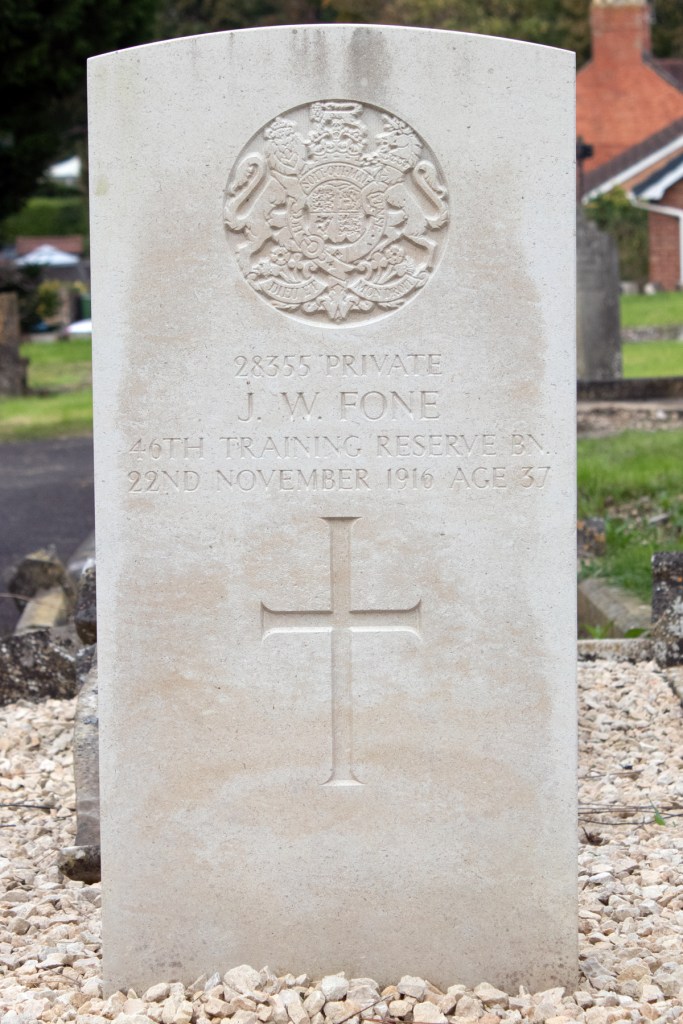
Details of James’ life become a bit sketchy from here on. He enlisted in the army when he received his call-up in the autumn of 1916. Joining the 46th Training Reserve Battalion, Private Fone was sent to a camp near Swanage in Dorset.
Barracks at this point in the war were tightly packed, and breeding grounds for illness and infections. James was not to be immune to this, and came down with cerebrospinal meningitis. He was admitted to the camp hospital, but died there on 22nd November 1916, at the age of 37 years old.
James Walter Fone’s body was brought back to Somerset for burial. He was laid to rest in Yeovil’s sweeping cemetery.
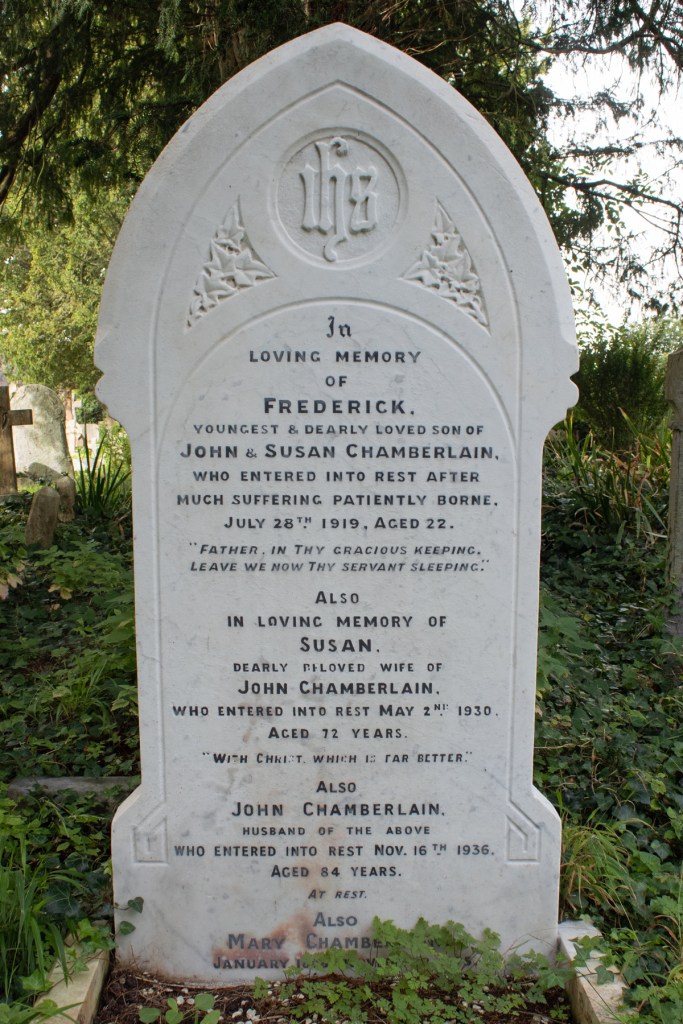
Frederick Chamberlain was born in the summer of 1896, the youngest of six children to John and Susan Chamberlain. John was a gardener from Dulverton in Somerset, but it was in Abbots Leigh, near Bristol, that the family were born and raised.
When he finished his schooling, Frederick found work in service and, by the time war broke out, he was employed as a footman. War presented a new adventure, however, and he was quick to step up and serve his country. He enlisted on 1st September 1914, just a few weeks after hostilities were announced, and was assigned to the 1/4th (City of Bristol) Battalion of the Gloucestershire Regiment.
Private Chamberlain’s service records are pretty sparse, but his unit was sent to France in May 1915, and he was to spend the next thirteen months on the Western Front. He seemed to have performed his duty well, however, and during that time was promoted to Corporal. Frederick returned to Britain in the summer of 1916, for what seemed to be health reasons. He was discharged from the army on medical grounds in November, suffering from phthisis, or tuberculosis.
At this point, the trail goes cold. He returned to Somerset, but his health deteriorated. Frederick passed away at home on 18th July 1919: he was just 22 years of age.
Frederick Chamberlain was laid to rest in the family plot in Holy Trinity Churchyard, Abbots Leigh. His funeral was presided over by Reverend Walter Brinkley, who had performed his baptism two decades earlier.
Charles Bayliss was born in Birmingham in 1861. Little concrete information is available about his early life, but later documents confirm his father was called John, and he was one of at least five children.
Charles married Ellen Kimberley on 8th April 1888. The couple wed at St Mary’s Church in Kidderminster, Worcestershire, and went on to have four children – Nellie, Charles, Burt and Eva.
Charles took up manufacturing work, and ended up being a machine belt maker. He also served in the South Staffordshire Regiment, although whether this was on a paid or voluntary basis is not clear.
When was came to Europe, Charles felt the need to serve his country once more. He enlisted on 23rd August 1917, taking five years off his age to ensure he was accepted. He was assigned to the Royal Engineers, and attached to the Inland Waterways and Docks unit.
Private Bayliss was based at Portbury Camp near Bristol, and records suggest that Ellen moved to be near him, finding lodgings on Myrtle Hill in Pill.
Charles was respected for the work that he was doing, and was promoted to Lance Corporal in May 1918. His health was against him, however, and just two months later he collapsed and died from a heart attack while at work. He was 58 years of age.
Charles Bayliss was laid to rest in the graveyard of St George’s Church, Easton-in-Gordano, not far from the docks where he had served, and the riverside home in which his widow still lived.
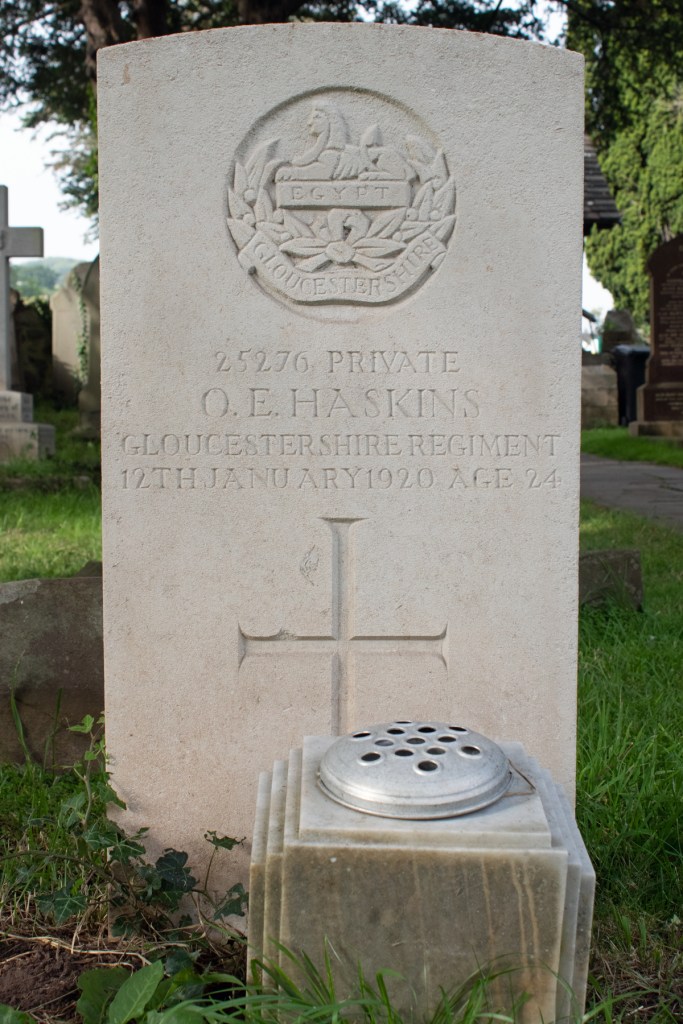
Oliver Edgar Haskins was born in 1896 in Portbury, Somerset. One of ten children, his parents were John and Hester Haskins. John was a gardener, and the 1911 census noted that Oliver was ‘working at home’, although no trade is listed.
When war came to Europe, Oliver stepped up to serve his King and Country, and was one of six Haskins brothers to fight in the conflict. He joined the Gloucestershire Regiment, and was initially assigned to the 15th (Reserve) Battalion. Based on home soil, his unit were barracked at Chiseldon Camp on the fringes of Salisbury Plain, Wiltshire.
At some point Private Haskins transferred to the Labour Corps, and became attached to the 207th Employment Company. It is not possible to identify exactly where he served, but he remained on home soil during the conflict.
The funeral took place at Portbury on Saturday of Mr Oliver Haskins… He was very popular in the village and at business, by virtue of his cheerful disposition and sterling qualities, and was beloved by everybody who came into contact with him. Mr Haskins was taken ill some ten days ago, and confined to his room, but he apparently made a quick recovery until Monday last, when he was suddenly taken worse and died in a few hours, at the age of 24.
Bristol Times and Mirror: Monday 19th January 1920
Oliver Edgar Haskins died on 12th January 1920. He was laid to rest in the once peaceful graveyard of St Mary’s Church in Portbury.











 Death and Service