Category Archives: injury

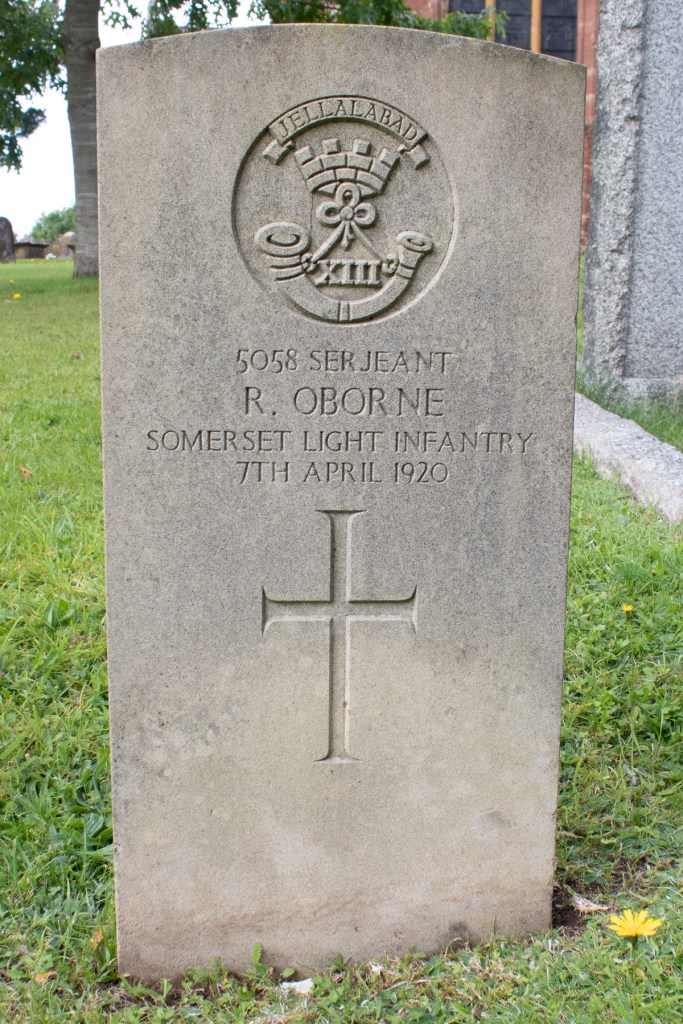
Serjeant Robert Oborne

Serjeant Robert Oborne

Robert Oborne and his twin, William, were born in the summer of 1880, two of ten children to John and Elizabeth Oborne. John was an agricultural labourer, and the family were raised in Bishop’s Lydeard, Somerset.

Death was to surround Elizabeth Oborne: William died when he was only three years old and John also passed away in 1886. This was around the time that she gave birth to their last child, who she also named William. The 1891 census recorded Elizabeth as living in the centre of Bishops Lydeard with four of her children: John, who was a farm labourer, Elizabeth, an errand girl, and Robert and William, both of whom were still at school.

When he completed his schooling, Robert found work as a coal hewer. He moved to South Wales, and boarded with the Hampshire family, in Ystradyfodwg, Glamorganshire. Further details of his life before the outbreak of war are scarce, although it seems that he changed career, taking up work as a groom. Known as Bobbie, later reports suggest that he was a genial young man, and had a large number of friends.

1915 proved a pivotal year for Robert: that summer he married Amy Lyons in Taunton. Elizabeth died in October, and his next oldest sibling, a sister also called Elizabeth, passed away just weeks later.

“Just before the war he joined the Somerset Light Infantry [Territorial] and went through the Gallipoli campaign, and then went to Egypt… he acted [in the capacity of a groom] to his officer commanding, and whilst in Egypt had the misfortune to get thrown from his horse, which caused internal trouble.” [Taunton Courier and Western Advertiser: Wednesday 14th April 1920]

The now-Serjeant Oborne was medically discharged from 3rd/4th Battalion on 21st August 1916, and returned to Somerset. He took up employment with Colonel Dennis Boles MP, acting as his groom from him from Watts House, on the outskirts of Bishops Lydeard.

Robert appears to have continued with this life for the next few years, but his wartime injuries continued to dog him.

…on Tuesday, March 2nd [1920], he gave up work and went to the doctor, who advised his removal to the hospital, where he was taken the following Friday, and underwent an operation the same evening. Hopes were held out for his recover, and he lingered until 1:30 on Wednesday morning [7th April], when he passed away.

Taunton Courier and Western Advertiser: Wednesday 14th April 1920

Robert Oborne was 39 years old when he died. He was laid to rest in the grounds of St Mary’s Church in his home village, Bishops Lydeard.


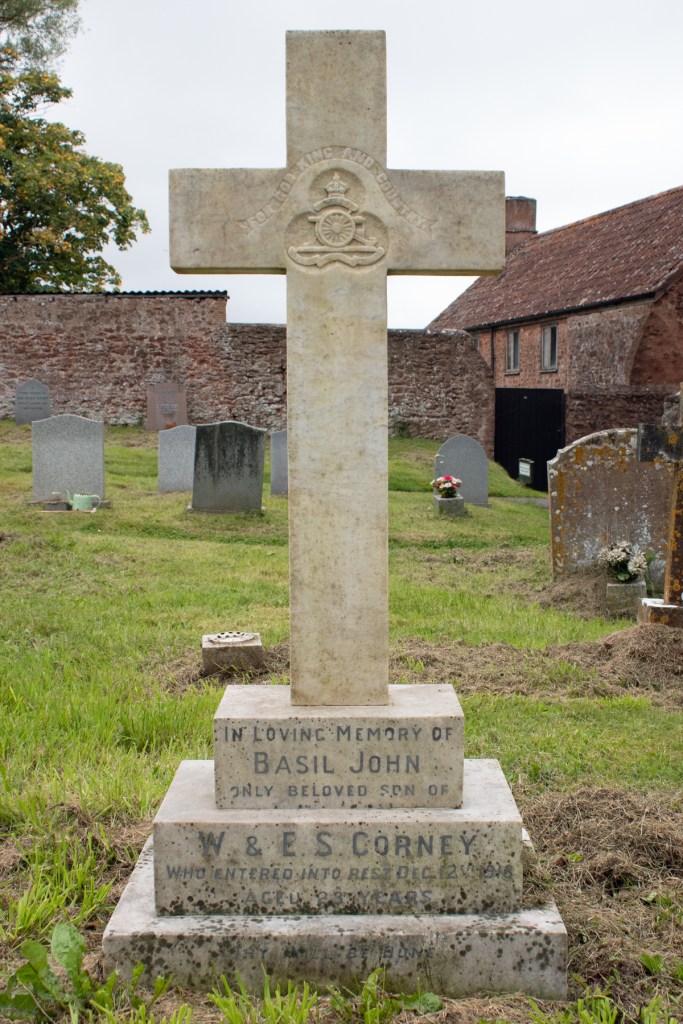
Gunner Basil Corney

Gunner Basil Corney

Basil John Corney was born in Berrynarbor, Devon, in the summer of 1895. The fourth of five children, his parents were William and Elizabeth. William’s work as a farm bailiff, took the family across the area: by 1901, they had moved to Shapwick in Somerset, and the next census record, in 1911, found the family living in Stogumber, where William had taken up management of the White Horse Hotel. Basil, meanwhile, was employed as a butcher’s assistant in the village.

When war came to Europe, Basil stepped up to serve his King and Country. He enlisted on 10th December 1915 and, from this point, preferred to go by his middle name, rather than his first. He asked to be assigned to the Royal Army Service Corps, but by the time he was mobilised in April 1916, he was attached to the Royal Garrison Artillery. Gunner Corney’s service records show that he was 20 years and 8 months old, stood 5ft 10ins (1.77m) tall and weighed 155lbs (70.3kg).

Basil was assigned to the 143rd Siege Battery and, by August 1916, he was sent to France. His time in Europe was to be brief, however, as, on 1st October, he was shot and wounded by shell fire in his right knee while fighting at the Somme. Invalided to Britain for treatment, he eventually seemed to recover, and was transferred to the regiment’s No.2 Depot.

In April 1918, Gunner Corney was admitted to hospital in Edmonton, Middlesex, as his injury was causing some issues again. An examination identified that his kneecap had all but disintegrated, and this led to his eventual dismissal from armed service on medical grounds. He left the Royal Garrison Artillery on 14th November 1918 and was awarded the Silver Badge, noting the reason for him not being in the army.

Basil returned to Somerset, but his time back with his family was to be brief. He passed away at home on 12th December 1918: he was 23 years of age.

The body of Basil John Corney was laid to rest in the peaceful graveyard of St Mary’s Church in Stogumber, across the road from, and within sight of, where his family still lived and worked at the White Horse Hotel.


Private Herbert Perry

Private Herbert Perry

Herbert Perry was born in Sampford Brett, Somerset, on 2nd July 1887. One of fifteen children, his parents were Henry and Mary Perry. Henry was a groom and gardener, and the family were raised in a small cottage in the centre of the village.

Herbert and his siblings attended the local Church of England school, but once he finished his education his own trail goes cold. The next records relate to his military service, although they are also a bit scarce.

What is clear is that Herbert enlisted early in the war. He joined the 1st Battalion of the Devonshire Regiment, and was in France as soon as January 1915. Private Perry found himself at Ypres, and it was here, in July, that he was badly injured.

Private Perry was medically evacuated to Britain for treatment, and he was admitted to the 5th Northern General Hospital in Leicester. Sadly, this was to be where he would breathe his last: his wounds were to prove too severe, and he succumbed to them on 1st August 1915. He had not long turned 28 years of age.

Herbert Perry’s body was taken back to Somerset for burial. He was laid to rest in the family plot in the peaceful graveyard of St George’s Church. There he was reunited with his mother, Mary, who had died three years before.


Herbert’s older brother, William, joined the Duke of Cornwall’s Light Infantry when war broke out. Assigned to the 1st Battalion, he rose to the rank of Lance Corporal. William fought at the Somme, and was killed there. He is commemorated at the Thiepval Memorial, and remembered on the family headstone in Sampford Brett.


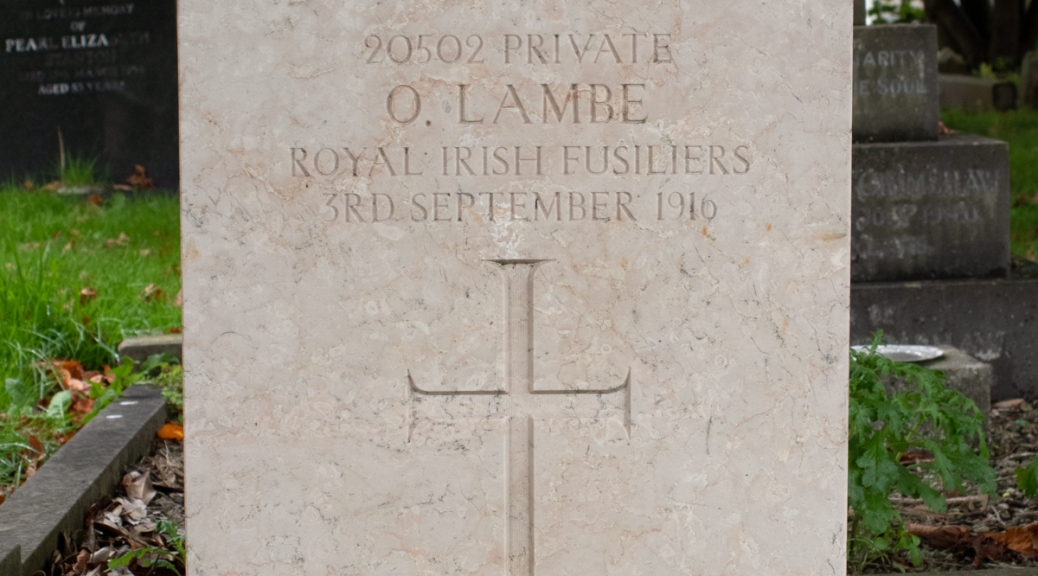
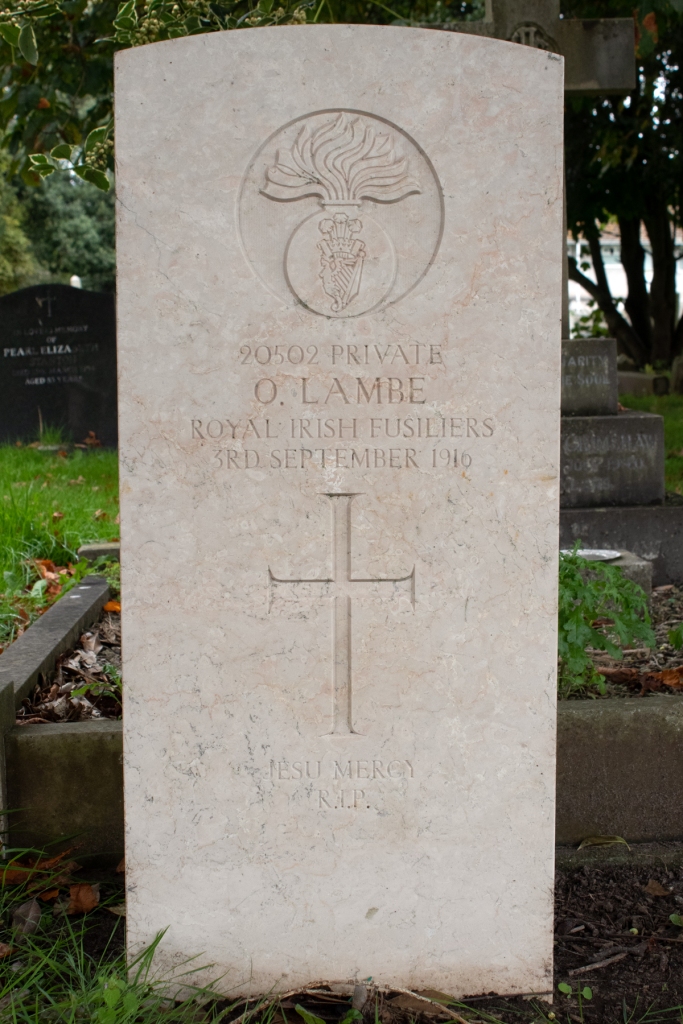
Private Owen Lambe

Private Owen Lambe

Owen Lambe was born in Drogheda, Co. Louth, Ireland, in November 1873. There is little information about his early life, but later documentation confirms that he was the son of John and Ellen Lambe, and that he had three brothers and one sister.

When Owen finished his schooling, he found work as a baker. He was also volunteering as a soldier in the 6th Battalion of the Royal Irish Rifles at the time, however, and this sparked a career move for him. On 7th May 1890, he formally enlisted: his medical report shows that he was 5ft 4ins (1.63m) tall, and weighed 128lbs (58kg). He was noted as having brown hair, grey eyes and a dark complexion.

Over the twelve years of his contract, Private Lambe saw a fair bit of the world. After eighteen months on home soil, he was sent to Malta, where he remained until November 1894. His battalion was then moved to India, where they remained for more than three years.

With seven years’ service under his belt, Owen returned to Britain. Put on reserve status, he was recalled to active duty in October 1899, as hostilities broke out in South Africa. He served in the Second Boer War for nearly three years, until, in July 1902, he returned home once more. By this point, he had completed his contract, and formally stepped down from the army on 31st August.

Owen’s trail goes cold at this point, and it is only possible to pick up details from later documents relating to his death. These confirm that he had re-enlisted by the spring of 1916, and that he joined the 8th (Service) Battalion of the Royal Irish Fusiliers. Based on his previous army experience, Private Lambe would have been sent to the Western Front fairly readily, and his battalion was certainly involved in the fighting at the Battle of the Somme.

It was here, on the front line, that Owen was injured. Again, details are sketchy, but he received gun shot wounds severe enough for him to me medically evacuated to Britain for treatment. He was taken to Somerset and admitted to the Volunteer Aid Detachment Hospital in Burnham-on-Sea for treatment. Private Lambe’s wounds were to prove too severe, however: he passed away from his injuries on 3rd September 1916, at the age of 42 years old.

Owen Lambe was laid to rest in the Roman Catholic section of Burnham Cemetery. His headstone was paid for by the local Catholic church.


Regimental Serjeant Major John Wimble

Regimental Serjeant Major John Wimble

John Henry Wimble was born in the autumn of 1870, in Bathampton, Somerset. One of seven children, his parents were William and Charlotte Wimble. Charlotte had been married before, but her husband, John Eastment, had died in 1862, leaving her with three children to raise. She remarried in 1864, and William helped support the growing household.

John sought an escape to adventure and, when he finished his schooling, he enlisted in the army. Full service records are not available, but by the time of the 1891 census, he was noted as being a Private in the Somerset Light Infantry, and was living in barracks in Farnborough, Hampshire.

In the autumn of 1891, John married Eliza Hammond. She had been born in Calne, Wiltshire, and, at the time of their wedding, which took place in Bath, she was working as a parlour maid. The couple would go on to have two children, Percy and Victor.

John completed his army service and, according to the 1911 census, the family had settled in Cheddon Fitzpaine, to the north of Taunton. He was noted as being an army pensioner and that he was working as a warehouseman in the government stores. By the time war broke out, the family had moved to Burnham-on-Sea, where John had taken up the role of caretaker at the local Institute.

The war has cost another gallant local soldier, in the person of Sergt.-Major Wimble, of the Somersets, his life. This brave man re-joined the Army when war broke out on condition he could go to the Front. He was wounded, and died in a hospital at Edinburgh. The War Office had the remains sent to Burnham on Tuesday, where they were placed in St Andrew’s Church, and a large attendance of the public and the [Volunteer Training Corps] attended the funeral on Wednesday.

Taunton Courier and Western Advertiser: Wednesday 17th November 1915

John had been assigned to the 6th (Service) Battalion on re-enlisting, and was quickly sent to the front. Caught up in the Action of Hooge and the Second Attack on Bellewaarde, he was medically evacuated to Britain in the autumn of 1915, and passed away on 4th November, at the age of 45.

Here, though, accounts differ slightly. While the newspaper report suggests that he died of his wounds, the Army Register of Soldiers’ Effects gives the cause of death as gastritis.

After the funeral at St Andrew’s Church, John Henry Wimble’s body was laid to rest in Burnham Cemetery.


Regimental Serjeant Major John Wimble
(from findgrave.com)

Private Charles Bagley

Private Charles Bagley

Charles Sainsbury Bagley was born in the autumn of 1889, one of eleven children to Benjamin and Jane Bagley. The couple’s early life was an intriguing one: they had both been born in Shoreham-by-Sea, West Sussex. The 1891 census recorded the couple living on board the barque Mizpah, with their three oldest children. Benjamin was the vessel’s master and there were ten other members of crew on board.

By the time Charles was born, the family had returned to shore and settled in Minehead, Somerset. By now Benjamin was working as a hairdresser and tobacconist on Park Street near the centre of the town.

Benjamin died in 1910, but left a thriving business to support Jane. At least three of the Bagley siblings went into hairdressing, while Charles’ older brother, Joseph, set up a bakery and confectioner’s in the town with his wife. Charles is absent from the 1911 census, although later records would suggest that he had moved to Lancashire, where he was also working as a hairdresser.

On 3rd July 1915, Charles married Celia Rogers in Lancaster. War was raging across Europe at this point and, in August 1916, he enlisted in the army. His service records confirm that he was 5ft 7.5ins (1.71m) tall and weighed 128lbs (58kg). Private Bagley joined the 5th Battalion of the King’s Own (Royal Lancaster Regiment) and by the end of the year he was on the Western Front, based around the Ypres salient.

The early part of 1917 proved relatively quiet for Private Bagley’s troop. At the end of July, however, he was caught up in the battle of Pilkem Ridge, and was shot in his left leg. Initially treated on site, the wound was severe enough for him to be medically evacuated to Britain for treatment.

Charles was admitted to the Royal Surrey County Hospital in Guildford, but his wounds were to prove to be too severe. He passed away on 28th October 1917, at the age of 27 years old.

The body of Charles Sainsbury Bagley was taken back to Somerset for burial. He was laid to rest in the family plot in Minehead Cemetery, reunited with his parents, Jane having died at the beginning of 1917. The seafaring headstone paid homage to his father’s maritime service.


Private Henry Webber

Private Henry Webber

Henry James Webber was born in Plaistow, Essex, in 1889. One of ten children, his parents were Frederick and Etty Webber. Frederick hailed from Somerset, but worked as a sergeant in the Metropolitan Police. By the time of the 1901 census, he had been promoted to Inspector: the family moved to Somerset when he retired in around 1905, settling in Minehead.

Of Henry, there is little information documented. He does not appear on the 1911 census, and there are no military records to confirm his service in the army. He had certainly enlisted by the summer of 1916, joining the Somerset Light Infantry.

Private Webber was attached to the 7th (Service) Battalion and certainly saw action overseas. His troop was heavily involved in the Battles of the Somme in 1916, and it was here that he was injured. Again, full details are not available, but his wounds were severe enough for him to be medically evacuated to Britain for treatment.

Henry was admitted to the 1st Southern General Hospital in Birmingham, but his injuries proved too severe. He died on 1st November 1916, at the age of 27 years old.

Henry James Webber’s body was taken back to Somerset for burial. He was laid to rest in Minehead Cemetery, not far from where his grieving family were living in Cher Street.


Private Frank Gunney

Private Frank Gunney

Frank Gunney was born in Brushford, Somerset, in the spring of 1890. The youngest of four children, with two sisters and a brother, his parents were William and Mary. William was a groom-turned-gardener, but when Frank left school, he found other employment: by the time of the 1911 census, he was recorded as being a tailor.

Frank’s older brother, James, followed his father’s trade, becoming a groom when he finished his schooling. His work took him to South Wales, where he met and married Emma Lewis. The couple went on to have two children: Hilda and Kenneth. When war came to Europe, James enlisted, joining the Royal Army Service Corps as a Private.

Frank followed his brother into the army, enlisting in the Somerset Light Infantry on 11th December 1915. This must have proved a tragic time for his mother, Mary, as, just ten days later, William died “after a long and painful illness.” [Western Times: Friday 24th December 1915]

Frank’s service records give little away about the man he had become, but do note that he was 5ft 5ins (1.65m) tall. He was re-assigned to the 1st/21st Battalion of the London Regiment, and was sent to France in June 1916.

Private Gunney’s service papers suggest that he was injured on 9th September 1916, having received a gun shot wound to the head. He appears to have been treated on site, and there seems to be no notable break in his time on the front line.

James was killed in action on 7th April 1917: he was 33 years of age, and was laid to rest in the Warlincourt Halte British Cemetery in Saulty. Mary had lost a husband and a son within eighteen months, and James had left a widow and two children.

In March 1917, Private Frank Gunney had transferred to the Labour Corps, and aside from a six-month period on home soil, would remain in France until September 1919. He then returned to Britain, and was demobbed a month later.

Frank returned to Somerset, but his trail then goes cold. Two documents give an idea as to what happened next, however. The first is a newspaper report about his burial:

The funeral took place in All Saints’ Churchyard, Dulverton… of Mr F Gunney, only don of Mrs Gunney… who died on Tuesday last. Deceased served three years in France, and has been in failing health practically ever since demobilisation, although the end came rather suddenly.

Western Times: Tuesday 22nd March 1921

His army Pension Ledger Card, confirms that he had been discharged from the army because of a ‘septic wound to his left thumb’, which was due to his military service. It appears that this had festered over the ensuing years: Frank Gunney passed away on 15th March 1921, aged 30 years of age.


Serjeant Walter Hayes

Serjeant Walter Hayes

Walter Hayes was born in Somerset in 1883. The oldest of seven children, his parents were William and Mary Hayes. William was an agricultural labourer, and the family lived and worked at Houndhill, to the south east of Stogumber.

Walter also fell into farm work and, in the spring of 1914, he married Emily Mary Tarr. The wedding took place in Tiverton, Devon, but the couple did not stay there for long as, just weeks after their wedding day, Emily gave birth to a daughter, Edith, over the Somerset border in Dulverton.

Storm clouds were brewing over European shores, and Walter was called upon to play his part. His service records are also sparse, but they confirm that he initially joined the Somerset Light Infantry, before moving across to the Devonshire Regiment.

Walter had either been in the army earlier in his life, or he worked his way up during the war, and at some point he reached the rank of Serjeant. He saw fighting overseas and, according to later documentation, was caught up in a gas attack. This was to have an impact on his health and he was discharged from army service sooner than he might otherwise have done. Officially stood down in March 1919, he returned home to his wife and family.

Emily and Walter had a second child, William, later that year, and the family were finally able to settle into a routine. Walter’s health, however, was severely impacted and, on 12th January 1921, he passed away from bronchitis. The lung condition was found to be directly attributable to his war service, and that gas attack, Walter was 38 years of age.

Walter Hayes was laid to rest in the quiet graveyard of All Saints’ Church in Dulverton.


Emily was pregnant when her husband died: she gave birth to their third child, a son she named Walter, just a few months later. She did not re-marry, and, according to the 1939 Register, she was boarding in a house in Dulverton and carrying out unpaid domestic duties.

Emily lived on until the autumn of 1973, passing away in Taunton at the age of 85.


Serjeant Walter Hayes
(courtesy of Trevor Hayes)

The early life of Walter Hayes was a challenge to piece together, as his was not an uncommon name in the area at the time. My thanks go to his great nephew, Trevor Hayes, for his help in pulling together the story and for the image of his great uncle.


Private William Harcombe

Private William Harcombe

William Harold Harcombe was born on 25th September 1897 in Sampford Arundel, Somerset. One of twelve children, his parents were William and Jane Harcombe. William was an agricultural engine driver who, by the time of the 1911 census, had moved the family five miles north west to Ashbrittle.

When war came to Europe, William was one of the first to enlist, joining the Devonshire Regiment in August 1914. He was assigned to the 8th Battalion, and after nine months’ training, he found himself in Northern France.

Private Harcombe’s troop was involved in some of the fiercest skirmishes of the conflict, at Loos in the autumn of 1915, and at the Somme the following year. It was during this battle – probably at Delville or High Wood – that he was injured.

William was medically evacuated to Britain for treatment, and was admitted to a military hospital in Mile End, London. His injuries were to prove too severe, however, and he succumbed to them on 31st July 1916: he was just 18 years of age.

The body of William Harold Harcombe was brought back to Somerset for burial. He was laid to rest in the tranquil graveyard of St John the Baptist Church in Ashbrittle.