Category Archives: unknown

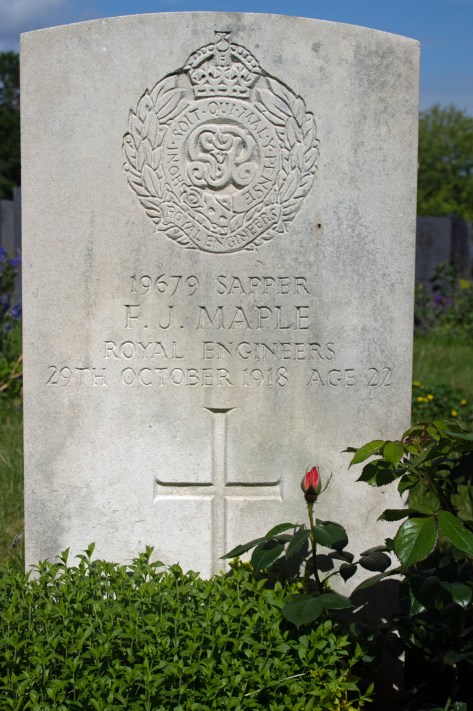
Sapper Frederick Maple

Sapper Frederick Maple

Frederick John Maple was born in 1896, the middle of three children to Royal Engineers Company Serjeant Major Frederick Maple and his wife Amelia. Frederick Jr was born in Brompton, Gillingham, Kent, but it’s interesting to note that the 1901 census gives Amelia’s place of birth as Canada, while Frederick Sr’s is not known.

Frederick Jr lost his father in 1904, and his mother five years later. At the age of just 13, he was an orphan, and this may have spurred him into finding a career. The next census – taken in 1911 – lists him as a Bugler in the Royal Engineers, barracked within walking distance of where he had grown up.

By the time war had broken out – and having come of age – the now Private Maple was assigned to the 15th Field Company. The regiment fought in a number of the key skirmishes of the war, including the Battles of Neuve Chapelle, the Somme, Loos, Ypres and Arras. Frederick went to France in March 1915, although it is not possible to confirm how or if he was involved in these battles. He was awarded the Victory and British Medals and the 1915 Star for his efforts.

Sadly, the next available document for Frederick is the Army Register of Soldiers’ Effects. This confirms that he was admitted to the 2nd London General Hospital in Chelsea, and that he passed away on 29th October 1918. Again, there is no evidence of the cause of his passing, so he may have fallen ill, or been wounded. Either way, Private Maple was just 22 years old when he died.

Frederick John Maple was laid to rest in the Grange Road Cemetery in Gillingham. When this was subsequently turned into a public park, he was commemorated in the neighbouring Woodlands Cemetery.


Private Joseph Redgrave

Private Joseph Redgrave

Joseph Redgrave was born at the start of 1897, the youngest of nine children to Charles and Hannah. Tragically, five of Joseph’s siblings passed away and, by the time of the 1911 census, the family were living in a three-roomed cottage within a few minutes’ walk of Charles’ place of work, the Naval Dockyard in Chatham, Kent.

Sadly, little documentation about Joseph remains. When it comes to his military service, his records confirm that he enlisted prior to November 1916, joining the Army Veterinary Corps as a Private. There is no evidence that he served overseas, but documents place him at the Larkhill Camp just north of Stonehenge in Wiltshire.

Tragically, Private Redgrave died from unrecorded causes at the camp’s hospital on 15th May 1917, at the age of just 20 years old.

Joseph’s body was brought back to Kent; he was laid to rest in the Woodlands Cemetery in Gillingham.


Private William Jennings

Private William Jennings

William Gladstone Jennings was born in Kent, in the summer of 1898, the only child of James and Emma Jennings. James was a marine engineer in the Naval Dockyard in Chatham, and it was here that the family lived.

Sadly, due to his age, and the lack of military service documentation, there is little written about William’s life. He was still at school by the time of the 1911 census, and the next records available confirm that he enlisted in the army. The date for this is not available, but it would have been by May 1917 at the latest and he seems to have enlisted with the surname Hickson, which was possibly his mother’s maiden name.

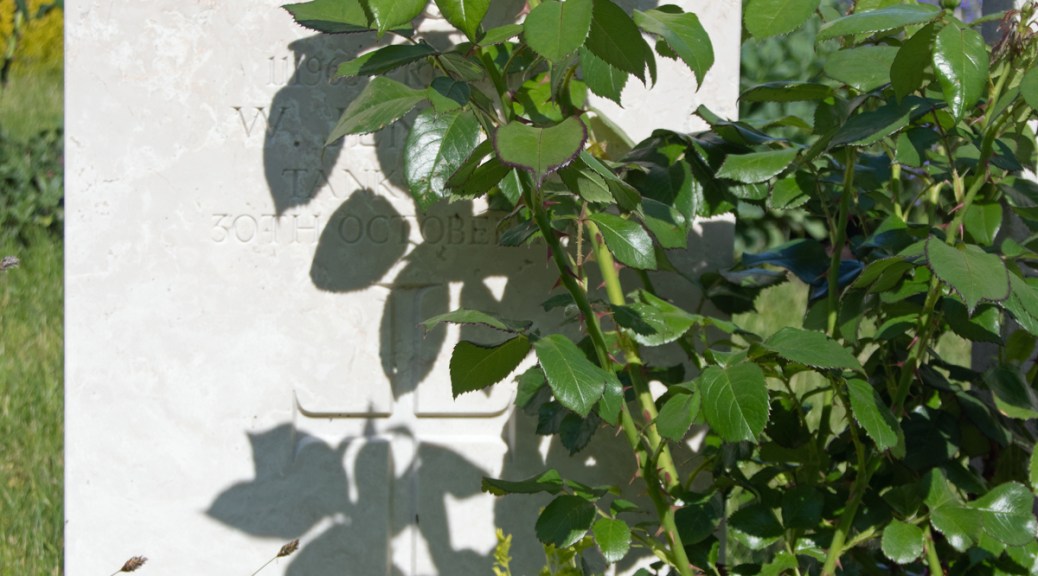
Private Jennings transferred to the Tank Corps when it was formed in July 1917. What his specific role was is lost to time, but it appears that his time in the regiment was short. The next available document is the Army Register of Soldiers’ Effects; this confirms that William passed away on 30th October 1917, in the Military Hospital in Woolwich.

There is no confirmation of the cause of his death, but Private Jennings was just 19 years old.

William Gladstone Jennings was brought back to his home town for burial, and he lies at rest in the Woodlands Cemetery in Gillingham.


Private Charles Debney

Private Charles Debney

Charles William Debney was born in the spring of 1887, one of eight children to George Debney and his wife Susannah. George was a cooper for a cement works, who had brought his family from Norfolk to Kent in the mid-1890s, presumably for employment.

When Charles left school, he found work as a bricklayer; war was on the horizon, though, and when the call came, he signed up quickly.

While full details of Charles’ service are not available, it is evident that he had joined the Northamptonshire Regiment by November 1914. He was assigned to the 5th Service Battalion as a Private. Formed in Northampton, the battalion moved to Kent in the early months of the war, before moving to the Western Front at the end of May 1915.

Sadly, there is limited additional information available on Private Debney. He passed away on 29th May 1915, but there is no confirmation of the cause of his death. He was just 28 years of age.

Charles William Debney was laid to rest in the Woodlands Cemetery, in his home town of Gillingham, Kent.


Sapper Walter Clark

Sapper Walter Clark

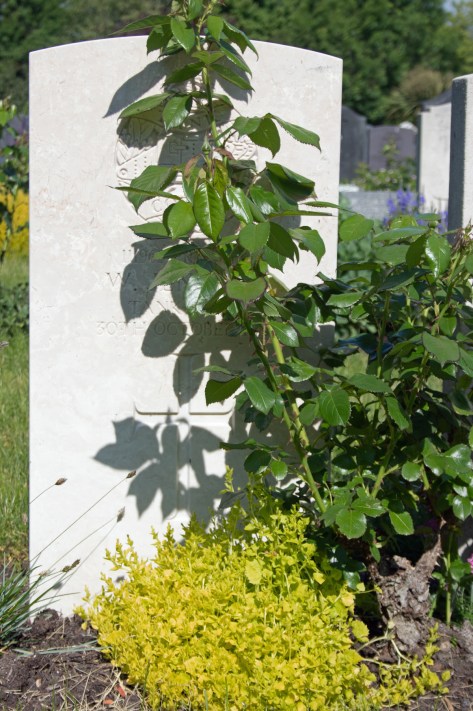
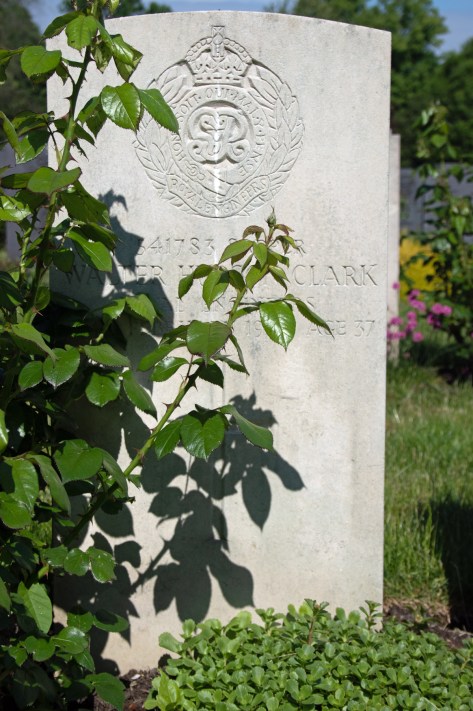
Walter Hudson Clark was born in 1883, the youngest of eight children to Thomas and Isabella Clark from Gillingham, Kent. Thomas was a miller who, with his wife, who was affectionately known as Sibella, raised their family in the centre of town.

When he left school, Walter found work as an apprentice to a painter and decorator. After Sibella died in 1903, he and two of his sisters remained living at home and, by the time of the 1911 census, he was supporting his father by working as a cooper in the nearby Naval Dockyard in Chatham.

Thomas passed away in December 1915, and this may have been the spur to guide his son into enlisting. Little documentation about Walter’s military service remains available although he joined the 480th Field Company of the Royal Engineers as a Sapper. He was in receipt of the Victory and British Medals, but there is nothing to confirm that he served abroad, so it seems likely that he was part of the territorial force.

Sadly this is where Sapper Clark’s trail goes cold. He survived the war, but died on 20th February 1920, at the age of 37 years old. There is no cause of death available either, but Walter was laid to rest in the Woodlands Cemetery in his home town of Gillingham, Kent.


Company Sergeant Major Hugh Caston

Company Sergeant Major Hugh Caston

Hugh Charles Caston was born in Chelsea in the summer of 1881, the oldest of three children to Emily and Hugh Caston. Hugh Sr died in the late 1880, leaving Emily to raise the family on her own. She moved the family to Gillingham, Kent, to be near her family. She found work as a seamstress and took in boarders.

As the effective head of the family, Hugh obviously felt he had to earn a wage. On 1st August 1896, he enlisted in the Royal Engineers as a Bugler.

Hugh’s medical report shows he stood at 5ft 4.5ins (1.63m) tall and weighed 97lbs (44kg). He had a medium complexion, with brown eyes and brown hair. The report also gave his distinctive marks as being a scar on his forehead, a brown patch on his left buttock and that his eyebrows meet.

Initially too young for full active service, Hugh formally joined up on 1st June 1897. He spent more than five years on home soil, rising through the ranks from Sapper to Lance Corporal to 2nd Corporal. In May 1902, he was posted to Malta, returning home nearly two years later. Hugh’s promotions continued over the next decade, and, by the time war broke out, he had reached the rank of Company Sergeant Major.

By this point, Hugh had married, wedding Rochester woman Mary May Coast in September 1907. The couple went on to have two children, Hubert, who sadly died young, and Joan.

War came to Europe, and things took a turn for Company Sergeant Major Caston. He was admitted to Netley Hospital near Portsmouth, with mania:

Patient’s very restless, often gets ‘excited’ is thwarted in any way. Has a delusion that he is to be promoted to Major and that he possesses great wealth. He continually asks that his motor may be sent round to take him out, also that his tailor be sent for to rig him out. Stated this morning that he wished all the other patients be supplied with Egyptian cigarettes.

Medical Report on Hugh Caston, 20th January 1915

The medical officer went on to state that he did not consider that military service had in any contributed to the mania; he was dismissed from the army on medical grounds on 2nd February 1915, after nearly 20 years’ service.

Sadly, at this point Hugh’s trail goes cold. There is no documentation relating to his time after being discharged from the army and, tragically, after his death Mary was not granted a war pension, as he had served for less that six months during the First World War.

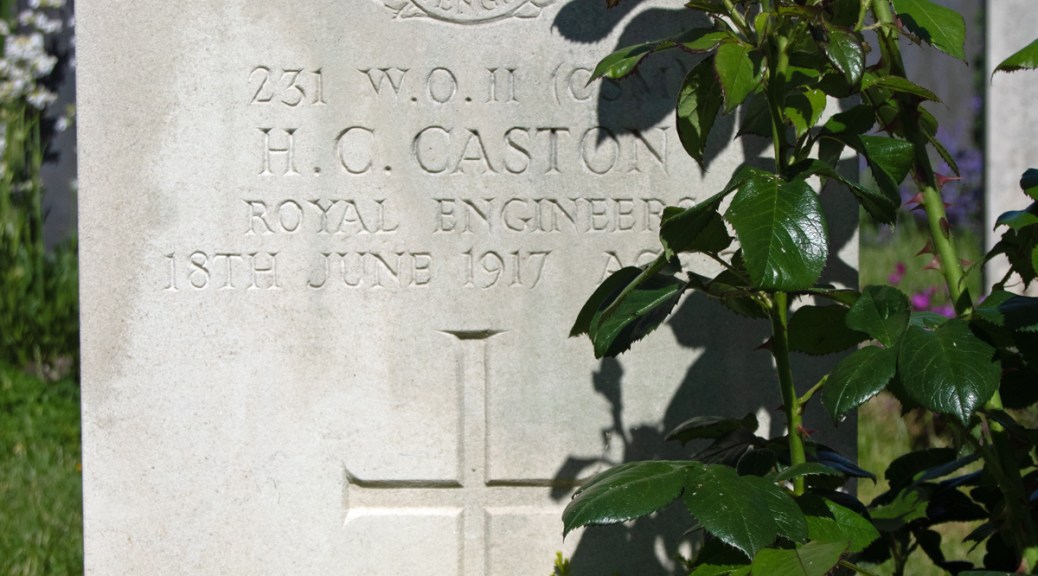
Hugh Charles Caston died on 18th June 1917, at the age of 36 years old. While the cause of his passing is lost to time, he was laid to rest in the Woodlands Cemetery in Gillingham, Kent.


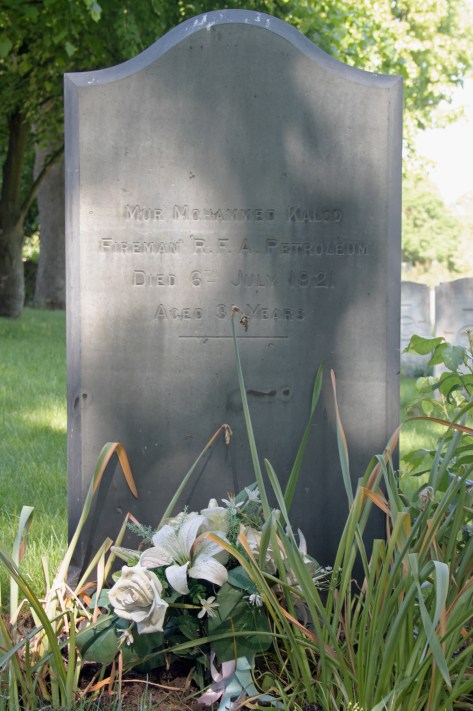
Fireman Nier Kaloo

Fireman Nier Kaloo

Sadly, there is extremely limited information on the man commemorated no this gravestone.

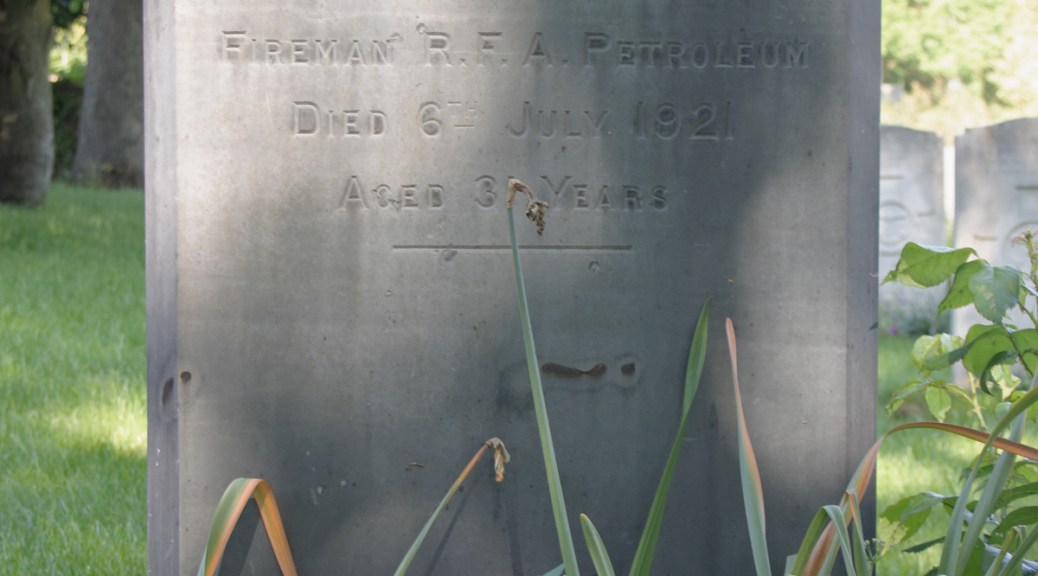
Nier Mohammed Kaloo (or, alternatively, Mur Muhammed Kaloo), was born in around 1890. He joined the Royal Navy and, by the end of the war at the latest, he had been transferred to the Royal Auxiliary Fleet as a Fireman.

His ship, the SS Petroleum, acted as a tanker for other naval vessels. In the immediate aftermath of the war, she travelled between Portsmouth and Copenhagen, but soon took on longer trips, to Hong Kong and the Far East.

It was after returning from Singapore in the first half of 1921 that Fireman Kaloo died, although the cause of his passing is lost to time. He was 31 years old. The ship having moored at the Naval Dockyard in Chatham, Kent, he was laid to rest in the Woodlands Cemetery in nearby Gillingham.


Private Albert Cobby

Private Albert Cobby

There are some mysteries that are just destined not to be solved, no matter how much digging you do. One gravestone in Worthing’s Broadwater Cemetery, dated 10th December 1916, proved to be one of those.

Research across the standard platforms revealed very little. There was no AEA Coby on Ancestry, the service number 9076 did not reveal anything on the Fold3 website. The name Coby did not feature in any contemporary newspaper article in December 1916 or January 1917.

One lead suggested that Private Coby’s first names are Albert Ernest, but again, this drew a blank. Another gave the surname with the spelling Cobby, and this seemed to fit better.

The birth of an Albert Ernest Cobby was registered in Sussex at the start of 1888, but the parents’ names are missing. The Commonwealth War Graves Commission website gives these as Alfred and Ellen Coby, but there is no concrete documentation to back this up.

The combination of Cobby and the service number did identify a military record on Fold3, but even here the information was limited. The document confirmed that Albert was nearly 29 when he enlisted in the Royal Sussex Regiment on 3rd December 1915, and that he was a motor cleaner in Worthing by trade. It gave his mother as Mrs A Cobby, but this does not fit with the Ellen suggested elsewhere.

Crucially, it confirmed that Private Cobby served on the home front for a matter of weeks – from 29th February 1916 to 4th May 1916. No reason is given for the end of his service.

Sadly, much of Private AEA Cobby’s life is destined to remain a mystery, with no definite links between the various pieces of evidence.


Private Charles Leach

Private Charles Leach

Charles George Leach was born in 25th July 1872 and was the second of eight children. His parent were Gloucestershire-born painter William Leach and his laundress wife Ellen who raised the family in Greenwich, South London. William had married previously, but his first wife, Emma, had died in 1868, leaving him a widow at 40, with five children to raise. He had married Ellen shortly after, and the family grew in size.

There is little information on Charles’ young life. It seems like the family had moved down to Sussex at some point; this is where Charles met his future wife, fisherman’s daughter Ellen. By the time William died in 1909, the family had again relocated, this time moving back to Gloucestershire.

The 1911 census gives Charles and Ellen visiting Charles’ sister Alice and her husband. The couple had two children by this point, as did Alice. Charles’ mother Ellen was also living there; a family of nine living in a house in the town of Cinderford.

Details of Charles’ military life as somewhat sketchy. He did enlist, joining the Royal Army Service Corps on 6th December 1915, and certainly served in France, gaining the Victory and British Medals and the 1915 Star. However the records suggest that Private Leach was discharged from the army on medical grounds in the spring of 1916, and the refusal of a war gratuity – paid once soldiers had attained six months’ service – seems to back this up.

There is little more information available on Charles Leach. He and Ellen went on to have four children in all, and moved back to Sussex, close to her family. He passed away on 4th March 1919, at the age of 46, but no cause of death is available.

Charles George Leach lies at rest in the Broadwater Cemetery, in Worthing, West Sussex.


Private Holdsworth Elphick

Private Holdsworth Elphick

Holdsworth Elphick was born on 7th June 1891, one of five children to Herbert and Mary Elphick. Herbert was a billiard marker and professional player, who had been born in Brighton. Mary was from Ireland, but the couple raised their family in London, presumably as this is where the best opportunities for work were.

When he left school, Holdsworth found work at the George Hotel in Balham, South London, where he was employed as a barman. The 1911 census shows another barman there called Geoffrey Elphick, who, while not one of Holdsworth’s brothers, may well have been a cousin.

When war broke out, Holdsworth was quick to sign up. He enlisted as a Private in the Buffs (the East Kent Regiment) on 9th September 1914 and, after a year on the Home Front, he was sent out to France as part of the British Expeditionary Force in August 1915.

There is little further information available about Private Elphick’s time in the army. He returned to England on 25th February 1916; this appears to have been a medical evacuation as, two months later, he was discharged from the army as he was no longer physically fit to continue.

Life continued for Holdsworth. In September 1917, he married Lydia Ann Armstrong, a dock labourer’s daughter from Southampton, although this is where his trail seems to end.

The next available evidence for Private Elphick is his gravestone. This confirms that he passed away on 11th November 1918 – Armistice Day – but no further information is available. He was just 27 years of age.

Holdsworth Elphick lies at rest in the Broadwater Cemetery in Worthing, West Sussex (presumably this is where he and Lydia moved after their marriage, although there is nothing to confirm this).