Category Archives: unknown

Quartermaster Serjeant Percy Macey

Quartermaster Serjeant Percy Macey

Percy George Macey was born in Frome, Somerset, in the autumn of 1889. He was the oldest of six children and the only son to Arthur and Susan Macey. Arthur was a general labourer and domestic gardener from Wiltshire, whose family had moved to Somerset in the 1870s.

When he left school, Percy found work at a local foundry, and, by the time of the 1911 census, was listed as a brass fitter. By this point he had met Winifred Rowe, a labourer’s daughter from Wiltshire, who had found work as a servant to a Frome butcher. The couple married at the start of 1913, and went on to have a son – who they called Arthur, after Percy’s recently deceased father – later that year.

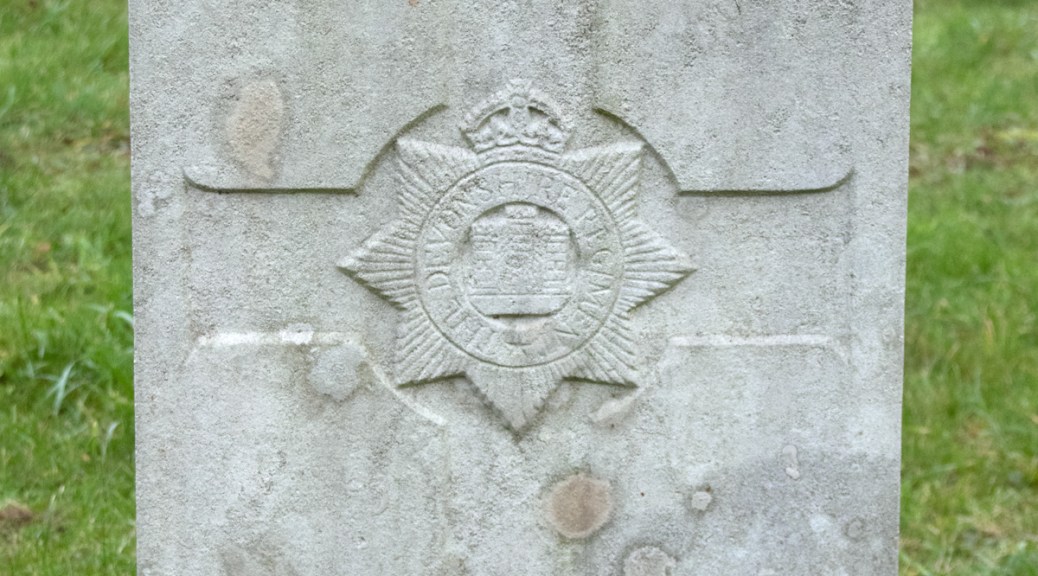
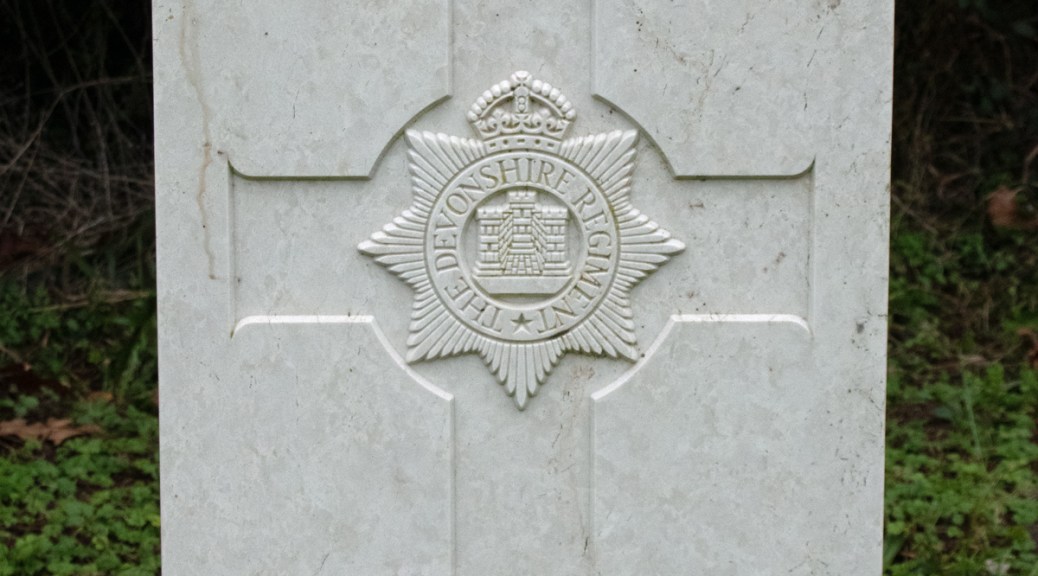
War was coming, and Percy joined the Somerset Light Infantry. Full details of his military service are not available, although at some point during the conflict he was promoted to Serjeant and transferred to the Labour Corps under the Devonshire Regiment. He was awarded the Victory and British Medals, but does not appear to have seen any service overseas.

By the end of the war, Percy had risen to the rank of Quartermaster Serjeant. The end of his life is, however, shrouded in a bit of mystery. He passed away on 15th March 1921 in Cheltenham, Gloucestershire; although no cause for his death is evident, it seems likely to have been from an illness of some sort, as there are no contemporary newspaper reports to suggest anything out of the ordinary. He was just 31 years old.

Percy George Macey was brought back to Frome; he was laid to rest in the Dissenters’ Cemetery in Vallis Road.


Private Charles Hide

Private Charles Hide

Charles Arthur Hide was born on 14th July 1897 and was the son of Ellen Edith Hide. The 1901 census found Charles living with his mother and her parents in the West Sussex village of Clapham. When Ellen’s father James died in 1909, local hurdle maker Alfred Daniels took her, Charles and her mother in as lodgers. Ellen subsequently married Alfred in 1916.

Charles, by this time, had left school and found employment with the railways. He started work on 22nd April 1913, earning 14s per week (around £55 a week in today’s money) as a porter at the station in Hove.

When war broke out, however, Charles felt the need to do his duty. He resigned from his job on 13th November 1914, and enlisted in the Royal Sussex Regiment as a Private. Charles was not alone in this: the employment records for Hove Station show that a number of other porters also handed in their notice around the same time.

Assigned to the 11th (Service) Battalion (also known as the 1st South Downs), Private Hide was initially based near Bexhill. His troop was then moved on, first to Maidstone in Kent, then to Aldershot, Hampshire. Whilst the battalion as a whole were shipped to France in 1916, there is no evidence that Charles went with them, and it seems that he may have served his time on home soil. Wherever he was based, he was awarded the Victory and British Medals for his time in the army.

At this point, details of Private Hide’s life become sketchy. He is only mentioned in one further document – the Army Register of Soldiers’ Effects – which confirms that he passed away at a military hospital in Epsom, Surrey, on 26th March 1917, although no cause is given. He was just 19 years of age.

Charles Arthur Hide’s body was brought back to Sussex for burial. He lies at rest in the quiet graveyard of St Mary the Virgin Church in his home village of Clapham.


Gunner George Trask

Gunner George Trask

George Trask was born on 22nd December 1875 and was the oldest of nine children. His parents were Absolam and Sarah Jane Trask, although it seems that the couple did not actually marry until after their first three children had been born. Absolam was an agricultural labourer and the family lived in his and Sarah’s home village of East Coker, near Yeovil in Somerset.

George was destined for a life of adventure; in May 1894, aged just 18, he enlisted in the army, joining the Royal Artillery as a Gunner. His medical examination sheds some light on his physique. He stood 5ft 7ins (1.70m) tall and weighed in at 144lbs (65.3kg). He had a fair complexion, hazel eyes and light brown hair.

Oddly, in the section on distinguishing marks – recorded to help identification should the soldier be killed – the medic only highlighted a ‘small mole midway between pubes and umbilicus’: it seems unlikely that this was the only distinguishing mark that could have been highlighted.

Gunner Trask’s initial service was spent in England. He served four-and-a-half years on the home front, before being shipped to Malta. After six months on the island, he was moved to Crete for a few months, before returning to Malta in September 1899.

George completed his initial term of seven years’ service, and elected to remain to complete a full twelve years of enlistment. As part of this, he was transferred to the Caribbean, spending two years stationed in Bermuda, before moving on to St Lucia for a further two years. By December 1905, Gunner Trask was back home in England, and it was on home soil that he remained.

Back in Somerset, George extended his term of service for another four years. Settled in his home village, he married Elizabeth Garrett on 27th December 1908; the couple would go on to have three children: Ethel (born in 1910), Lilian (1911) and George Jr (1916).

Gunner Trask’s military service continued apace. Reassigned to the Royal Garrison Artillery, he was posted in Portsmouth up until the outbreak of the war. He was awarded a third Good Conduct Medal in addition to the ones he had received in 1900 and 1904.

At this point, details of George’s military service become a little hazy. He achieved 21 years’ military service on 29th May 1915 and was awarded a further Good Conduct Medal. At this point, with the war raging, his period of duty was extended again, until the end of the conflict.

At some point during this time, he was assigned to the Royal Artillery’s School of Experimental Gunnery in Shoeburyness Essex. Sadly, there is nothing to confirm his exact role there, although, given that he was in his 40s by this point, it is likely that he acted as more of a mentor.

And it is here that the story comes to an end. Gunner Trask is noted as passing away in the Military Hospital in Shoeburyness on 31st October 1918, though there is nothing to confirm the cause of his death. He was 43 years of age.

George Trask’s body was brought back to Somerset for burial. Having travelled the world with the army, he was laid to rest in the graveyard of St Mary’s Church in his home village of East Chinnock.


George’s son George was to follow his father into military service.

Working as a press operator for a plastics company, he married Gwendoline Harper in Southend, Essex in April 1940. There is no record of whether he had enlisted at this point, but is seems likely that he had.

When the Second World War broke out, he joined the 4th Battalion of the Suffolk Regiment. After initially helping in the defence of England following the British Army’s evacuation from Dunkirk, late in 1941, he was sent first to Egypt, then to Singapore to help strengthen the garrison there.

Early the following year, the 4th and 5th Battalions fought in the defence of Singapore, before the island surrendered to the Japanese Army. At this point, Lance Corporal Trask found himself a prisoner of war.

The prisoners were put to work building the Burma railway, and suffered great hardship at the hands of their captors. Many succumbed to illness, and George was amongst them, dying from beriberi on 18th December 1943. He was just 27 years old.

George Reginald Trask was laid to rest in the Chungkai Cemetery in Thailand, 100km west of Bangkok.


Rifleman Arthur Langdon

Rifleman Arthur Langdon

Arthur William Langdon was born on 23rd December 1882, the son of Rose Langdon, from the Somerset village of Chiselborough. While Arthur’s father is lost to time, Rose married Frederick Hockey in 1886, and the couple went on to have three children – half-siblings to Arthur.

Arthur was destined for a life of adventure, and in 1902, at the age of 19, enlisted as a Rifleman in the King’s Royal Rifles, a career that was to last more than a decade.

On 13th April 1903, Arthur married Florence Beatrice Druce, who was also from Chiselborough. Noticeably absent from the marriage certificate was the name of the groom’s father; he was simply marked as ‘unknown’. The newlyweds would go on to have a son, also called Arthur, the following year.

Rifleman Langdon was soon destined for service overseas, however. After 18 months in South Africa, he returned to England for a year. He was sent to India for four years; it is likely that Florence went with him, or at least that Arthur returned home on leave during this time, as two further children – Henry and Reginald – were born in 1907 and the summer of 1910 respectively.

Arthur returned to England in February 1910, and remained on reserve home service – supplementing his income by working as a gardener – until the outbreak of the First World War. During this time he and Florence had two further children, Frederick, born in 1912, and Ivy, born just a month before war broke out.

With the start of the conflict, Rifleman Langdon was send to France as part of the British Expeditionary Force. After five months on the Western Front, he had a brief respite back in England, before being shipped back to France in May 1915, and on to Salonika in the Balkans that November.

Rifleman Langdon did not stay in Greece for long, however. Within a couple of months he was back in England and on 14th April 1916, he was discharged from the army on medical grounds. Sadly, details of the cause of his exit from the army are not detailed.

Arthur was not one to rest on his laurels, however, and continued work as a gardener and labourer. Military life wasn’t far away, though, and in June 1918, he enlisted again, this time joining the Royal Air Force as a Private.

Initially based at Long Sutton, Arthur moved to Edinburgh Castle in March 1919. Full details of his time there are lost, but he remained in Scotland until being demobbed at the end of April 1920.

Details of Arthur’s life back on civvy street are not available. All that can be confirmed is that he passed away on 28th February 1921, at the age of 38 years old. Arthur William Langdon was laid to rest in the graveyard of St Margaret’s Church in the Somerset village of Middle Chinnock, where his widow now lived.


Arthur William Langdon
(from ancestry.co.uk)

Ordinary Seaman William Stanley

Ordinary Seaman William Stanley

William Alfred Stanley is one of those names that seems destined to be lost to the annuls of time. Little documentation exists for his early life, but what there is gives some hints at a determined young man.

William was born in London to an Annie Stanley, who lived in the Kentish Town area of the city. At some point, he emigrated to Canada as, according to his wartime enlistment papers, he joined up in Ontario.

William enlisted in the Canadian Expeditionary Force on 5th November 1915, and was initially assigned to the 44th Battalion of the Canadian Infantry. His troop embarked for England in July 1916, and, on his arrival he was transferred to the 98th Battalion.

It was at this point that things too an unusual turn. With a few months, Private Stanley was again transferred, this time to the 19th Battalion, and then again to the 4th Reserve Battalion from where he was discharged from the Canadian Infantry in February 1917 for being underage.

At this point, William seems to have been undeterred.

The next record for him – in fact the memorial to him – is his headstone. This confirms that he had enlisted in the Royal Naval Canadian Voluntary Reserve as an Ordinary Seaman. He was based at HMS Pembroke, the shore establishment at Chatham Dockyard, but there is no other information for him.

Ordinary Seaman Stanley died on 28th December 1917, at the age of 21. (His previous military discharge might suggest that he was, in fact, younger than this, but that is conjecture on my part.) There is no record of a cause of death and nothing in contemporary newspapers to suggest anything out of the ordinary.

William Alfred Stanley was laid to rest in the Woodlands Cemetery in Gillingham, Kent, not far from the Naval Dockyard where he had been based.


Private William Sweet

Private William Sweet

William Frank Sweet was born towards the end of 1897 and was the youngest of seven children. His father, Richard, was a groom and, together with his wife, Mary, he raised the family in the Somerset town of Yeovil.

When William left school, he found work as an errand boy for a tailor; by the time of the 1911 census, Richard was working as a coachman for a hotel, and the family were living in a house on the north side of the town.

There is very little other documentation on young William’s life. When war broke out, he enlisted in the Somerset Light Infantry, and was assigned to the 5th Battalion, who were based in Taunton.

Further information on Private Sweet is scarce; given when he died, it is likely that he enlisted as part of the first wave of voluntary recruiting. It is also likely that, when he was training at the Tidworth Barracks on Salisbury Plain, he came down with some illness, and it was this to which he succumbed.

William Frank Sweet died on 4th October 1914, at the age of just 17 years old. His body was brought back to Yeovil, and he was buried in the town’s cemetery on 10th October, the day after his Battalion set sail across the English Channel to join the onslaught.


Private Frederick Jury

Private Frederick Jury

Frederick Jury was born in 1882, the oldest of four children to William and Lucy. William was a farm labourer from Minehead, Somerset, and this is where the young couple raised their family.

When he left school, Frederick found work as a labourer for a stonemason, but he had his sights on a higher calling. In March 1903, he enlisted in the Somerset Light Infantry and, after two years’ service, he was assigned to the Army Reserve.

By the time of the 1911 census, Lucy has been widowed; she was working as a charwoman in Minehead and living in a small cottage with her youngest daughter – Frederick’s youngest sister – Alice. Sadly, there is no record to confirm where Frederick was at this time.

When war broke out, Private Jury was called back into service. He was dispatched to France on 19th September 1914, and served there with his regiment for eight months before returning to England in May 1915 and transferring across to the Agricultural Company of the Labour Corps.

Private Jury’s time in the army seems to have been a troubled one. He was pulled up at least six times between 1903 and 1905, for being absent from parade, and for smoking in the stables. He was subsequently censured for failing to attend training during both 1910 and 1911, and the list went on into his time on active duty. He was punished for overstaying his pass in July, October and November 1915, for having a rusty rifle on inspection in August 1915 and for quitting his guard duty in January 1916. On each of these latter occasions, he was brought back by the Military Police and fined.

Frederick’s service records also confirm that he was treated in hospital for gonorrhoea in January 1905, something that may well have been par for the course for young soldiers at the time.

The continuous lapses in duty, however, may have proved too much for his regiment, and Frederick was discharge from military service on 8th March 1916.

At this point, Frederick Jury’s trail goes cold. The only further information available is that he died on 13th January 1919, at the age of 38 years old. He was laid to rest at Yeovil Cemetery in his home county of Somerset.


Private Frederick Major

Private Frederick Major

Frederick John Major was born in the spring of 1882, the oldest of seven children to John and Eliza Major. John was a farm labourer and he and Eliza – who was 20 years his junior – raised their family in the Dorset village of Batcombe.

John passed away in 1900, when Frederick was just 18 years old. He was already working as a carter, and continued to live with his mother, helping support her financially, along with his brother and sister.

With war on the horizon, Frederick was keen to do his part. He enlisted in the Somerset Light Infantry, and was assigned to the 9th Battalion as a Private. This was a service battalion based in Plymouth, and it is unlikely, therefore, that Private Major saw any active service overseas.

Sadly, Frederick’s time in the army was to be short. He passed away in Somerset on 11th January 1915, aged just 33 years old. No evidence of the cause of his death is documented.

Frederick John Major was laid to rest in Yeovil Cemetery, in the town in which he died.


Private Percival Peacock

Private Percival Peacock

Percival William Peacock was born in early 1888, the son of Thomas and Louisa Peacock. Little information survives about Percival’s early life, other than that he was one of two children, and that, like his parents, he had been born in Gillingham, Kent. Thomas was a sexton and gravedigger, but Percival found work as a hairdresser.

The 1911 census shows him as head of the household in a cottage in the village of Stone, near Dartford; he was living there with his cousin James and his family.

On 21st April 1913, now living in Kensal Green, North London, Percival married Clara Milton, a labourer’s daughter from just a few doors up.

War was now imminent, but again there is limited information about Percival’s involvement. He did enlist, joining the Labour Corps as a Private, but this seems to have been later in the war. He appears to have served on home soil, although there is nothing to confirm this either way.

The next concrete evidence for Percival is the Army Register of Soldiers’ Effects. This confirms that he passed away on 5th December 1918 at the Paddington Military Hospital in London. No cause of death is provided, and the beneficiary given is his father, Thomas. Private Peacock was just 30 years old.

Percival William Peacock was laid to rest in the Grange Road Cemetery in Gillingham, Kent. Hs is commemorated in the nearby Woodlands Cemetery.


Tragedy was not far from the Peacocks’ life. Clara’s mother, Bessie, had passed away just a couple of weeks before Percival. Clara herself died on 5th March 1919, three months after her husband.


Sapper Frederick Maple

Sapper Frederick Maple

Frederick John Maple was born in 1896, the middle of three children to Royal Engineers Company Serjeant Major Frederick Maple and his wife Amelia. Frederick Jr was born in Brompton, Gillingham, Kent, but it’s interesting to note that the 1901 census gives Amelia’s place of birth as Canada, while Frederick Sr’s is not known.

Frederick Jr lost his father in 1904, and his mother five years later. At the age of just 13, he was an orphan, and this may have spurred him into finding a career. The next census – taken in 1911 – lists him as a Bugler in the Royal Engineers, barracked within walking distance of where he had grown up.

By the time war had broken out – and having come of age – the now Private Maple was assigned to the 15th Field Company. The regiment fought in a number of the key skirmishes of the war, including the Battles of Neuve Chapelle, the Somme, Loos, Ypres and Arras. Frederick went to France in March 1915, although it is not possible to confirm how or if he was involved in these battles. He was awarded the Victory and British Medals and the 1915 Star for his efforts.

Sadly, the next available document for Frederick is the Army Register of Soldiers’ Effects. This confirms that he was admitted to the 2nd London General Hospital in Chelsea, and that he passed away on 29th October 1918. Again, there is no evidence of the cause of his passing, so he may have fallen ill, or been wounded. Either way, Private Maple was just 22 years old when he died.

Frederick John Maple was laid to rest in the Grange Road Cemetery in Gillingham. When this was subsequently turned into a public park, he was commemorated in the neighbouring Woodlands Cemetery.