Category Archives: Northamptonshire

Lance Corporal Edmund Durnford

Lance Corporal Edmund Durnford

Edmund George Durnford was born in the spring of 1881 in the Somerset village of Pitcombe. The second oldest of twelve children, he was the oldest son to Edmund and Eliza Durnford. Edmund Sr was an agricultural labourer who travelled with the work – the 1891 census recorded the family living in Mells, near Frome.

When Edmund Jr left school, he found work at an ironmonger’s. He moved to Midsomer Norton and, in 1907, he married local carter’s daughter Bessie Welch. The young couple set up home in a terraced house on the road to nearby Radstock, and went on to have two children: Ian, who was born in 1908, and Ronald, born the following year.

War came to Europe, and Edmund was keen to play his part. He enlisted in the Royal Army Service Corps as a Driver, and was assigned to the 827th Company. Full details of his service are not available, but he remained a part of the territorial force and was promoted to Lance Corporal.

The local newspaper of the time reported on what became of Edmund:

Lance Corporal Edward [sic] G Durnford, Army Service Corps… son of Mr and Mrs EG Durnford… died suddenly on April 18 at Duston Hospital, Northampton, from shell shock and hemorrhage [sic] of the brain, was 38 years of age. The body was brought back from Northampton, and the deceased accorded a military funeral at Midsomer Norton last week.

Somerset Guardian and Radstock Observer: Friday 3rd May 1918

There are a couple of inconsistencies with the report. The newspaper has Edmund’s name wrong, while his pension record does not mention shell shock as the cause of death (it confirms the cerebral haemorrhage, but also cites a granular kidney). Given that Lance Corporal Durnford did not serve abroad, it seems unlikely that shell shock was a contributing factor.

The same article also places three of Edmund’s brothers in the war, and gives an insight into what had become of them before the conflict. Gunner Percy Durnford was with the Canadian Field Artillery, training in the South of England; Sergeant Major Arthur Durnford, of the Australian Light Horse, was based in Sydney; Bombardier Horace Durnford, of the Royal Garrison Artillery, had served in France, where he had been gassed, but was, at the time of his oldest brother’s death, based in Egypt.

Edmund George Durnford died in Northampton on 18th April 1918. He was 38 years of age. His body was brought back to Somerset, and he was laid to rest in the graveyard of St John the Baptist Church in Midsomer Norton.


Edmund’s younger son, Ronald, served in the Second World War. He joined the Royal Artillery, reaching the rank of Lance Bombardier. Ronald was serving in the Far East early in 1942, and for the next year, no news was heard of him.

However, contact was made in March 1943, confirming that Ronald had been captured by the Japanese, and was a prisoner of war in Borneo. Three months later, his wife, Kathleen, received a postcard from him, confirming he was a prisoner of war, well and unwounded.

Tragic news was quick to follow, however:

In last week’s issue it was stated that Mrs [Bessie] Durnford… had received through her daughter-in-law news that her son, Lance Bombardier Ronald Durnford, was a prisoner of war in Jap hands and was unwounded.

On Saturday she received the sorrowful news that he was dead in the following messages, which her daughter-in-law had sent on:

“I deeply regret to inform you a report has been received from the War Office, that [Ronald], who was reported a prisoner of war in Borneo Camp, had died from dysentery. The date of his death is not yet known, but you may rest assured as soon as any further information is received, I will immediately let you know.”

Somerset Guardian and Radstock Observer: Friday 30th July 1943

Lance Bombardier Durnford was laid to rest in the Labuan War Cemetery in Malaysia.


Further family tragedy, albeit with a life well-lived, was to follow as, on 6th September 1943, Bessie too died at the age of 86. She was laid to rest alongside Edmund in the family plot. Her obituary confirmed that “She leave a husband, seven daughters, and four sons to mourn her loss. One son and one daughter are in Canada, and one son in Australia, and one daughter and son in London.” [Somerset Guardian and Radstock Observer, Friday 17th September 1943]

Bessie had not, in fact, remarried: the husband was, in fact, the one who had died some 25 years before.


Sergeant John Foxworthy

Sergeant Joh Foxworthy

John James Foxworthy was born in the South Devon village of East Allington in 1867. He was the middle of five children to carpenter Roger Foxworthy and his wife Ann.

When he left school, John found work on a local farm, but he had bigger plans and, in July 1887, he enlisted in the Royal Marine Light Infantry. His service records show that he stood 5ft 8ins (1.73m) tall, had dark brown hair, brown eyes and a fresh complexion.

John had a varied military career that lasted for more than two decades. During this time, he served on nine ships, and was based at HMS Vivid – the Royal Naval Dockyard in Plymouth – for significant periods of time. He began as a Private, but rose through the ranks to Corporal (in 1894) and Sergeant (in 1900). He was wounded in April 1899, when he was shot in the leg, but recovered from this and continued his career.

In 1895, John married Maria Woodley, the daughter of a railway labourer from Totnes. The couple went on to have four children, Minnie, Gladys, Alice and William.

In 1908, Sergeant Foxworthy left the Royal Marine Light Infantry after 21 years’ service. By now the family home was in Prospect Terrace, Newton Abbot, just a short walk from the town centre. The 1911 census records him as being a Royal Marine pensioner and caretaker of the Miniature Rifle Club.

When war broke out, John was called back into duty and, by September 1914, he found himself in a Royal Marine Depot in Belgium. His service overseas was fairly short, and he had returned to England by the spring. He was working as a recruiting sergeant in Northampton on 30th March 1915, when he suddenly collapsed and died. He was 47 years of age.

John James Foxworthy’s body was brought back to Devon; he lies at rest in the family grave in Newton Abbot Cemetery.


Private William Henderson

Private William Henderson

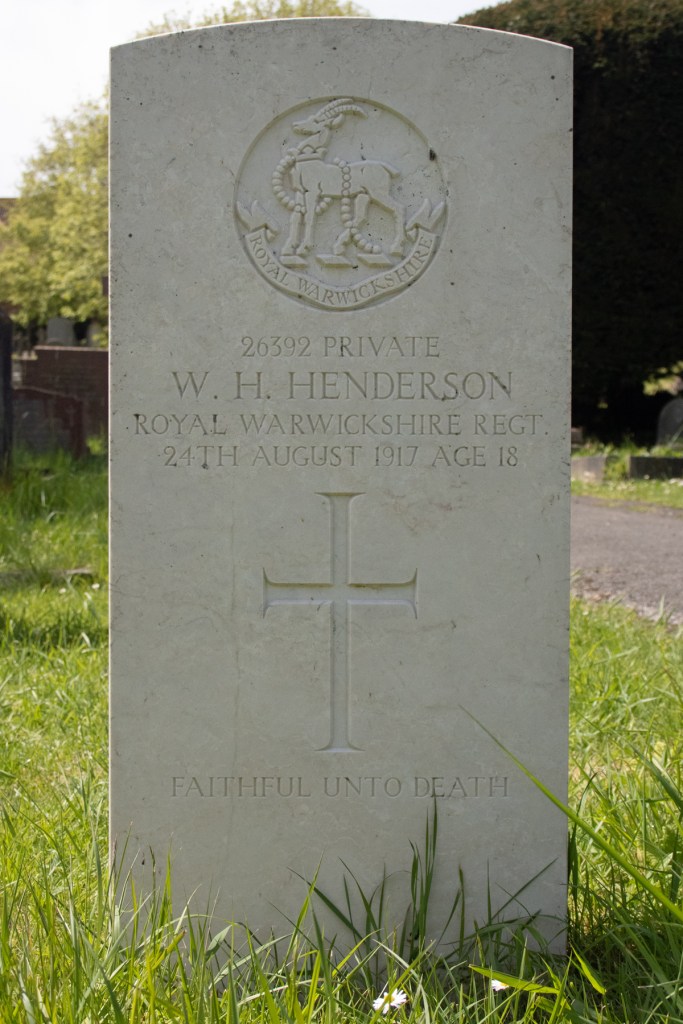
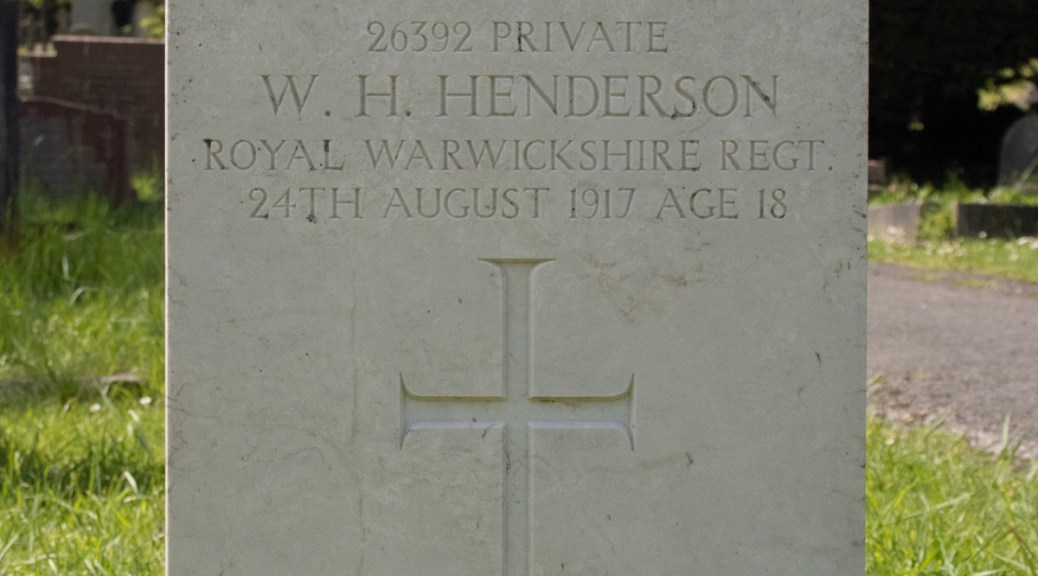
William Henry Henderson was born in Weston-super-Mare in December 1898. The oldest of four children, his parent were tailor Herbert Henderson and his wife Fanny.

As with a lot of servicemen born around 1900, there is little documentation around William’s early life. When war broke out, he was 15 years old, and seems to have been eager to do his bit. Few military records for him survive, but he joined the Royal Warwickshire Regiment and was given the role of Private in the 5th (Reserve) Battalion.

Part of William’s training seems to have taken place in Northumberland, and he was based near the coastal town of Blyth. On 24th August 1917, he was one of 600 men taken on a route march from the camp to the coast. The Somerset Standard took up the story of that day’s events:

Lieutenant Colonel Frank Martin Chatterley, the officer in command, said that he… allowed the men 20 minutes to cool, and after taking all necessary precautions gave orders for them to enter the sea.

The witness inquired from a boy the state of the tide, and was told that it was low ebb; he expected it to rise shortly. The witness undressed, bathed and came out of the water, and was dressing when he was told that some of the men were in difficulties.

Somerset Standard: Friday 31st August 1917

The Morpeth Herald added to this: “The soldiers had not been in the water long when some of them got into difficulties and were washed out seawards, in spite of their struggles. A number of comrades rushed to their assistance until at the fatal spot 13 men were seen struggling and evidently drowning.  Soldiers formed a human chain by joining hands and wading as far they could into the fast-ebbing tide. They succeeded in saving 5 of their comrades, three of whom were very exhausted, when they got ashore that they were immediately rushed off by car.”

Nine soldiers, including Private Henderson, drowned that day, despite the commended attempts by Reverend Verschoyle, the Army Chaplain, to save their lives.

Some of the survivors told the inquest that they were from the Midlands; they could not swim, and one had never seen the sea before. The inquest was told that there were terrific currents and shifting sands in that particular spot that day, and the conditions seemed to have changed after the soldiers had entered the water. Chatterley said that he had had men bathing at that spot before, and had also seen civilians bathing there before.

The other eight servicemen who perished that day were Privates Thomas Forley, Henry Southern, Fred Shale, George Beavan, Gordon Noy, William Blann, Lieutenant Kenneth Brown and Sergeant Riley. Private Henderson was just 18 years old.

William’s body was brought back to Weston-super-Mare for burial. He lies at rest in the Milton Cemetery in the town.


Private William Diamond

Private William Diamond

William Diamond was born in around 1888, although documentation relating to his life are tantalisingly absent. From what does remain, the following can be identified.

William was one of ten children, whose mother was Maryann (or Mary Ann) Diamond. His father had passed away by the time of the 1911 census, by which point the Maryann was living with six of her children, including William, in the village of Litton, on the north side of the Somerset Mendips.

When war broke out, William enlisted, and was assigned to the 15th Battalion of the Hampshire Regiment. Again, there is little documentation to confirm his military service; sadly, the next time Private Diamond appears in the records is to confirm his passing.

The local newspaper reported on his funeral:

The funeral took place on Sunday afternoon, at Litton, his native place, of Private W Diamond, 28 [sic], late of the Hampshire Regiment, who died in hospital in Northampton after a serious illness, after serving some seven months at the front.

Among the chief mourners was a younger brother in khaki (an elder one is now serving in India) and several officers of the AOF, of which deceased was a member.

Shepton Mallet Journal: Friday 24th August 1917

Private William Diamond passed away on 15th August 1917, at the age of 29 years old. He lies at rest in the churchyard of St Mary the Virgin, in Litton, Somerset.


Artificer William Brighton

Artificer William Brighton

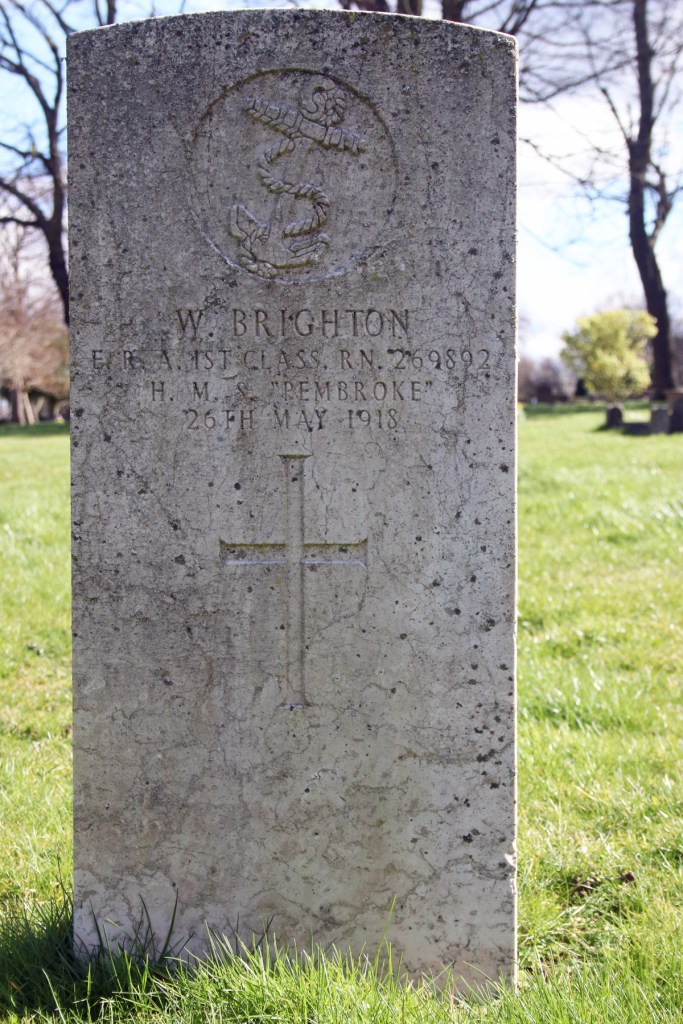
William Brighton was born on 13th August 1877 in Peterborough, Northamptonshire. Sadly, details of his early life are lost to time, so his parents’ names, and details of any siblings are a mystery.

William chose a military life early on; he enlisted in the Royal Navy in October 1899 for twelve years’ service. Working as an Engine Room Artificer, he was an engine fitter and repairer on a number of vessels in his time, including the battleship HMS Repulse and the cruisers HMS Andromache and Scylla.

William married Lily Franklin in the autumn of 1904, and the couple went on to have three children; Mona, Lily and John. With William away at sea a lot of the time, Lily set up home in Gillingham, Kent, close to the shore facility – HMS Pembroke – where her husband was based.

The uncertainty around potential conflict meant that William extended his service when it initially came to an end in November 1911. He continued to serve on a number of vessels during the war and was based on a ship off the Scottish coast when he fell ill in May 1918.

William was transferred to the US Hospital in Strathpeffer, near Inverness, suffering from an abdominal aneurysm. Sadly the treatment did not work, and he passed away on 26th May 1918. He was 40 years old.

William Brighton lies at rest in the Woodlands Cemetery in Gillingham, Kent.


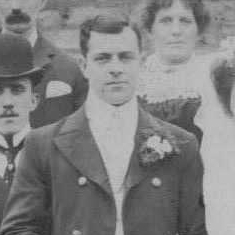
William Brighton (from ancestry.co.uk)