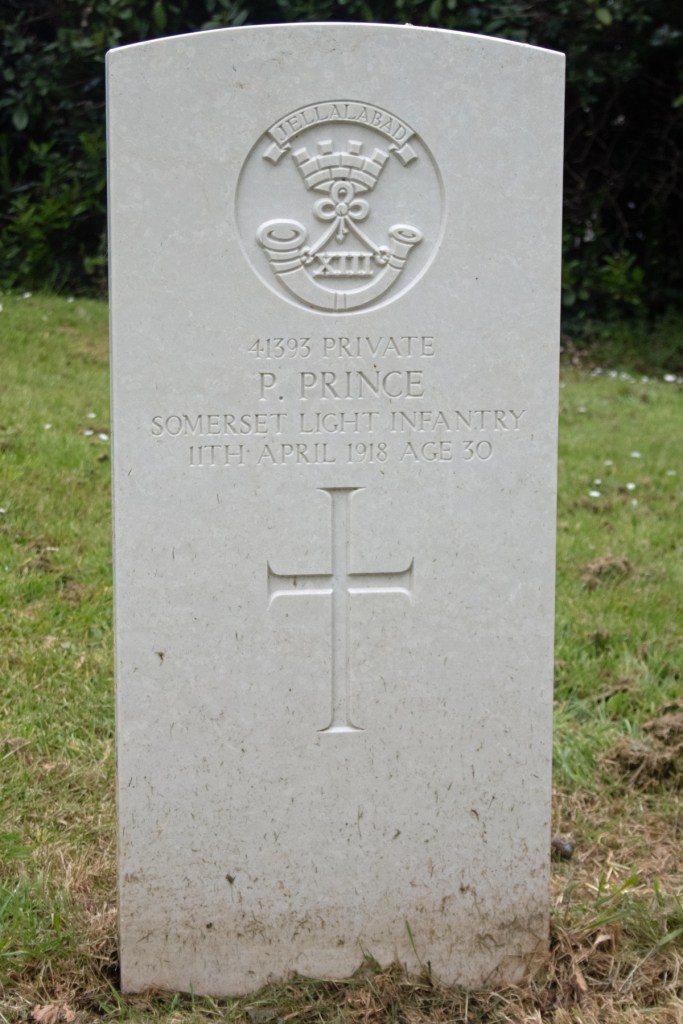
Percy Prince was born in 1890, one of seven children to John and Eliza Prince. John was an agricultural labourer and coal merchant, and brought his family up on the Somerset/Wiltshire border, near Bruton.
Percy followed in his father’s line of work when he left school, eventually moving to Frome. He met and married a woman called Florence Stickler in July 1909, setting up home in Water Lane, to the south of the town centre.
War was soon beckoning, and Percy enlisted in the Somerset Light Infantry as a Private. Sadly, his service records are lost to time, and so details of him time in the army are not available. What we do know is that he was assigned to one of the depots, although which one is not clear.
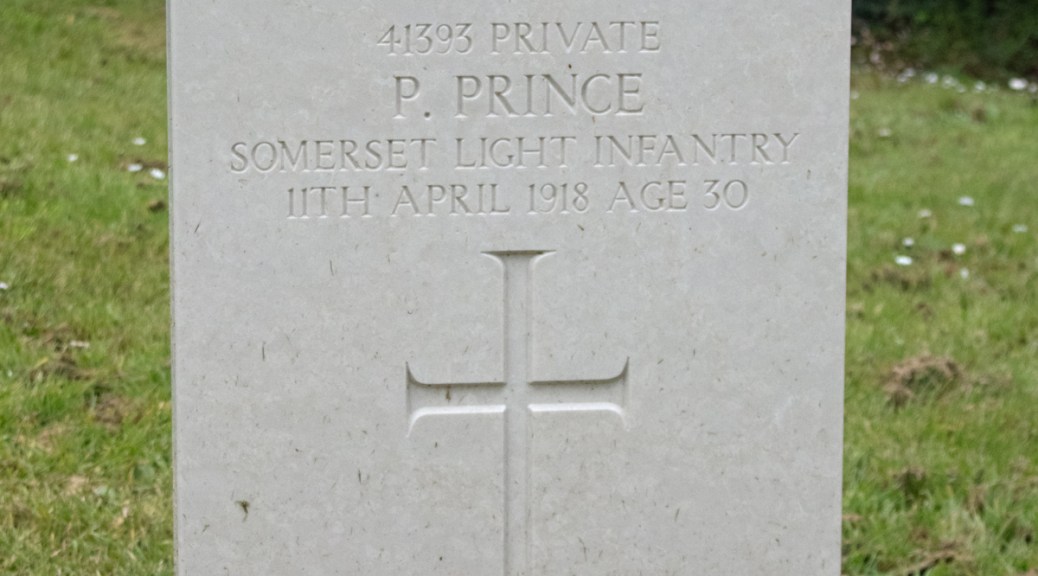
Sadly, that is about the limit of information available about Private Prince. He died on 11th April 1918, at the Military Hospital in Taunton. There is nothing to confirm a cause of death, but he just was 28 years old.
Percy Prince was buried in St James’ Cemetery in Taunton.
Alfred Ernest Davidge was born on 22nd July 1882, one of six children to Richard and Ermina. Richard was a boilermaker from Bristol, but brought his family up in the Wiltshire town of Swindon.
Alfred was keen on adventure, and sought out a live on the open seas. In August 1898, at the age of sixteen, he joined the Royal Navy. After serving two years at the rank of Boy, he officially enlisted for a term of twelve years.
Starting as an Ordinary Seaman, Alfred had worked his way up to Leading Seaman by 1905. He continued in this role until 7th June 1909, when he was knocked back a rank for misconduct. He evidently realised the error of his ways, however, as, just over a year later, he was promoted again.
Leading Seaman Davidge’s term of service came to an end in July 1912, and, having been assigned to seventeen vessels during that time, he became part of the Royal Naval Reserve.
Back on home soil, and Alfred set up home in Taunton. He found work as a labourer and, in October 1913, married local lady Louisa Pomeroy. The couple went on to have a daughter, Hilda.
Storm clouds were gathering over Europe by now, and Alfred was soon recalled to the Royal Navy. He took up his previous role, and, after a period of training at HMS Vivid in Plymouth, he was assigned to HMS Suffolk.
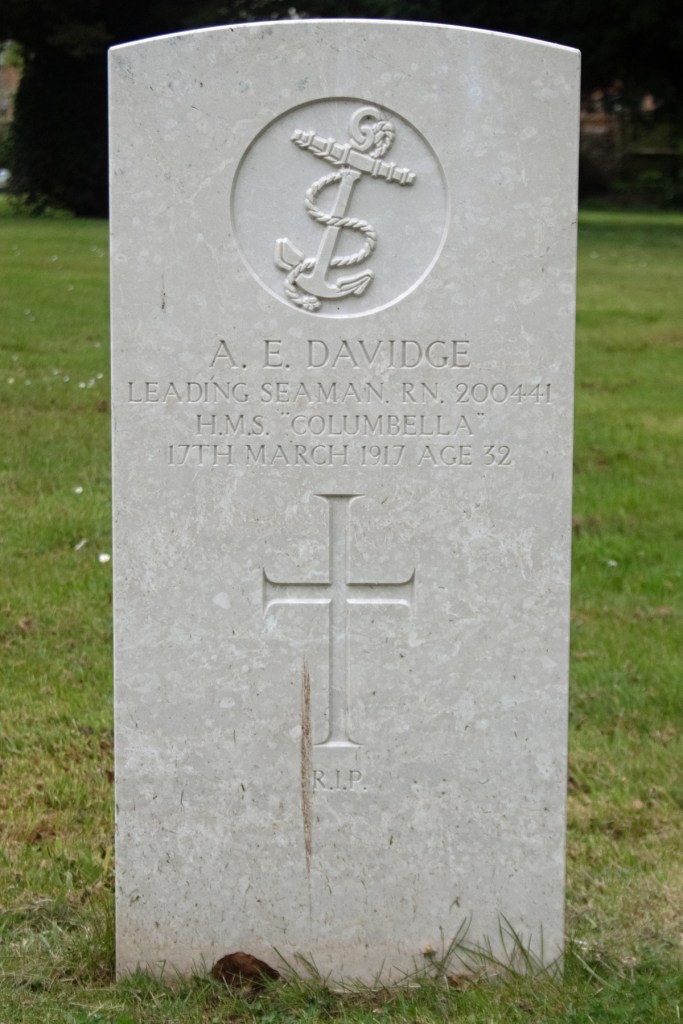
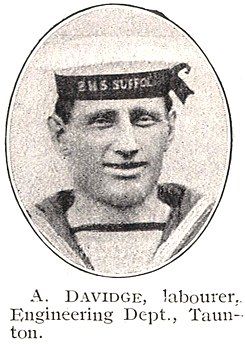
Leading Seaman Davidge spent eighteen months aboard HMS Suffolk (during which time the photo below was taken), before being transferred to HMS Columbella in November 1916. His time there was short, however, as he became unwell.
Admitted to the Royal Infirmary in Glasgow with influenza, Leading Seaman Davidge sadly succumbed to the condition on 17th March 1917. He was 34 years old.
Alfred Ernest Davidge was brought back to Taunton for burial. He lies at rest in the St James Cemetery in the town.
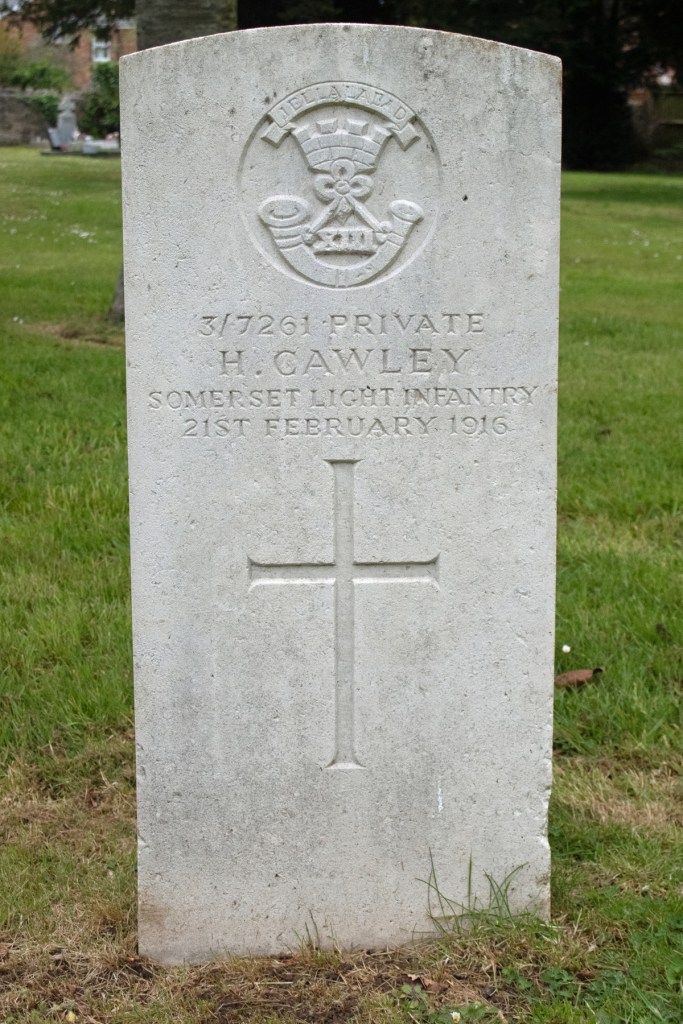
Henry Cawley was born in September 1871, one of eight children to John and Ann Cawley. John worked as a blacksmith in the village of Corfe, near Taunton, Somerset, but when Henry left school, he found work as a butcher’s assistant in Bristol.
Henry disappears from the radar for a while. John died in 1884, but the next information available for his son comes in the form of his war medals. This confirms that he enlisted in the Somerset Light Infantry in the summer of 1915, and that he was assigned to the depots as a Private. He was awarded the Victory and British Medals, as well as the 1915 Star, but then fell ill early in 1916.
Private Cawley was medically evacuated back to England, and was admitted to a sanatorium in Taunton. Sadly, whatever illness he contracted, he succumbed to, and he passed away on 21st February 1916, at the age of 45 years old.
Henry Cawley was laid to rest in St James’ Cemetery in Taunton.
Henry’s war pension was given to his mother, Ann. After her husband’s death, she continued to live in Corfe and, based on the available information, lived into her 80s.
Ernest John Sedgbeer was born in Taunton in the summer of 1891, the second of seven children to Henry and Alice Sedgbeer. Henry worked in a foundry, and his son joined him as a labourer.
By the time of the 1911 census, most of the nine members of the family disappear from the records – it is likely that these were lost – but both father and son are to be found living in South Wales – Henry working as a furnace stoker in the Rhondda, Ernest as a labourer below ground in Llanwonno, near Pontypridd.
Ernest seems to have had an opportunity to find other employment, and started work for Great Western Railways in February 1914. War was imminent, however, and a little over a year later, he had enlisted.
Ernest first joined the Duke of Cornwall’s Light Infantry as a Private, but transferred over to the Dorsetshire Regiment. He was certainly involved in fighting on the Western Front, although full details of his military service are not documented.
His records show that he was awarded the Victory and British Medals and the 1915 Star. Private Sedgbeer was wounded in July 1916 and medically evacuated back to England, where he was admitted to King’s Hospital in Lambeth. Sadly, he was to die of his injuries on 7th July 1916, aged just 25 years old.
Ernest John Sedgbeer lies at rest in the St James’ Cemetery in his home town of Taunton, Somerset.
The local newspaper reported on Private Sedgbeer’s funeral, although it seems to have attributed it to the wrong brother.
The death took place… on Friday last, of Private Charles Sedgebeer of the Dorset Regiment, who was severely wounded in the recent heavy fighting on the Western Front. Deceased was the second son of Mr and Mrs Henry Sedgebeer… and was employed on the railway before the war. His father and three brothers are on active service in France, and one brother in the Navy. The eldest brother has won the DCM.
Taunton Courier and Western Advertiser: Wednesday 19th July 1916
Ernest was indeed the second son of the family, but Charles was the oldest, and survived the war.
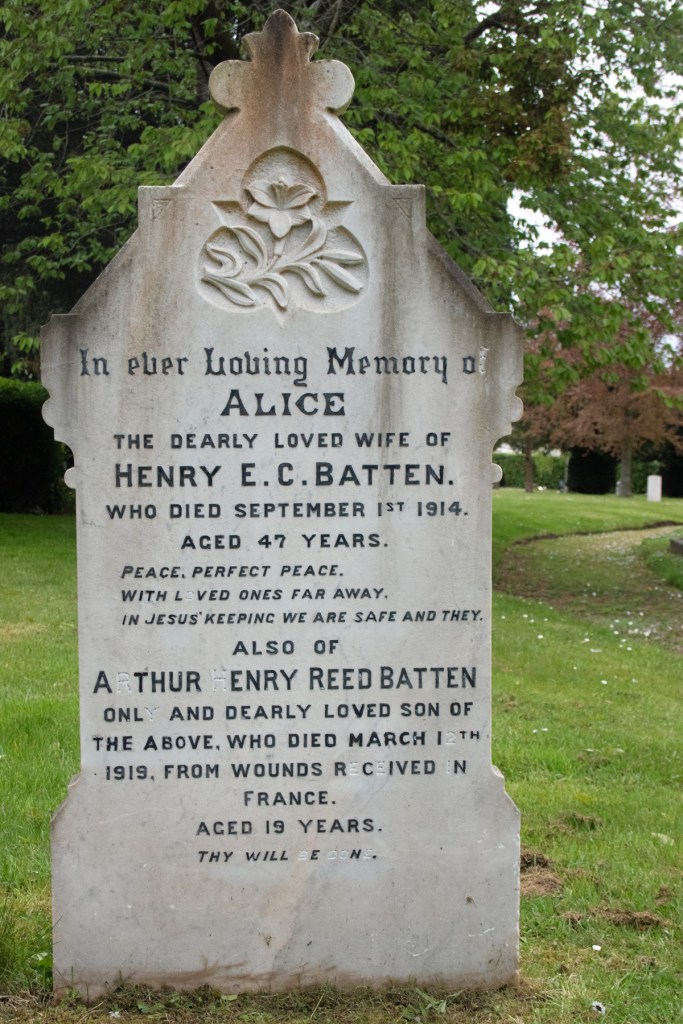
Arthur Henry Reed Batten was born in the spring of 1900, the only child to Henry and Alice. Henry was a gardener, and the young family lived in the Somerset town of Taunton.
There is little documentation about Arthur’s short life. When war broke out, he enlisted in the 1st Battalion of the Devonshire Regiment. While there is nothing to confirm the date he joined up, it may well have been a reaction to the passing of his mother, who died on 1st September 1914, at the age of 47 years old.
Private Batten’s battalion initially fought on the Western Front during the war, before moving to Italy in November 1917, then back to France the following April. It seems likely that it was during this second stint in France at some point late in 1918 that Arthur was caught up in the fighting.
He received a gunshot wound, and was shipped back to England for treatment. Admitted to the Military Hospital in Stockport, Greater Manchester, he seems to have suffered for a long time, passing away from his injuries on 12th March 1919, three months after the Armistice was signed. He was just 19 years of age.
Arthur Henry Reed Batten was brought back to Taunton burial, and lies in the family grave in St James’ Cemetery, alongside his mother.
Joscelin William Currey was born in the summer of 1897, one of six children to Job Arthur Currey and his wife, Eliza Jane. Job was a shoesmith, and brought his young family up in his home town of Taunton, Somerset.
When Joscelin left school, he worked as an errand boy, before becoming an apprentice with local foundry of Messrs. Rudman, Lancey and Co. But with war on the horizon, things were about to change.
Along with his older brothers, Joscelin enlisted in the army, joining the 3/5th Reserve Battalion of the Somerset Light Infantry in August 1914. Initially based on Salisbury Plain, he was soon transferred to Bath, and attained the position of Lance Corporal.
It was in Bath that he fell ill, and was admitted to hospital with cerebrospinal meningitis. Sadly, Joscelin was to succumb to this condition, and he passed away on 28th June 1915. He was just 18 years of age.
Joscelin William Currey was laid to rest in the St James Cemetery of his home town of Taunton.
The newspaper report of Lance Corporal Currey’s funeral confirmed that one of his brothers was a prisoner of war in Germany, while another was in the Royal Field Artillery. Joscelin was the only one of the three to die during the conflict.
Joscelin’s name is spelt variously as Jocelyn and Joslin across the documents relating to him, and his surname is also spelt Curry. For the purposes of this post, I have chosen to use the spelling cited on the Commonwealth War Graves Commission records.
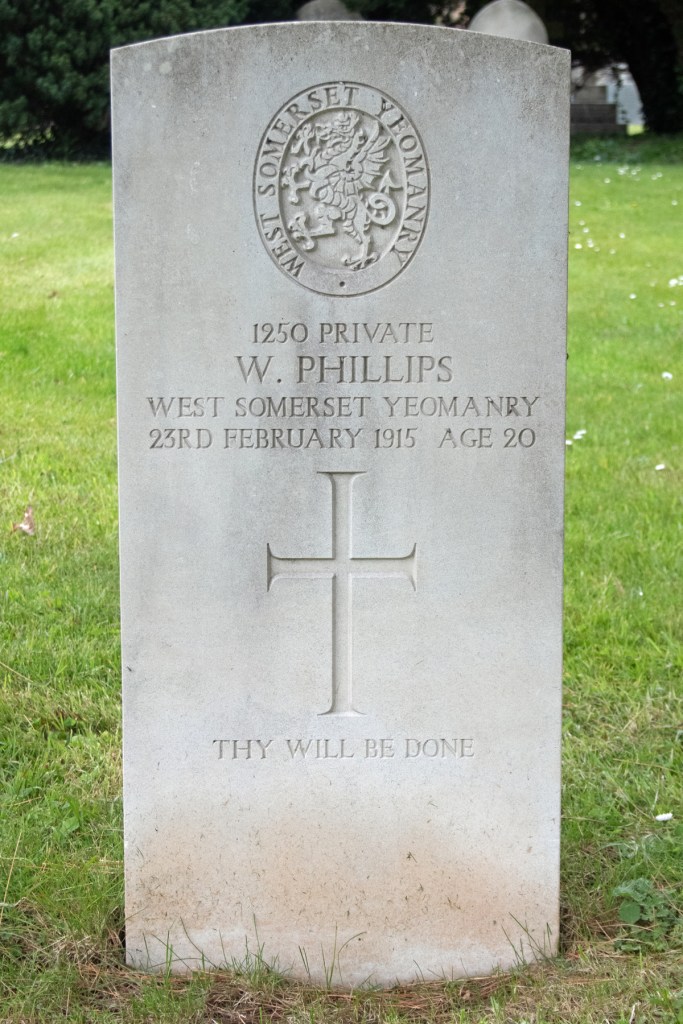
William Phillips was born in 1895, the youngest of seven children to Frank and Emily Phillips. Frank was a joiner and carpenter and, while his young family initially grew up in his home village of Thurloxton, Somerset, he and Emily soon moved them to nearby Taunton, where there would be more work and more opportunities.
By the time of the 1911 census, the young family were all tied up with different jobs. While William had become an office boy for an accountant when he left school, his siblings all had varying different roles: one was a boiler cleaner, another a mason, a third a cellarman and the fourth a shop assistant. With Frank’s own work, this meant that there were five wages coming into the home, albeit on a much smaller scale that we are used to these days.
War was coming, however, and, at the beginning of 1915, William enlisted in the West Somerset Yeomanry. Little information remains of his military service, but it is known that Private Phillips’ experience as a clerk was made use of, and he worked in admin at the reserve depot in Minehead.
William had, by this time, got himself a lady friend, who worked at the hospital in Taunton, and, while they did not see each other a lot, they corresponded regularly.
His new-found freedom from the family home seemed to have led to William being a bit freer with his money than his parents would like, and it appears that he may have run up a few debts He reassured his mother that he did not want to worry them with any business that he had. However, financial matters may well have played on his mind more than he would have liked to admit.
On Saturday 20th February 1915, Private Phillips travelled to Taunton to see his girlfriend; she was working, but he caught up with his sister instead, before returning to the base in Minehead that evening.
The following Tuesday morning, he received a letter from his girl and was last seen heading to breakfast in the hotel digs where he was billeted.
That afternoon, a local engineer was walking along the seafront, when he saw a body lying on the foreshore, about four feet (1.21m) from the high-water mark. The body – which was later identified as William – was wearing some clothing, but other bits were scattered around him. The police were called and Private Phillips’ body was taken to nearby Dunster.
The coroner confirmed William had drowned; the letter he had received was amongst his clothing, but there was nothing in it to suggest that anything was amiss. At the inquest, he suggested that “he could hardly suppose at this time of year that the deceased had taken off his clothing in order to bathe. [His conclusion was that William] got into the water with intent to drown himself.” [Taunton Courier and Western Advertiser: Wednesday 3rd March 1915]
The jury at the inquest returned the verdict of ‘found drowned’. Private Phillips was just 20 years old.
William’s body was brought back to Taunton for burial. He lies at rest in the St James Cemetery there.
William Phillips (from britishnewspaperarchives.com)
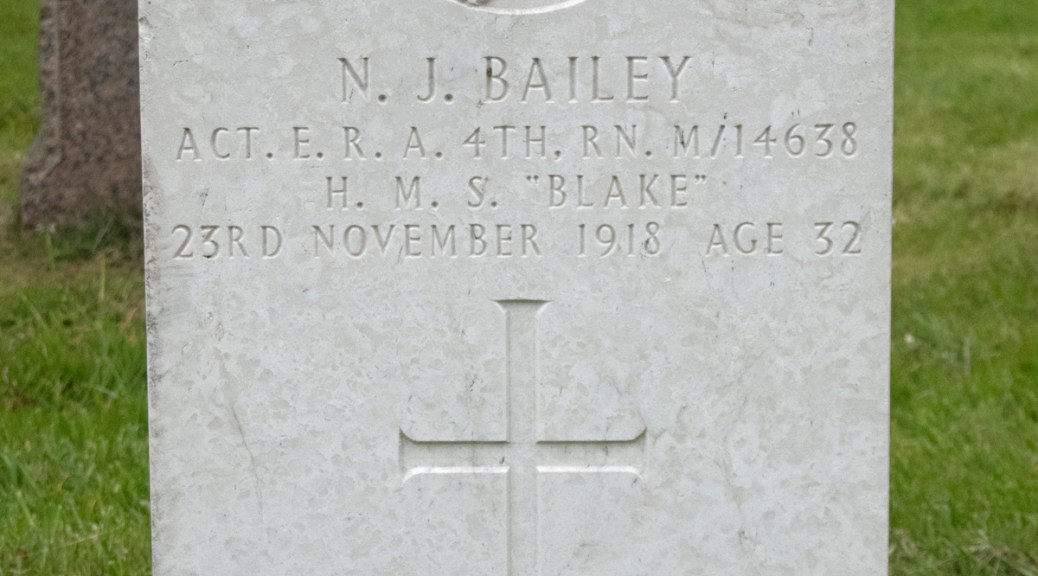
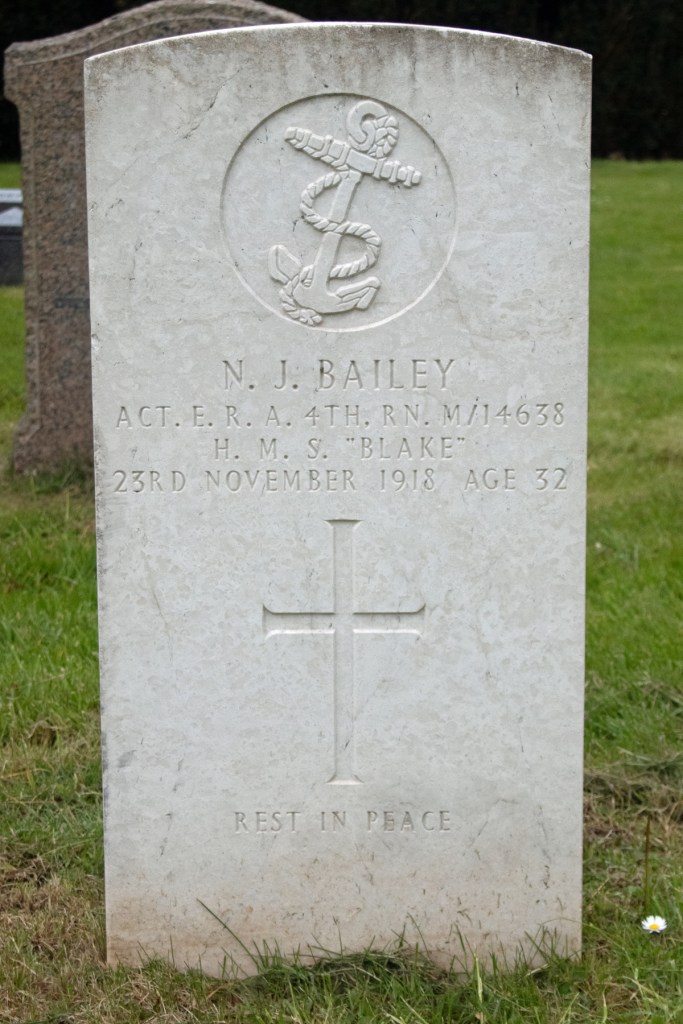
Newman Joynt Bailey was born on 1st August 1887, the eldest of five children to Newman Bailey and his wife Anna (née Joynt). Newman Sr worked as a switchman and signalman for Great Western Railway and had been born in Bath. He married Anna (whose maiden name was Joynt, and who had been born in Ireland) in 1885 and, after a short stint living across the county border in Devon – where Newman Jr was born – he settled his young family in Taunton.
When Newman Jr left school, he became an office boy, but he soon found himself following in his father’s footsteps. He became a fitter for the railways and, by 1910, was living with spitting distance of the GWR depot in the town.
It was here, in William Street, that he set up home with his new wife, Lily Gill, who he had married on 31t July 1910. Lily was the daughter of a Taunton lamplighter, and, to help make ends meet, worked as an ironer at the town’s collar factory.
War was on the way, and in July 1915, Newman enlisted in the Royal Navy. After initial training aboard Vivid II, the shore establishment in Devonport, he was deployed on HMS Blake as an Engine Room Artificer.
HMS Blake was an auxiliary ship designed to provide maintenance support to a flotilla of destroyers or other small warships. With his experience with steam engines at GWR, his knowledge of mechanics would have made him ideally suited to this type of role.
While he survived the war, Artificer Bailey was to be struck down with something much closer to home. In the immediate post-war period, the Spanish Flu pandemic swept the globe, and Newman was to fall victim to it. Admitted to the Royal Naval Hospital in South Queensferry, near Edinburgh, he passed away from the lung condition on 23rd November 1918. He was just 32 years old.
Brought back home, Newman Joynt Bailey was laid to rest in St James Cemetery in his home town of Taunton.
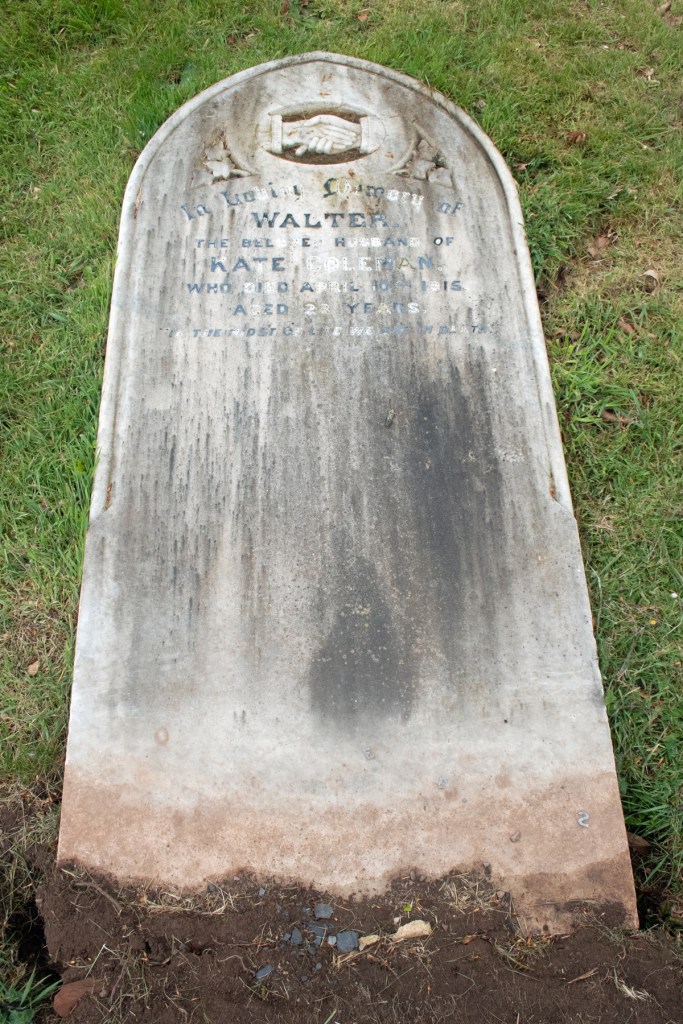
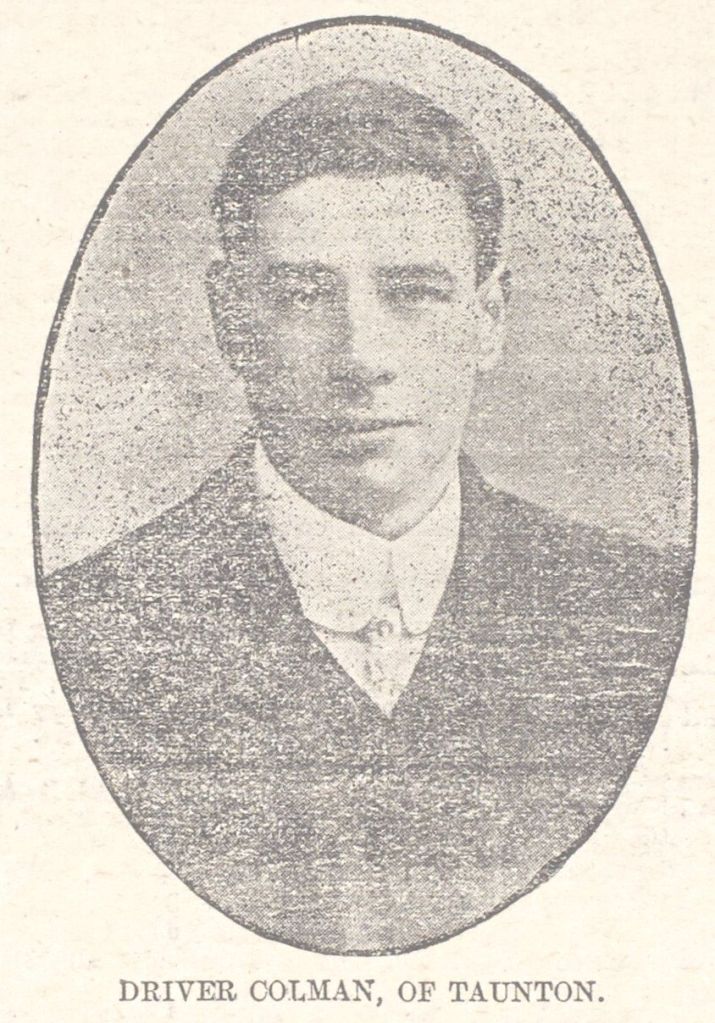
Walter Coleman was born in the spring of 1887, one of seven children to James and Emily Coleman. James was a hairdresser and the family lives in the Somerset town of Taunton.
Walter didn’t follow his father’s trade; instead, after a spell working at a collar factory when he left school, he was soon employed as a groom.
On Christmas Day 1910, he married Kate Norris, and the couple set up in a two-up, two-down in the middle of the town.
War was on the horizon, however, and when it broke out, Walter signed up straight away. He joined the 72nd Brigade of the Royal Field Artillery as a Driver and trained at the Bulford Camp on Salisbury Plain. It was while he was here on 10th April 1915 that he had an accident and fell off his horse. Sadly, Driver Coleman fractured his skull and died of his injuries that day. He was just 28 years old.
Walter Coleman lies at rest in the St James’ Cemetery in his home town of Taunton.
Walter Coleman (from findagrave.com)
Walter’s older brother Henry James Coleman also served in the Great War. Posted to France as part of the Labour Corps, he died of wounds on 12th April 1918. He was 33 years old, and left behind a widow and four children. He is buried at the Longuenesse Souvenir Cemetery in France.
William Arnold Howard was born in Cumbria towards the end of 1887. He was the youngest of two children, the son of gospel minister Edwin Howard and his wife Alethea. Edwin’s role took him across the country; by the time William was four, the family were settled in Worksop, Nottinghamshire; ten years later, they were based in Taunton, Somerset.
William’s older sister became a music teacher, and was presumably inspired by her father’s calling. William, however, took a different route, and, by the time of the 1911 census, was listed as a physical culture expert.
He had, by this time, met and married a woman called Alice, and the couple had two children, Edna and Marjorie. The census found the young couple living in a three-roomed house in the middle of Taunton.
War was on the horizon, and William enlisted as a Gunner in the Royal Garrison Artillery. His battalion – the 3rd/4th Siege Reserve Brigade – were those manning with large scale weaponry, although, as part of the reserve, Gunner Howard was based in England for the duration of the conflict.
William was awarded the Victory and British Medals for his service but once the Armistice was declared it seems that he fell ill. He was admitted to the Military Hospital in Taunton with exhaustion following a bout of enteritis, and succumbed to this on 15th January 1919. He was 31 years old.
William Arnold Howard lies at rest in the St James Cemetery in Taunton, Somerset.









 Death and Service