Category Archives: Suffolk

Officer’s Steward 2nd Class Frederick Shiplee

Steward 2nd Class Frederick Shiplee

Frederick John Shiplee was born on 15th November 1895 in the Essex town of Harwich. The oldest of eight children, his parents were Frederick and Matilda. Frederick Sr worked as a carter for the local railway, while his son found employment as a butcher’s errand boy when he left school.

In November 1913, having just turned 18, Frederick Jr enlisted in the Royal Navy as an Officer’s Steward, and spent three years training and serving on board HMS Ganges, the shore establishment at Shotley, near Ipswich.

From Suffolk, Frederick moved to Kent, and was based at the HMS Pembroke in Chatham. From here, he was involved in trips on HMS Spey, an old river gunboat that had been converted for use as a diving tender. It was during one of these trips that tragedy struck.

STORY OF A COLLISION IN THE THAMES

Mr CB Sewell resumed the inquest at Chatham, on Monday, on the 13 naval men who lost their lives after a collision between the London County Council steam hopper Belvedere and an old naval vessel in the Thames on March 7th [1917]…

The collision occurred shortly before four o’clock in the afternoon, the weather being bitterly cold and boisterous, and the sea extremely rough. The men, who had taken to a raft, were drifting about till 9pm before the raft was driven ashore. On the raft, when discovered, were a pile of dead men, who had been rendered unconscious by the cold and subsequently drowned through the raft being partly submerged. Lieutenant Humphreys, Royal Naval Reserve, and the other officers were all drowned. In all, 30 of the 37 members of the ship’s company lost their lived, and several bodies have not been recovered. Thirteen of the ship’s crew managed to get ashore at Sheerness in the cutter and three reached the shore at the Isle of Grain in the gig, while one was saved by the hopper.

Arthur George Chick, able seaman, said he was at the wheel of the naval vessel, which was steaming up river at six knots an hour to secure shelter from the weather. Lieutenant Humphreys and a warrant officer were on the bridge, and there were two look-out men. All were now missing. He saw the hopper coming down the river when she was two miles away. When the vessels were nearing each other, the hopper suddenly altered her course to starboard. The witness then altered his course to port by his officer’s orders, but the hopper crashed into his ship, stroking it a glancing blow in line with the forepart of the bridge on the starboard side. The ship sank in three minutes.

Alfred Rawlings, leading signalman, stated that the hopper changed her course when almost abreast of the naval vessel. The hopper’s alteration of course was, he considered, the cause of the collision.

Henry Davies, second officer, and Joseph Beard Hasdell, master of the hopper, gave evidence that they considered the collision was caused through the naval vessel’s error of judgment in starboarding, instead of going to port. The hopper, they stated, ported its helm in accordance with the ‘rule of the road’.

South Eastern Gazette: Tuesday 27th March 1917

While not mentioned in the newspaper report for security reasons, the ‘old naval vessel’ was, in fact HMS Spey. Annoyingly, I can trace no further report of the inquest, other than the conclusion that the deaths were due to drowning following a collision at sea.

Officer’s Steward Shiplee was one of the twenty men who died that day. He was just 21 years of age.

Frederick John Shiplee’s body was laid to rest in the Woodlands Cemetery in Gillingham, not far from the Naval Dockyard in Chatham, where he had been based.
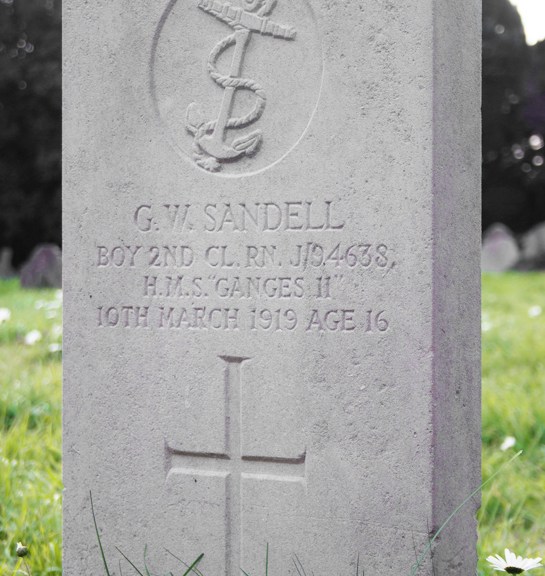
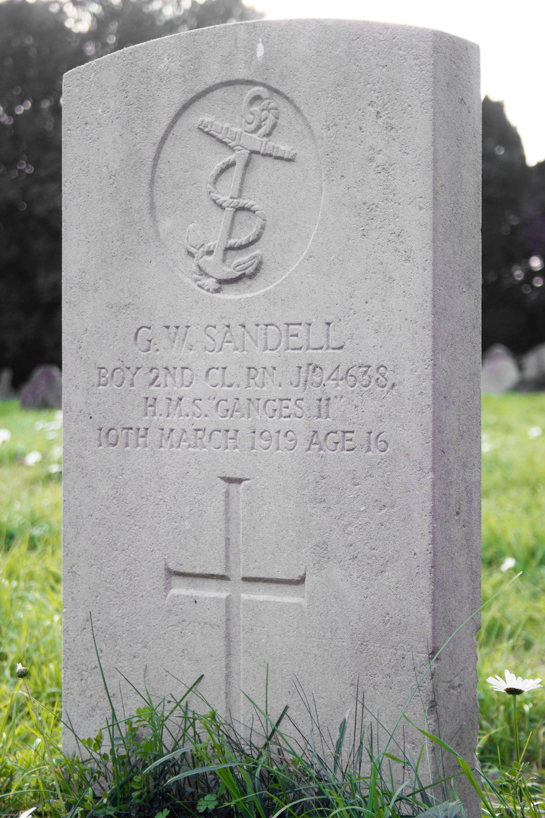
Boy 2nd Class George Sandell

Boy George Sandell

George William Sandell was born on 13th August 1902, the oldest of five children to William and Mary Sandell. While George was born in Chichester, William raised the family in Worthing; he was a carpenter and joiner by trade, and came from a local building family.

When George left school, he found work as a porter on the railways. Too young to be directly involved in the 1914-1918 conflict, he was definitely for adventure, and, on 5th February 1919, he enlisted in the Royal Navy.

Assigned the rank of Boy – because of his age – he was sent to HMS Ganges II, a training establishment in Suffolk. His decision to enlist was set to be young George’s undoing; within weeks he had contracted pneumonia, and he passed away on 10th March 1919. Tragically, he was just 16 years old.

William and Mary brought their boy back to Worthing; he was buried in the Broadwater Cemetery there, within walking distance of their home.


For me, a huge coincidence to this story is that I lived in the house George was brought up in. He was raised at 27 Southfield Road, in Worthing, up until he was sent for training in 1919. I lived at the same address for a number of years in the early 2000s.


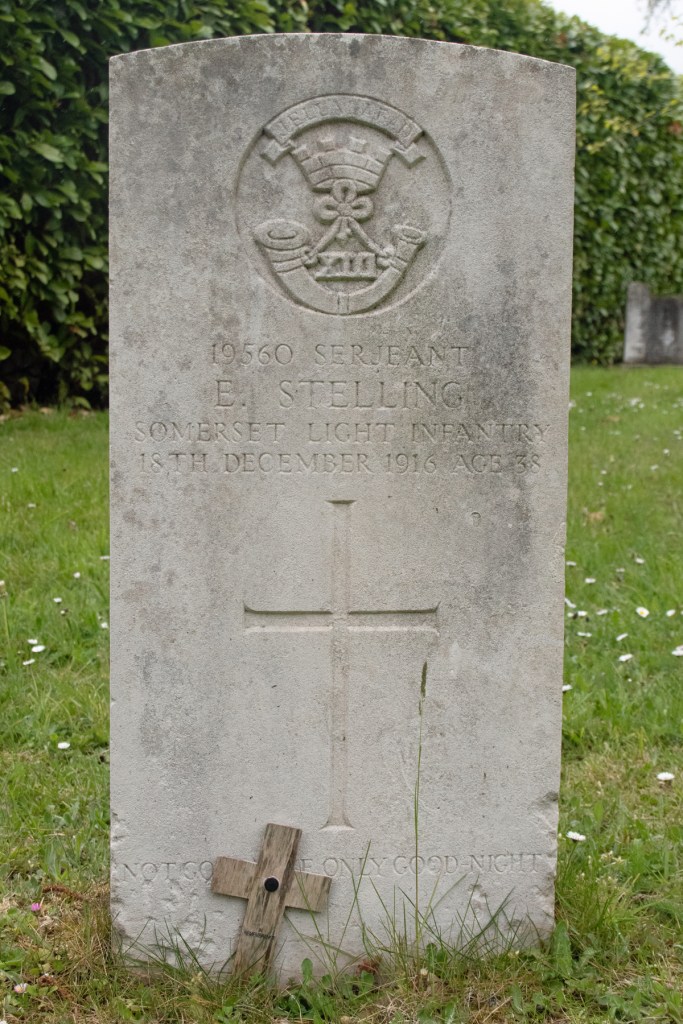
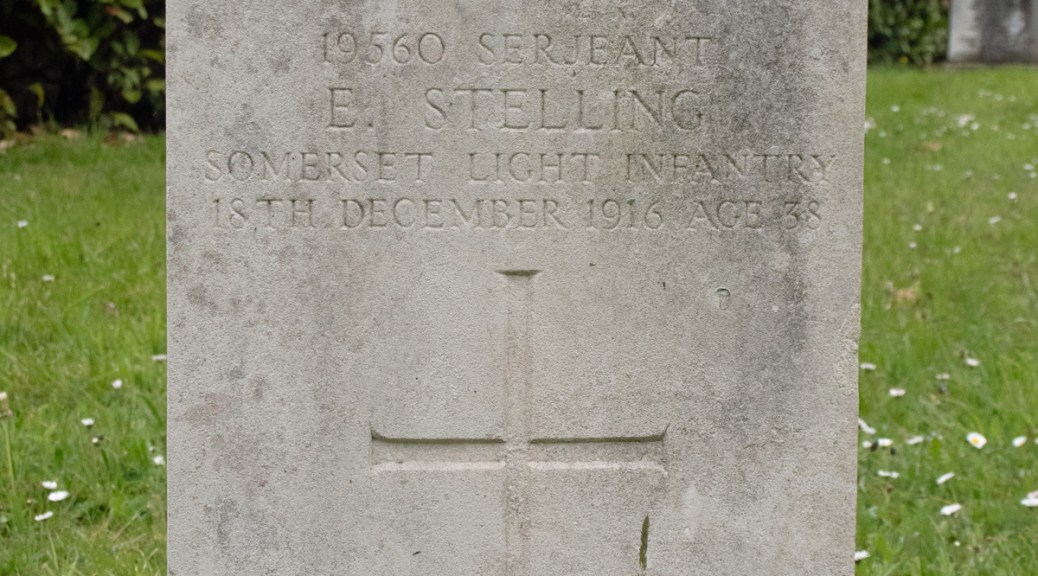
Serjeant Ernest Stelling

Serjeant Ernest Stelling

Ernest Leonard Stelling was born in the summer of 1881, the oldest of six children to Charles and Bertha Stelling. Charles was a tailor from London, and while Ernest was born in Suffolk, by the time of the 1891 census, the family had settled in Reading, Berkshire.

Ernest followed in his father’s footsteps, becoming a tailor and cutter in his own right. He met a woman from Reading called Lettie Eliza Mazey, and the couple married in 1904. The couple set up home with Lettie’s brother and his family in Tilehurst, but didn’t go on to have any children themselves.

Details of Ernest’s military service are a bit scarce. He initially enlisted in the Royal Berkshire Regiment, but quickly moved to the Somerset Light Infantry in the early stages of the First World War.

Sadly, no formal documents of Ernest’s time in the army are available, but a local newspaper gave a good insight into his Somerset service.

Death of a Master Tailor

After an illness of only seven days, the death took place at the military hospital on Monday afternoon of Sergeant EL Stelling, who has been master tailor of the Depot for the past two years. The cause of death was pneumonia, and the loss of so popular a member of the Depot staff is deeply regretted by all ranks.

Sergeant Stelling, who was 37 years of age, came to the Somersets from the Royal Berkshire Regiment, and succeeded the late Sergeant-Master-Tailor Chambers. He was a native of Reading, and one of four brothers serving their King and country. His father, Mr Charles Stelling, for many years carried on business as a master tailor in Reading.

Since he had been at Taunton barracks, Sergeant Stelling had made many friends, and actively identified himself with the social life of the sergeants’ mess, taking a prominent part in the arrangement of concerts, etc.

He was of a bright, generous disposition, and before his illness he was making a collection at the Depot on behalf of the Buffaloes’ Christmas treat to poor children of the town. He was a valued member of the local Lodge of the Royal Order of Buffaloes, and his death is greatly regretted by all the brethren.

He leaves a widow but no family. Much sympathy is felt for Mrs Stelling, who has for some years been a confirmed invalid.

The funeral took place with full military honours at St Mary’s Cemetery on Friday afternoon.

Taunton Courier and Western Advertiser: Wednesday 27th December 1916

This gives a real insight into Ernest’s personal life. He was obviously very active socially, and committed to the community. Whether Lettie’s infirmity contributed to the couple’s lack of family will never be known, but, from his support of the poor children of Taunton, it seems evident that he would have been a good family man.

The next document relating to Serjeant Stelling is his pension record; this confirms the news article’s report that he contracted pneumonia and influenza, and he succumbed to the conditions on 18th December 1916. He had, in fact, just turned 38 years old.

Ernest Leonard Stelling lies at rest in St Mary’s Cemetery in his wartime adopted home town of Taunton, Somerset.


Serjeant Ernest Stelling (from Ancestry.co.uk)