Category Archives: Duke of Cornwall Light Infantry

Private George Whiteway

Private George Whiteway

George William John Whiteway was born in Paignton, Devon, on 4th February 1893. The youngest of three children, and the only son, his parents were William and Sarah Whiteway.

William was a journeyman painter, and from at least when his son was born, the family lived in a small terraced house, 9 Tower Road, on the outskirts of the town centre.

By the time of the 1911 census, George had completed his schooling, and was working as an apprentice painter. It is unclear whether this was under his father’s tutelage, as he gave his employment as verger and caretaker of the local parish church.

When war broke out, George stepped up to play his part. He enlisted in Torquay on 1st December 1915, and his service records note that he was of good physical development, stood 5ft 6.25ins (1.68m), and weighed 126lbs (57.2kg). He was also recorded as having light brown hair, brown eyes and a fair complexion.

Initially assigned to the Duke of Cornwall’s Light Infantry, Private Whiteway was transferred to the London Regiment and attached to the 3rd/21st Battalion. By the summer of 1916 George had transferred to the 1st/21st (County of London) Battalion, also known as the First Surrey Rifles. On 15th June his unit was sent to France, and he soon found himself in fighting on the Somme.

Private Whiteway’s time in France was to be a brief one. Caught up in the Battle of Flers-Courcelette, he was wounded in the back and neck, and, after initial treatment on site, he was medically evacuated to Britain.

It is unclear where George was first admitted, but by February 1917, he was being tended to in the Voluntary Aid Detachment Hospital in his home town, Paignton. He remained there for a couple of month, before being released back to duty.

Private Whiteway’s time fighting was over. He was transferred to the 619th Home Service Employment Company of the Labour Corps, and would spend the next year in and around Winchester, Hampshire. It is evident, however, that George’s health had been impacted. By March 1918 he was in hospital again, this time close to his army base. Suffering from a combination of peritonitis and tuberculosis, the contagious nature of the latter condition would lead to his dismissal from military service, and he was formally stood down on 29th April 1918.

At this point, George’s trail goes cold. It seems likely that he returned home, as his death was recorded in Totnes, Devon. He breathed his last on 25th August 1918: he was 25 years of age.

George William John Whiteway was laid to rest in Paignton Cemetery, a short walk from his family home.


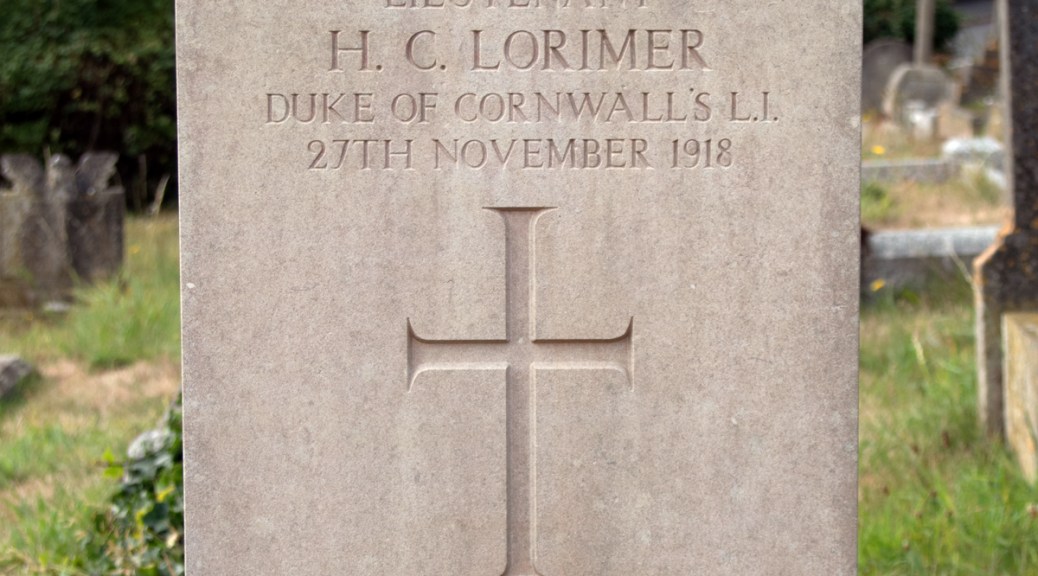
Lieutenant Hugh Lorimer

Lieutenant Hugh Lorimer

Hugh Cowan Lorimer was born on 27th November 1886 in Totnes, Devon. The oldest of four children, his parents were Scots-born draper Robert and his Devonian wife, Susan.

This was a family business, with Robert’s father – also called Robert – running the drapery at 59 Fore Street since the 1871 census. By 1891, Hugh’s father had taken over, and the family remained there until at least the time of the 1911 census return.

Hugh, by this point, had also taken on the mantle of draper. With the Lorimer business firmly set up in Totnes, he moved to Paignton, and opened a shop on the central Victoria Street. By 1911 he was listed as being the main employer, with his sister Muriel at his side, and a live-in servant, Bella Loram, helping to manage the household.

In the spring of 1914, Hugh married Gwendoline Pridham. Little information about her is available, but she had been born in Newton Abbot, and was a year younger than her new husband.

When war came to Europe later that year, Hugh was called upon to play his part: “He joined the Army in June, 1915, and received a commission in the 1/5th [Duke of Cornwall’s Light Infantry] with whom he served in France for 15 months prior to March 30th, where he was severely wounded, with the result that he had to undergo several operations, and only recently rejoined his Regiment.” [Western Times: Monday 2nd December 1918]

Lieutenant Lorimer was not fully out of harm’s way, however. As the summer moved to autumn, he fell ill, contracting influenza, which became double pneumonia. Admitted to hospital in Eastbourne, East Sussex, he succumbed to the condition on 27th November 1918: his 32nd birthday.

Hugh Cowan Lorimer was brought back to Devon for burial. He was laid to rest in Paignton’s sweeping cemetery, on the outskirts of the town he had made his home.


Gwendoline was pregnant when she was widowed: the couple’s child, Joyce, was born on 29th June 1919, never to know her father.


Hugh’s younger brother Kenneth was also caught up in the Great War. He had emigrated to Canada at some point after the 1911 census, but volunteered for army duty in 1915.

Lieutenant Lorimer was attached to the 4th Battalion of the Canadian Machine Gun Corps, and was entrenched on the Western Front. “He was in command of a section that was in a tank taking part in an attack north west of Le Quesnel. The tank was put out of action by enemy shell fire, and Lieutenant Lorimer was wounded by a splinter from a shell. He was removed from the tank and received First Aid but died shortly afterwards.” [Canadian War Graves Registers (Circumstances of Casualty)]

Kenneth Lorimer died on 8th August 1918, days short of his 30th birthday. He was laid to rest in Beaucourt British Cemetery in Picardie.


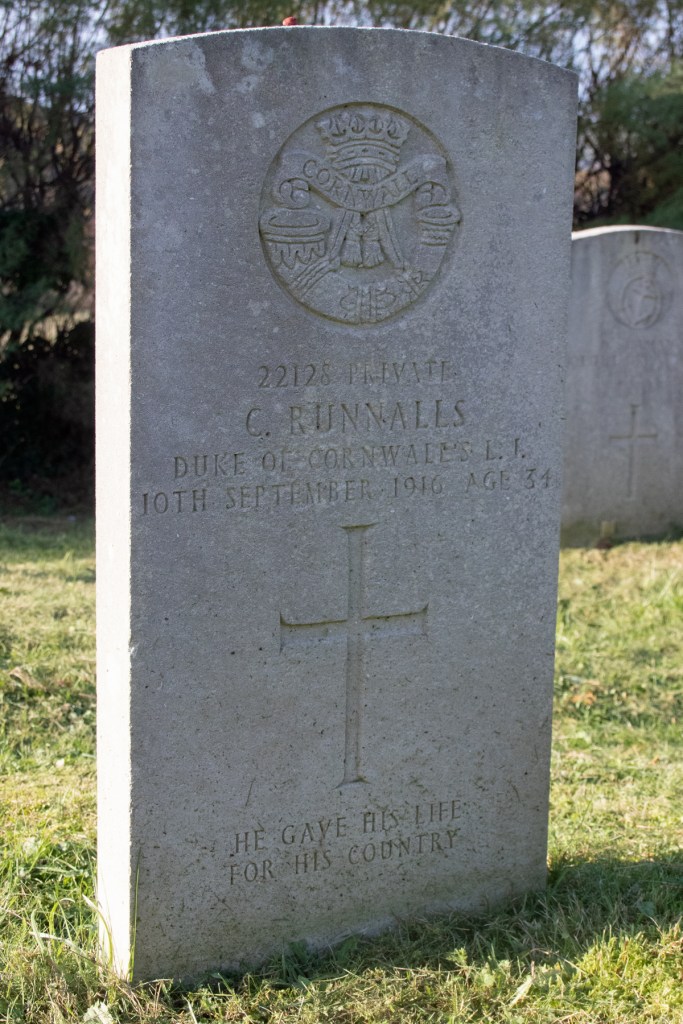
Private Christopher Runnalls

Private Christopher Runnalls

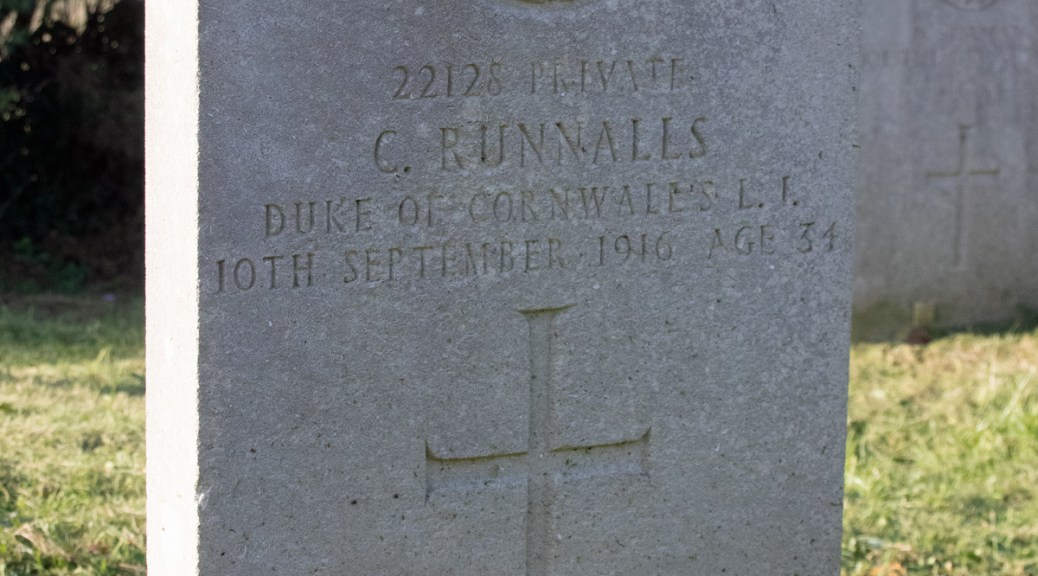
Christopher Runnalls was born in the village of Cardinham, Cornwall, in 1892. The fourth of five children, his parents were game keeper John Runnalls and his wife, Mary. Christopher – who was better known by the nickname Kitt – didn’t follow in his father’s footsteps, instead finding work as a stone mason when he finished his schooling.

Kitt moved to St Minver, near Wadebridge, for work and, in 1907, he married Susan Buse. The couple set up home in a small cottage in the village, sharing their home with Susan’s niece, Vivian.

When war was declared, Kitt stepped up to play his part. He enlisted in the Duke of Cornwall’s Light Infantry, and, as a Private, was assigned to the 10th (Service) Battalion, also known as the Cornwall Pioneers. He soon found himself on the Western Front and, in the summer of 1916, was caught up in the Somme.

Pte. Kitt Runnals [sic], of the DCLI, who was wounded in France on August 10th, and was brought to Leeds Great Northern Hospital, died at that institution on September 10th. The body was brought to St Minver and buried at [St Enodoc’s Church] on Thursday, the 14th.

[He] was one of the most respected men in the parish. He was a mason by trade. When war broke out he thought it his duty to join up. He was a member of the United Methodist Church. He leaves a widow but no family.

Newquay Express and Cornwall County Chronicle: Friday 22nd September 1916

Christopher ‘Kitt’ Runnalls was 34 years old when he passed. He lies at rest in the peaceful landscape of St Enodoc’s Church, Cornwall.


Private Arthur Dudley

Private Arthur Dudley

Arthur Samuel Dudley was born in the spring of 1895, and was the second of six children to Arthur and Alberta Dudley. Arthur Sr was an fitter for an engineering works in Birmingham, and it was in the Kings Norton area of the West Midlands where he and Alberta raised their family.

When he finished his schooling, Arthur found work as a grocer’s assistant, but factory work offered better financial prospects, and by the time war was declared in 1914, he was working as a tube drawer for the company that employed his father.

The conflict brought further opportunity for a career and an adventure, and this was not something Arthur was able to let pass by. He enlisted on 3rd September 1914, but intriguingly did so in Bodmin, Cornwall, some 200 miles to the south of his home, and there seems to be no direct connection between the Dudleys and this part of the country.

Arthur joined the Duke of Cornwall’s Light Infantry and was assigned to the 6th (Service) Battalion. His medical report – which was completed back in Birmingham towards the end of September – showed that he was 5ft 6.75ins (1.69m) tall and weighed 120lbs (54.4kg). He had brown hair, green eyes and a fair complexion.

On 18th January 1915, Private Dudley transferred to the Army Cyclist Corps, and was attached to the 19th Divisional Cyclist Company. Based in Somerset, he soon found himself barracked near Burnham-on-Sea. It was here, just two weeks later, that Arthur became ill. On 30th January 1915 he was sent to the Volunteer Aid Detachment Hospital in the town, in a diabetic coma, and passed away same evening. He was just 19 years of age.

Unable to afford the cost of bringing their son’s body back to the West Midlands, Arthur Sr and Alberta instead made their way to Somerset for the funeral. Arthur Samuel Dudley was laid to rest in the peaceful Burnham Cemetery, not far from where he had breathed his last.

About 700 of his comrades followed the coffin… Mrs Duncan Tucker and Mrs T Holt, representing the staff of the Red Cross Hospital, were also present.

Shepton Mallet Journal: Friday 5th February 1915

Private Maurice Lock

Private Maurice Lock

Maurice Lock was born in Nailsea, Somerset, the seventh child to William and Rebecca Lock. Dates of birth vary according to documents available: census records suggest he was born around 1884, although his military records put his year of birth as 1877.

Maurice had a total of eleven siblings, with names including Merrick, Britannia and Cinderella. His father was a licensed hawker and this was something of a family trade.

The 1891 census recorded the family living at The Heath in Nailsea, although, unusually, it was noted that “this family now residing in a house occupy a travelling van in summer.” By the time of the next census return, the family business was continuing, with eight members, Maurice included, recorded as being peddlers, hawkers and horse dealers.

On 23rd January 1909, Maurice married Emily Hughes. There is little information available about her, but the couple continued Maurice’s parents’ travelling lifestyle, and went on to have four children: Albert, Mary, Gladys and Agnes.

Maurice was called upon to do his duty when war came to Britain. He enlisted on 4th September 1916 and was initially assigned to the Duke of Cornwall’s Light Infantry. Private Lock’s service record shows that he was 39 years and 10 months old when he joined up, and that he stood 5ft 8ins (1.73m) tall. He was working as a basket maker and farm labourer when he received the call to enlist.

Private Lock spent a couple of months on home soil, before his troop – the 12th (Labour) Battalion – were sent to France. He remained overseas for some sixteen months, before three separate bouts of trench fever within a month saw his return to Britain’s shores.

Maurice was transferred to the Labour Corps at this point and, once he had recovered, it was to be presumed that his previous farm work would be called upon once more. However, his age and the conditions on the Western Front conspired against him, and he developed rheumatism, which led to his discharge from the army. His medical records at this point noted that “he walks very lame with the aid of a stick. His left leg is especially [bad]. He has pains in his back, legs and shoulders. These pains are aggravated by pressure and weather changes.”

Maurice returned home, but his time back in Somerset was to be brief. His health deteriorated, and he passed away at home on 29th June 1918: he was in his late 30s or early 40s when he died.

Maurice Lock was laid to rest in the peaceful graveyard of Christ Church in his home town of Nailsea.


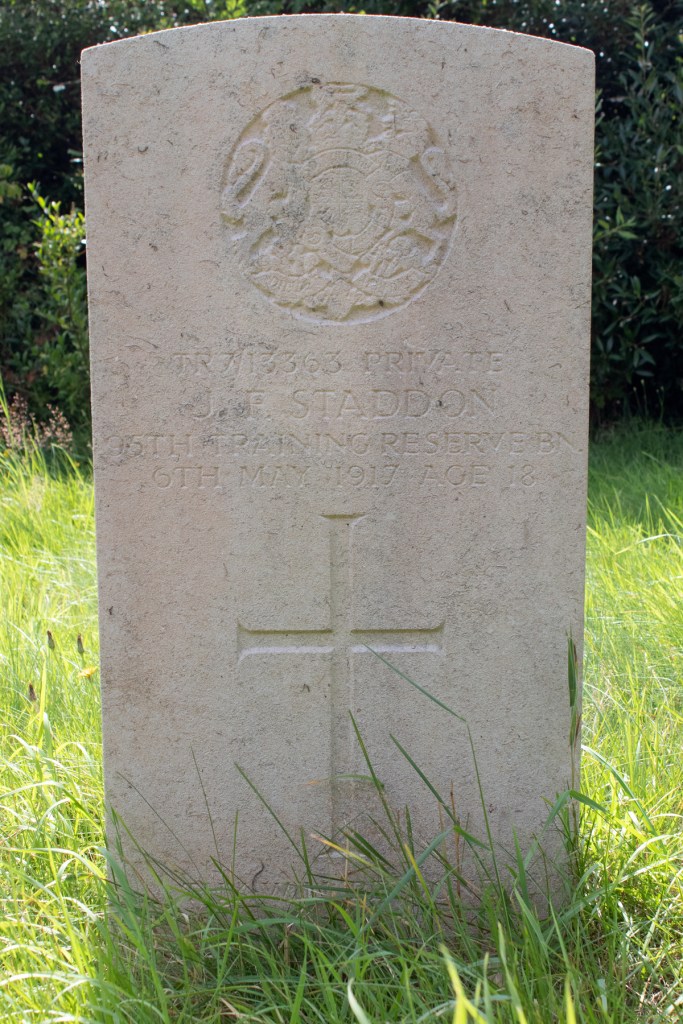
Private Joseph Staddon

Private Joseph Staddon

Joseph Frederick Staddon was born at the start of 1899, the oldest of seven children to John and Mary Ann Staddon. John was a farmer from Luccombe in Somerset, and it was in this small village that the family were born and raised.

There is little documentation to expand on Joseph’s life. He enlisted in the Duke of Cornwall’s Light Infantry when he turned 18, and was initially attached to the 95th Training Reserve Battalion.

Private Staddon was barracked in Chiseldon, Wiltshire, but his time in service was not to be a lengthy one. Admitted to a military hospital near the camp, he passed away from what was probably an illness on 6th May 1917. He was just eighteen years of age.

Joseph Frederick Staddon’s body was brought back to Somerset for burial. He was laid to rest in the cemetery extension to St Mary’s Church, Luccombe.


Tragedy was to strike again when, ten months after his son’s passing, John also died. Mary was left picking up the pieces, while supporting her six remaining children, the youngest of whom, Dorothy, was not even two years old.

The family survived, Mary running the farm with her oldest boy, Edward. She passed away on 4th August 1937, at the age of 63 years old.


Private Alfred Daymond

Private Alfred Daymond

Alfred Daymond was born on 9th July 1891, in Porlock, Somerset. The second youngest of seven children, his parents were wall mason Albert Daymond and his wife, Maria. By the time of the 1901 census, Albert’s work had moved the family to the sleepy village of Luccombe.

When Alfred finished his schooling, he followed his father into wall building. This was the career he was still following when, in 1914, war broke out.

Alfred was quick to play his part for King and Country. He enlisted on 4th November 1914, joining the Somerset Light Infantry. Private Daymond’s service records show that he was 5ft 10ins (1.78m) tall, with good vision and a fair physical development.

Initially serving as part of a territorial force, Alfred remained on home soil until September 1916. At this point he was transferred over to the Duke of Cornwall’s Light Infantry, and became attached to the 7th (Service) Battalion. Details of his time in the army are sketchy, but his troop certainly fought at the Somme in 1916, and at Ypres the following year.

In May 1917, Alfred returned to British shores. His health appears to have been suffering, although it is not clear from what ailment. On 8th February 1918, Private Daymond was discharged from army service as being no longer physically fit.

Alfred’s trail goes cold at this point. It is likely that he returned home to Luccombe, and this is where he passed away, on 11th November 1918, Armistice Day. He was 27 years of age.

Alfred Daymond was laid to rest in the family plot of St Mary’s Church, Luccombe. He was interred alongside his younger brother, Albert.


Alfred’s younger brother, Albert, also enlisted for war service. Read his story here.

Private Edward Davies

Private E Davies

In a quiet corner of Portishead Cemetery, Somerset, is the grave of Private EG Davies. His headstone confirms that he was in the Duke of Cornwall’s Light Infantry, give the date of his death – 23rd March 1919 – and his age when he passed – 40 years old. The Commonwealth War Graves Commission website confirms that Private Davies transferred to the Labour Corps, but only a couple of documents remain from his time in the army.

The soldier’s pension records confirm that his full name was Edward George Davies, and that, at the time of his death, he was living with his ‘unofficial wife’, Minnie Louisa Holbrook. The records also give the cause of death: influenza and septic bronchitis.

Minnie Louisa Fido was born in the spring of 1874 in Bedminster, Bristol, one of thirteen children to farmworker David Fido and his wife, Sarah. She married Arthur Holbrook on 28th April 1895, and had Gertrude four months later.

The Somerset School Register from 1906 notes that Gertrude Fido joined the Church of England School in Weston-in-Gordano on 12th February. It gives her mother’s name as Minnie Fido, but doesn’t give a father’s name. It seems that Gertrude left the school in November 1914, as she had found work.

A search of the 1911 census records shows Edward and Minnie (whose surname is now given as Davies), living in George Street, Portishead. Edward is listed as a wagoner on a farm, and that he was born in Gloucestershire. Minnie is noted as a charwoman from Nailsea, Somerset. Making up the household is Gertrude, noted as being Edward’s stepdaughter, and who was working as a domestic servant.

Edward’s history is more of a challenge to piece together. His name is too common to be able to single him out on census records, and, while the 1911 census suggests he and Minnie had been married for eight years, there is no marriage record to shed any further light on his family. (This is not surprising, given that his army pension documents suggest Minnie was his unofficial wife.)

Most of Edward’s life, therefore, is destined to remain lost to time. Minnie did not marry, or co-habit, again, and she passed away on Christmas Day 1949, at the age of 75 years old. Gertrude looks to have married a man called Bessant. The 1939 England and Wales Register recorded her living in the Portishead area, and working as a supervisor in a boot factory. She was living with her maternal uncle, Herbert Fido, but was noted as being the head of the household. She died early in 1967 in Weston-super-Mare.


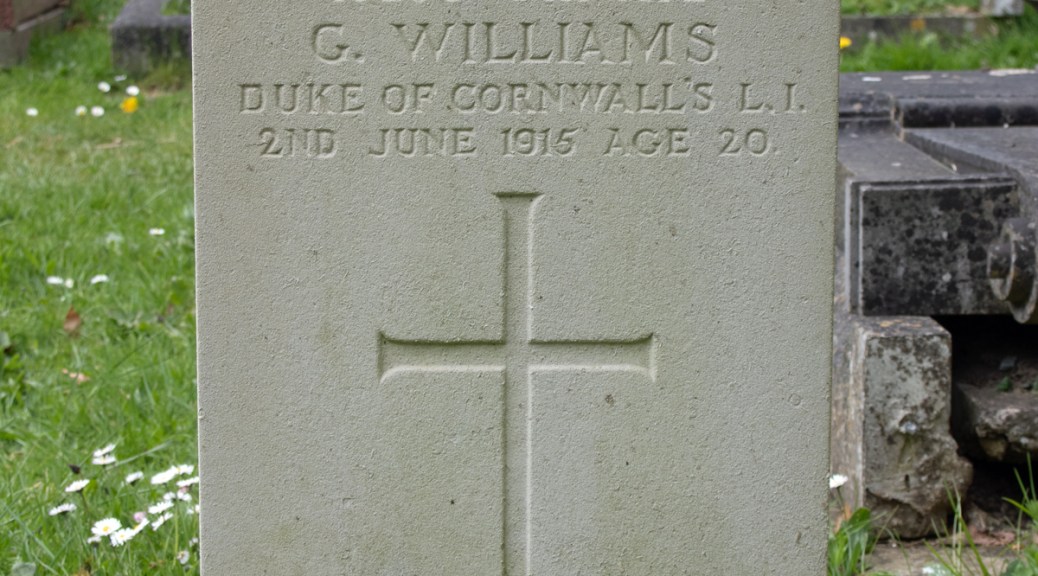
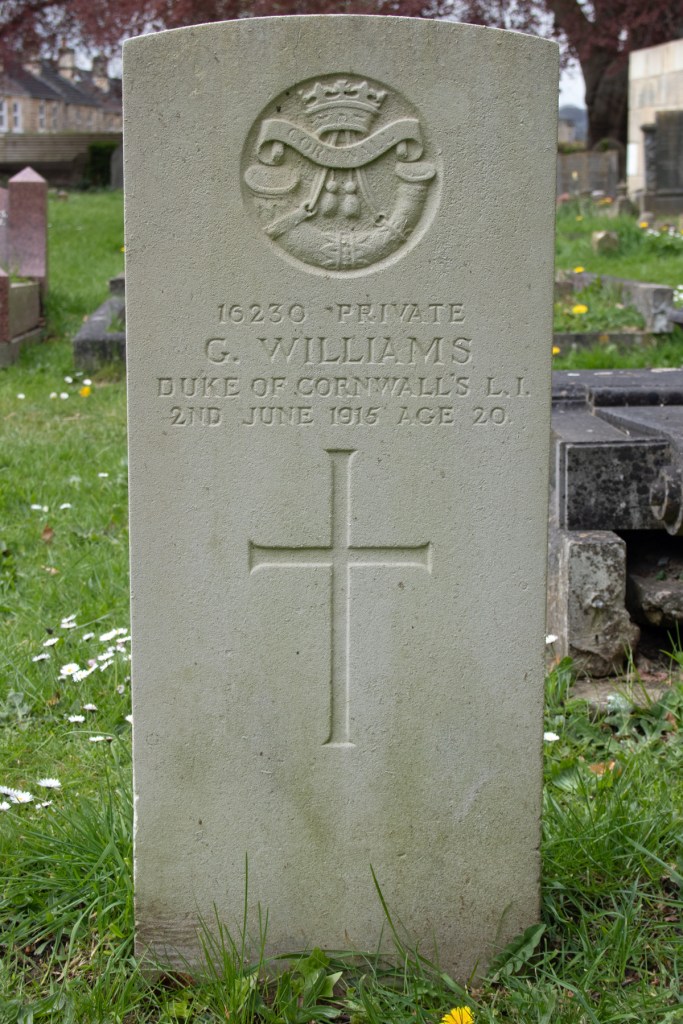
Private George Williams

Private George Williams

George Williams was born in West Bromwich, Staffordshire, in 1895. One of ten children, his parents were George and Sarah. When George Sr died in 1908, his widow was left to raise the family herself. By the time of the 1911 census, all of the children were still living at home, and four of them, including George Jr, who was working as a labourer, were bringing in a wage.

When conflict broke out, George stepped up to play his part. He enlisted in the Duke of Cornwall’s Light Infantry before the end of 1914 and, as a Private, was assigned to the 8th Battalion.

Little information is available about George’s military life and, indeed, the only other details available for him are that of his passing, based on reports available in a contemporary newspaper.

About half-past eight on Thursday [3rd June 1915] the body of a soldier was found in the river at Bath… The corpse was in a somewhat advanced state of decomposition, its condition suggesting it may have been in the river about three weeks. The man had on his full regimentals, with top coat.

Papers found in the pocket indicate that the deceased is Private George Williams, of the 8th Battalion Duke of Cornwall’s Light Infantry, now encamped at Sutton Veny, Wilts. This regiment was quartered in Bath during the winter, and left the city some weeks ago.

There are.. no marks of violence on the body.

There was found on the body a pass dated 14th May, giving him three days’ leave. The leave expired at 11:55pm on May 17th. The permit allowed him to proceed to Birmingham. There was also found on the deceased a telegram addressed to 22 Green Street, West Bromwich, which said “Leave extended.”

The supposition is that Williams returned as far as Bath, on his way back to camp, by Midland Railway, and when in the city by some means or other fell into the river.

Curiously enough, the Bath police had been advised of the absence without leave from camp at Sutton Veny of a soldier of the same name. But in this case the man belonged to the 10th Devons. They had received no notification regarding Private Williams of the 8th Cornwalls.

Bath Chronicle and Weekly Gazette: Saturday 5th June 1915

The telegram mentioned in the report is likely one sent to George’s family, who was living at 22 Queen Street (possibly an error on the newspaper’s part).

George was just 20 years old when he died: the army report gave the date of his death as 2nd June 1915, although it seems likely that he had passed some weeks before.

Sarah and the family were possibly unable to afford to have George’s body taken back to Staffordshire for burial. Instead, he was laid to rest in the Twerton Cemetery in Bath, with Sarah and two of his brothers, Leonard and William, in attendance. Another member of his battalion, “deceased’s chum” [Bath Chronicle and Weekly Gazette: Saturday 5th June 1915] Private Fred Cotton, was also at the funeral, and sent his own wreath – from “his old pal Fred” [Bath Chronicle and Weekly Gazette: Saturday 5th June 1915].


Major Francis Dickinson

Major Francis Dickinson

Francis Arthur Dickinson was born on 5th February 1874 in Lufton, near Yeovil, Somerset. The elder of two children, his parents were banker Arthur Dickinson, and his wife, Alice.

Francis was drawn to a military life. The 1891 census lists him as an army student at a boarding school in Cornwall, and by the end of the decade, he had enlisted in the Duke of Cornwall’s Light Infantry.

Over the next fifteen years, Francis served around the world, fighting in India, South and East Africa and in the Middle East. By the end of his term of service, he had risen to the rank of Major. During this time, he had been awarded a number of decorations, and had been mentioned in dispatches twice for his gallantry.

On 23rd July 1914, Francis married Clare Phipps, the daughter of a man of private means from Dilton Marsh, near Westbury, Wiltshire. The couple married in Clare’s home village, but set up residence in the Dickinson family home in Kingweston, Somerset.

When war was declared in 1914, the newlyweds were on their honeymoon. Francis returned to the army and was offered the rank of Colonel, but turned it down, in order to return to the Duke of Cornwall’s Light Infantry. He soon found himself in the thick of things again, and was caught up in the fighting at Mons, Marne, Aisne and Messines.

In April the following year, Major Dickinson was wounded. Evacuated to a camp hospital in Boulogne, he was not to survive his injuries this time round. He passed away at the hospital on 11th April 1915, at the age of 41 years old.

Due to the masses of servicemen being killed, a decision had been taken by the government of the time to not repatriate the dead to Britain, but to bury them in cemeteries close to where they fell. However, whether because of his family’s connections, or because he passed on the Channel coast, Major Dickinson’s body was, in fact, brought back to Somerset.

Francis Arthur Dickinson was laid to rest with full military honours in the graveyard of All Saints’ Church. He was buried alongside other family members, and in the shadow of the family manor.


Major Francis Dickinson
(from findagrave.com)