Category Archives: Somerset Light Infantry

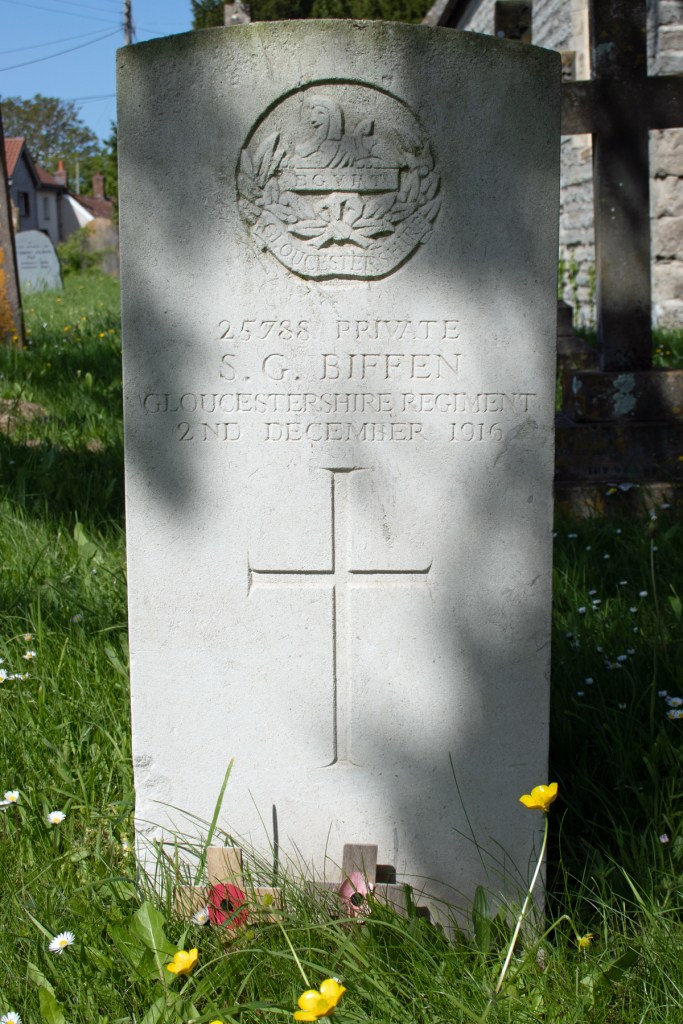
Private Stanley Biffen

Private Stanley Biffen

Stanley George Oliver Biffen was born in the autumn of 1894 in the Somerset village of East Huntspill. He was the second child to Oliver and Fanny Biffen, although his older sibling, sister Florence, had passed away at just three months of age.

Oliver was a carter and farm labourer, and the family went where the work was. The 1901 census found them living in Eastover, Bridgwater, Fanny’s widowed father, George, also living there. Ten years later, the four of them had moved to the village of Stawell. Stanley had finished his schooling, and had also taken up farm work.

When war came, Stanley stepped up to play his part. Full details of his service are lost to time, but he had enlisted in the Army by the spring of 1915. He initially joined the 1st Battalion of the Somerset Light Infantry, and by May that year, was in France.

It is not possible to track Private Biffen’s movements during the conflict, but he did transfer across to the Gloucestershire Regiment at some point. Assigned to the 7th (Service) Battalion, his was a troop that served at Gallipoli and in North Africa, although there is no evidence that Stanley fought in there.

The only other concrete evidence available for Private Biffen relates to his passing. By the autumn of 1916, he had been admitted to the 1st Western General Hospital in Fazakerley, Liverpool. He was suffering from phthitis, or tuberculosis, and this was the condition that was to get the better of him. He passed away on 2nd December 1916, at the age of just 22 years old.

The body of Stanley George Oliver Biffen was brought back to Somerset for burial. He was laid to rest in the quiet graveyard of Stawell Church.


Stanley’s parents had now lost both of their children, and this is likely to have taken a toll on them. Fanny passed away in December 1924, at the age of 64 years old. Oliver died just a year later aged 54 years old.

Lance Corporal John Harris

Lance Corporal John Harris

John Henry Harris was born at the turn of 1879, the oldest of eight children to John and Florence Harris. John Sr was a mason’s labourer from Somerset, and his and Florence’s three oldest children were born in Bishop’s Hull, near Taunton. By 1890, however, the family had moved to Monkton Combe, on the outskirts of Bath, presumably to follow John Sr’s work, and this is where they settled.

When John Jr completed his schooling, he followed in his father’s trade and when the 1901 census return was completed, he was employed as a mason’s labourer, while his father had moved into carpentry.

Florence died in April 1901, and six years later, John Sr remarried. His new wife was Ann Gibbs, and the couple went on to have three children, new half-siblings to John Jr.

In the autumn of 1905, John Jr married in Eliza Mundy, a cowman’s daughter from Monkton Combe. The couple settled in a small cottage on Mill Lane, and had a son, Frank, who was born in 1907. By this point, John had found new employment as a gardener to the local vicar, Reverend Pitcairn.

When war came to European shores, John quickly stepped up to enlist. He joined the 7th Battalion of the Somerset Light Infantry and arrived in France in July 1915 after his training.

Private Harris was wounded during the opening weeks of the Battle of the Somme, but recovered and returned to the Front Line. He was promoted to the rank of Lance Corporal, but in March 1917 he was wounded again. “A piece of his steel helmet was driven into his head at the temple, and little hope of his recovery was entertained from the first.” [Bath Chronicle and Weekly Gazette: Saturday 24th March 1917]

Medically evacuated to Britain, Private Harris was admitted to a hospital in Stockport, Cheshire. His “wife (who has been dangerously ill in hospital), Mr John Harris (his father) and a sister proceeded to Stockport, but, unfortunately, did not arrive until shortly after death had occurred.” [Bath Chronicle and Weekly Gazette: Saturday 24th March 1917]

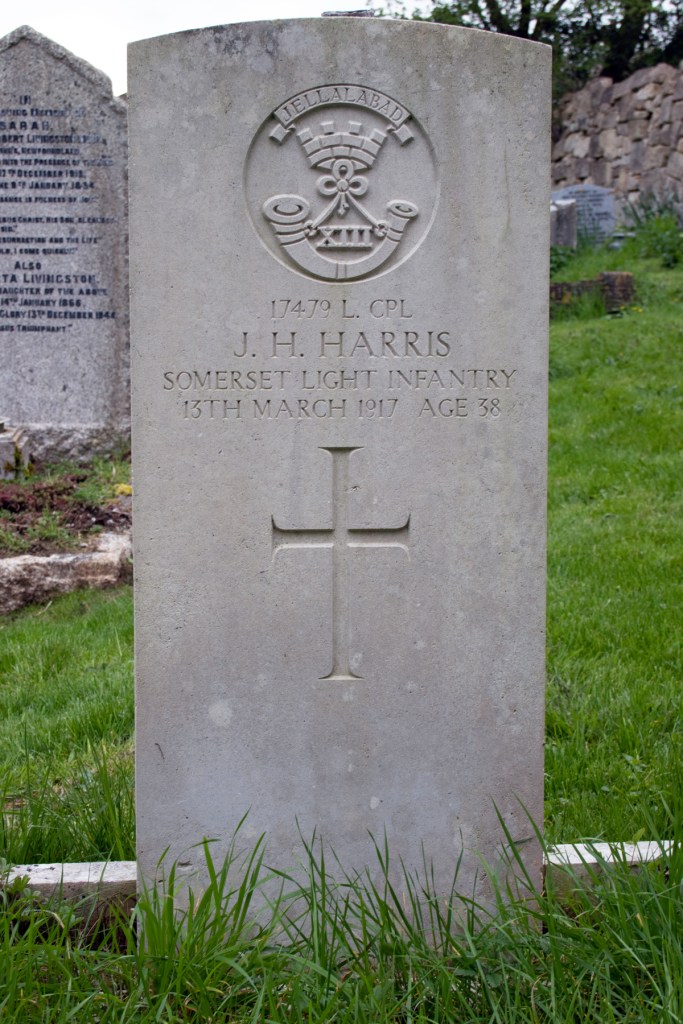
Private Harris passed away on 13th March 1917, at the age of 38 years of age.

John Henry Harris’ body was brought back to Monkton Combe for burial and he was laid to rest in the peaceful graveyard of St Michael’s Church, his funeral being officiated over by his former employer, Reverend Pitcairn.


Eliza went on to marry again, wedding Walter Giggs in 1921. The couple went on to have a daughter, Margery, who was born two years later. Eliza lived on until 1949, when she died at the age of 69 years old. She was also laid to rest in St Michael’s Churchyard.


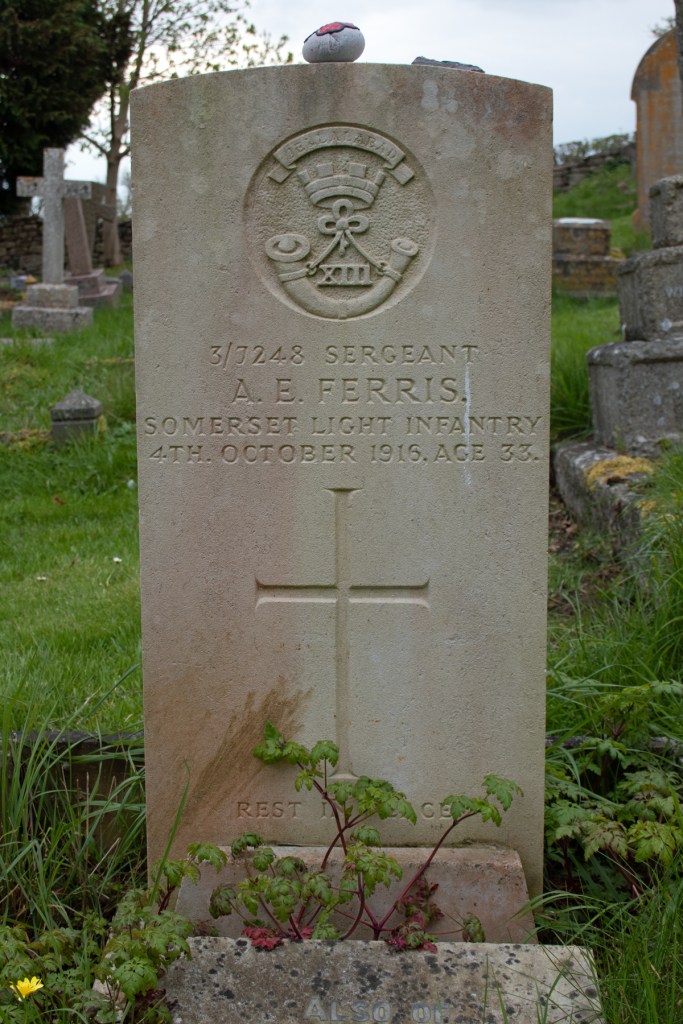
Sergeant Albert Ferris

Sergeant Albert Ferris

Albert Edward Ferris was born in the spring of 1884, one of six children to Charles and Juliana. Charles was quarryman turned farm labourer from Gloucestershire, but it was in the village of Claverton, near Bath, that the family were born and raised.

When he finished his schooling, Albert found work as a baker, but soon sought out a career in the military. On 2nd January 1903 he enlisted in the Royal Marine Light Infantry as a Private. His services records show that he was 5ft 6ins (1.68m) tall, with brown hair, blue eyes and a fair complexion.

Based out of Plymouth, over the next nine years Private Ferris served on four different ships and was recognised as having a very good character and an ability to match.

In 1910, Albert married Eliza Jane Warren, a mason’s daughter from Monkton Combe. The 1911 census found Albert on board the armoured cruiser HMS Cumberland, while Eliza was living with her parents. Military life was taking a toll on married life and, on 6th December 1911 bought an end to his naval career and was ‘discharged by purchase’.

Returning to Somerset, Albert found employment as a motor-man with Bath Electric Tramways. He and Eliza settled into married life, but war was on the horizon and things were to change.

At the outbreak of war, [Albert] promptly responded to his country’s call, and enlisted in the [Somerset Light Infantry], as a Private. When his battalion was sent to France, he distinguished himself in a short time by his excellent work as a sniper, speedily earning his first stripes as a consequence. With his battalion he participated in the heavy fighting around the Ypres district, over an extended period, without sustaining any serious injury. Later his battalion was moved further down the line to take part in the “Great Push,” where, for meritorious conduct, he was… promoted to Sergeant in the field…

Bath Chronicle and Weekly Gazette: Saturday 7th October 1916

Sergeant Ferris’ luck was not to last, however, and things took a turn in September 1916.

In the… fighting around Delville Wood… Sergt, Ferris was severely wounded in the right thigh by a machine-gun bullet. One of his officers gave him the best first-aid treatment possible under the circumstances, and later he crawled nearly three miles in an endeavour to reach the nearest field dressing station. Through loss of blood, shock, and general exhaustion he was on the point of collapse when picked up by a field ambulance, after which he was transferred to the base and later to Tooting Military Hospital, where, despite skilled treatment and the greatest care, septic poisoning intervened and he passed away…

Bath Chronicle and Weekly Gazette: Saturday 7th October 1916

Sergeant Ferris died while admitted in the Surrey hospital on 4th October 1916. He was just 32 years of age.

The body of Albert Edward Ferris was brought back to Somerset for burial. He was laid to rest in the peaceful graveyard of St Michael’s Church, Monkton Combe.


Serjeant Joseph Smith

Serjeant Joseph Smith

Joseph Smith was born at the beginning of 1879 in Bath, Somerset. The fifth of six children – all boys – his parents were William and Sarah Smith. William was a carpenter and, while he did not follow in his father’s trade, Joseph found employment as a house painter when he left school.

Joseph married Alice May Martin in 1896: the couple were young, the groom being a year older than the bride, and they went on to have a daughter, Dorothy, who was born the following year. The newlyweds moved into a small, terraced house in Bath with Alice’s mother and sister, both of whom were widowed, and Alice’s nephew.

The 1911 census found the extended family living in larger home away from the centre of the city. Joseph was still employed as a house painter, Dorothy had left school and was apprenticed to a dressmaker. Alice looks to have been looking after the household, while her mother and sister were both living on their own means.

In his spare time, Joseph was also a member of staff at Bath’s Theatre Royal. He was sporty, with a keen interest in football and partial to a game of cricket. He was also very connected to St Stephen’s Church in the city, and was involved in parish life.

War was coming to Europe, and Joseph stepped up to play his part. Full details of his military service are lost to time, but from his gravestone and linked records, it is clear that he enlisted in the 6th Battalion of the Somerset Light Infantry. Further details are outlined in a contemporary newspaper report:

Though married, he was anxious to enlist practically as soon as the war began: and on January 16th, 1915, he offered himself for service, and was at once accepted. He did not leave England till 16th August [1916]. He had been selected for inclusion in 32 drafts on various occasions prior to that date; but had been obliged to remain behind from illness or some other cause. When he actually sailed, it was not as a member of a draft, but as one of five sergeants who had volunteered for special service.

Bath Chronicle and Weekly Gazette: Saturday 28th October 1916

Sergeant Smith made it to the Western Front, and was entrenched at the Somme. The newspaper report picks up on what happened next:

He was wounded in September, being struck by a bullet while leaving the trench preparatory to advancing. The bullet struck him in the thigh, and severed an artery… After doing what he could with his first-aid dressing, Sergt. Smith crawled some three miles from the firing line amid bursting shells. After five hours of this painful progress he was picked up by a stretcher party.

Bath Chronicle and Weekly Gazette: Saturday 28th October 1916

Sergeant Smith was medically evacuated to Britain for treatment, and was admitted to the 3rd Western General Hospital in Cardiff. Alice and Dorothy were a constant presence as his bedside, but the wound was to prove too severe, and he passed away at the hospital on 25th October 1916. He was 38 years of age.

Joseph Smith was brought back to Bath for burial. He was laid to rest in the Lansdown Cemetery, overlooking the city he called home.


Captain Fritz Bartelt

Captain Fritz Bartelt

Friedrich Wilhelm Bartelt was born on 23rd September 1887 in the Somerset village of Corston. He was the younger of two children to Friedrich and Rosanna Bartelt. Born in Prussia, Friedrich Sr was an import and export merchant of oil and chemicals, who had become a magistrate and chemical manufacturer by the time of the 1901 census.

Friedrich Jr – who was also known as William or Fritz, to avoid confusion with his father – had the upbringing to be expected for the son of a prominent businessman.

He was educated first at St Christopher’s, Bath… and afterwards at Bath College, which he entered in September, 1900, and left in December, 1904. He was prominent in sport and as in the school Rugby Fifteen in 1903 and 1904, and a member of the Cricket Eleven in the summers of 1903 and 1904, and was in the second rowing four in 1904. He subsequently studied chemistry… at Bristol University College, and after a time he became a director in the company of which his father is chairman.

Somerset Guardian and Radstock Observer: Friday 15th September 1916

Fritz enlisted in the Somerset Light Infantry not long after finishing his studies, becoming a Lieutenant in H Company of the Volunteer Battalion, before taking command of G Company. Possibly because other pressures took priority, he stood down from his role in 1911.

On 2nd June 1910, Fritz had married Gertrude Isgar, a gentleman’s daughter from Bathwick, near Bath. The couple went on to have two children, both boys.

[Fritz] was a churchwarden of Corston, and always took a keen interest in all parochial matters, and his loss is very keenly felt in the village. Always kind and genial to all alike, he won the hearts of all with whom he came in contact. His readiness to help, his careful attention to the needs of those around him, and his kindly words and acts will dwell long in the memory of many in Corston.

Somerset Guardian and Radstock Observer: Friday 15th September 1916

When war was declared in 1914, Fritz stepped up to play his part, and was given the commission of Captain in the 2nd/4th Battalion of his old regiment, the Somerset Light Infantry.

On December 1, 1915, he sailed for India, when he took charge of his company, and was afterwards given an important post, being appointed in command of his station at Barrackpore [Barrackpur].

Somerset Guardian and Radstock Observer: Friday 15th September 1916

Captain Bartelt fell ill in the summer of 1916, and was admitted to a hospital in neighbouring Kolkata. While his condition is not reported on, he seemed to have been improving, but his health then took a downward turn, and he passed away while still admitted, on 11th September 1916. He was 28 years of age.

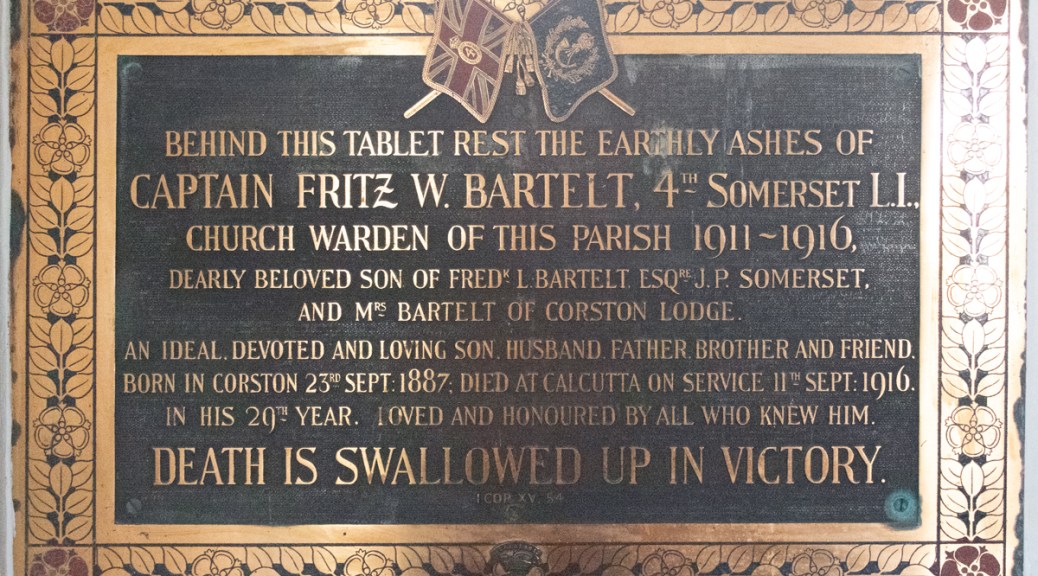
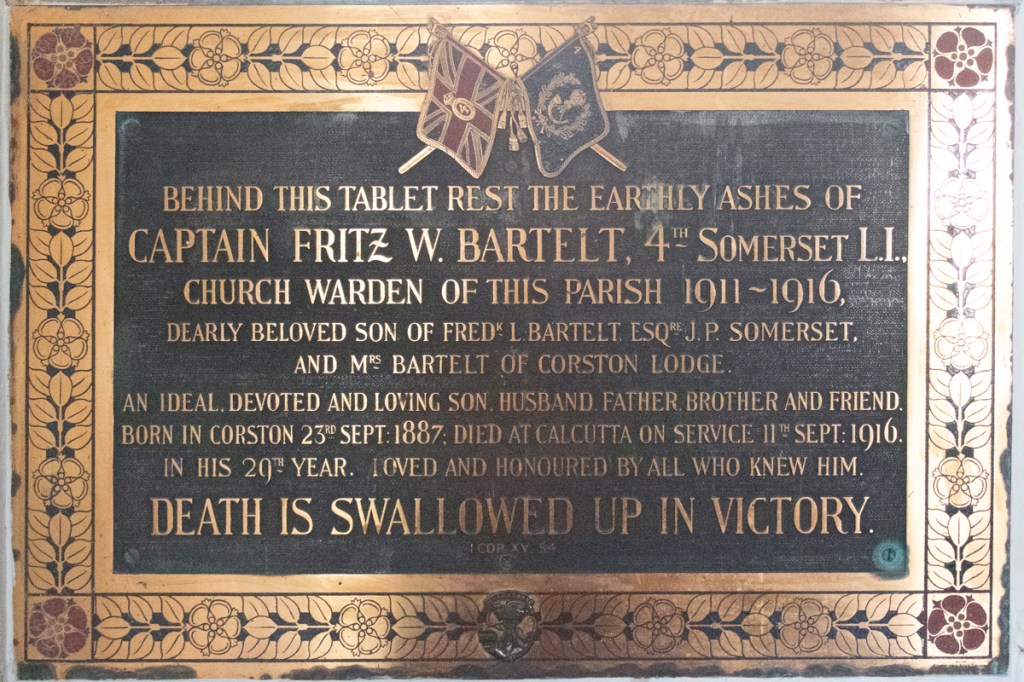
Fritz William Bartelt’s body was cremated in India. His ashes were returned to England, and were interred in All Saints’ Church in his home parish, Corston, where a plaque and a stained glass window are dedicated to his memory.


Captain Fritz Bartelt
(from ancestry.co.uk)

Private Reginald Day

Private Reginald Day

Reginald Charlie Day was born in the spring of 1891, the sixth of thirteen children. His parents – George and Charlotte Day – were born and raised in Gloucestershire, but had moved to Wellow in Somerset by the time Reginald was born.

George was originally a shepherd, but Wellow had two key industries – mining and the railways – and it was into the former that he went, presumably to bring in a regular wage for the expanding Day family.

When he left school, Reginald initially followed his father to the pit, but in April 1913, he opted for a more prestigious career, and enlisted in the army. He joined the Somerset Light Infantry as a Private but, because of his profession, he was not formally mobilised until 1916. His service records give away little about his stature, only that he was 5ft 7ins (1.7m) tall, with good vision and good physical development.

In January 1916, Private Day was moved to the North Somerset Yeomanry and, within a matter of weeks was bound for France. By that October, however, he was moved again, and became attached to the 5th (Service) Battalion of the Dorsetshire Regiment. He was assigned to one of the regiment’s depots, and remained close to the Western Front until the end of July 1917.

At this point, Reginald’s health was beginning to suffer, and he was moved back to the UK for treatment. He was admitted to hospital suffering from a pelvic abscess, and this was later diagnosed as carcinoma of the rectum. No longer fit for military service, he was dismissed from the army on 17th February 1918, his medical records noting that he had been fitted with a colostomy belt.

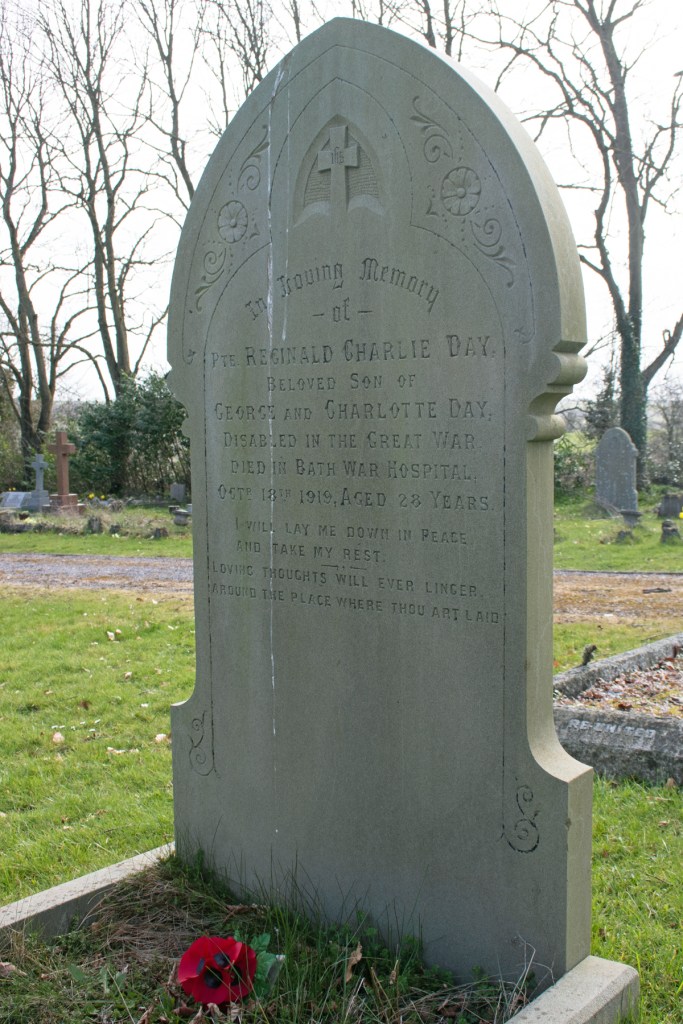
At this point, Reginald’s trail goes cold. It is likely that he returned home, but whether he was able to take up his previous employment – or work at all – is unclear. His headstone records that he died in Bath War Hospital, although again it is uncertain whether he was admitted from the point of leaving the army, or only in later months as his condition deteriorated. He passed away on 18th October 1919, at the age of 28 years old.

Reginald Charlie Day was laid to rest in the family plot in the peaceful Wellow Cemetery.


Private Alfred Creese

Private Alfred Creese

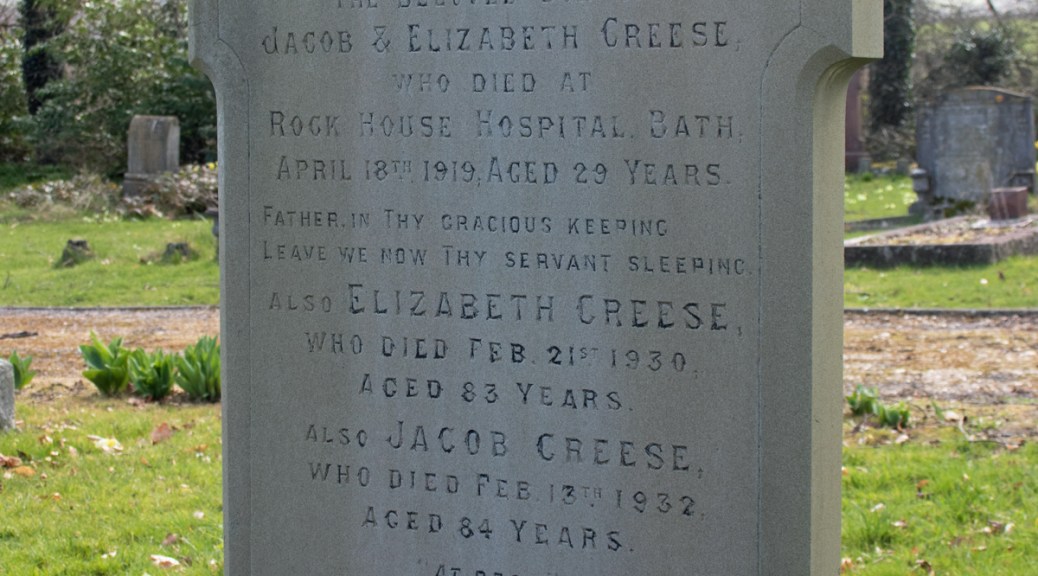
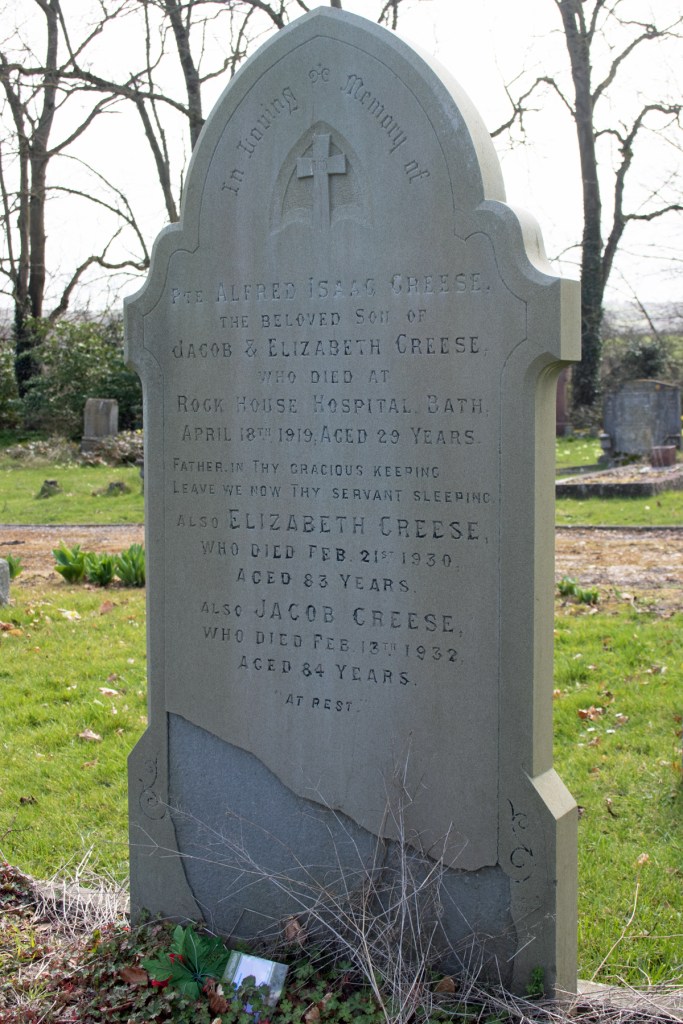
Alfred Isaac Matthew Creese was born in Wellow, Somerset, in the summer of 1889, and was the youngest child to Jacob and Elizabeth Creese. Jacob was a wagon builder for the Somerset & Dorset Railway, working in the village’s station. When Alfred left school, however, he found employment as a farm labourer.

When war came to Europe, Alfred stepped up to play his part. Sadly, few of his military records remain, and those that do give little information away. He enlisted in the Somerset Light Infantry as a Private and, as a result of his war service, he was awarded the Victory, British and Territorial Force War Medal.

Private Creese survived the conflict, but, according to his headstone, he passed away at the Rock House Hospital in Bath. While this does not appear to be a dedicated hospital, there are a number of locations called Rock House in the Bath area, and it is likely to have been a house used for convalescent purposes. Whatever the location, this is where Private Creese passed away on 18th April 1919, at the age of 29 years old.

Alfred Isaac Matthew Creese was brought back to Wellow for burial. He was laid to rest in the family plot in the village’s peaceful cemetery, to be joined there by his mother in 1930, and his father in 1932, a family reunited once more.


Air Mechanic 2nd Class Leonard Luke

Air Mechanic 2nd Class Leonard Luke

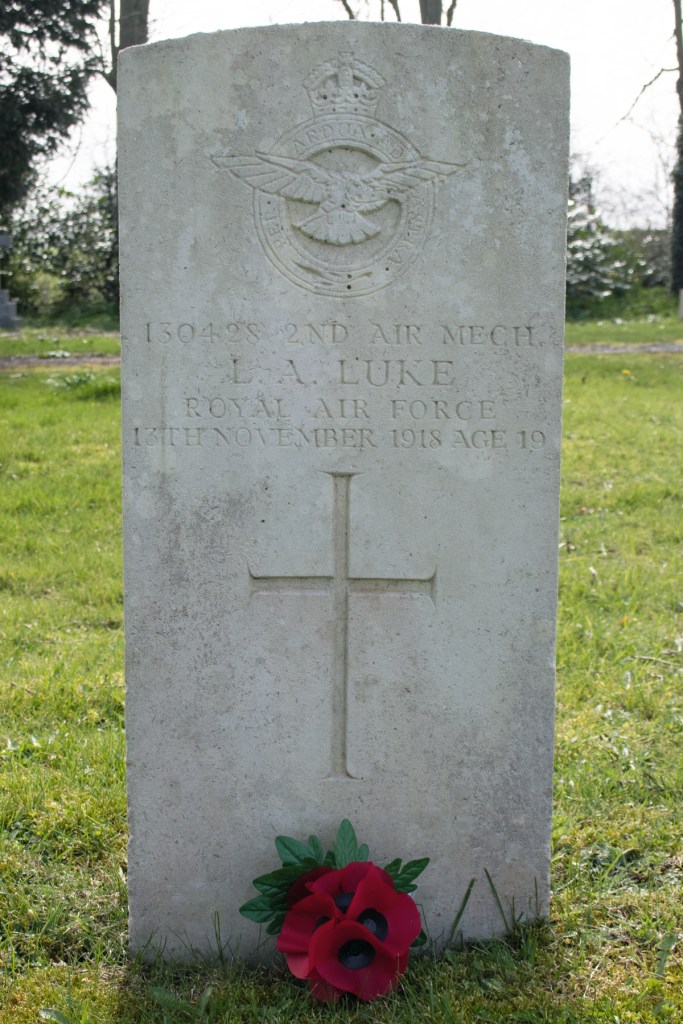
Leonard Arthur Luke was born in the autumn of 1899 in Shepton Mallet, Somerset. He was the fifth of ten children to railway guard George Luke and his wife, Georgina.

By the time of the 1911 census, the family had moved north west, to the village of Wellow, where George continued his employment with the railway. The track and station have now since disappeared, but at the time, it was a busy stopping point for the mining village.

When Leonard left school, he found work as a porter with the Somerset & Dorset Railway, but by now war was raging across Europe, and he was keen to play his part. He initially enlisted in the Somerset Light Infantry on 3rd January 1918, but moved to the Royal Flying Corps after a matter of weeks.

On 1st April 1918, Leonard transferred across to the Royal Air Force. Formally holding the rank of Air Mechanic 2nd Class, he was training to become a wireless operator in Winchester, Hampshire. He was admitted to the Red Cross Hospital in the city, having contracted rheumatic fever. Sadly, this was to take his life, and he passed away on 13th November 1918, two days after the Armistice. He was just 19 years of age.

Leonard Arthur Luke’s body was brought back to Somerset for burial. He was laid to rest in the quiet Wellow Cemetery.


Air Mechanic 2nd Class Leonard Luke
(from britishnewspaperarchive.co.uk)

While Wellow Station was a bustling place, it is highly likely that Leonard would have known Edward Bending, one of the clerks at the time he was there. Edward also went off to war, and his story can be found here.


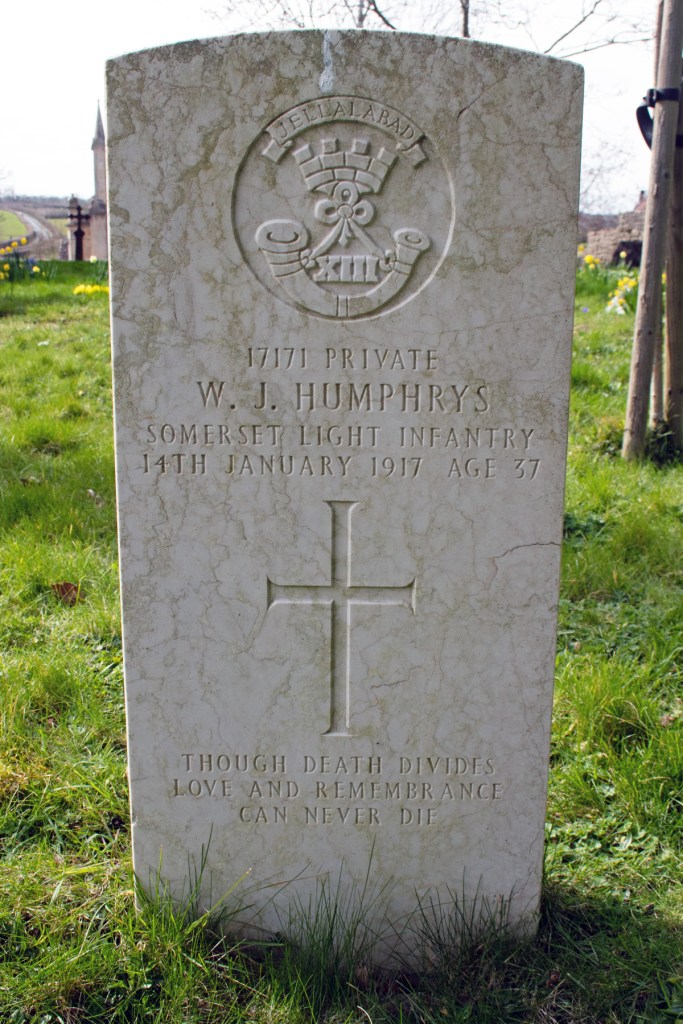
Private William Humphrys

Private William Humphrys

William James Humphrys was born early in 1880, the fourth of seven children to Mark and Alice Humphrys. Mark was a gardener from Wellow in Somerset, but it was in nearby Norton St Philip that the family were born and raised.

Alice died in 1904, by which time William was working as a mason’s labourer. By the time of the 1911 census, he was living in the family home on Church Street, with his father and two older sisters, Annie and Mary.

On 17th April 1911, William married Annie Holcombe, a farmer’s daughter from the village. It is likely that they set up home with Mark, but those details are lost to time.

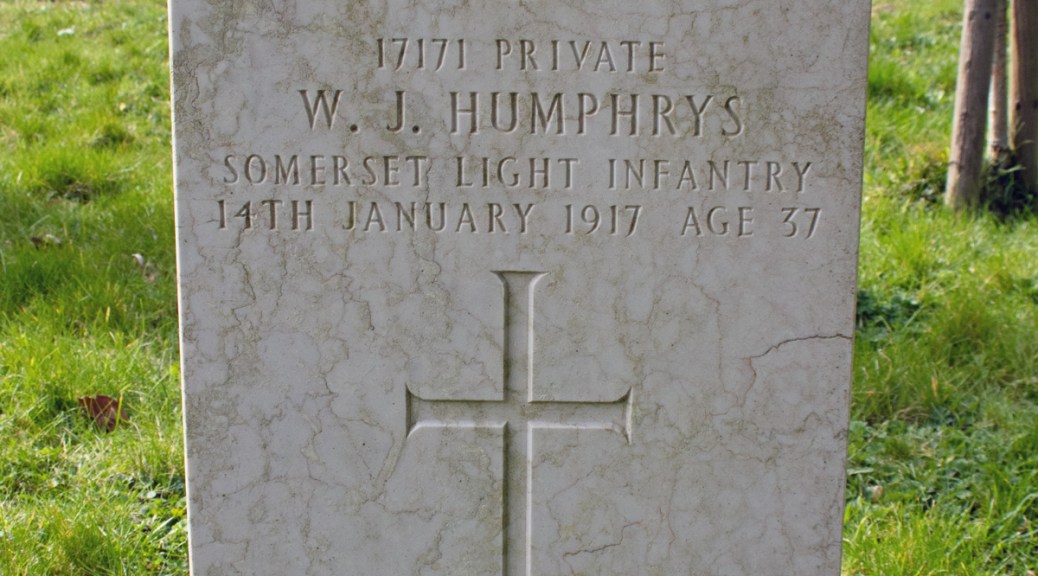
War came to Europe in the summer of 1914, and William was quick to step up and play his part. He enlisted in the Somerset Light Infantry early in 1915, and was assigned to the regiment’s 6th Battalion as a Private.

William arrived in France in June 1915, and over the next eighteen months was caught up in some of the fiercest battles of the war. The 6th Battalion first saw fighting at the Action of Hooge, where it had the misfortune to be the first to be attacked by flamethrower. During 1916, Private Humphrys was firmly ensconced at the Somme, although full details of his service are lost to time.

In fact, the only other concrete information about Private Humphrys is that of his passing, which happed on 14th January 1917 at King George’s Hospital in London. The cause of his death is unknown, but he was 36 years old at the time.

William James Humphrys was brought back to Somerset for burial. He was laid to rest in the quiet graveyard of Saints Philip & James’ Church, Norton St Philip, within sight of his family home.


Private William Badman

Private William Badman

William Ewart Badman, whose first names appear interchangeable, was born in the summer of 1888, the older of two children to Francis and Elizabeth Badman. Francis was a builder from Holcombe in Somerset, and this is where the family were born and raised.

Francis died in 1905 and, after William’s sister, Cristabelle moved to Cardiff to take up work as a milliner, he stayed to help support his mother. The 1911 census recorded Elizabeth and William living in Holcombe, where he had found employment as a carpenter.

On 14th November 1915, William married dressmaker Amy Talbot. The couple were living in a terraced house in St Leonard’s Road, Bristol, where he was still finding work as a carpenter.

War had come to Europe by this point, and William was soon to play his part. He enlisted as a Private in the 11th Battalion of the Somerset Light Infantry, in November 1916. Full details of his military service are lost to time, but a local newspaper report give a little information:

Mr Ewart Badman, who… had undergone a slight operation, had passed away.

Somerset Standard: Friday 13th July 1917

No detail of the need for William’s operation are evident, nor does the report expand on his condition any further. His entry in the Army Register of Soldiers’ Effects confirm that he died at the War Hospital in Bath. He passed away on 1st July 1917, at the age of 29 years old.

William Ewart Badman’s body was brought back to Holcombe for burial. He was laid to rest in the graveyard of St Andrew’s Church in the village.