Category Archives: Private

Private John Hookway

Private John Hookway

The early life of John Hookway seems destined to be lost to time. He was born in 1876 or 1877 in Lancashire, and the only surviving 1881 census featuring that name would suggest his parents were James, who was a shoeing smith, and Leah Hookway.

The next census on which John appears is in 1911. This confirms that John had married a widow called Rose Ash the year before. They were living in Huntspill, Somerset, with Rose’s three children – daughters Rose, Violet and Lily – and her sister, Emily. John was employed as an ‘improver in grocery trade’, while Violet, who was 17 years old, was noted as being a ‘servant on the Isle of Wight’. Violet’s sister, Rose, the census recorded, was ‘feebleminded’, while Emily was identified as an ‘imbecile’.

When war broke out, John stepped up to enlist. His age may have excluded him from any compulsion to join up – he was nearly 40 years old when he signed his attestation papers in December 1915. This may suggest that he had served in the army before, hence the absence from the 1891 and 1901 census records.

Private Hookway’s service records noted that he was a grocer, and that he had been born in Devon, although this is at odds with other, earlier, documents. He was 5ft 4ins (1.64m) tall and weighed 137lbs (62.1kg). He was assigned to the Somerset Light Infantry, and he joined the 13th (Home Service) Battalion. As the name suggests, John saw no action overseas, and his time appears to have been split between Somerset and Suffolk.

John’s time in the army was not without issue. In September 1916, he was admitted to a local Volunteer Aid Detachment Hospital with appendicitis, which saw him laid up for more than six weeks. In November 1918, the war having come to an end, Private Hookway was sent to the 2nd Southern General Hospital in Bristol, Gloucestershire, with an aneurysm of the abdominal aorta. This was, understandably, severe enough for him to be discharged from the army, and he was formally stood down on 12th March 1919.

John returned home to be with his family. The next record for him is that of his passing, on 4th June 1919. He was around 43 years of age.

John Hookway was laid to rest in Highbridge Cemetery, Somerset. Rose, who had now been widowed twice in ten years, never remarried. She was laid to rest near her second husband when she passed in 1946.


Private Arthur Perkins

Private Arthur Perkins

Arthur Perkins was born on 22nd April 1883, the seventh of eight children to James and Jane Perkins. James was a farm labourer who subsequently found work on the railways. The family were all born in Huntspill, Somerset, moving the few miles north to Highbridge when James’ work changed.

Arthur initially took on labouring work, but sought a more reliable career. On 26th February 1903, he enlisted in the army, joining the Somerset Light Infantry, for whom he had previously been a volunteer. His service records show that he was 5ft 7ins (1.7m) tall and weighed 122lbs (55.3kg). He had brown hair, hazel eyes and a fresh complexion, and his medical records note that he had a scar above his right eye.

Private Perkins was initially attached to the 2nd Battalion, remaining on home soil until September 1904. At this point, Arthur was moved to the 1st Battalion and, as a result, was sent to a unit in Quetta, India. He remained overseas for more than eighteen months, and, during his army career had a number of spells in hospital. He was admitted for bronchial catarrh in March 1904, a swollen stomach in December, a blistered foot in January 1905, syphilis in April and dyspepsia in September.

Arthur returned to Britain in May 1906, and at this point was stood down to reserve status. He returned to Somerset and, by the time of the 1911 census, was living with his older brother Harry and his family.

The Perkinses shared a small cottage in Benedict Street (at the time known as Station Road), Glastonbury. Arthur and Harry both laboured in a timber yard, while one of the yard’s engineers, William Webb, boarded with the family to bring an extra income in.

By the time war broke out in 1914, Arthur had moved back to Highbridge. He had taken up employment as a butcher, but this came to an end when he was mobilised on 5th August. Attached to the 1st Battalion of the Somersets again, Private Perkins was sent to France with his unit within weeks of the conflict being declared.

On the 18th September, Arthur was caught up in the Battle of the Aisne. He was wounded in the arm, and subsequently knocked unconscious by a shell burst nearby. From that point on, Private Perkins was dogged by a persistent tremor, which resulted in him being medically evacuated to Britain, and ultimately discharged from active service. “He had a functional tremor of the whole body. He he typically neurasthenic and depressed and convinced he will never be any better. No treatment is of the slightest avail.” [Medical discharge papers for Private Arthur Perkins: 26th June 1915]

Following Arthur’s discharge from the army, his trail goes cold. It is likely that he returned to Highbridge, although it is also likely that he spent periods of time – or longer – hospitalised because of his condition. He married a woman called Florence, although details of her are also scarce.

Arthur Perkins died through causes unknown on 2nd November 1918: he was 35 years of age. He was laid to rest in the cemetery of his home town, Highbridge.


Private William Higgins

Private William Higgins

William George Newton was born in Culmstock, Devon, early in 1889. His mother, Ada, was unmarried at the time, and there is no indication as to who his father was. The 1891 census found mother and son living with Ada’s parents, John and Hannah, in South Street, Wellington, Somerset.

In the summer of 1892, Ada married Frederick Higgins, a police constable from Baltonsborough. The couple set up home in the village of Mark, and went on to have ten children. It was at this point that William took on Frederick’s name, though whether that was because he was actually his birth father is unclear.

When he finished his schooling, William found labouring work. On 9th March 1910, he married Annie Achilles, a painter’s daughter from Glastonbury. The couple set up home in a small cottage in Bank Street, Highbridge, and went on to have three children.

The next year’s census recorded that William was employed as a stoker for Highbridge Bacon Co Ltd, a large factory to the south of the town. His and Annie’s oldest child, son William Jr, who was just two months old at this point, and William’s grandfather, the now widowed John, completed the household.

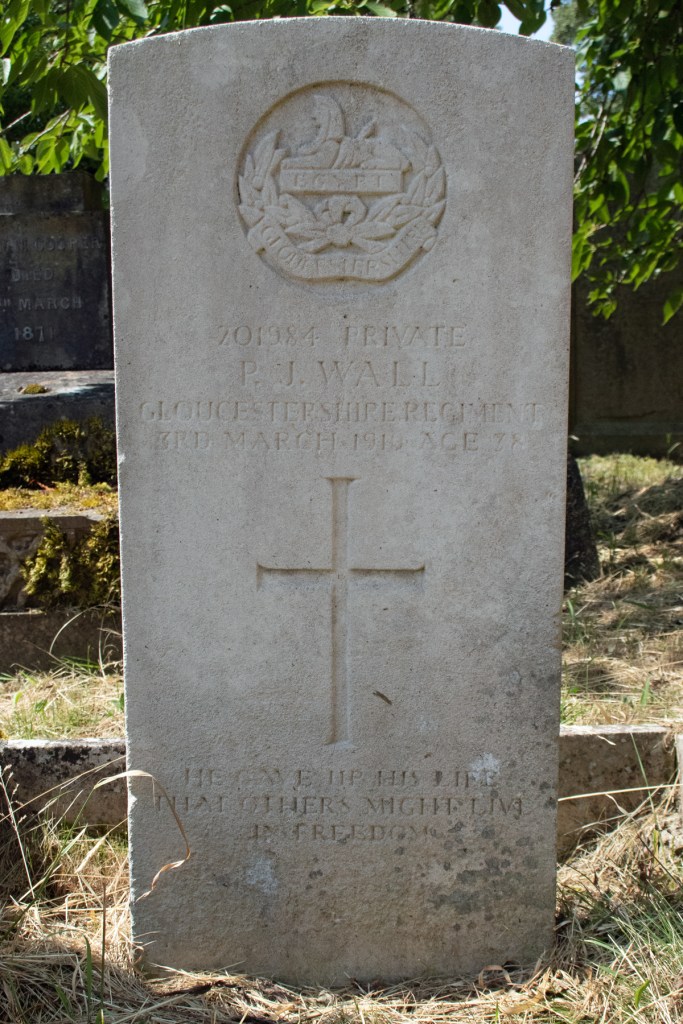
When war broke out, William stepped up to play his part. He enlisted on 28th October 1915, joining the 3rd Battalion of the Gloucestershire Regiment as a Private. His service records show that he was 26 years and 10 months old, and stood 5ft 2ins (1.57m) tall.

Private Higgins’ service documents confirm that he served for nine months before being medically discharged from the army. He had contracted haemoptysis and had an enlarged heart. His medical records confirmed that, at the time of his dismissal, he was totally incapacitated and unable to work.

William returned to Somerset, but is would seem that his health continued to dog him over the next couple of years. He passed away on 29th October 1918, at the age of 29 years of age.

William George Higgins was laid to rest in the cemetery of his adopted home town, Highbridge.


Annie was now a widow, with three young children to support. She married again in the spring of 1922, to bus conductor William Davey. Annie was to outlive not only her husband, but all three of her children.

William and Annie’s youngest, Cyril, passed away when he was just a couple of months old.

Albert, their middle son, “had been for a great while a cripple from trouble in his leg, but was able to get about on crutches.” [Central Somerset Gazette: Friday 22nd July 1932] He passed away on 16th July 1932, aged just 18 years old.

William Jr had tried out in the Royal Navy when he was sixteen years of age. Beginning with the rank of Boy 2nd Class, he was dismissed in March 1928, as he was deemed unsuitable for the rank of Boy 1st Class.

In the autumn of 1934, he married Nettie King, the daughter of a factory worker from Street, Somerset. The couple went on to have three children, although in an echo of his parents’ tragedy, their middle child, Phyllis, passed away when just eighteen months old.

When war came to Europe for a second time, William sought to serve his country for a second time. He enlisted in the Royal Air Force, and rose to the rank of Leading Aircraftman. On 18th June 1940, he was on board a Blenheim aircraft flying from the UK to Malta, when the plane came down in bad weather near Marseille. William and his two companions, Pilot Officer Johnston and Sergeant Micklethwaite were all killed.

Leading Aircraftman Higgins was laid to rest in the Mazargues War Cemetery near Marseille.


Private William Lock

Private William Lock

William Charles Shallis Lock was born in the spring of 1894, the eldest child to Harriet Lock. Born out of wedlock, Harriet went on to marry William’s father, Charles Shallis, in 1897. The couple would go on to have two more children – Walter and Lilian – before Harriet’s untimely death in 1900.

The 1901 census recorded William living with his maternal grandparents, Daniel and Ellen Lock, in the family’s home village of Bishops Lydeard, Somerset. Daniel was a farm labourer and, by the time of the 1911 census, William was making his own way in the world, boarding at Rainbow Wood Farm in Claverton, to the east of Bath. The document seems to indicate that William had ditched his first name, and was now using Charles as his preference.

War came to Europe in the summer of 1914, and Charles stepped up to play his part. Sadly, full service records are no longer available for him, but it is clear that he had enlisted in the opening months of the conflict, and that he joined the Bedfordshire Regiment.

Assigned to the 7th (Service) Battalion, Private Lock found himself in France by the end of August 1915. Charles would have found himself in the thick of the fighting, and was entrenched at both the Somme in 1916 and Passchendaele the following year.

It seems likely that Private Lock’s luck ran out at either the Battle of St Quentin in March 1918, or at the Battle of the Avre, just a few weeks later. That he was wounded is certain, as he was medically evacuated back to Britain, and admitted to Liverpool Infirmary. Charles’ injuries were to prove too severe, however, and he died while admitted on 5th April 1918. He was just 24 years of age.

The body of William Charles Shallis Lock was taken back to Somerset for burial. He was laid to rest towards the front of the graveyard of St Mary’s Church, in his home village, Bishops Lydeard.


Private George Rawle

Private George Rawle

George Rawle was born on 26th April 1867 in the Somerset village of Milverton. One of nine children, his parents were William and Ann. William was a shepherd turned general labourer and, when he first finished his schooling, George was sent north to Nether Stowey, where he worked as a stable boy at Castle Hill House.

The 1891 census found George back living with his parents, who had moved to Milverton, presumably following William’s work. George, by this time, was employed as a domestic groom, although the next census found both him and William – now 74 years of age – working as general labourers.

William died in 1902, and Ann passed away seven years later. By 1911, George had moved just up the road to Wiveliscombe. He was living in a four-roomed cottage and employed as a jobbing gardener. He shared his home with two of his sisters: Jane was 46 years old and working as a housemaid; Alice, 33 years of age, was a housekeeper.

When war came to European shores, George felt the need to step up and play his part. He joined up at an enlistment drive at the brewery in Wiveliscombe, and was assigned to the Royal Army Service Corps as a Private. While waiting for his medical he returned to the home he shared with his sisters. It was here, just five days later, that he ended his life.

A painful sensation was caused in Wiveliscombe on Wednesday morning, through the action of Priv. George Rawle, of the E Squadron, Somerset Mule Depot, who took his own life under distressing circumstances at his residence at Higher Nunnington.

Deceased… had been restless through the night, and about five o’clock in the morning he told his sister he was going to get up to write a letter. The sister begged him to put his clothes on, but he would not do so, and went downstairs. She followed him in her nightdress. He picked up a gun in the hall, and she tried to take it away from him, but failed. Rawle went out to the path in front of the door of the house. His sister took hold of his arm, but he wrenched himself away, put the muzzle of the gun in his mouth, pulled the trigger, and fell down beside her, having blown out his brains.

Dr WH Randolph was in attendance shortly after, but could only pronounce life extinct.

The inquest took place on Friday, before Mr Foster Barham, coroner for West Somerset.

Jane Rawle, deceased’s sister, said her brother had suffered from nervous depression for many years, and seventeen years ago was a patient at Cotford Asylum. Lately he had been worried about the house in which he lived.

Taunton Courier and Western Advertiser: Wednesday 29th September 1915

The jury at the inquest returned a verdict of suicide while of unsound mind. George was 48 years of age.

George Rawle was laid to rest in the quiet graveyard of St Andrew’s Church, Wiveliscombe. His estate was shared between two of his sisters, Jane and Hannah.


Private Thomas Besley

Private Thomas Besley

The short life of Thomas Besley is a challenge to unpick. He was born in Bampton, Devon, early in 1896, one of ten children to farm labourer Steven Besley and his wife, Fanny.

Steven’s work took the family around the region, and the 1901 census found the Besleys living on Cordings Farm in Wiveliscombe, Somerset. The document records Thomas as being 5 years of age, sharing the accommodation with his parents and six of his siblings.

The 1911 census records Thomas working as a live-in labourer at Manor Farm in Huish Champflower, a village just three miles outside of Wiveliscombe.

Meanwhile, his family are still recorded as living in Wiveliscombe itself, Steven and Fanny residing with four of their children. Now, however, another Thomas is listed with them: seven years old, he is the only child of their oldest son, William and his late wife, Elizabeth. She had died in 1904, around the same time as young Thomas’ birth, and it would appear that Steven and Fanny adopted their grandson (he is listed on the census as their ‘son’). William went on to marry again, but his new wife, a widow called Hannah, had seven children from her first marriage. The couple would go on to have a son of their own, but it was a crowded house, and so Thomas lived permanently with his grandparents.

The older Thomas Besley signed up almost as soon as war was declared in 1914. While his service records are sparse, he joined the 3rd/5th Battalion of the Somerset Light Infantry.

What can be determined from the records is that Private Besley drowned. His death certificate – which mistakenly records his surname as Beasley – confirms that Thomas’ body was found in the River Tone in Taunton on 16th February 1915, and the cause of death noted as ‘found drowned’.

While research for Besley draws a number of blanks about the circumstances of his death, the misspelled surname featured in a contemporary newspaper report:

On Tuesday afternoon, around four o’clock, MJ Chapman… while passing the Locks at Firepool, Priory, Taunton, observed what appeared to be the body of a man floating in the swirl caused by the overflow of the Locks into the pool. The police were immediately informed… and proceeded to the spot with the ambulance and recovered the body of a man, dressed in khaki uniform. The body had evidently been in the water for a considerable time and was much decomposed. The deceased was subsequently identified as Thomas Beasley, son of Mr Stephen Beasley, of Langley Marsh, Wiveliscombe. He was a private in the 5th Battalion of the Somerset Light Infantry, and was 40 years of age. He had been in ill-health for a considerable period, and latterly had been depressed. He disappeared on January 16th, and despite all enquiries his whereabouts remained a mystery until Tuesday…

[At the inquest] Stephen Beasley, a farm labourer… gave evidence of [Thomas’] identification. He said that his son had lately been ill. Three months ago he was taken from Salisbury Plain to Bristol Hospital, where he remained for about a month. After his discharge from Hospital he went home, where he remained about a fortnight, and for the last two months he had been quartered at Taunton. In this time witness had seen his son twice, but he could not say that he had been well since he came out of Hospital. He was low-spirited, but never told witness that anything troubled him.

Florence Beasley… sister of deceased, said she last saw her brother about a month ago in Taunton. He seemed very strange and low and would not speak unless spoken to first. He seemed to be troubled, and would not shake hands with her when she left him. He seemed to be always ‘studying.’ There was no suicidal tendency in the family…

Captain Burridge stated that deceased was sent to hospital from the Plain about September. About the middle of October he had a wire from Bristol Infirmary informing him that he was dangerously ill and dying. However, he got over that, and he was discharged on October 28th. He was sent for 22 days’ furlough to his home and returned to duty on November 22nd. Ever since that time he had not been in the best of health, but nothing had been noticed of his mental condition. He believed at one time there was a talk of his being discharged as medically unfit. He disappeared on January 16th.

The Coroner asked [how] long deceased had been in the service, and witness answered that he joined on June 1st, 1913. His complaint when removed to Bristol Hospital was double pneumonia.

On the suggestion of the Coroner, the jury returned an open verdict.

Taunton Courier and Western Advertiser: Wednesday 24th February 1915

In addition to the Besley/Beasley surname, the report features a couple more discrepancies. Thomas’ father’s name is given as Stephen, when it was Steven. The deceased is also recorded as being 40 years old when he died, when he was actually half that age.

Thomas Besley was laid to rest in the peaceful graveyard of St Andrew’s Church in Wiveliscombe. It gives his age as 17 years old and the date of his death as 16th February 1917.


Private Amos Vickery

Private Amos Vickery

Amos Vickery was born in the autumn of 1886 in Bishops Lydeard, Somerset. He was the youngest of six children to William and Annie Vickery. William was a farm labourer, but when he finished his schooling, his son found work as a groom.

On 23rd February 1909, Amos married Alice Gratton. She was the daughter of a farm labourer from Halse, Somerset, who had taken up domestic duties in Bishops Lydeard. Not long after they were married, Amos took up new employment as publican of the Tynte Arms Inn in Enmore, and this is where he and Alice brought up their two children, Evelyn and William.

Amos’ time as a landlord seems not to have lasted long. By the time war broke out, the family had moved to Wiveliscombe, where he was working as a postman. Amos stepped up to play his part for King and Country, but was initially rejected. There are no longer any documents to confirm why this was the case, but it may have been based on any medical carried out.

Amos was finally accepted for armed service in June 1917, and was assigned to the Royal Army Service Corps. Private Vickery was attached to the Remounts Unit, and seems to have been posted around Bristol, Gloucestershire.

On Monday afternoon last the funeral took place… of the late Private Amos Vickery, ASC, who died somewhat suddenly from paralysis… at No 2 General Hospital, Bristol, at the age of 31, after a few days’ illness.

Taunton Courier and Western Advertiser: Wednesday 12th September 1917

Private Vickery’s service documents gave an official cause of death as hemiplegia and cerebral thrombosis: in effect, a stroke. He had been in the army for just ten weeks.

Amos Vickery was laid to rest in the graveyard of St Mary’s Church, Bishop’s Lydeard.


Private William Yandell

Private William Yandell

William Daniel Yandell was born in 1884 in Bishops Lydeard, Somerset. The second of four children, his parents were Samuel and Jane Yandell. Samuel was a farm labourer, and this is work that William and his younger brothers, wins Sam and Walter, also went into.

The 1911 census found William living with Walter, who had found employment as a labourer at Cotford Asylum, not far from the village. The brothers also had a boarder, Samuel Chaffey, a carter, who brought in some more money to the household. Samuel Sr and Jane were all that remained in the family home. Samuel Jr had married three years before, and was living in a small cottage with his wife, Rosina, and their two children. The oldest of the Yandell siblings, Alice, had been married for ten years by the time of the census, and was living with her husband and son in Minehead.

Samuel Sr died in the spring of 1914. By the summer, war had been declared, and the three Yandell brother enlisted to serve their king and heir country.

William, by this point, had found work at the Goodlands Coal Yard and volunteered for the local fire brigade. He did not enlist immediately but joined the Royal Fusiliers in the spring of 1916. Attached to the 3rd Battalion, Private Yandell found himself in France that summer.

On 1st October 1916, he was badly wounded in the right arm and shoulder, and was medically evacuated to the 2nd Western General Hospital in Manchester for treatment. This proved to be long-term support, and on 21st January 1917, he underwent an operation on the injury. Private Yandell was not to come round from the surgery: he passed away the following day at the age of 33 years of age.

William Daniel Yandell was brought back to Somerset for burial. He was laid to rest in the peaceful graveyard of St Mary’s Church in his home village of Bishops Lydeard.


The deepest sympathy is felt for [William’s] widowed mother and relatives, as the widow has another son a prisoner of war in Turkey, who was taken with General Townshend’s force at Kut, and no news has been heard since they were taken prisoner. Another son is somewhere in Salonica, from whom no news has been heard for some weeks past.

Taunton Courier and Western Advertiser: Wednesday 31st January 1917

Walter was the son being held in Turkey. He had joined the Somerset Light Infantry as a Private, and was assigned to the 1st/5th Battalion. His troop was caught up in the Siege of Kut in the spring of 1916. He died on 31st May 1916, soon after being taken prisoner, a fact his mother would not be made away of for at least nine months, based on the newspaper report. Private Walter Yandell is commemorated on the Basra Memorial in Iraq.

Sam Jr was the son who was based in Salonika. Full details of his military service are not available, but later records confirm that he survived the war. By the time of the 1939 England and Wales Register, he was living back in Bishops Lydeard with Rosina, and was working as a Mess Orderly at a military camp. Sam died in January 1951, at the age of 63.


Private John Pole

Private John Pole

John Pole was born in Halse, Somerset, early in 1897. He was one of eleven children to Robert and Martha Pole. Robert was a basket weaver, and the family had moved to nearby Fitzhead by the time of the 1901 census.

Martha died in 1911, at the age of 51. John had finished his schooling by this point, and had found employment as a gardener. When war came to Europe, he gave that up to serve his King and Country. Details are scarce, but it is clear that he enlisted in the Somerset Light Infantry, and was attached to the 5th Battalion.

Private Pole was sent to Taunton for training, but his time in the army was not to be a lengthy one. His unit was sent to Southampton in September 1914, but it seems that he did not go with them. John contracted pneumonia, and seems to have been admitted to a military hospital in the town – possibly connected to his barracks. He died from the condition on 18th December 1914, aged just 17 years old.

John Pole’s body was brought back to Fitzhead for burial. He was laid to rest in the tranquil surroundings of St James’ Churchyard, close to where his father and siblings still lived.


Corporal Herbert Snook

Corporal Herbert Snook

Herbert Snook was born in the spring of 1895 in the village of Thurlbear, Somerset. The fourth of nine children, he was the second son of Henry and Clara Snook. Henry was employed as a stockman and cowman and by the time of the 1911 census, the family had moved to Bishop’s Lydeard, to the west of Taunton.

When Herbert completed his schooling, he found work as a postman. When war broke out, Herbert stepped up to play his part. Sadly, full details of his time in the army are no longer available, but the documents that remain give an indication about what he did.

Private Snook enlisted in the Somerset Light Infantry, and was assigned to the 8th (Service) Battalion. His unit served in France, but there is no evidence that Herbert went with them. During his time with the regiment, however, he was promoted, reaching the rank of Corporal.

In the summer of 1918, Herbert married Alice Webber. There is little information about her, but the wedding took place in Taunton. That winter, Herbert fell ill, contracting a combination of influenza and pneumonia. His health deteriorated quickly, and he passed away at his in-laws’ home on 3rd March 1919. He was just 24 years of age.

Herbert Snook’s body was taken to Ash Priors, near Bishop’s Lydeard, for burial. He was laid to rest in the tranquil graveyard of Holy Trinity Church, not far from where his family were living.