Category Archives: Private

Lance Corporal Colin Clarke

Lance Corporal Colin Clarke

Colin Lewis Clarke was born in the spring of 1879 in Cardiff, South Wales. He was one of seven children to Bernard and Elizabeth Clarke. Bernard was a carpenter, but after Elizabeth died in 1886, he took over the running of the Windsor Hotel in Penarth.

When he left school, Colin found work as a clerk. Bernard also died in 1908, and the 1911 census records Colin and his brother Thomas living with his sister, Beatrice. They were sharing the house with Beatrice’s second husband, Charles, and her six children from her first marriage in the Cheshire village of Poulton.

Colin’s trail goes tantalisingly cold at this point. When war broke out, he enlisted to play his part, joining the 16th (Transport Workers) Battalion of the York and Lancaster Regiment by the summer of 1916. This troop was a territorial force, and Private – and then Lance Corporal – Clarke was based in the Yorkshire Dales.

At some point during the autumn Colin fell ill, and was admitted to the Military Hospital in Middlesbrough. His condition is unclear, but he was to succumb to it, passing away on 5th November 1916, the age of 37 years old.

Colin Lewis Clarke’s body was brought back to Wales for burial. He was laid to rest in the graveyard of St Augustine’s Church in Penarth, Glamorganshire.

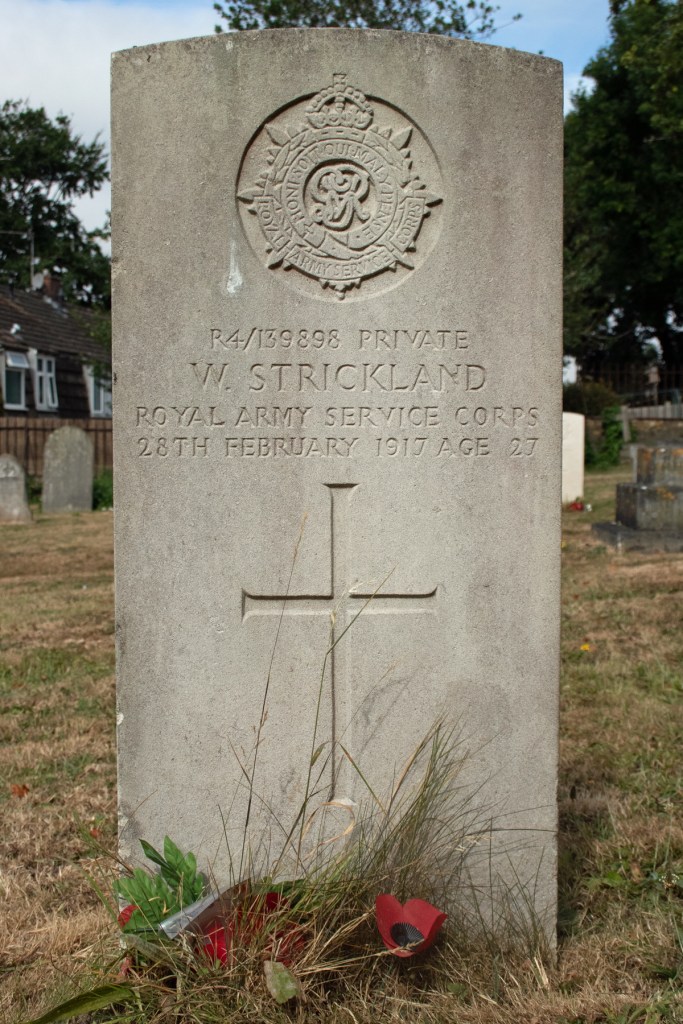
rivate Walter Strickland

Private Walter Strickland

Walter Strickland was born in 1890 in Pitminster, Somerset, the youngest of eight children to William and Sarah Strickland. William was a farm labourer, but his son found employment in the local coal mines on leaving school.

In December 1910, Walter married local woman Eliza Burton. The couple moved with Eliza’s brother and sister-in-law to Monmouthshire, where mining was the primary industry. After a couple of years, the young couple moved back to Somerset and went on to have a son, Wilfred, who was born in 1913. Walter had found other work, by this time, and was employed as a groom.

Storm clouds were brewing over Europe, and Walter enlisted in September 1915. He was assigned to the Royal Army Service Corps and given the rank of Private. His service records show that he was 5ft 6ins (1.67m) in height, and had a 35in (89cm) chest measurement.

Details of Private Strickland’s military service are limited. It seems likely that he was sent overseas, but that cannot be confirmed. By the start of 1917, however, he was back in England, and had been admitted to the Royal Victoria Hospital in Netley, near Southampton. He was suffering from an exophthalmic goitre – also known as Grave’s Disease – which results in heart palpitations, and an enlargement of the thyroid gland.

Sadly, this was an illness to which Private Strickland was to succumb: he passed away in the hospital on 28th February 1917, Eliza by his side. He was just 27 years of age.

Walter Strickland’s body was brought back to Somerset for burial. He was laid to rest in the graveyard of All Saints’ Church in his now home town of Norton Fitzwarren.


Private William Pole

Private William Pole

William James Pole was born on 22nd July 1892 in the Somerset village of Halse. He was the third of six children to shepherd and farm labourer William Pole and his wife, Harriet. When he left school, William Jr also found work on a relative’s farm in Herefordshire.

William Jr was still working on the farm when war broke out. He enlisted in the spring of 1915, joining the Royal Army Service Corps as a Private. There is no evidence of whether he served overseas, although it seems likely that he would have done, if only for a short while.

By September 1915, however, he was back on English soil, having been admitted to Netley Hospital in Southampton, suffering from enteric fever, also known as typhoid. Sadly, his illness was to get the better of him, and he passed away in the medical facility on 12th September 1915. He was just 23 years of age.

William James Pole’s body was brought back to Somerset for burial. He lies in the graveyard of St James’ Church, Halse. His parents would also be buried there: William Sr in 1935, and Harriet in 1949.


Private Cyril Pratt

Private Cyril Pratt

Cyril Robert Pratt was born on 31st October 1899 in the Somerset village of Halse. The younger of two children, his parents were local baker Robert Pratt and his wife, Elizabeth.

Little information about Cyril’s early life remains. He enlisted in the army not long after his eighteenth birthday, joining the Royal Warwickshire Regiment as a Private in November 1917. He was sent to Salisbury Plain for training, and was barracked in Larkhill, just north of Stonehenge.

Sadly, this seems to have been Private Pratt’s undoing. As with numerous other soldiers at the time, being billeted in cramped quarters with other men from across the country meant that disease was quick to spread. During his first winter at the camp, Cyril contracted pneumonia, and was admitted to the local Fargo Hospital. The lung condition was to get the better of him, and he passed away on 28th February 1918, at the age of just 18 years old.

Cyril Robert Pratt was brought back to Somerset for burial. He was laid to rest in the graveyard of St James’ Church in his home village, Halse.


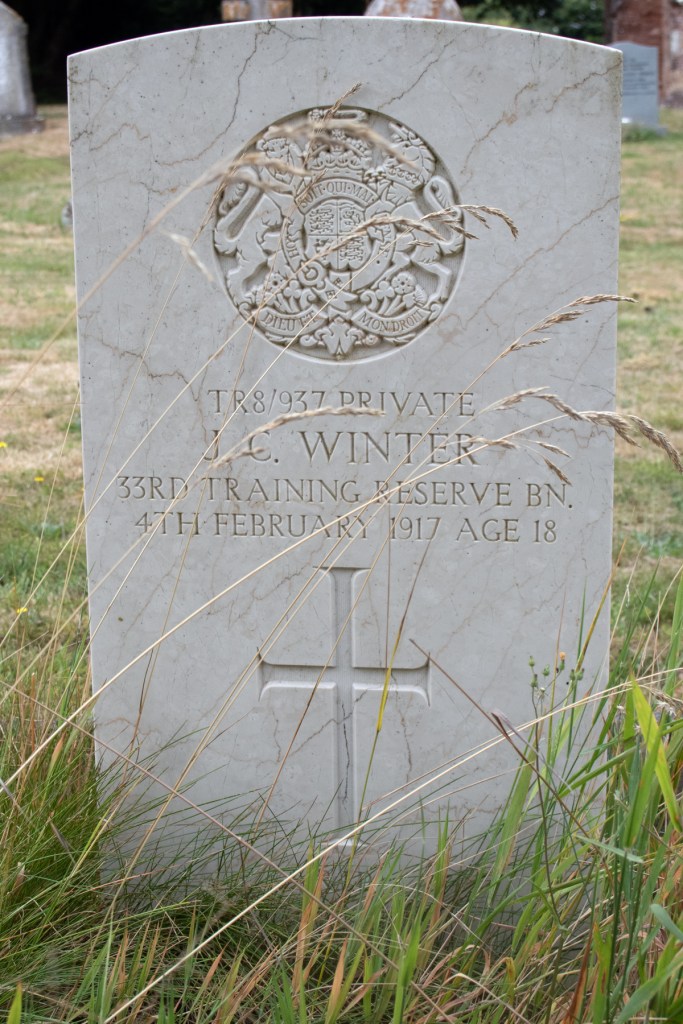
Private John Winter

Private John Winter

John Charles Winter was born in the summer of 1898, the younger of two children to James and Henrietta Winter. James was an agricultural labourer and carter from the village of Oake in Somerset. Henrietta had been born in Ontario in the USA, and was the daughter of English immigrants.

Little is documented about John’s early life. The 1911 census shows him living with his parents and his mother’s widowed brother, an army pensioner. At 12 years old, John was still at school.

War was coming to Europe by this point, and, as soon as he was able to (and probably encouraged by his uncle), John enlisted. He joined the 33rd Training Reserve Battalion, which was connected to the Warwickshire Regiment, at some point after August 1916.

Again, the details of his military service are scarce, but it seems that he soon fell ill, presumably from one of the medical conditions that tend to run rife in barracks crowded with men from across the country. The illness was to get the better of him and, on 4th February 1917, Private Winter passed away. He was just 18 years of age.

John Charles Winter was laid to rest in the graveyard of St Bartholomew’s Church in his home village of Oake.


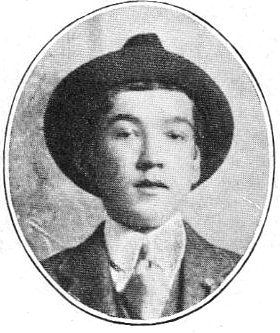
Private John Winter
(from findagrave.com)

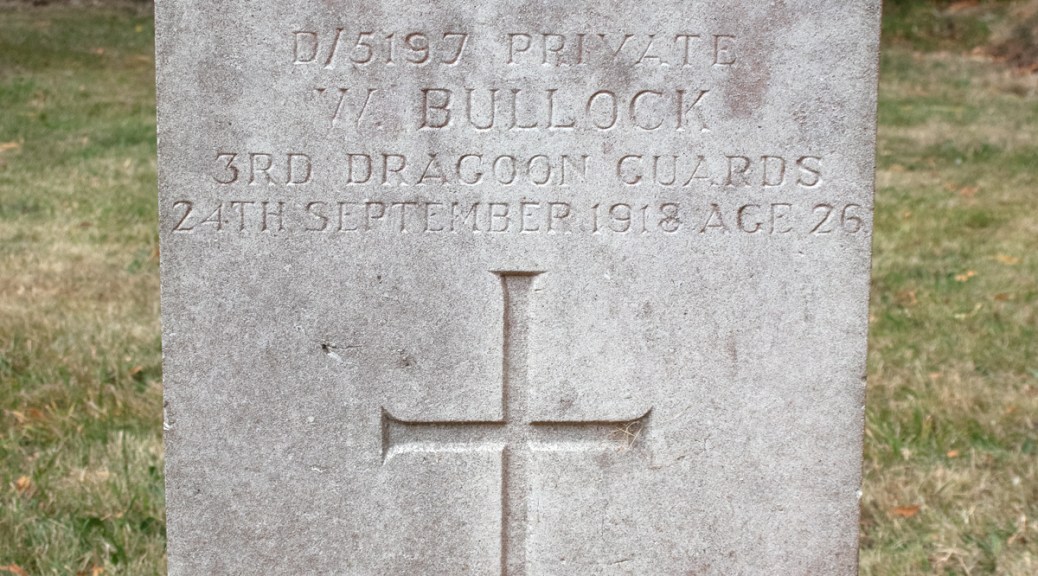
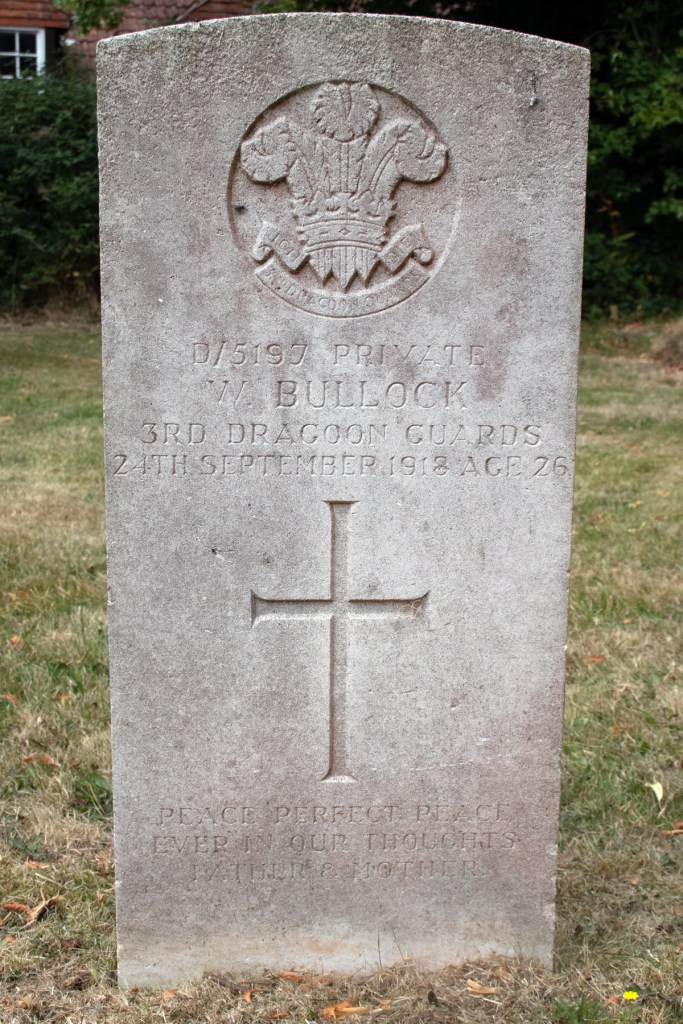
Private William Bullock

Private William Bullock

Frederick William Bullock, who was known by his middle name, was born in the spring of 1894 in the small Somerset village of Hillfarrance. His parents were Frederick and Mary, and he was one of eleven children.

Frederick Sr was an agricultural labourer, but William wanted a life of adventure, and, by 1910, he had joined the army. It seems likely that he lied about his age when he enlisted, as he would only have been 16 years of age. Assigned as a Private to the 6th Dragoon Guards (The Carabiniers), he was based in Aldershot, Hampshire. His service records show that he was 5ft 6ins (1.68m) tall, had black hair and grey eyes.

Private Bullock’s early years of service were seemingly free of incident but this was to change. On 22md January 1914, his troop were preparing to board ship to sail to Egypt, but William went AWOL. He was apprehended a week later, tried and convicted of desertion. He was imprisoned for 56 days and his previous service with the army was forfeited.

On 16th August, just a fortnight after war was declared, Private Bullock was sent to France. He spent three months on the Western Front before returning to England. In June 1915, he had transferred to the 3rd (Prince of Wales) Dragoon Guards, and was again sent to France.

William remained in France until the end of July 1916, when he fell ill and was medically evacuated to England for treatment. He was initially admitted to the 2nd Southern General Hospital in Bristol with a crumbling spine, but then transferred to the 2nd Western General Hospital in Manchester for more specialist treatment.

The condition, while not aggravated by his military service, was enough to have him medically discharged because of it. Private Bullock left the army on 28th July 1917.

At this point, William’s trail goes cold. What can be confirmed is that he passed away on 24th September 1918, at the age of 24 years old. He was laid to rest in the graveyard of St Giles’ Church in Bradford-on-Tone, a village not far from his birthplace, where his family now lived.


Private Victor Langdon

Private Victor Langdon

Victor Frank Langdon was born in the autumn of 1897, the only child to Francis and Martha Langdon. Frank was a carter and cowman from Clatworthy in Devon, but it was in Bradford-on-Tone in neighbouring Somerset that Victor was raised.

Victor was 16 years old when war was declared, but he was still keen to play his part. While full details of his military service are not available, he initially enlisted in the Hampshire Yeomanry, before transferring across to the 15th (Service) Battalion of the Hampshire Regiment in 1917.

Records suggest that Private Langdon served as part of a territorial force and, by the summer of 1918, was based in Norfolk. It was here that he fell ill, and, while in the camp hospital on 15th June 1918, he passed away. Details of his condition are lost to time, but it was noted as “disease”. He was just 21 years of age.

Victor Frank Langdon was brought back to Somerset for burial. He lies at rest in the graveyard of St Giles’ Church, in his home town of Bradford-on-Tone.


Private Robert Creasey

Private Robert Creasey

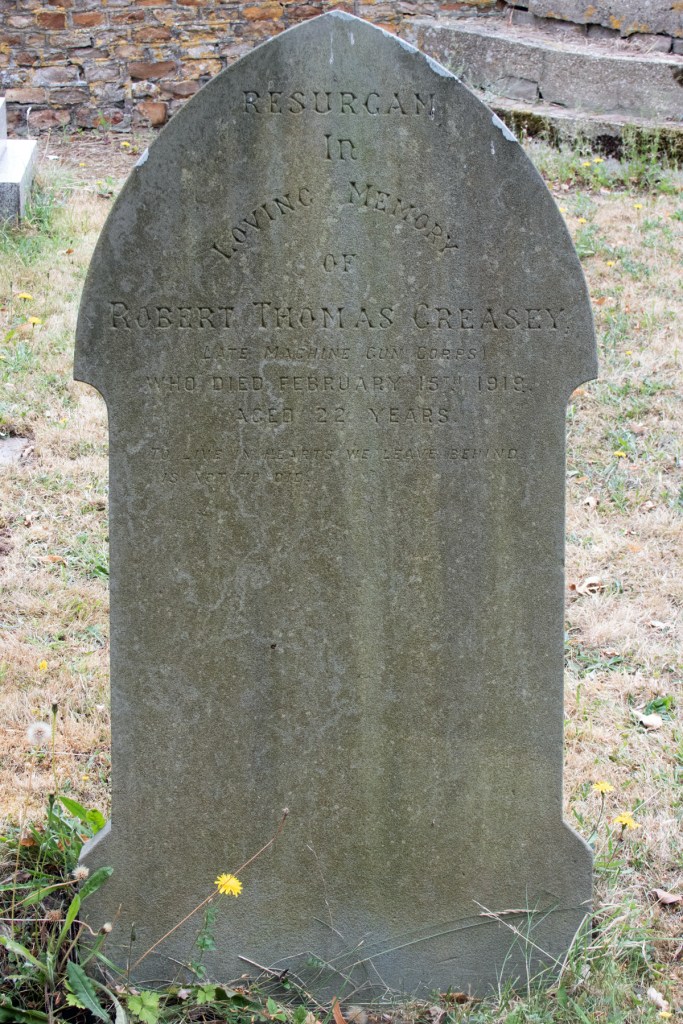
Robert Thomas Creasey (also known as Thomas Robert Creasey) was born in the village of Ash, near Farnham in Surrey, on 3rd January 1896. He was the youngest of four children to Edwin and Elizabeth Creasey. Edwin was the landlord of the Standard of England public house in the village.

When he died in 1902, Elizabeth moved her family to Somerset, where she had been born and where she still had relatives living. With four young children to raise, she married again in April 1903, to local dairy farmer Frederick Gould.

Robert was working as a farmer when war was declared, but was one of the first to step forward and volunteer. He enlisted in the Somerset Light Infantry and in the autumn of 1915 was involved in the fighting in Gallipoli.

In July 1916 Private Creasey transferred to the Machine Gun Corps. Sadly, little further information about his military life is available, but he survived the war, and returned home to Somerset on furlough, before being demobbed.

This is where Robert’s trail ends. He passed away at home on 15th February 1919, presumably from one of the lung conditions running rampant across a war-torn continent. He was just 23 years of age.

Robert Thomas Creasey was laid to rest in the graveyard of St Michael and All Angel’s Church in Angersleigh, Somerset, not far from where his mother lived.


Private Tom Simmons

Private Tom Simmons

Tom Simmons was born early in 1889, one of fourteen children to William and Elizabeth Simmons. William was a farm labourer from Devon, who had moved to Runnington, near Wellington in Somerset, with Elizabeth in the late 1880s. This was where their growing family was born and raised.

Tom found work away from Somerset when he left school and, by the time of the 1911 census, he was lodging in a house in Llanwonno, Glamorgan. He was employed as an assistant machine repairer at the local colliery.

War was beginning to encroach on England’s shores, and Tom was to play his part. Full service details are not available, but he enlisted in the Royal Army Service Corps and served as part of a territorial force. For the part he played, he was awarded the Victory and British Medals and the Silver War Badge.

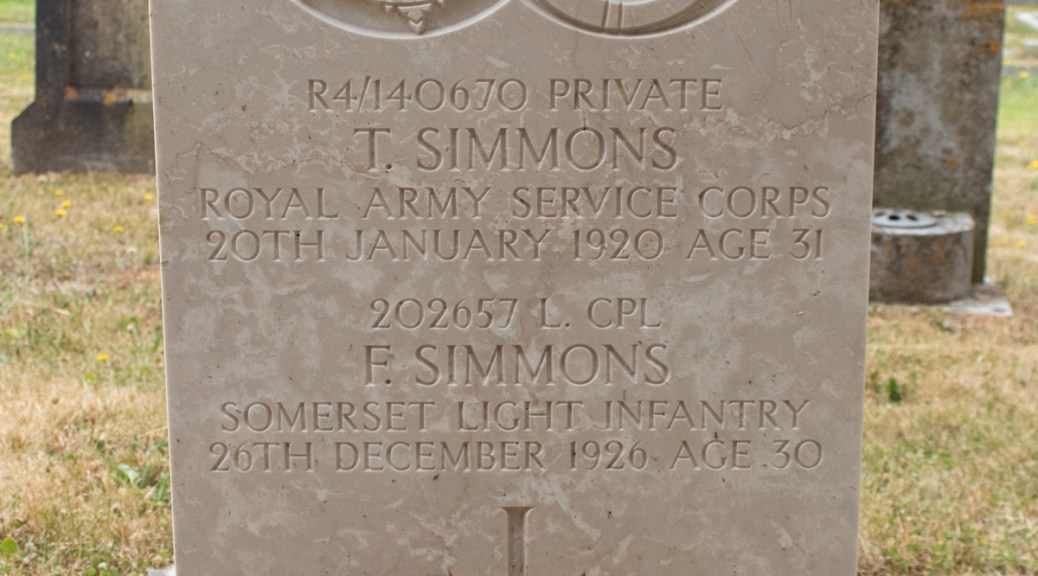
It would seem that Private Simmons survived the war and was demobbed, returning to Somerset at some point by the end of 1919. Sadly, his trail goes cold: the next record available is of his death – through causes unspecified – at home on 20th January 1920, at the age of 31 years old.

Tom was buried in Wellington Cemetery, not far from his family home.


Tom’s headstone also includes a dedication to a Lance Corporal F Simmons.

Frederick Simmons was seven years younger than his brother. When he left school, he worked as a wool spinner in the local wool mill. When war came to Europe, he too played his part. Again, full details of his service are sketchy, but he enlisted in the Somerset Light Infantry.

Like Tom, Frederick served as part of the territorial force, and worked his way to the rank of Lance Corporal. After the war he returned home, but his life there was not set to be a long one. He passed away, through causes not noted, on 26th December 1926. He was just 30 years of age.

Frederick was laid to rest in the same grave as his brother. Technically not entitled to an official Commonwealth War Grave (the rules are laid out here), his service was remembered alongside that of Tom’s.


Private Bernard Lane

Private Bernard Lane

Bernard Fred Lane was born in Wellington, Somerset, in the spring of 1880, and was the oldest of nine children to Frederick and Agnes Lane. Frederick was a house painter and, after a stint as a butcher, his son followed the same work. By the time of the 1901 census he was one of four boarders with the Hapgood family, living in Bournemouth, Dorset.

On 5th October 1901, Bernard married Annie Louisa Joyner. The couple wed in St Paul’s Church in Poole, but soon settled back in Wellington, and went on to have four children: Agnes, James, Mildred and Winifred.

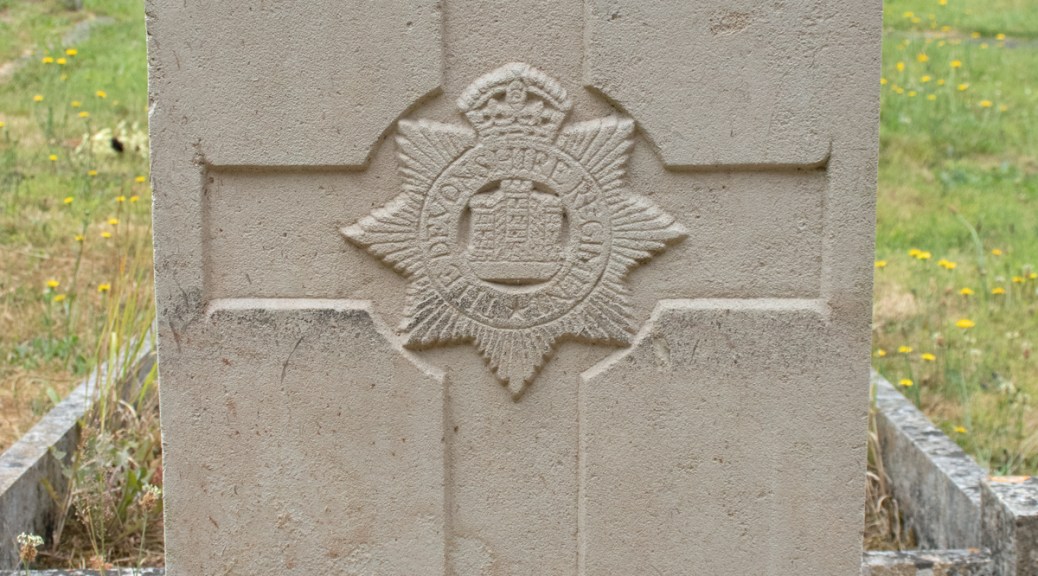
War came to Europe in 1914, and Bernard wanted to play his part. Full details of his military service are not available, but it is clear that he had enlisted in the Devonshire Regiment by March 1918. At some point during the conflict Private Lane was assigned to the Labour Corps, and attached to the 312th Company.

Bernard was serving on Salisbury Plain by the autumn of 1918, and fell ill, although it is not clear what befell him. Admitted to the Fargo Military Hospital at Larkhill, Wiltshire, he passed away on 15th October 1918. He was 38 years of age.

Bernard Fred Lane was brought back to Somerset for burial. He was laid to rest in Wellington Cemetery, the resting place for several other members of his family.


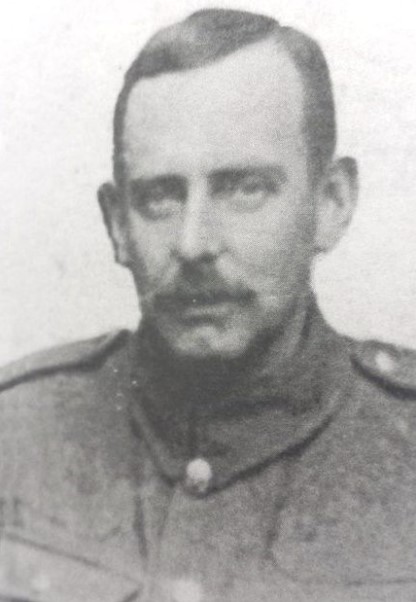
Private Bernard Lane
(from findagrave.com)