Category Archives: Rifleman

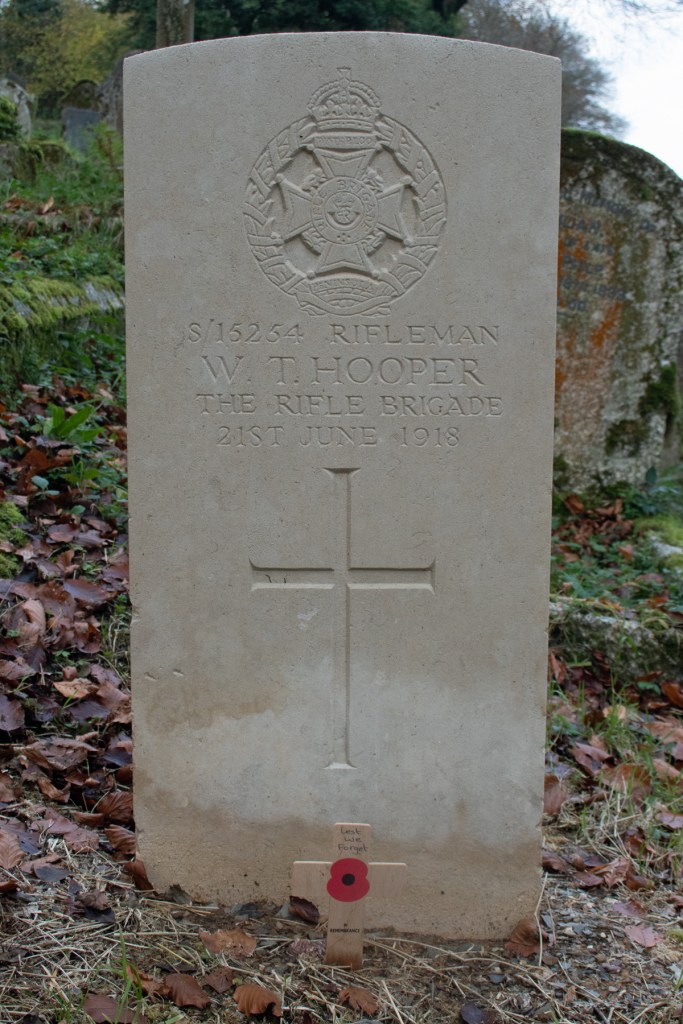
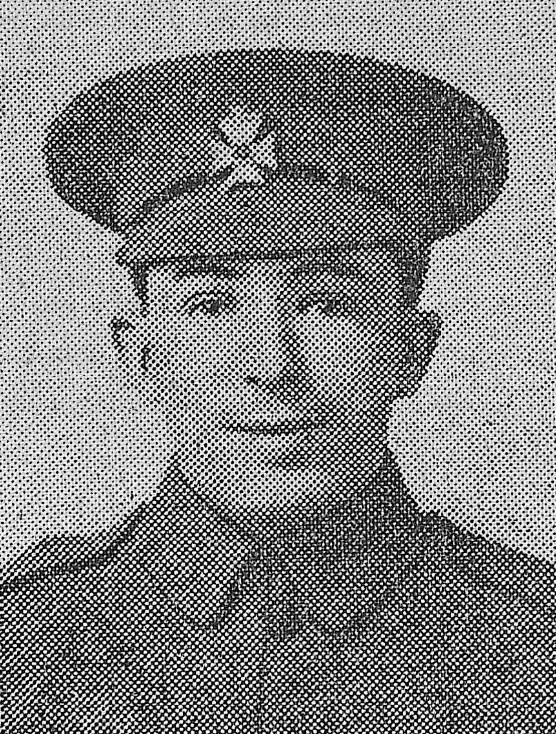
Rifleman William Hooper

Rifleman William Hooper

William Thomas Hooper was born in St Breock, near Wadebridge, Cornwall, in the summer of 1890. One of three children his parents were gardener William Hooper and his wife, Sarah.

When he left school, William Jr found work as a warehouseman and salesman, up in London, but when war broke out, he stepped up to play his part. He enlisted in December 1915, joining the Rifle Brigade, but was not formally mobilised for another couple of months.

Little detail of Rifleman Hooper’s military service survives, but records confirm that he was 5ft 6ins (1.68m) tall, and weighed 124lbs (56.3kg). It also notes that his left testicle had not descended, but that his condition was not severe enough for William to be refused for military service.

Rifleman Hooper’s was initially assigned to the 5th Battalion, based on the Isle of Sheppey, Kent, as part of the Thames & Medway Garrison. By the spring of 1916, however, he had been transferred to the 1st Battalion, and sent to France. He was involved in the Battle of Albert, and returned to the UK in August 1916 .

William appears to have been transferred back to the 5th Battalion and, in the spring of 1917, was hospitalised for three month, suffering from trench foot and rheumatism. By September that year, however, he was back with his unit.

Rifleman Hooper’s service documents become a little confused at this point. One record suggests that he was discharged from the army on 2nd January 1918 as being no longer medically fit for duty, while a second entry confirms that he passed away while on leave pending discharge.

Either way, William was back at home in St Breock when, on 21st June 1918, he passed away from a combination of pericarditis and pericardial effusion. He was just 27 years of age.

William Thomas Hooper was laid to rest in the wooded graveyard of St Breoke’s Church, in his home village.


An entry in the local newspaper confirmed that “Mr and Mrs Hooper and family… and Miss Ive Jones, London” [Cornish Guardian: Friday 18th June 1918] offered their thanks for the sympathy they had been shown in the bereavement. This suggests that, when he passed, William had been courting, his loss felt further.


Rifleman William Locke

Rifleman William Locke

William Thomas Locke was born at the start of 1900 in the Kent village of Eccles. His parents were Thomas and Annie Locke, although it seems that he was orphaned early on. The 1901 census recorded him as living with his grandparents John and Mary Locke. Their daughter Annie is also recorded as living at the property, although there is nothing to confirm whether she was William’s mother or an aunt.

By the time of the 1911 census John Locke had died. Mary was living in the same house, with two of her sons – Frederick and Alfred – and her grandchildren, William and his cousin Gladys. Both of William’s uncles were labourers in the local cement works, and it seems likely that this would be work that he would have followed them into once he had completed school.

William’s trail goes cold at this point, although he would have been too young to join up at the outbreak of the First World War. Records confirm that he had enlisted by March 1918, and it seems likely that he would have done so as soon as he came of age.

Rifleman Locke joined the 5th Battalion of the King’s (Liverpool Regiment), but this is the only detail of his military service that can be confirmed. The next record for him confirms that he passed away on 5th October 1918, having been admitted to hospital in Oswestry, Shropshire, suffering from intestinal problems. He was just 18 years old when he passed.

William Thomas Locke’s body was brought back to Kent for burial. He was laid to rest in the graveyard of St Peter & St Paul’s Church in Aylesford, the parish church for his home village of Eccles.

The specific location of William’s grave is not known, although it is likely that he was laid to rest near his grandfather. Instead, he is commemorated on a joint headstone in the First World War section of the graveyard. William’s grandmother passed away the following year, and records confirm that his next of kin was noted as his aunt, Mary Ann Longley.


Rifleman Frederick Avards

Rifleman Frederick Avards

Frederick John Avards was born in Lamberhurst, Kent, in the summer of 1891. The oldest of three children, his parents were Frederick and Lucy Avards. Frederick Sr was a licenced publican and went on to run the Beckingford Arms in Tovil, near Maidstone.

Frederick Jr helped his father with the business, but when war came to Europe, he stepped up to play his part. He enlisted on 1st January 1915, joining the 7th (Service) Battalion of the King’s Royal Rifle Corps.

Rifleman Avards was sent to France on 19th May 1915 and very quickly found himself in the thick of things. Based on the Western Front, his regiment was involved in a number of skirmishes during the Battle of the Somme.

Last week [Rifleman Avards’] parents received a telegram stating that he was lying at the Royal Victoria Hospital, Netley, dangerously wounded. They at once proceeded to Netley but only to find that he had passed away.. Meanwhile his lieutenant, knowing he had been hit and thinking he had been killed on the battlefield, had written a feeling letter to the parents, saying his gallantly he had done his duty and that he had died a true rifleman’s death in the hour of victory, and worthily upheld the name of his regiment.

Kent Messenger & Gravesend Telegraph: Saturday 9th September 1916

Rifleman John Avards had passed away from his injuries on 3rd August 1916: he was just 24 years of age. His body was brought back to Kent for burial and he was laid to rest in the graveyard of St Peter & St Paul’s Church in Aylesford, Kent, not far from the Lower Bell public house, which his parents were then running.


Rifleman Frederick Avards
(from britishnewspaperarchive.co.uk)

While buried in the churchyard, the location of Frederick’s grave is not known. Instead, he is commemorated on a joint headstone in the First World War section of the graveyard.


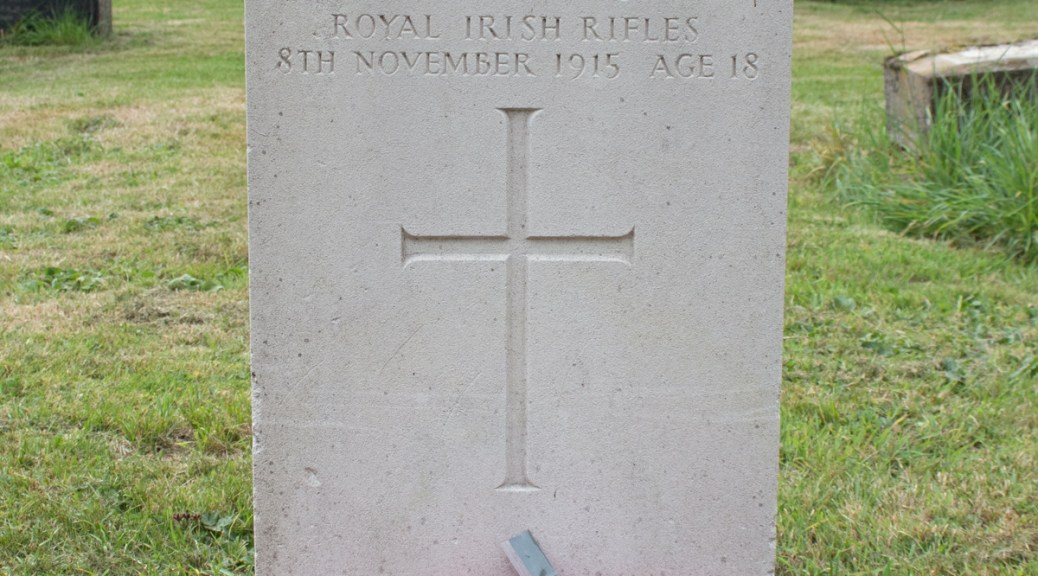
Rifleman Joseph Collins

Rifleman Joseph Collins

Much of Joseph Collins’ life is destined to remain a mystery. He was born in Northern Ireland on 8th November 1897, and was the son of William and Minnie Collins, who lived near Lurgan, in Armargh.

When war broke out, Joseph enlisted, joining the 16th (Service) Battalion – the 2nd County Down Pioneers – of the Royal Irish Rifles. Formed in Lurgan, the regiment moved from Northern Ireland to Seaford in East Sussex in July 1915. By that October, Rifleman Collins found himself on the Front Line in Northern France.

Joseph was invalided on 26th October, and medically evacuated to Britain for treatment. Admitted to the Brynkinalt Hospital in Chirk, Denbighshire, he was operated on, but this was to prove insufficient, and he passed away from his injuries on 8th November 1915 – his eighteenth birthday.

Rifleman Collins was well thought of in his regiment, as the comments in the Lurgan Mail [Saturday 20th November 1915] confirmed. Captain HF Sheppard, who commanded Joseph’s Company, noted “I need hardly say I was shocked, as I thought when he left us that the operation necessary for his complaint was certain to prove successful. I had always been attracted by his cheerful temperament, and I was always keenly interested in him as he was one of the first to join my Company.

Lieutenant E Somerfield noted that Joseph “was a great favourite with the rest of his platoon, and a boy I had great regard for. I can assure you we all feel his loss very keenly.

The most touching comments, however, come from one of Joseph’s colleagues, Rifleman R McKeown: “I am sending you these few lines to let you know I got a letter today which Joe wrote before he died. The nurse found it in his locker and sent it on to me I am sending you a copy of it and the nurse’s letter. I was never so badly struck in my life as when I heard of his death, for his could not have grieved me more has it been my own brother. The day he went away I never got bidding him good-bye, for the morning he went on the sick list I was on parade, and when I came in he was away. The boys in the platoon and company he was in were all greatly grieved at hearing about his death. You have my sincerest sympathy in your trouble. I don’t know how I am ever going to go home – if I ever do – without him. He was like a brother to me.

Unable to bring their son back to Ireland, William and Minnie had to be content with the fact that their son was given a military funeral in the town where he died. Joseph Collins was laid to rest in the graveyard of St Mary’s Church in Chirk.


Serjeant Frank Ely

Serjeant Frank Ely

Frank Harold Ely was born in November 1889, and was the oldest of four children. His parents were coal porter Frank Ely and his wife, Florence. They were both born in Kent, and raised their family in their home town of Faversham.

When Frank Jr left school, he found work as a bottler, but he had his eyes set on bigger adventures. In January 1908, at the age of 18, he enlisted in the 1st Battalion of the Rifle Brigade. His service records show that he was 5ft 5.5ins (1.66m) tall and weighed 109lbs (49.5kg). Rifleman Ely had brown hair, grey eyes and a fair complexion. He was also noted as having a scat on his right knee.

Rifleman Ely’s early service was wholly territorial, but not without incident: in 1909 he was treated for tonsillitis, two years later, he received treatment for syphilis.

He was also not one to toe the line. In August 1911, he was reprimanded for not appearing at the 6:30am parade. On 9th March 1912, he was severely reprimanded for ‘improper conduct in town, at about 11:35pm’. On 25th September 1913, he was reprimanded once again, this time for irregular conduct – using the officers’ latrines.

When war came to Europe, the Rifle Brigade were soon in the thick of it. On 26th August 1914, Frank was wounded in the hand during fighting at Ligny, France, and was then captured and held as a prisoner of war in Hamelin until the spring of 1918.

Moved to the Netherlands, Rifleman Ely was finally released after the Armistice was signed, and returned to England on 19th November 1918. He was demobbed the following March, but re-enlisted within weeks, was given the rank of Serjeant and was due to be shipped to India to continue his service.

However, while at an army camp in Aldershot, Frank contracted pneumonia. The struggles the previous few years had had on his health proved too much for him, and, on 26th August 1919 – five years to the day that he had been shot and captured – Serjeant Ely passed away. He was 40 years of age.

Frank Harold Ely was brought back to his home town for burial. He was laid to rest in Faversham Borough Cemetery.


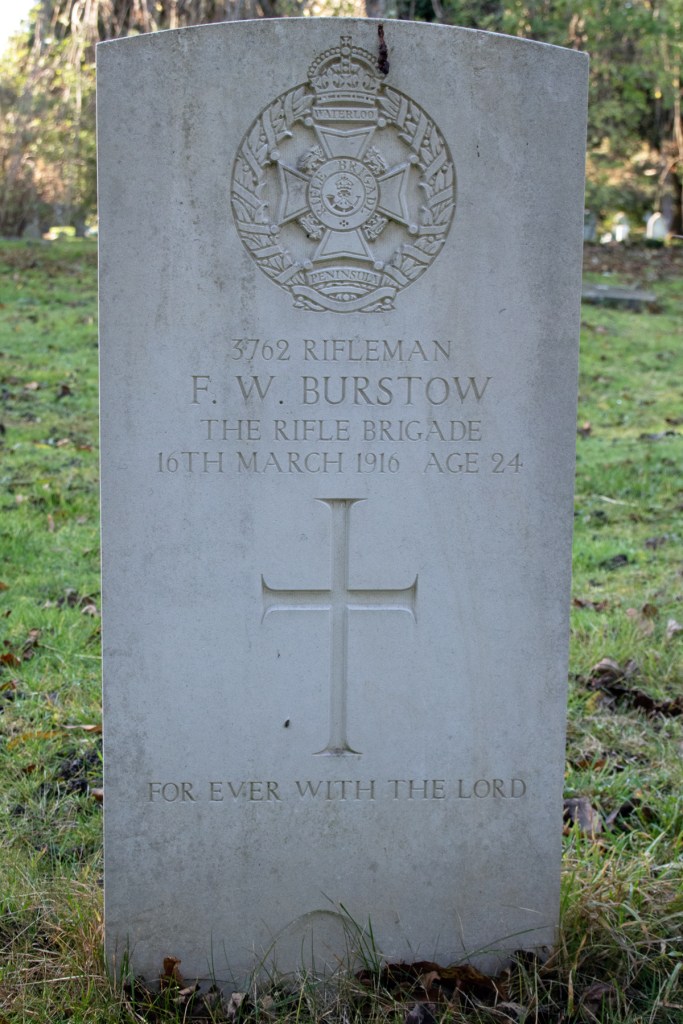
Rifleman Frederick Burstow

Rifleman Frederick Burstow

Frederick William Burstow was born in the summer of 1893, and was one of thirteen children. His parents were plasterer Alfred Burstow and his wife, Lydia. Both came from Sussex, and it was in Bexhill-on-Sea where they raised their family.

There is little documented about Frederick’s early life, but he sought a life outside of Sussex and, in around 1900, he enlisted in the 2nd Battalion of the Rifle Brigade, serving in India for a time.

Rifleman Burstow was still serving when, in August 1914, war was declared. His battalion was sent to France that November, and he ended up serving two terms on the Western Front.

In the summer of 1915, Frederick married Priscilla Epps. She was from Faversham, Kent, and this is where the couple set up home together.

It was while on his second term in France that Rifleman Burstow became ill. He had contracted enteric fever – also known as typhoid – and, at the beginning of 1916, he was sent home to recuperate. While here, Priscilla gave birth to a child, Alice.

Sadly, however, Frederick’s condition was to get the better of him: he passed away at home on 16th March 1916, at the age of just 24 years old.

Frederick William Burstow was laid to rest in the Borough Cemetery in his adopted home town of Faversham.


Rifleman Frederick Burstow
(from ancestry.co.uk)

Frederick was not the only Burstow family member to die during the war. His older brother, Arthur Edward James Burstow, fought on the Western Front with the 2nd Battalion of the London Regiment.

Private Burstow was caught up in the fighting in Arras in the spring of 1918, and was killed in action on 13th April. He was 38 years of age, and left behind a widow and six children.

Arthur Edward James Burstow is commemorated on the Ploegsteert Memorial in Belgium.


Rifleman Bert Burridge

Rifleman Bert Burridge

Bert Burridge was born in the spring of 1893, one of nine children to Charles and Elizabeth. Charles was a journeyman shoemaker from Crediton in Devon, and this is where Bert was born. By the time of the 1901 census, however, the family had moved south to Newton Abbot.

When Bert left school, he found work as a carriage cleaner for the railways; he soon moved out, and boarded with a family in Kingsbridge, in the south of the county.

War was coming to England’s shores, however, and Bert was keen to play his part. He enlisted in the 4th Battalion of the King’s Royal Rifle Corps as a Rifleman on 16th January 1912. His service records show that he stood 5ft 4ins (1.63m) tall, and weighed 121lbs (55kg). He had a fresh complexion, grey eyes, dark brown hair, and a tattoo on right wrist of two crossed hands.

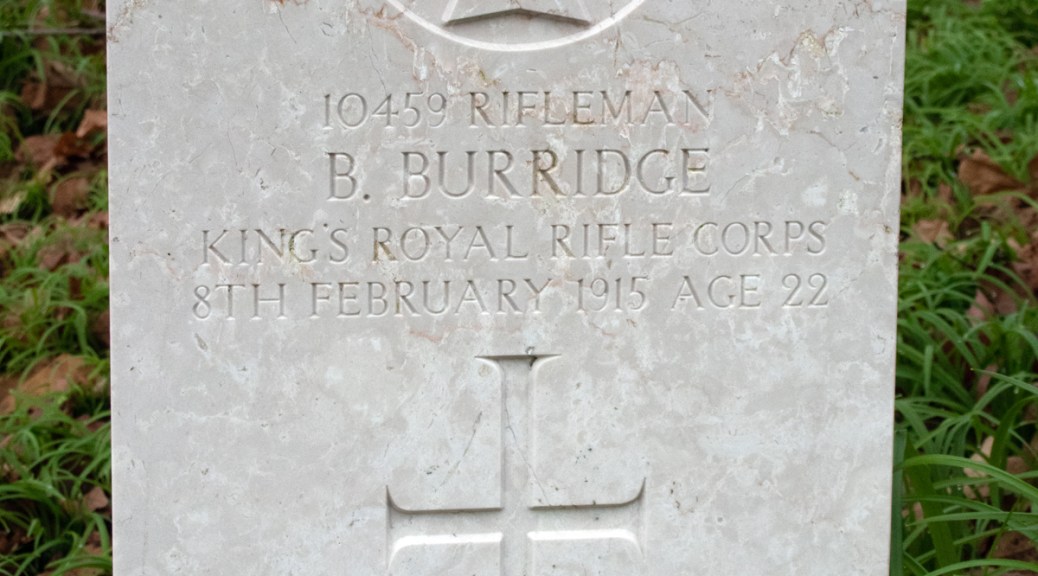
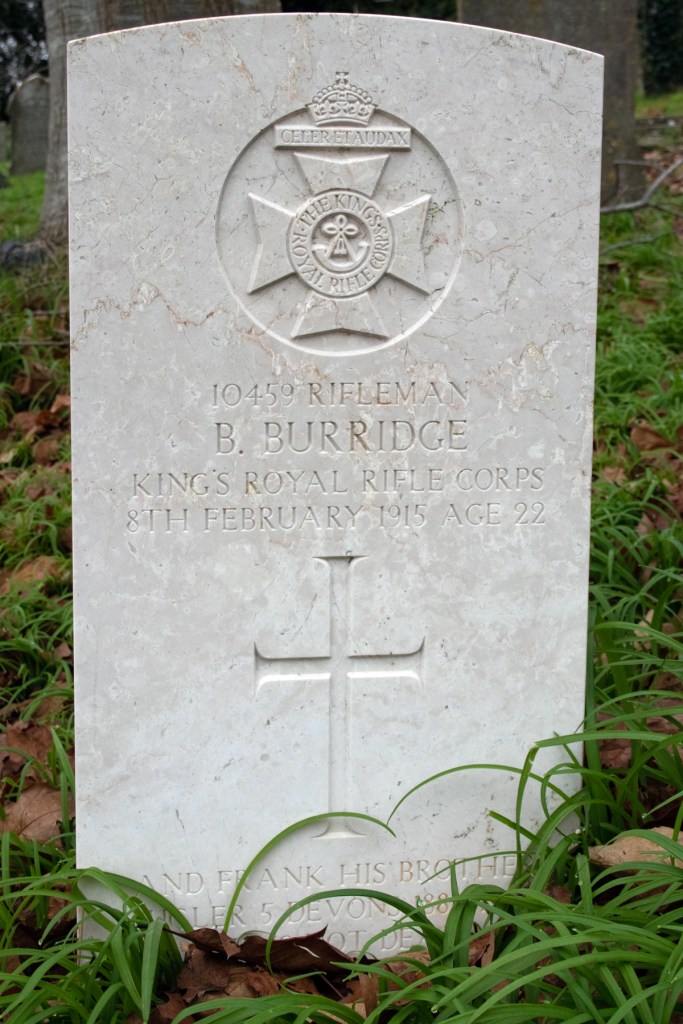
When war broke out, Rifleman Burridge was sent to France and was caught up in the fighting early on. After three months at the front, during the winter of 1914, he contracted frostbite, and was medically evacuated back to England. He was admitted to the 2nd Eastern General Hospital in Brighton, but died of injuries on 9th February 1915. He was just 22 years of age.

Bert Burridge’s body was brought back to Devon for burial. He was laid to rest in the graveyard of St Mary’s Church in Wolborough, on the outskirts of Newton Abbot.


Bert’s headstone also includes a commemoration to his older brother, Frank. Seven years older than Bert, he had enlisted in the Devonshire Regiment as a Bugler when quite young. He passed away in the autumn of 1906, aged just 20, but further details are unclear.


Rifleman Frederick Partridge

Rifleman Frederick Partridge

Frederick George Partridge was born on 26th May 1890 in Kingsteignton, Devon. He was one of ten children to clay cutter George Partridge and his wife, Anna. George passed away in 1903, but Frederick left school, and also found work as a cutter, helping to pay his way at home.

When was came to Europe, Frederick was keen to play his part. He enlisted on 18th November 1915, and was assigned to the King’s Royal Rifle Corps as a Rifleman. His service records show that he stood 5ft 9ins (1.75m) tall and weighed 145lbs (66kg). He was of good physical development, but had slightly flat feet.

After his initial training, Rifleman Partridge was sent to France, arriving in April 1916. His regiment soon found itself on the front line and, that summer, was firmly ensconced at the Somme. Sadly, Frederick was not to escape injury – he received a gun shot wound to his left thigh on 2nd September.

The wound was serious enough for him to be medically evacuated back to England for treatment. He was admitted to the Royal Victoria Hospital in Netley, near Southampton, but died of his injuries on 12th September 1916. He was just 26 years of age.

Frederick George Partridge was brought back to Devon for burial. He was laid to rest in the graveyard of St Michael’s Church in Kingsteignton.


Rifleman Edward Drewett

Rifleman Edward Drewett

Edward Phillips Drewett was born on 22nd September 1893 in the Somerset town of Castle Cary. He was one of four children to Richard and Martha Drewett; his mother had been widowed before marrying Richard, and had a child from that marriage, Edward’s half-sister.

Richard was a solicitor’s clerk, but when he left school Edward found employment as a grocer’s assistant. It was this that he was doing when war broke out in 1914 and, in November 1915, he joined up to do his bit for King and Country.

Edward joined the 17th Battalion of the London Regiment as a Rifleman: his service records show that he stood 5ft 7.5ins (1.71m) tall, weighed in at 9st (57.2kg) and was of good physical development.

Rifleman Drewett ended up spending three-and-a-half years in the army, and travelled a lot. After nine months on home soil, he was sent to France, Salonika, Malta and Egypt, spending between four and nine months in each place. By July 1918, he was back in France, and by Christmas that year was on home soil again.

By this point, Rifleman Drewett was unwell, and suffering from nephritis – inflamed kidneys. The condition was severe enough for him to be stood down from the army, and he was formally discharged from military service on 31st March 1919, while admitted to the Bath War Hospital.

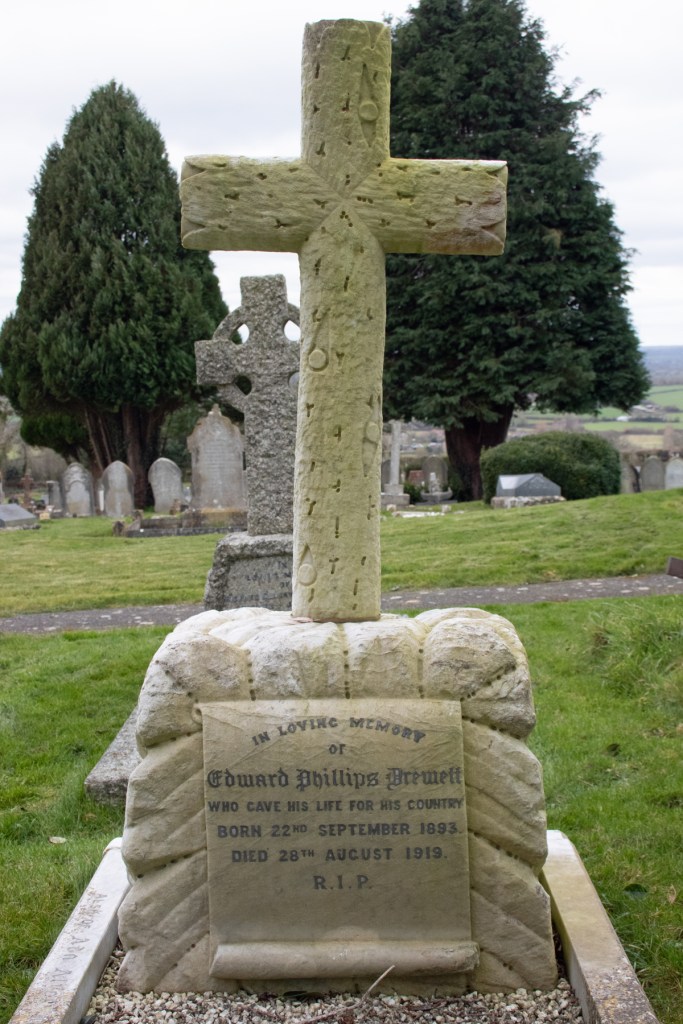
At this point, Edward’s trail goes cold. He passed away on 28th August 1919 and, while the cause is unclear, it seems likely to have been kidney-related. He was just 25 years of age.

Edward Phillips Drewett was laid to rest in the cemetery of his home town, Castle Cary.


Rifleman George Hill

Rifleman George Hill

George Hill was born in Castle Cary, Somerset, in 1868. Documents relating to his early life are hard to pin down and, as his is a common name, it is not possible to identify any parental relationships.

The first document that can be categorically connected to George is the 1891 census. This confirms that he was living in his home town, and was married to a woman called Ellen. The couple had a year-old daughter, Elsie, and were both employed as horsehair workers, getting the material ready for use in upholstery.

It seems that Ellen must have died soon after the census as, in the autumn of 1893, he married Florence Cave, a stonemason’s daughter, who was also from Castle Cary. The 1901 census finds George and Florence living with Elsie, but with two children of their own, Laura and Edward.

By the time of the following census, in 1911, the family had grown again, with two more children, Percy and Doris. George’s eldest daughter was, at this point, working as a housemaid for a family in Winchester, while Laura was employed as a tailoress. George himself was still working as a horsehair curler, a trade he had been in for more than twenty years.

War was on its way, and despite being in his mid-forties, George appeared to have been keen to play his part. Full details are not available, but it seems that he had enlisted by May 1918, initially joining the Somerset Light Infantry, where he was assigned to the 4th Battalion. He was soon transferred over to the Rifle Brigade, however, and was attached to the 22nd (Wessex and Welsh) Battalion.

This particular troop initially served on home soil but was sent to Salonika in the Eastern Mediterranean in 1916. There is nothing in Rifleman Hill’s records to suggest that he went with them, however, and it may be that he had not yet enlisted at this point in the conflict. His medal records show that he was awarded the Victory and British Medals, but that these were for his territorial work, rather than anything overseas.

Rifleman Hill served until near the end of the war. He had returned home by November 1918, and it was here, on the 9th, that he passed away from pneumonia. He was 52 years of age.

George Hill was buried in the cemetery of his home town, in the family plot. Florence was also laid to rest there, some eighteen years later, husband and wife together again at last.