Tag Archives: 1914

Able Seaman Melville Franklin

Able Seaman Melville Franklin

Melville Franklin was born on 25th November 1890, the youngest of seven children to Edmund and Alice Franklin. Edmund had been born in Birmingham, and had taken up holy orders. He and Alice married in the UK, but their first born, a boy called Victor, had been born in Australia, while their second child, another son called Harold, had been born a year later in Birmingham.

By the late 1880s, Reverend Franklin had taken up the post of vicar of St Nicholas’ Church in Whitchurch, near Bristol, and the family moved there. Unsurprisingly, the parish record for both Melville and his older sister Elsie, both of whom had been born in the village, shows they were baptised in the church by their father.

The Franklin children’s upbringing stood them in good stead in life. The 1901 census found that Victor and Harold had both found work as clerks – Victor for a timber merchant, and Harold for an oil cake merchant – while the following census, in 1911, recorded that another brother, Percival, was a motor expert for an insurance company. Melville, aged 20 by this point, had also found employment as a clerk, his employer being a wine merchant.

Melville wanted to expand his horizons further and, on 25th February 1911, he joined the Royal Naval Volunteer Reserve. His service records are sparse, but they confirm that he was 6ft 1ins (1.85m) tall, had fair hair, grey eyes and a fresh complexion.

Melville was formally mobilised on 22nd August 1914. At this early point in the war, there was a surplus of more than 20,000 men from the Royal Naval Volunteer Reserve, and the powers that be recognised that this was enough to form three brigades of land troops – one of Marines and two Naval.

Able Seaman Franklin was assigned to the Collingwood Battalion of the Royal Naval Division, and appears to have found himself heading to Belgium via Dunkirk by the late summer.

In the general rush to get men to the front line, more than three quarters of the troops went without even the most basic of equipment – packs, mess tins, water bottles.

The Division had no artillery, field ambulances or other support. Melville’s brigade was provided with old rifles, which they were given just three days before embarking for Europe.

Able Seaman Franklin landed in Antwerp shortly before the German invasion, and in the retreat, more than 1500 troops were captured and interned in the Netherlands. Melville, it would seem, was one of those who managed to escape back to England.

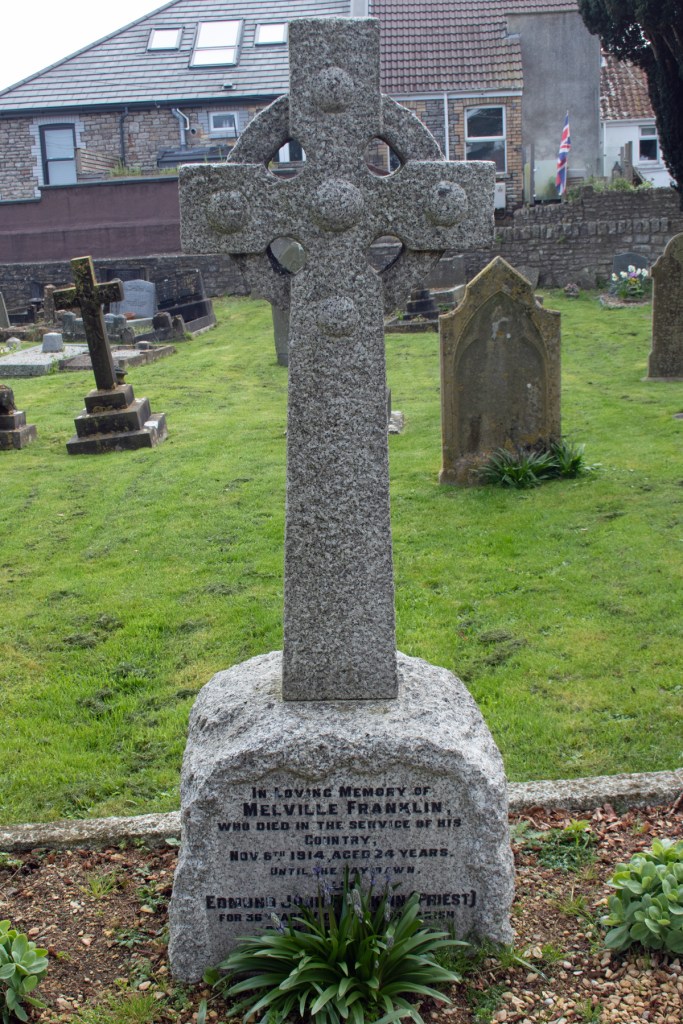
This was only to be a very temporary reprieve for Able Seaman Franklin, however. He had returned to Bristol, but had contracted enteric fever, also known as typhoid. This was to get the better of him, and he succumbed to it on 6th November 1914. He was weeks away from his 24th birthday.

Melville Franklin was laid to rest in the graveyard of St Nicholas’ Church, Whitchurch, in a funeral likely to have been presided over by his father, Edmund.


Private Albert Townsend

Private Albert Townsend

Albert Henry Townsend was born on 7th November 1890 in Bath, Somerset. One of thirteen children, his parents were George and Annie Townsend. George was a painter by trade, but when he died in the autumn of 1895, Annie was left to take in laundry to earn money to support her and the four of her children still living at home.

By the time of the 1911 census, Albert was 21, and had found work as a baker. He was still living with his mother, two siblings and a nephew in a house in the centre of the city. All but Annie’s grandson were earning money by this point, and, with five rooms, the family were in a better position than some of their neighbours. Next door was Albert Smith, a coal carter, who had to support a family of ten people.

In the summer of 1914 war broke out, and within months, three of the Townsend brothers – Albert and his older brothers Arthur and Charles – had enlisted.

Arthur Townsend had joined the Duke of Cornwall’s Light Infantry earlier in the year, and within weeks of conflict being declared, he was on the Western Front. He was to be one of the early casualties of the conflict, and was killed in action during the Battle of the Marne on 9th September. He was just 29 years old and, while his body was never identified, he was commemorated on the La Ferte-sous-Jouarre Memorial.

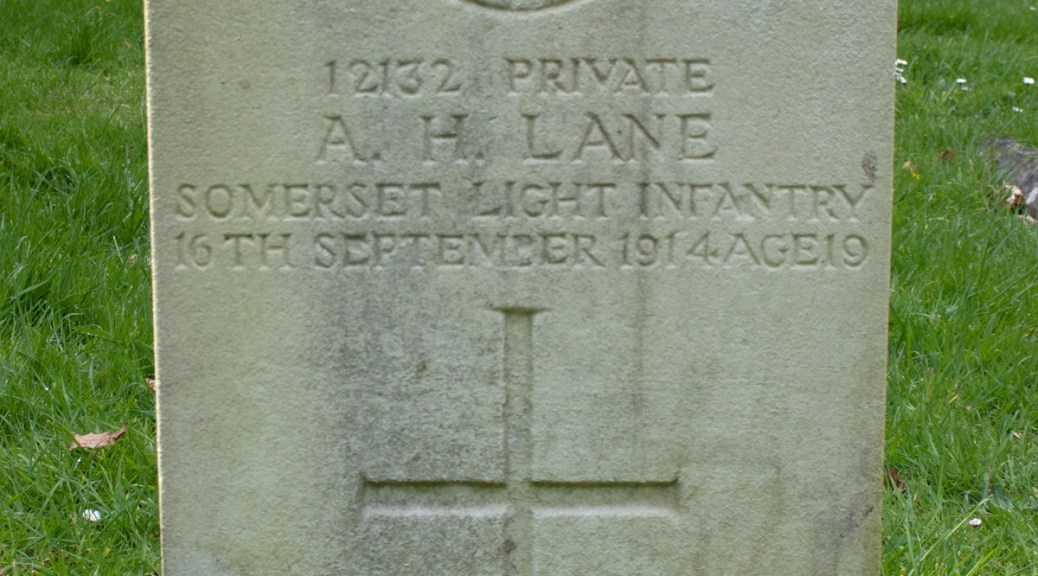
Albert’s service records have been lost to time, so it is not possible to identify when he enlisted. He joined the Somerset Light Infantry, and was assigned to the 4th Battalion, who set sail for India in October 1914. Private Townsend was not to travel with them, however as he had contracted septicaemia while camped on Salisbury Plain, Wiltshire. He was transferred to the Royal United Hospital in Bath for further treatment, but his condition was to prove too severe. He passed away while still admitted on 19th October 1914. He was just 23 years of age.

Albert Henry Townsend was laid to rest in the St James’ Cemetery in his home city, Bath.


Annie Townsend had now been a widow for nearly twenty years and, within a matter of weeks, had lost two of her sons. Tragically, the war was not done with her family yet.

Charles Townsend was still serving, having enlisted in the 8th Battalion of the Somerset Light Infantry. He arrived in France in July 1915, and over the next year, wascaught up in some of the fiercest fighting of the conflict. On 1st July 1916, the Battle of the Somme began, the darkest day in history for the British Army. Twenty thousand soldiers were killed, and Private Charles Townsend was amongst the fallen. He was just 30 years of age. He was commemorated on the Theipval Memorial.

Annie had lost a third son to the conflict in a little under two years, and her pain must have been unimaginable. She lived on until 1923, when she died at home in Bath. She was laid to rest close to her husband and Albert, a family partly reunited once more.


Private Joseph Viles

Private Joseph Viles

Joseph Viles was born at the end of 1886 in Bath, Somerset. One of seven children, his parents were collier-turned-general labourer Joseph Viles and his wife, Sarah.

When he left school, Joseph found work as an errand boy, but, in reality, there is little documented about his life. There are only really two records that give an insight into the man he became.

The first is the 1911 census, which confirms he was a Private in the 2nd Battalion of the Somerset Light Infantry. The return gives his location as the St Andrew’s Barracks in Malta.

The second document dates from 29th June 1909, and is a court martial for Private Viles’ for the use of insubordinate language towards a senior officer, in this case a Major. The trial was held in Portland, Dorset, and Joseph was sentenced to 30 days’ imprisonment.

Sadly, a lot of the service records for the Somerset Light Infantry have been lost over time, and those relating to Joseph are amongst them. The only other confirmed detail for Joseph is that of his passing, but even this raises questions.

Private Joseph Viles died on 4th August 1914 – just seven days after war was declared. His regiment was actually based in Quetta, India, at this point, so it is likely that he was at home on leave at the time he died. No cause for is death is noted, and it is likely to have been from an illness of some description, as nothing unusual was reported in the newspapers of the time. Joseph was 27 years of age.

Joseph Viles was laid to rest in Bath’s St James’ Cemetery, where his parents would also be buried, Joseph Sr in 1948, and Sarah in 1958.


Private Robert Templeton

Private Robert Templeton

Robert Muckart Templeton was born in Glasgow, Scotland, in 1894. He was the fourth of five children to shipyard labourer William Templeton and his wife, Agnes.

There is little information on Robert’s early life: the family’s 1911 census records are lost, so it is not possible to identify what work he took on when he left school. It is, however, reasonable to assume that he joined his father in the shipyards.

When war broke out, Robert was one of the first to enlist. He joined the Royal Scots Fusiliers, and, as a Private, was assigned to the 8th (Service) Battalion. His troop was sent to Salisbury Plain, Wiltshire, for training, and he was camped at Codford St Mary.

Towards the end of October, the 8th Battalion was moving to Bristol, and it was at this point that the fates intervened for Private Templeton. Suffering from an acute bout of appendicitis, he was admitted to the Abbas and Templecombe hospital. The condition was to prove his undoing and, on 1st November 1914, he passed away. He was just 20 years of age.

A shipyard labourer’s wages were not going to be enough to transport a body halfway across the country, so the Templetons were left with little choice but to have their son buried close to where he died. Robert Muckart Templeton was laid to rest in the quiet graveyard of St Mary’s Church, in Templecombe, Somerset.


Editor’s note: My gratitude goes to Christine Scott, who was able to furnish me with details of Robert’s death.

Gunner Theophilus Burdock

Gunner Theophilus Burdock

Theophilus Walter Burdock was born on 18th June 1871 in Whitminster, Gloucestershire. One of nine children, his parents were painter and decorator Nathaniel Burdock and his wife, Mary.

While he found labouring work when he left school, Theophilus – who went by his middle name, Walter – decided that he wanted bigger and better things and, on 30th December 1889, he enlisted in the Royal Artillery. His service records show that he was 5ft 5ins (1.65m) tall and weighed 115lbs (52kg). The document also records that he has a tattoo of a man, star and crown on his left forearm.

Initially assigned to the 1st Depot 2nd Battery as a Driver, over the next couple of years Walter made solid progress within the regiment. By September 1892, he was promoted to Gunner, within a couple of years he was raised to Bombardier, and by April 1895 he had made the rank of Corporal.

By his last formal year in the ranks, things seemed to take a different turn. On 9th March 1896, Corporal Burdock received a contusion to his face. He was formally transferred to the Army Reserve when his contract of service ended in December 1896, but within eighteen months he re-enlisted.

At this point, however, Corporal Burdock’s conduct began to race downhill. In August 1898 he was tried for an undisclosed reason, and his rank was reduced to Bombardier. Within a couple of months, he was tried for a second crime, and reduced in rank again, back to Gunner.

For a time Walter kept his nose clean, and, in February 1900, he was promoted back to the rank of Bombardier. This was to be only a fleeting move, however, as he reverted back to Gunner less than two months later.

Over the next couple of years, Walter generally kept his head down. On 30th April 1901 he was injured by a kick in the eye, although, again, details are tantalisingly scarce. By April 1902, his contract came to an end and this time he was stood down and formally demobbed.

Civilian life seemed to be something to which Walter was not to be destined. He enlisted again almost immediately, joining the Imperial Yeomanry in May 1902. He lasted less than a year with the regiment, however, having served ten months in South Africa.

In January 1904, was recalled to the Royal Artillery for further service in South Africa. His medical report showed the man he had become in the fifteen years since he had first joined up: he was now 5ft 7ins (1.7m) tall, and weighed 141lbs (64kg).

Private Burdock served six months on home soil, but in July 1904, he was sent to South Africa, having never actually seen any overseas service before. He returned to Britain in September 1905, and was discharged from service, specifically so that he could re-enlist with the Royal Artillery and complete his fourteen years’ service with them.

Gunner Burdock remained with the Royal Artillery until February 1906, presumably as he had finished his fourteen years. Interestingly, his discharge papers noted his conduct as ‘indifferent’.

Walter’s trail goes at this point. His mother, Annie, passed away in Gloucestershire in the spring of 1908. His father, Nathaniel, died Bristol in 1912. The next evidence for their son comes in September 1914, in attestation papers for the Canadian Expeditionary Force.

Walter was, by this point, living in Victoria, British Colombia, and working as a lumberjack. He had been unable to completely leave his army days behind him, and his service records give his year of birth as 1876, five years younger than he actually was at the time.

Those service records give similar physical characteristics to his 1904 papers, and confirm the presence of some additional tattoos: a butterfly and pair of hands with the words true love.

Walter was assigned to the Royal Canadian Horse Artillery, and given the rank of Gunner. He arrived back in Britain in October 1914, but his previous indifference seems to have recurred. He was imprisoned for a week from 21st October for having been absent without leave, and was found to be absent again at reveille on the morning of 30th October.

Yesterday afternoon the body of a man was found floating in the Avon just below Bathampton Weirs, and close to the entrance to the back-water on the Batheaston side of the river.

The body was floating face downwards some yards from the bank, and only the top of the head was visible.

The body was recovered shortly before five o’clock. It appeared to be that of a middle-aged man of medium height. The trousers had something of the appearance of a mechanic’s overall and deceased was wearing a sleeve vest.

The conjecture naturally arises whether the body is that of the missing Canadian soldier Burdock, whose clothes were discovered on the bank at Batheaston on Saturday, October 31st, and of whom nothing has been heard since. Burdock was a member of the Canadian contingent now in training on Salisbury Plain. It is known that the missing soldier had several tattoo marks on his arms… so the question will not long remain in doubt when the body has been brought to the bank.

Bath Chronicle and Weekly Gazette: Saturday 14th November 1914

The body did indeed turn out to be that of Gunner Burdock. An inquest reached a verdict of suicide while temporarily insane. He was 43 years of age.

Theophilus Walter Burdock was laid to rest in the graveyard of St John the Baptist Church in Batheaston. Interestingly, while his next of kin was identified as his brother Frederick Burdock, Walter’s service records add a further dimension to his passing:

A maple tree has since been planted at the head of the grave by Miss Henderson, The Hill, Batheaston, who took a great interest in the case. Miss Henderson also sent a beautiful wreath when deceased was buried.


Seaman James McNichol

Seaman James McNichol

James McNichol was born on 21st December 1884, in Greenock, Renfrewshire. His parents were James and Elizabeth McNichol, but there is little additional information about his early life.

On 22nd May 1908, James enlisted as a Seaman in the Royal Naval Reserve. Again, little information is available, although he appears to have spent most of his career based out of his home town or on the ship Spindrift, based out of Glasgow.

James’ service records do shed some light on him. His height was recorded as 5ft 4ins (1.63m), he had a fair complexion and blue eyes. He also had a tattoo of a tombstone on his right arm and the words True Love on his right.

James had married a woman called Elizabeth at some point, and, while the marriage documents are lost to time, she is noted as his next of kin on his naval death records.

By the summer of 1912, Seaman McNichol was assigned to the battleship HMS Bulwark. The ship patrolled the English Channel at the outbreak of war, but by that autumn of 1914, she had moved to North Kent, guarding the waters around the Isle of Sheppey against potential German invasion.

James was on board Bulwark on the morning of 26th November 1914, when an explosion ripped through the ship and sinking it. More than 740 lives were lost, Seaman McNichol among them. He was just 29 years of age.

James McNichol was laid to rest in a marked grave in Woodlands Cemetery, Gillingham, not far from a mass grave where scores of his colleagues had been buried.


Seaman James McNichol
(from findagrave.com)

Private Thomas Clarke

Private Thomas Clarke

Thomas Clarke was born on 18th July 1893 in the Cheshire town of Altrincham. The second of nine children, his parents were Irish-born couple Thomas and Mary Clarke. Thomas Sr worked in the building trade as a bricklayer, but, by the time of the 1911 census, his older children had found other trades. His oldest child, Nora, was a shop assistant, Thomas Jr was a shorthand typist, while the next two Clarke children worked in the printing industry.

Thomas Jr, however, wanted to see the world and, on 3rd October 1911, he took his first step towards that aim, enlisting in the Royal Marine Light Infantry. His service records note that he was 5ft 6ins (1.68m) tall, had blue eyes, fair hair and a fresh complexion. They also record a scar on his left hand and a tattoo on his right arm.

Private Clarke was first sent for training in Deal, Kent, and his swimming ability tested there on 6th December, presumably in the freezing English Channel. In August 1912 he moved to barracks in Portsmouth, Hampshire. Over the next couple of years, he served on two ships – HMS Prince of Wales and HMS Dido – returning to the Royal Naval Dockyard in Portsmouth after each assignment.

In July 1914, Thomas was assigned to the battleship HMS Bulwark. The ship patrolled the English Channel when he first came on board. By that autumn, however, she had moved to North Kent, guarding the waters around the Isle of Sheppey against potential German invasion.

Thomas was on board Bulwark on the morning of 26th November 1914, when an explosion ripped through the ship and sinking it. More than 740 lives were lost, Private Clarke among them. He was just 21 years of age.

Thomas Clarke was laid to rest in a marked grave in Woodlands Cemetery, Gillingham, not far from a mass grave where scores of his colleagues had been buried.


Note: While Thomas’ surname is spelt Clark on his headstone, all documents relating to him – and the Commonwealth War Graves Commission website – give the correct spelling as Clarke.


Leading Stoker Daniel Johnson

Leading Stoker Daniel Johnson

Daniel Johnson was born in Dingle, County Kerry, Ireland, on Christmas Day 1883, one of nine children to John and Ellen Johnson. John was a general labourer in the town, but while he initially followed suit, his son was destined to see the world.

On 3rd April 1903, Daniel joined the Royal Navy as a Stoker 2nd Class. His service records show that he was 5ft 7ins (1.70m) tall, with auburn hair, grey eyes and a sallow complexion.

Stoker Johnson was initially sent to HMS Vivid – the Royal Naval Dockyard in Devonport – for training. He was given his first posting in December, and was assigned to the battleship HMS Empress of India. She was to be his home for the next fifteen months.

In February 1905, Daniel was moved to another battleship, HMS Hannibal. Over the next eight years, he would go on to serve on six further vessels. His conduct was noted as Very Good throughout his time in the Royal Navy, and this was matched with the promotions he received. In July 1906, while on board HMS Suffolk, he was given the rank of Stoker 1st Class, and four year later, while serving on HMS Commonwealth, he was promoted to Leading Stoker.

In between voyages, Daniel’s base was HMS Vivid, but in February 1913, he was assigned to HMS Victory – the Royal Naval Dockyard in Portsmouth, Hampshire. He had been serving for ten years by this point, and his records hint at the man he had become. His height was now 5ft 10ins (1.78m), his hair recorded as dark brown and his complexion was noted as being fresh.

On 16th April 1913, Daniel seems to have been assigned to the Northern Irish Inniscrone Battalion, remaining with them for some fifteen months. Based at Inniscrone (now Enniscrone, Co. Sligo), this posting seems to have been with the Coastguard, patrolling the western coast of Ireland.

August 1914 saw Leading Stoker Johnson return to the Royal Navy. He was assigned to the battleship HMS Bulwark, which patrolled the English Channel when he first came on board. By that autumn, however, she had moved to North Kent, guarding the waters around the Isle of Sheppey against potential German invasion.

Daniel was on board Bulwark when, on the morning of 26th November 1914, an explosion ripped through the ship, tearing it apart and sinking it. In all 741 souls were lost, Leading Stoker Johnson among them. He was just 30 years of age.

The majority of those who died in the explosion aboard HMS Bulwark were buried in a mass grave in Woodland Cemetery, Gillingham, Kent. Daniel’s body, however, was not recovered until 24th January 1915, some two months after the explosion.

The sixteenth inquest on the victims of the Bulwark disaster was held at Chatham Naval Hospital on Monday. A body clothed in the dress of a patty officer was identified as that of Thomas Henry Treacher, who was a gun-layer. Two stokers were identified by marks on their clothing as Daniel Johnson, of Blackfields, Co. Kerry. and Edward Henry Buckingham of Nunhead, London, and an able seaman’s body proved to be that of John Griffin, of Kilrush, Co. Clare. The jury returned a verdict of accidental death in each case. Twenty-five bodies have now been recovered.

Westerham Herald: Saturday 30th January 1915

Daniel Johnson was laid to rest in a marked grave in Woodlands Cemetery, not far from his fellow servicemen.


Interestingly, the Coastguard station at Enniscrone would feature in history again a few years after Daniel’s death. Based next to the town’s pier, it was manned by up to five guards and was home to them and their families.

The coastguard station at Enniscrone, County Sligo, was raided on Thursday night, and arms and ammunition taken. The streets of Enniscrone were cleared by the Volunteers prior to the raid. One coastguard is stated to have fired several shots at the attackers, but he was eventually overpowered, and the garrison were then marched out. The arms and ammunition were removed to a waiting motor car, and the furniture and personal belongings of the coastguards taken from the building, which was then set fire to and destroyed.

Belfast News-Letter: Saturday 28th August 1920

Able Seaman John Griffin

Able Seaman John Griffin

John Griffin was born on 26th November 1885, one of six children to John and Mary Griffin. John Sr was a shoemaker from Limerick, Ireland, but it was in neighbouring County Clare, in the coastal town of Kilrush, that he and Mary raised their family.

John Jr’s siblings found labouring work when they left school, but he was after bigger and better things. In July 1901 he enlisted in the Royal Navy, set for a life at sea. As he was only fifteen years old at this point, he was not formally enrolled in service, but given the rank of Boy 2nd Class. He was initially posted to the training ship HMS Black Prince, which was based in Queenstown – now Cobh – County Cork.

Boy Griffin spent nine months on board the Black Prince, rising to the rank of Boy 1st Class in the process. In May 1902 he was given his first posting, aboard the battleship HMS Minotaur. After six months he transferred to the frigate HMS Agincourt, before moving again – to HMS Russell – on 18th February 1903.

It was while John was assigned to this battleship that he came of age. On his eighteenth birthday, he was formally enlisted into the Royal Navy for a period of 12 years’ service. He was given the rank of Ordinary Seaman and his records give an indication of the man he had become. They note that he was 5ft 4.5ins (1.64m) tall, with dark brown hair, brown eyes and a fresh complexion.

In April 1904, Ordinary Seaman Griffin was transferred to the battleship HMS Queen. He spent two years on board, gaining a further promotion – to Able Seaman – in September 1905.

Over the next nine years, John served on seven further vessels and, when not at sea, was based primarily at HMS Vivid, the Royal Naval Dockyard in Plymouth/Devonport, Devon. In July 1914, with Europe on the brink of war, he was given another transfer, to the battleship HMS Bulwark. Boarding in Portsmouth, Hampshire, the ship sailed to the North Kent coast, off Sheerness.

Able Seaman Griffin was on board Bulwark when, on the morning of 26th November 1914, an explosion ripped through the ship, tearing it apart and sinking it. In all 741 souls were lost, John among them. He should have been celebrating his 29th birthday.

The majority of those who died in the explosion aboard HMS Bulwark were buried in a mass grave in Woodland Cemetery, Gillingham, Kent. John’s body, however, was not recovered until 24th January 1915, some two months after the explosion.

The sixteenth inquest on the victims of the Bulwark disaster was held at Chatham Naval Hospital on Monday. A body clothed in the dress of a patty officer was identified as that of Thomas Henry Treacher, who was a gun-layer. Two stokers were identified by marks on their clothing as Daniel Johnson, of Blackfields, Co. Kerry. and Edward Henry Buckingham of Nunhead, London, and an able seaman’s body proved to be that of John Griffin, of Kilrush, Co. Clare. The jury returned a verdict of accidental death in each case. Twenty-five bodies have now been recovered.

Westerham Herald: Saturday 30th January 1915

John Griffin was laid to rest in a marked grave in Woodlands Cemetery, not far from his fellow servicemen.


Stoker Anthony Eames

Stoker Anthony Eames

Anthony Eames was born on 29th October 1876 in the village of Newhall, Derbyshire. He was one of four children to James and Mary Eames, although Mary passed away in 1880, not long after Anthony’s younger brother was born. James remarried, and he and his new wife (and possibly his late wife’s sister), Theresa Barlow went on to have twelve children of their own.

James was a coal miner, and while Anthony initially followed in his father’s footsteps, he sought bigger and better things. In September 1896, just short of his twentieth birthday, he joined the Royal Navy as a Stoker 2nd Class. His service records show that he was 5ft 3.5ins (1.61m) tall, had brown hair, grey eyes and a fresh complexion. The document also noted that he had tattoos on both of his arms.

Stoker Eames’ initial posting was at HMS Victory, the Royal Naval Dockyard in Portsmouth, Hampshire. He spend a year there, honing his skill, before being assigned to HMS Powerful in September 1897. Three months later, he was transferred to the cruiser HMS Alacrity and, over the remainder of his twelve years’ service, he worked on eight further vessels, rising to the rank of Stoker 1st Class in the process.

It was during this time that Anthony met and married Frances Pelley, a young woman from Portsmouth. The couple went on to have three children and, when Stoker Eames was stood down from active service at the end of his contract in 1908, the family moved to Sheffield. Anthony found employment in the mines again and the family settled in to a small terraced house in the then village of Darnall.

The sea continued to call to Anthony, though, and, on 8th March 1912, he re-enlisted. For the next couple of years he was based at HMS Victory, but when war broke out he was transferred to the battleship HMS Bulwark.

Stoker Eames was on board Bulwark when, on the morning of 26th November 1914, an explosion ripped through the ship, tearing it apart and sinking it. In all 741 souls were lost, Anthony amongst them. He was 38 years of age.

The majority of those who died in the explosion aboard HMS Bulwark were buried in a mass grave in Woodland Cemetery, Gillingham, Kent. Anthony Eames’s body, however, had been identified, and so he was laid to rest in a marked grave in the cemetery.