Harold Cook was born in February 1899, the youngest of nine children to George and Amelia Cook from the Somerset town of Street. George worked as a bootmaker, presumably for the Clark’s factory in the town.
Harold lost his mother at a young age; Amelia passed away in 1901, aged just 41 years old.
By the time of the 1911 census, George, his two older sons – Maurice and George Jr – and his four daughters – Beatrice, Florence, Alice and Gladys – were all employed by the factory. In fact, the only member of the family not employed by Clark’s was Harold himself, who was still at school.
Harold’s military records are not available, but, from the information I have been able to gather, it appears that he enlisted as soon as his age allowed. He joined the Suffolk Regiment, and was in training when an accident occurred.
The local newspaper – the Central Somerset Gazette – picks up his story:
It appears that about 11pm on August 24th [Private Cook was] in bed and suddenly got up, saying he was lying on something. This proved to be the oil bottle of his rifle and he said he would put it away. He got hold of his rifle and turned it muzzle downwards in order to put the oil bottle in the butt. When he closed the butt-trap the rifle went off.
He at once exclaimed “Who put the safety catch forward?”. Corporal Butler and [Private Johnson] then bandaged Private Cook’s foot (which was drilled clean through) and he was taken away at once.
From subsequent evidence by the Adjutant, it transpired than the rifle had been faultily loaded and that the safety catch had been broken.
Deceased had received every possible attention at the American Hospital in Cambridge, but his leg had to be amputated and subsequently septicaemia set in and to this he succumbed.
The jury, in accordance with the Coroner’s summing up, returned a verdict of “Accidental Death.”
Central Somerset Gazette: Friday 19th October 1917
Private Cook died on 4th October 1917, aged just 18 years old.
His body was brought back to his home town of Street and he lies at rest in the local cemetery.
Francis George Richards (or Frank) was born in 1889, the oldest of five children to William and Rhoda Richards. William was an agricultural labourer and the family lived in his home village of Long Sutton in Somerset.
Frank followed his father into agriculture, and, by the 1911 census, was working as a carter.
And that is where the trail of Private Richards goes cold.
What records do exist confirm that he enlisted in the Wiltshire Regiment, serving at its depot in Devizes. This suggests he was part of the 7th (Service) Battalion, raised through the Kitchener Scheme.
The battalion were shipped to France in September 1915, before being moved on to the Balkans, where they fought in the Battle of Horseshoe Hill and the Battles of Dorian. As there are no records of Private Richards’ service, it is not possible to confirm how involved in the fighting in Europe he was, or whether he remained on the Home Front.
Frank’s death also remains a mystery. All that can be said for sure is that he died in hospital on 11th April 1917, in a hospital in England. He was 27 years old. He does not appear to have married, and his pension was assigned to his father.
Frank George Richards lies at rest in the quiet graveyard of Holy Trinity Church in his home village of Long Sutton.
George William Burroughs was born in 1899, the eldest of two sons to harness maker Stratton Burroughs and his wife Alexandra. George was born in Warminster, Wiltshire, but the family soon moved closer to Alexandra’s family in Somerton, Somerset.
The 1911 census found the young family living in Market Place in the centre of Somerton, with a visitor, fancy goods seller Joseph Cazes from Constantinople.
George seems to have enlisted almost as soon as he was old enough to do so, giving up his job as a school teacher (surprising given he was only 17 at the time). He signed up for the Royal Engineers in January 1917, gaining the role of Pioneer.
Sadly, his time in the services was very short. Within weeks of being posted, Pioneer Burroughs was admitted to hospital with meningitis, an illness that was becoming more widespread within the armed forces.
Tragically, after a month in the Norton Barracks Military Hospital in Worcestershire, George passed away from the disease. He was just 18 years old.
George William Burroughs lies at rest in the cemetery of his home town of Somerton.
Gilbert Victor Drew was born in Dinder, Somerset in 1898, the youngest of the eight children of James and Theresa Drew, a groom/coachman and laundress respectively.
Gilbert initially enlisted in the West Somerset Yeomanry on 11th December 1915, serving on the Home Front.
Private Drew then transferred to the 1st Battalion of the Somerset Light Infantry and was shipped overseas as part of the British Expeditionary Force on 1st August 1916.
He first reported to a medic in mid-November 1916; his records pick up the story from there:
First noticed he was passing a larger quantity of water than usual and was also feeling very thirsty.
2nd December 1916, caught influenza and was sent to England. Thirst has been great and urine very large in quantity since November. General condition good. Passes from 14 to 17 pints of urine each 24 hours – large quantity of sugar contained. No evidence of other disease. No improvement since admission.
Result of AS[?] Prolonged strain – especially during Somme offensive.
Medical Records
Private Drew was discharged from the army on 3rd February 1917 as “no longer physically fit for war service” due to diabetes.
Gilbert Victor Drew died on 1st July 1917; he was just 19 years of age. He was buried in the graveyard of the Church of St Michael in his home village of Dinder, Somerset.
He was one of six villagers to fall during the Great War.
Walter Ernest Hartnell was born in 1888 to William and Jane Hartnell in Charlton Musgrove, on the outskirts of Wincanton in Somerset.
One of eight children, it appears he could have been a bit of a tearaway in his youth; in October 1905, the Shepton Mallet Journal reports on a “Hobbledehoy Nuisance” in Evercreech, when a Walter Hartnell was caught with nine of his friends causing a disturbance close to the church.
They were shouting, racing after each other up and down the road, using obscene language, and smoking cigarettes. This continued till 7.15, about half an hour.
Shepton Mallet Journal – Friday 20th October 1905
Hartnell was fined 5/- and 2/6 costs, or would face ten days in prison.
Things looked up for Walter and, by the time his call to enlist came, he was working on the railways. He joined the Somerset Light Infantry and the Machine Gun Corps (MGC), while his brother Fred fought in the Royal Artillery.
The MGC was a particularly brutal part of the armed forces. Of the 170,500 officers and men who served in the corps, 62,049 became casualties, including 12,498 killed, earning it the nickname ‘the Suicide Club’.
Details of Private Hartnell’s death are sketchy; his company saw action at Ypres and Arras. However, records suggest that he died in Colchester; the Military Hospital there was used to dealing with troops straight from the Front. It is likely that he was injured at Ypres and shipped back home to recuperate, but died of his injuries.
This is all conjecture on my part, of course, but either way, Private Walter Hartnell lies at peace in a quiet cemetery at Evercreech in Somerset.
Henry Charles Edwards was born in 1883, the eldest of four children for Joseph and Elizabeth.
Joseph was an agricultural labourer, and Henry (or Harry) followed his father in the farming life, continuing in the role after Joseph died, and up until at least the 1911 census.
I was unable to find much regarding Harry’s military service. He signed up the Royal Warwickshire Regiment, and subsequently transferred to the Somerset Light Infantry.
He died from tetanus on 24th July 1917, aged 34. His pension records give his mother, Elizabeth, as his beneficiary.
Private Henry Edwards lies at rest in the churchyard of Lydeard St Lawrence, Somerset.
Cecil John Paine was born in Sherborne, Dorset, in May 1899, the son of John and Emily Paine. He was the fifth of seven children, and the second son.
Cecil’s military records are sparse, but the local newspaper provides more information. According to the Western Gazette, Cecil joined up on reaching his 18th year, and had only been in service for three weeks, when he succumbed to pneumonia at Chiseldon Camp in Wiltshire on 6th June 1917.
Private Cecil Paine lies at rest in Sherborne Cemetery.
As an aside, Chiseldon Camp was initially set up to train new soldiers. In 1915, part of it was developed into a hospital for wounded soldiers before, in 1916, it began to treat soldiers coming back from the front who had contracted VD. Interesting times that Private Paine probably knew little about.
Cecil’s eldest brother, Frederick William Paine also served in the Great War. He had enlisted in the navy in 1903, initially for 12 years, but continued on and was finally discharged in 1919.
Augustus Kenneth Seymour Dodge was born in September 1898 to shoe and furniture dealer Augustus William Dodge and his wife Mildred. The elder of two children, Augustus and his family lived on Cheap Street, the main retails thoroughfare of his home town, Sherborne.
Augustus William had been plying his trade for a number of years, having been apprenticed to his father – another Augustus – in Frome and Devizes.
Augustus Kenneth joined the 7th Battalion of the Dorsetshire Regiment, a territorial reserve, which was trained in North Wales and based on a camp in Wool, near Bovington, Dorset. Sadly, I have been able to find little else of his military life, but it is unlikely that he was involved on the front line.
Private Dodge died on 31st March 1917, aged just 18. Nothing in the newspapers of the time suggest an unusual or violent passing, so it can only be assumed that he died from an illness, possibly influenza or pneumonia.
Augustus Kenneth Seymour Dodge lies at peace in the cemetery of his home town, Sherborne.
I was intrigued that Augustus Kenneth’s gravestone also commemorates his father – Augustus William Dodge – and so I did a bit more research. I found that the 1910s were not a good time for the Dodge family.
Augustus Dodge Sr (Augustus William’s father) died in 1912, at the age of 88. He left his estate – totalling more than £500,000 in today’s money – to his widow, Mary Ann, and two of his sons, including Augustus William.
Mary Ann Dodge passed away in April 1916, as the local newspaper reported:
Mrs Dodge, widow of the late Mr Augustus Dodge [Sr] died unexpectedly at her residence at Butts-hill on Thursday last. Mrs Dodge, who was in her 82nd year, walked down to St John’s Church in the morning and attended a service, and then walked up the hill to her home. She was taken ill at noon and passed away two hours later. On Saturday morning, the family received the news that Mr Hubert Dodge, bootmaker, or Warminster (brother of the late Me Augustus Dodge) had died.
Somerset Standard: Friday 28th April 1916
By this point, and within six years, Augustus William Dodge had lost both of his parents and his uncle Hubert. He had also lost his daughter, Ethel, who had died in 1910.
Another of Augustus William’s uncles, Albion Dodge, died in 1917, as did Private Augustus Kenneth Dodge, his son, and the protagonist of this post.
The effect of these losses – particularly that of his eldest son – cannot be underestimated and may well have contributed to his own passing, a year later.
Augustus William Dodge died on 17th June 1918, aged 51.
The Somerset Standard show how much of a businessman he had been, however, with an announcement of the sale of his estate, which included:
LARGE SHOP AND DWELLING-HOUSE, with extensive Premises in the rear, No 3 Stony-street, Frome, in the occupation of Mr Arthur Dodge, at £40 per annum.
SHOP AND PREMISES, No 4 Stony-street, Frome, in the occupation of the Argentine Meat Co. Ltd’, t £25 per annum.
SHOP AND PREMISES, No 13 Market-place, Frome, in the occupation of the National Party, at £18 per annum.
Substantially-built and Commodious TWO-STOREY WAREHOUSE, with Accommodation for Motor Car or Van, situate in the Blue Boar Yard, Frome. The top story is in the occupation of the Frome Town Band, at £12 per annum. The bottom storey is void.
DWELLING-HOUSE AND PREMISES, No 25 King-street, Frome, in the occupation of Mrs Thomas at £13 8s 8d per annum.
DWELLING-HOUSE AND PREMISES, No 1 Willow Vale, Frome, lately occupied by Mr Clarke, a £15 12s per annum.
TWO Substantially-built RESIDENCES with large Gardens, Nos 1 and 2 Hythe House, Rodden Lake, Frome, together with PADDOCK adjoining, in the occupation of Messrs Webb, Golden and Haddrell, at the net annual rental of £37.
FIVE COTTAGES AND GARDENS, Nos 2, 3, 4, 5, 6 Rodden Lake, Frome.
A commodious 3-storey WAREHOUSE, with double-door entrance for vans and side entrance, situate and being No 22 Vicarage-street Frome, in the occupation of Mr E Glass at £8 per annum.
SHOP, with DWELLING-HOUSE AND GARDEN, in Cheap-street, Sherborne, Dorset, in the occupation of Miss Beedell, at £20 per annum.
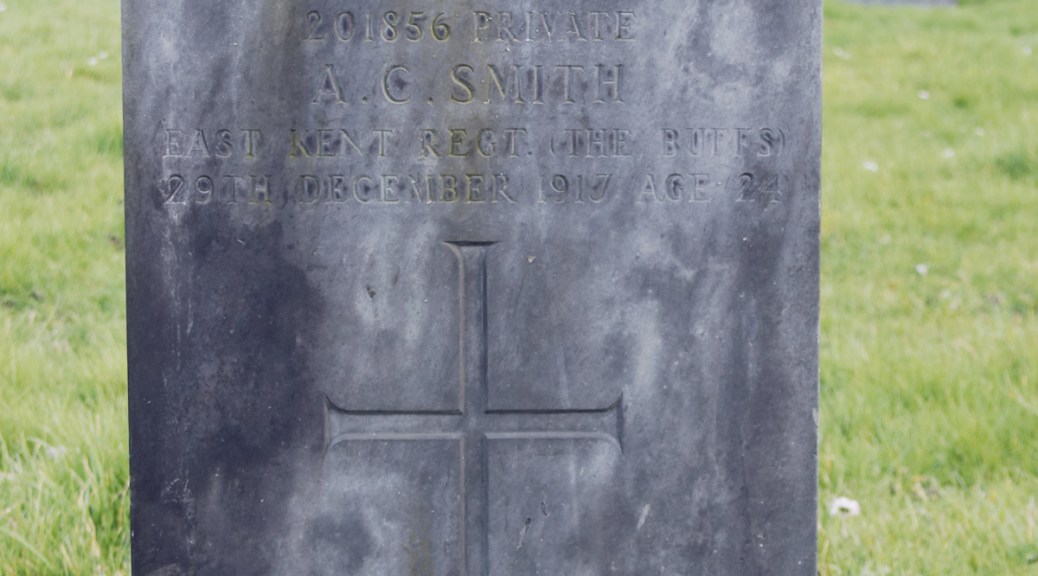
Thomas Charles Holloway was born in Chatham, Kent in 1893. The fourth of five children, his parents were Joseph, a domestic coachman, and Caroline Holloway.
By the time of the 1911 census, Thomas had left school and was working in a corn warehouse.
Thomas presented a bit of a challenge when I was researching his history.
His military records show that he enlisted on 31st December 1914, signing up to the Royal Field Artillery. However, Gunner Holloway’s service records show that he was posted on 9th January 1915, before being discharged as medically unfit just a week later. The records confirm that he served for 16 days.
The medical attestation states that he was discharged because of cardiac dilation and hypertrophy, a systolic murmur and dyspnoea, all heart-related conditions.
Despite only serving for just over a fortnight, he was afforded a Commonwealth War Grave when he died.
Searching the local newspapers of the time, a bigger story was unveiled.
The death of Bombardier Thomas Holloway, aged 24, of the RFA… occurred in a hospital at Cambridge. He was kicked by a horse in the course of his training, nearly two years ago, and had practically been on the sick list ever since. On recovering from the effects of the accident, he was seized with spotted fever at Seal, and ultimately succumbed to paralysis of the brain.
East Kent Gazette: Saturday 21st July 1917
The discrepancies between the original discharge and the newspaper report are intriguing. Either way, this was a young life cut far too short: he was 24 years old.
Gunner Thomas Holloway lies at rest in St Margaret’s Churchyard, in his home town of Rainham in Kent.
Harold Edward Shelbrooke was born in Poplar, East London, the eldest son of Edward and Jane. One of seven children, Harold lost his father – a labourer in the local gasworks – when he was only eight.
To support his mother – most of his sisters having moved on – he soon found employment as an umbrella maker, and by the 1911 census he had worked his way up to the position of warehouseman.
In July 1915, he married Alice Pulley; six months later their son, George was born. The young family had moved south of the Thames by now, and were living in Greenwich.
Private Shelbrooke’s military records are pretty sparse; he enlisted after marrying Alice – their Banns show him as an umbrella maker – and served in the King’s Royal Rifles.
He saw battle on the Western Front and was involved in the Battle of Menin Road Ridge at Ypres. Harold’s military documents record him as wounded and missing on the day of that battle – 20th September 1917 – and he was officially declared dead on 9th November that year. He was 33-years-old.
Private Shelbrooke had lost his father at the age of eight; his son, George, was not even two years old.
Private Harold Shelbrooke is commemorated at the Tyne Cot memorial in Zonnebeke, Belgium.
Harold Edward Shelbrooke was my first cousin, three times removed.