Tag Archives: 1920

Private Ernest Hector

Private Ernest Hector

Ernest Edward Hector was born in 1875, one of six children – all boys – to Thomas and Mary Hector. Thomas was a farm labourer, and this was a trade Ernest and his brothers all followed their father in.

Ernest was keen for a better life, however, and enlisted in the Somerset Light Infantry in May 1896, aged 21. After initial training and service in England, Private Hector was off to the East Indies, arriving there just after Christmas 1897.

Six years abroad followed, after which Ernest returned to England to serve another four years. He completed the 12 years of his military career in May 1908.

By this point, Ernest had married Eliza Humphries, a young lady seven years his junior, who came from his home village of North Wootton in Somerset. The couple went on to have six children and, by the time of the 1911 census, Ernest had settled his family in West Pennard, near Glastonbury, and was working as a farm labourer.

Ernest’s service during the Great War remains tantalisingly hidden. Given that he was 39 when hostilities broke out, it is unlikely that he was called up again straight away; his gravestone confirms that he was assigned to the Machine Gun Corps (Infantry), but research on his service number provides little other detail.

There is nothing in the media of the time reporting on his death or funeral either, so no concrete cause of death can be confirmed. All that is known is that Private Hector died on 9th May 1920, aged 45 years old.

Ernest Edward Hector is buried in the graveyard of St Peter’s Church in North Wootton.


Serjeant Ernest Morris

Serjeant Ernest Morris

Ernest George Morris was born in September 1879, one of six children to John and Eliza Morris. John was a carter for the railways, and this was a trade his son was to follow.

Ernest married Sarah Garrett in Bristol on Christmas Eve 1904, and the young couple went on to have two children, Charles and William.

Ernest’s father died in 1907, and Ernest became head of the family. He moved them in with him in Bristol, and by the 1911 census, the household consisted of Ernest, his mother Eliza, his brothers Frank and William, sister Lily and his own son William.

The census also lists Ernest as a widow; I have not been able to track down any records of when Sarah died. Their eldest boy, Charles, passed very early on, however, so this is likely why Ernest set up home with his family.

By this time, Ernest was working as a carman in the Bristol Goods Yards, and it appears that had a strong character. In September 1912, he was cautioned for “smoking whilst on duty and refusal to give an undertaking to refrain from doing so in future.” He cited his reason that the rulebook “did not prohibit men from smoking when not with a load.”

Ernest was suspended for two days, and was only allowed back to work when he promised to follow instructions in the future. This, it seemed he may not have done, as he was dismissed just three months later.

Ernest’s military service records are hard to piece together. He enlisted in the Rifle Brigade as a Gunner, going on to achieve the rank of Serjeant. He was awarded the Victory and British medals – the standard awards for men involved in the Great War.

Serjeant Morris survived the war, but there is little information for him after that. He passed away on 28th June 1920, aged 40 years old, although there is no record of how he passed. His war pension was awarded to his mother, who was acting as guardian for his son William.

Ernest George Morris lies at rest in the cemetery of his home town of Langport.


Lieutenant Stanley Russ

Lieutenant Stanley Russ

Stanley Hugh Russ was born in 1888, the youngest of five children to Alfred and Elizabeth. The family lived in Wells, Somerset, where Alfred worked as Clerk to the Guardians of the local workhouse. They were doing well for themselves, as they had two domestic servants at the time of the 1891 census.

Stanley seems to have been a studious young man, and by 1911 was boarding in London, where he was a dental student.

Details of Stanley’s military service are scant, but he obviously did well at his job, and rose to the rank of Lieutenant. The local newspaper gave a good overview of his life when reporting on his funeral:

The deceased gentleman was a dentist by profession, and served his apprenticeship with Mr Goddard of Wells. He afterwards went to London, where for some years he had been following his profession at Guy’s Hospital.

At the outbreak of was he joined the Middlesex Yeomanry as a trooper. He was later given a commission in the same regiment… After much service in France, he was, by reason of a physical disability incurred whilst on service, transferred to the Royal Army Service Corps (Mechanical Transport).

He again went to France and was attached to the North Somerset Yeomanry. He was invalided home, but went out a third time, being attached to a Canadian Siege Battery. He took part in the great push around Arras and Vimy Ridge.

He returned to England in October 1918, suffering from heart trouble, severe shell shock, and slight gassing. He was discharged from hospital in January 1919 and demobilised in the following March.

His health gave way, and he was subsequently operated on by a Harley Street specialist. He derived little benefit, and was afterwards removed to a nursing home, where he died.

The deceased gentleman, who was unmarried, was of a very bright and happy disposition, and enjoyed a wide circle of friends.

Wells Journal: Friday 5th November 1920

Stanley Hugh Russ died on 28th October 1920. He was 32 years old. He lies at rest in the cemetery of his home city of Wells.


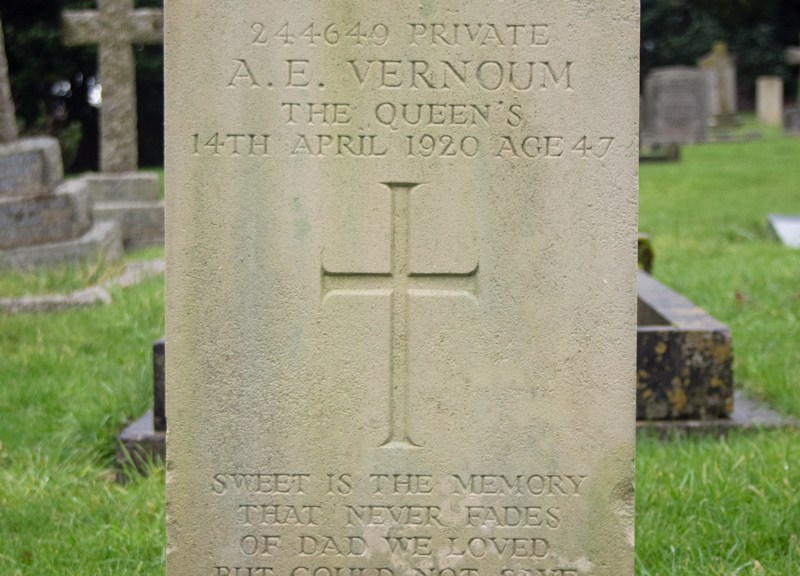
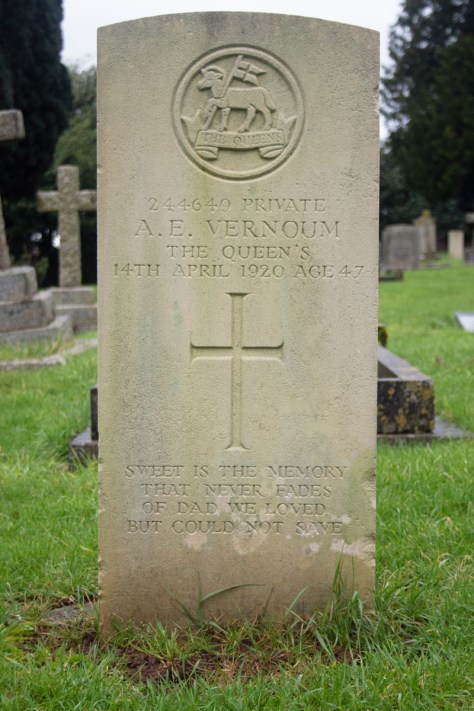
Private Arthur Vernoum

Private Arthur Vernoum

Arthur Edward Vernoum was born in 1874, the second of seven children to David and Sabina Vernoum. David worked on the railways, while Arthur went into labouring, as a stonemason.

He married Elizabeth Parker in 1896, and the couple settled in Wells, Somerset. They had four children – William, Samuel, Richard and Winifred.

Arthur’s military service records are a bit scarce; he enlisted in the Royal West Surrey Regiment (The Queen’s). Given his age – he was 40 when war broke out – if is likely that this was towards the end of the conflict.

While is troop served in many of the key battles of the Great War, there is no evidence whether Private Vernoum was involved – again, because of his age, it may well have been that he served as part of a territorial, rather than European force.

Arthur’s pension records show that he passed away on 14th April 1920, of a carcinoma of the tongue and a haemorrhage. He was 46 years old.

Arthur Edward Vernoum lies at rest in the cemetery of his home town, Wells in Somerset.


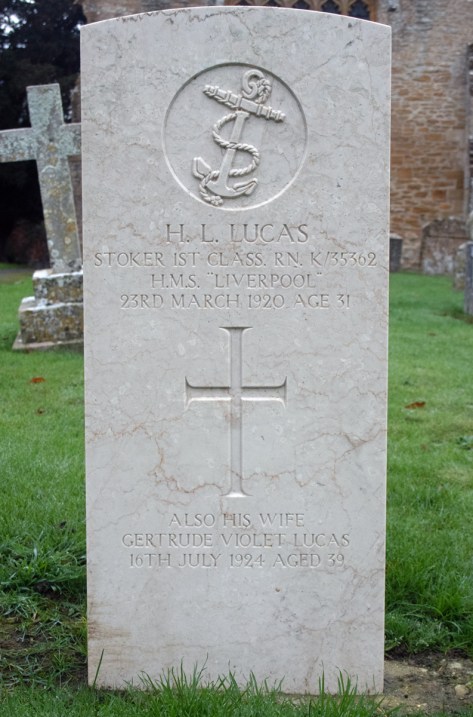
Stoker 1st Class Henry Lucas

Stoker Henry Lucas

Henry Luke Lucas was born in September 1888, in the quiet Somerset village of Tintinhull. His father Luke worked as an agricultural labourer, while his mother, Ellen was a glovemaker. Henry had three siblings – Kate, Beatrice and Edwin – and two half-siblings – Martha and Eli – from Ellen’s previous marriage (she was widowed in 1880).

Henry married Gertrude Woodman in 1909 having set himself up as a groomsman in the village. Henry Jr, was born the following year and the young couple went on to have three further children, Ellen (born in 1913), Edwin (born in 1915, who sadly died shortly afterwards), and a further son, called Edwin, born in 1916.

The 1910s proved a tragic decade for the Lucas family. Henry’s father Luke had passed away in 1912, and his Ellen had also died four years later.

It may well have been the death of his parents or the promise of continuous paid employment that spurred Henry into enlisting; he joined the Royal Navy on 26th July 1916 as a stoker.

Initial training was carried out on HMS Vivid II in Devonport, Stoker Lucas was assigned to HMS Liverpool for an eight month tour of the Adriatic. While on this tour, Henry was promoted to Stoker 1st Class.

Returning to England, Stoker Lucas was assigned to HMS Egmont II, an accommodation vessel based in Chatham. His move here may have been due to health reasons; within a few weeks Henry was transferred back to HMS Vivid II, from where he was invalided out of service on medical grounds.

The reasons for Henry’s discharge from the Royal Navy was tuberculosis; the local newspaper gave more details when it reported on his funeral:

The death has occurred of Henry Lucas (31) from tuberculosis, which he contracted while serving as a stoker in the Navy. Deceased served abroad during the period of the war and was in Eastern waters when he contracted the disease. He was removed to hospital at Malta, where he remained until his discharge. [This differs from his service records.] In health Lucas was a fearless man, and he maintained this spirit all through his trying illness.

Western Chronicle: Friday 2nd April 1920

Henry Luke Lucas died on 23rd March 1920; he was 31 years old. He lies at rest in the grounds of St Margaret’s Church in his home village of Tintinhull in Somerset.


Serjeant Richard Prout

Sergeant Richard Edwin Prout

Richard Edwin Prout was born in 1896, the second son of Frederick and Anna (Hannah) Prout. When his father died in 1908, his mother remarried and by the 1911 census, Richard and his family had moved to Lydeard St Lawrence, where he was a baker’s boy.

He enlisted in June 1914, joining the Somerset Light Infantry and served throughout the war, receiving the Mons Star, Victory Medal and General Service Medals.

After the war, he continued in the army, and was assigned to Taunton Barracks.

His passing was unusual enough for it to be reported on in the local newspaper.

Sergt. Prout, it was stated at the Barracks yesterday, had been on leave for some days prior to his departure for Ireland, and had been spending his furlough at Crowcombe, where his parents live. On the evening of his death, he left home, after taking a hearty meal, to catch the 7.25 train to Taunton. He had to walk a mile to Crowcombe station, most of the way uphill. Early the following morning his dead body was discovered lying face downwards by the roadside, about 50 yards from the station. The body was removed to his home, and Dr. Frossard, of Bishop’s Lydeard, was called in to make a post-mortem examination. The doctor has reported that death was due to asphyxia brought on by over exertion on a full stomach, and syncope, following pressure on the neck by the tightness of the collar of his outside jacket, the doctor adding that he had great difficulty in unfastening the collar.

Western Daily Press – Friday 20th February 1920

A genuine case of someone going before their time. Having visited Lydeard St Lawrence, I recognise the hill he would have had to have climbed to reach the station, and it’s steep enough in a car, let alone walking up it.

Sergeant Prout, the newspaper reported, was generally esteemed by his fellow company, and at his funeral he received full military honours.

Richard Edwin Prout lies peacefully in the churchyard of Lydeard St Lawrence.

Private James Burnett

This image has an empty alt attribute; its file name is img_4008s.jpg
Private James Burnett

James Burnett was born in 1888, the second son of James and Sarah Ann Burnett. James Sr was a farm labourer, and his son quickly followed his line of work.

James enlisted in the Devonshire Regiment in February 1916. He was noted as being 5ft 2ins (1.58m) tall, and weighed in at 7.5st (47.6kg).

Private Burnett’s medical record notes that his sight was such that he should wear glasses constantly, and, in fact, he was signed off medically as Category B1 (“Free from serious organic diseases, able to stand service on Lines of Communication in France, or in garrisons in the tropics. Able to march 5 miles, see to shoot with glasses, and hear well.”)

After training, Private Burnett was mobilised in September 1916, but transferred to the Agricultural Company (of the Labour Corps) in the summer of 1917.

Sadly, however, I have been unable to locate any details of James’ passing. He died on 29th February 1920 and lies at rest in the local churchyard of his home village, Lydeard St Lawrence, Somerset.

Private Nelson Pitman

Private Nelson Pitman

Nelson Victor Pitman was born in April 1890, the fourth of eight children to George Pitman and Amy Roles Pitman (née Treasure). George was a butcher’s assistant, and the family lived in their home town of Sherborne in Dorset.

As with a number of the other servicemen I have been researching, Nelson’s military records are sparse, probably lost to time. He is not listed as living with his parents on the 1911 census and, in fact, is nowhere to be found.

On 2nd January 1915, Nelson marries Alice Moores at the parish church (Sherborne Abbey). His profession is listed as soldier, so we know that, but this point in the war, he had enlisted.

While there are no records of Private Pitman’s service, his battalion, the 1st Royal Warwickshire Regiment was involved in a number of the key battles of the war, including the second Ypres, Arras and Passchendaele. The battalion was also involved in the Christmas Truce, so there is a slight chance that Nelson played football with his German counterparts in one of the defining moments of the Great War.

Private Pitman survived the war to end all wars, but was discharged on 22nd February 1919 with a disability. He was suffering from bronchitis, and steadily went downhill.

Private Nelson Pitman passed away eighteen months later, on 21st November 1920. He was 31 years old.

He lies at rest in Sherborne Cemetery.