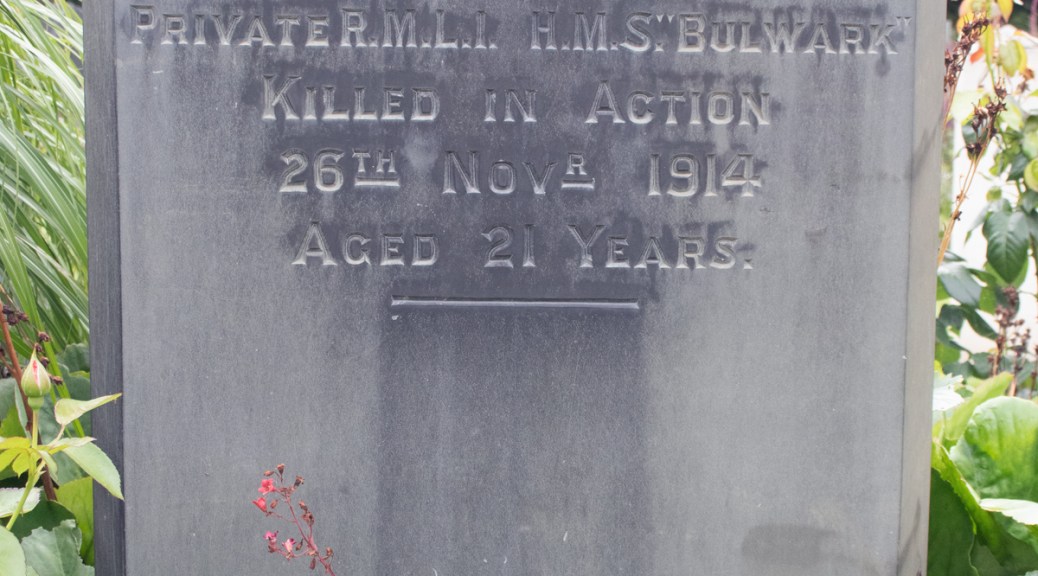
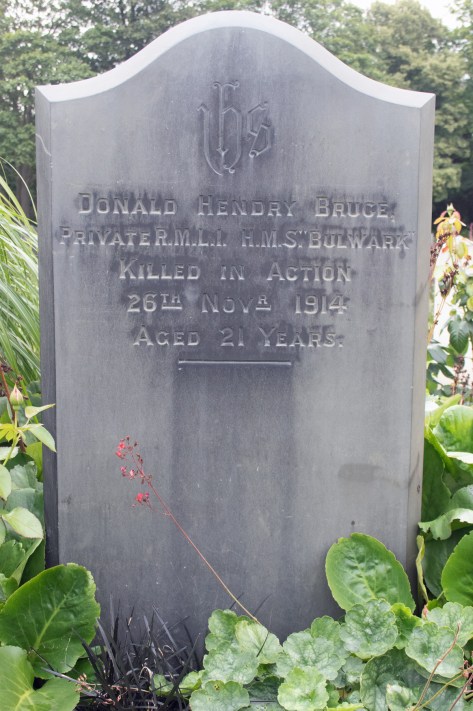
Donald Hendry Bruce was born on the 23rd July 1893 in the remote Logiealmond estate in Perthshire, Scotland. The oldest of six children, his parents were slate quarrier Hugh Bruce, and his wife, Ellen.
There is little information available about Donald’s early life, but the 1911 census records that he had enlisted in the Royal Marine Light Infantry as a Private, and was based at the barracks in Deal, Kent.
By the time war broke out, Private Bruce was assigned to the battleship HMS Bulwark. Part of the Channel Fleet, she was tasked with patrolling and defending Britain’s southern coast.
On 26th November 1914, Bulwark was moored in the River Medway, close to Sheerness, and was being stocked with shells and ammunition. That morning, some poorly stowed cordite charges overheated, detonating the shells stored nearby. The resulting explosion ripped through the battleship, and more than 740 crew were killed. Donald’s body was among those recovered: he was 21 years of age.
Those who were killed in the explosion were buried in the naval section of Woodlands Cemetery, Gillingham, Kent. As his body had been identified, Donald Hendry Bruce was laid to rest in a marked grave.
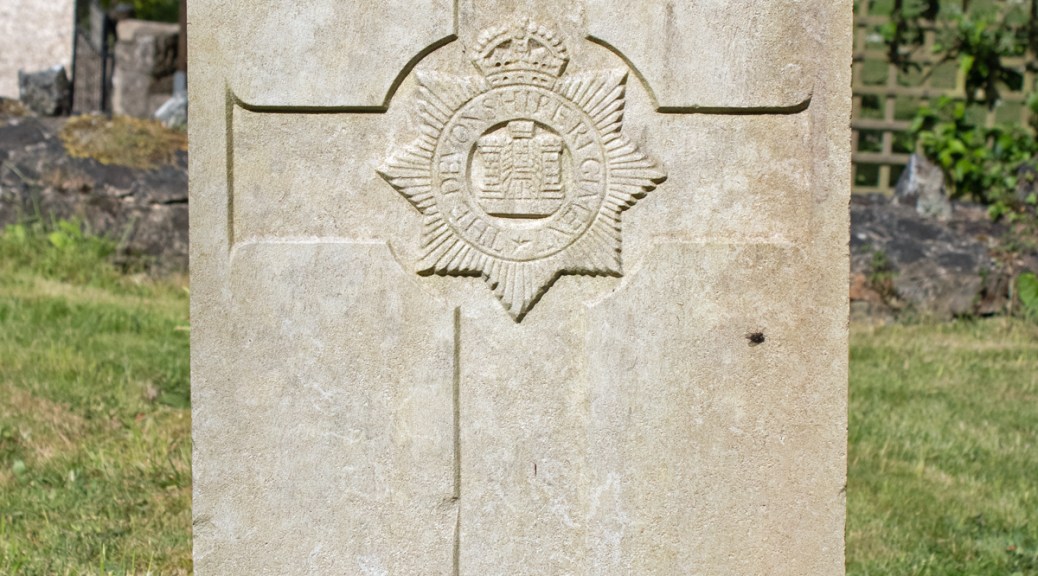
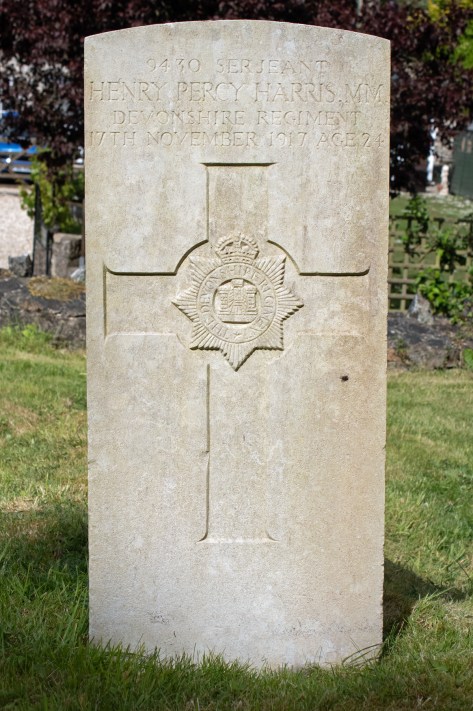
Henry Percy Harris was born in the Devon village of Combpyne in the spring of 1893. The oldest of eleven children, he was one of five sons to Eli and Amelia Harris. Eli, who was known by his middle name, Charles, and was employed as a carter on a farm. In a similar vein, Henry was known as Percy, and he also took up farm work when he completed his schooling.
When war was declared, Percy was one of the first to join up. Joining the Devonshire Regiment as a Private, he was assigned to the 1st Battalion. His service papers have been lost to time, but during the opening months of the conflict, his unit fought at Marne, Aisne and Messines, amongst other fierce battles.
One record confirms that Private Harris was wounded in the thigh on the 20th June 1915. Details are unclear, but the 1st Battalion were fighting near Ypres at the time. Percy’s wound healed, and he would soon be back in the fray.
Percy seemed to impress his superiors, and he rose to the rank of Sergeant. By the autumn of 1917, he was caught up in the fighting at Passchendaele, and was injured again. Medically evacuated to Britain for treatment, his luck was not to hold a second time. he died from his wounds on 17th November 1917, at the age of 24 years old.
The body of Henry Percy Harris was taken back to Devon for burial. He was laid to rest in the peaceful setting of St Mary’s Churchyard in his home village of Combpyne.
Harold Francis Ford was born on the 12th November 1896, and was the older of two children to George and Alice. George was a domestic gardener, and the family were raised in Buckland, Somerset.
When Harold completed his schooling, he joined his father in the gardening business. The 1911 census recorded that the family had moved to Axmister, Devon, and were living in Old Park Cottage (although Alice and Harold were actually staying with her brother in Buckland St Mary when the return was taken).
By the time war broke out, Harold had found work as an assistant mechanic. He was keen to play his part, however, and enlisted in the Royal Fusiliers in May 1915. His service papers show that he was 5ft 10ins (1.77m) tall, with brown eyes and dark brown hair.
Sent to Devonport for training, Harold seemed to impress his superiors. On 4th February 1916, he was made an Acting Lance Corporal, and this rank was formalised just a week later.
In April 1916, Lance Corporal Ford came down with bronchitis, and was hospitalised for two months. During that time he developed a heart condition, and this would prove severe enough for him to be discharged from military service. He was formally stood down on 14th June 1916.
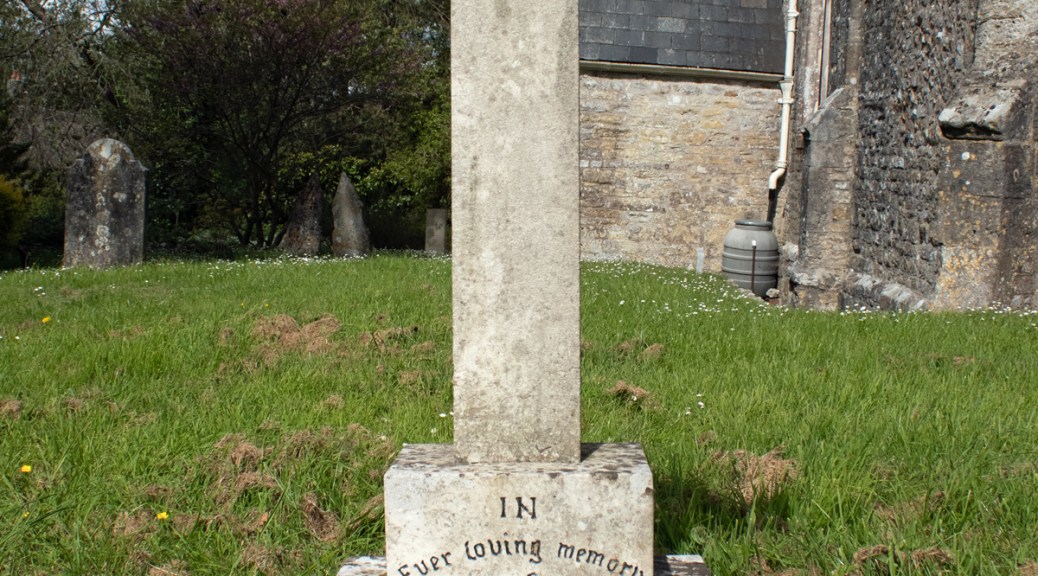
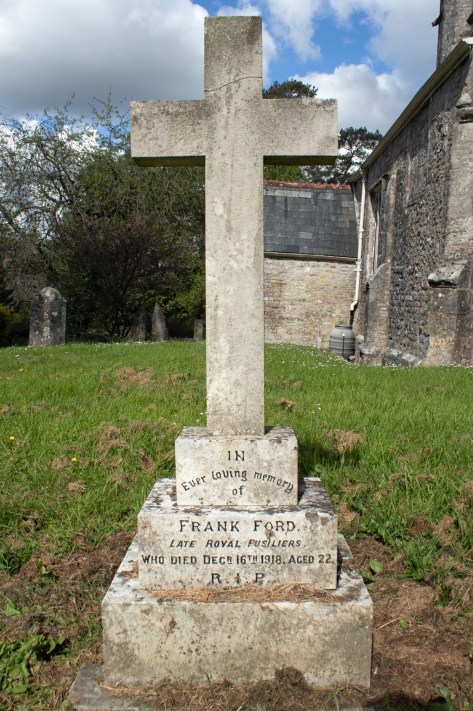
At this point, Harold’s trail goes cold. He appears to have returned home, as this is where he died, on 16th December 1918. He had not long celebrated his 22nd birthday.
The body of Harold Francis Ford was laid to rest in the tranquil setting of St Michael’s Churchyard in Musbury, close to where his family were living. His headstone remembers “Frank”, an affectionate nod to what he was known as to family and friends.
William Bernard Lethbridge was born in Cheltenham, Gloucestershire, in the summer of 1886. The seventh of eight children, his parents were Robert and Mary Lethbridge. William’s baptism record gives his father’s profession as gentleman, while the 1891 census return gives him as being an indigo merchant.
The family were living in Bedford by this point, in a large house on Shakespeare Road. The oldest of the children was 13, but the family had two live-in servants, and shared their neighbourhood with army surgeons, wine merchants and barristers.
Robert died in 1897, and at this point, the family’s trail goes frustratingly cold. Mary and three of her daughters pop up in 1911, living in Kensington, Middlesex, but of William there is no sign. It may be that he travelled abroad, either with the army, or for business, but with no documentation to support this, it remains speculation.
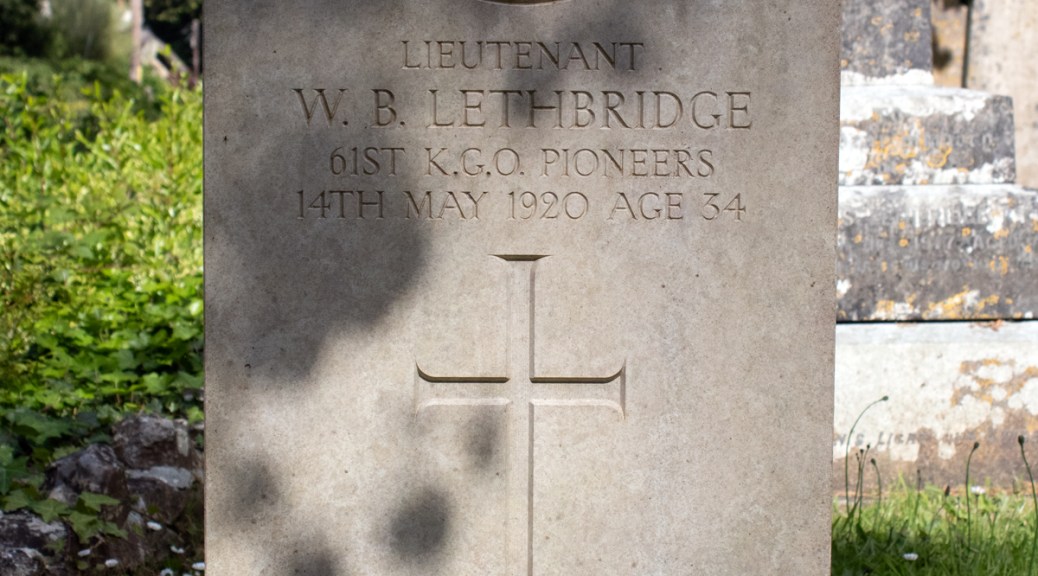
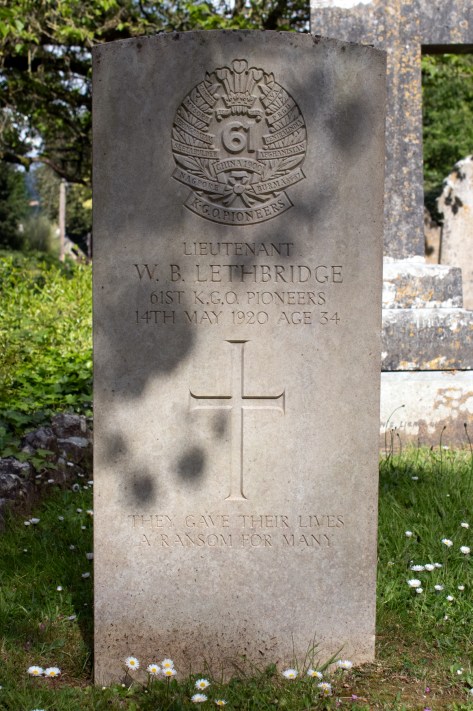
Lieutenant Lethbridge’s probate record confirms that, at the time of his passing, he was living in the Devon village of Musbury, but passed away in the village of Murtle, near Aberdeen, Scotland. The CWGC documentation states that he died on 14th May 1920 from a sickness contracted in German East Africa. During the war he was connected to the 61st King George’s Own Pioneers, and this unit of the Indian Expeditionary Force was based in Africa during the conflict.
The body of William Bernard Lethbridge, who was 33 years old, was taken back to Devon for burial. He was laid to rest in the tranquil setting of St Michael’s Churchyard, Musbury.
William’s younger brother, Patrick, also served in the First World War. A former medical student, he went on to become a Captain in the King’s Own Scottish Borders.
Captain Lethbridge was killed on 25th September 1915, during the Battle of Loos. Just 27 years of age, he is commemorated on at Dud Corner Cemetery.
Robert Hawes was born early in 1891 in Rochester, Kent. One of twins, his parents Henry and Alice had six children in all. Sadly, two of their children, including Robert’s twin, Edward, died early.
Henry was a bricklayer, and the 1891 census found the family living in rooms at 26 John Street, to the south of the town centre. This was a road they would know well, and the following return, taken in 1901, found them living two doors down, at No. 22.
When Robert completed his schooling, he found work as a general labourer for a wine and spirit merchant. By 1911, the Hawes family had relocated to 171 Rochester Avenue. Just one road from their previous home, this move afforded the seven of them more space.
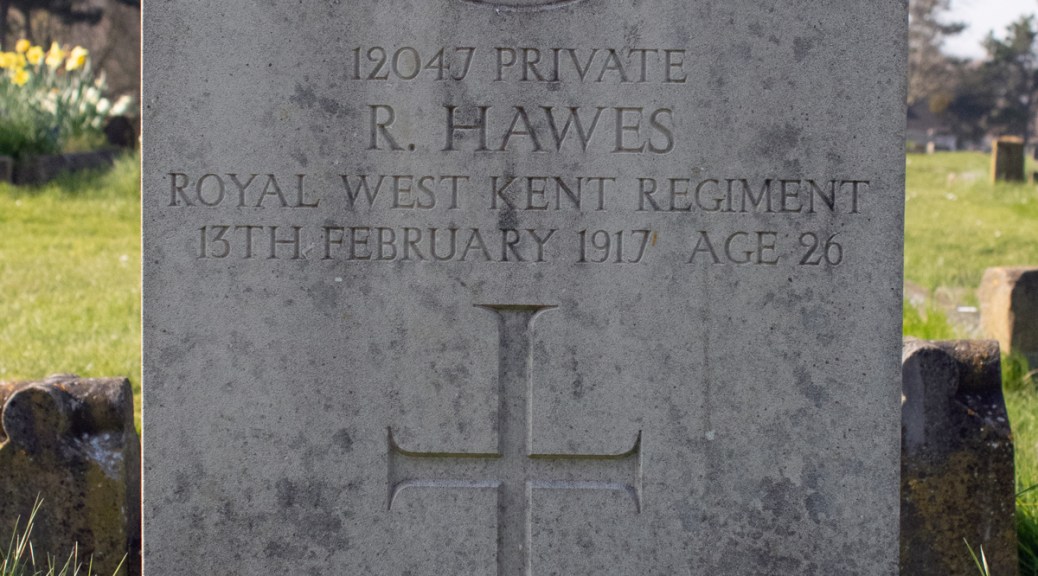
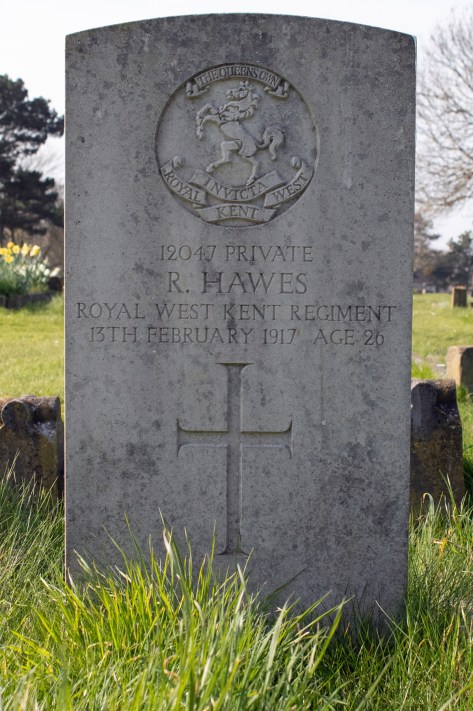
War broke out in the summer of 1914, and Robert stepped up to play his part. Leaving his job as a cellarman, he enlisted on 11th December 1915, and, as a Private, was assigned to the Queen’s Own (Royal West Kent Regiment). His medical report notes that he was 5ft 7ins (1.7m) tall, and had slight varicose veins to his right knee.
Initially attached to the 12th (Reserve) Battalion, by the summer of 1916 Private Hawes had been transferred to the 7th (Service) Battalion and sent to France. His unit was deeply ensconced at the Somme, and Robert was wounded during the opening day of the Battle of Ancre Heights.
Robert’s injury – a gun shot wound to the head – meant he was medically evacuated to Britain, and he was admitted to King George’s Hospital, London. Despite the treatment he received, his condition would prove too severe: Private Hawes passed away on 13th February 1917, at the age of 26 years old.
The body of Robert Hawes was taken back to Kent for burial, and he was laid to rest in St Margaret’s Cemetery, Rochester.
Robert’s older brother, Harry, had also served in the First World War. Attached to the 2nd Battalion of the Royal Warwickshire Regiment, Private H Hawes was killed on the first day of the Battle of Loos: he was 30 years of age.
Harry Henry Hawes is commemorated on the Loos Memorial at Dud Corner Cemetery, France.
By the time of Robert’s death, Henry and Alice had lost all three of their sons.
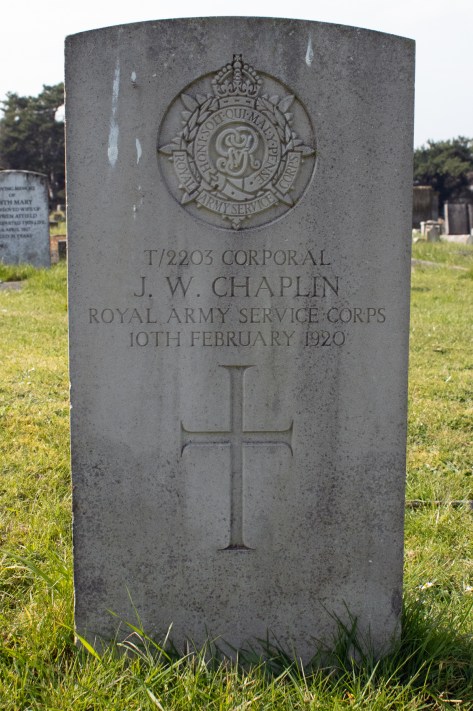
An inquest was held on Thursday at the Guildhall, Rochester… on the body of John William Arthur Chaplin (28)… who hanged himself in the lavatory on Tuesday. Deceased was a demobilised soldier and had served in France and Egypt during the war.
Mrs Sarah Jane Chaplin stated that lately her son had complained of pains in the back of his head. Usually he was of a cheerful temperament. Since leaving the Army he had spent his grstuity and being without money and our of employment he became depressed.
George William Lewis Paterson, deceased’s cousin who occupied the same bedroom with deceased, stated that at 10.40pm on Monday, deceased was reading a paper in the kitchen. Witness when to bed and awoke at 5.30am to find deceased had not been to bed. The light downstairs was still burning. In the lavatory he found deceased handing by the neck…
A verdict of “Suicide whilst of unsound mind” was returned.
[Chatham, Rochester and Brompton Observer: Saturday 14th February 1920]
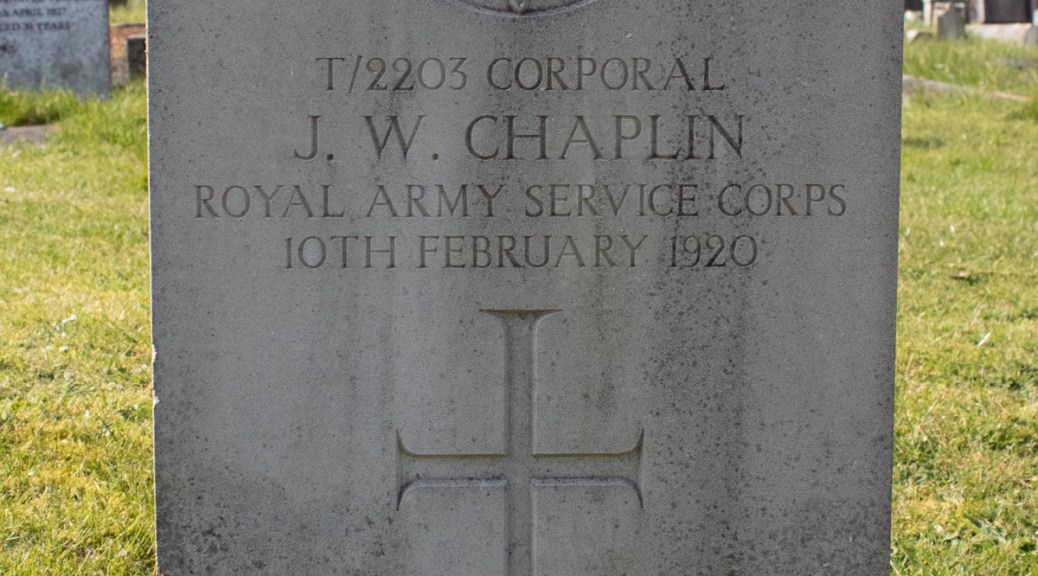
The life of John William Arthur Chaplin remains frustratingly elusive. He does not recognisably appear on any census return, and, while it is clear that he served in the Army Service Corps as a Corporal, his military records are no longer available.
The body of Corporal Chaplin, the former solder with nowhere to turn, was laid to rest in St Margaret’s Cemetery, Rochester, Kent.
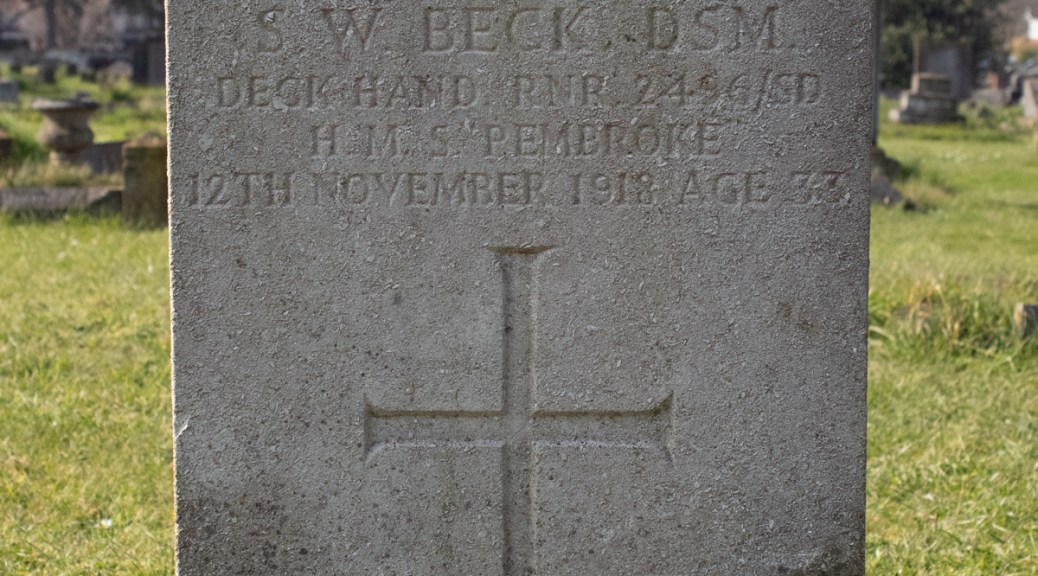
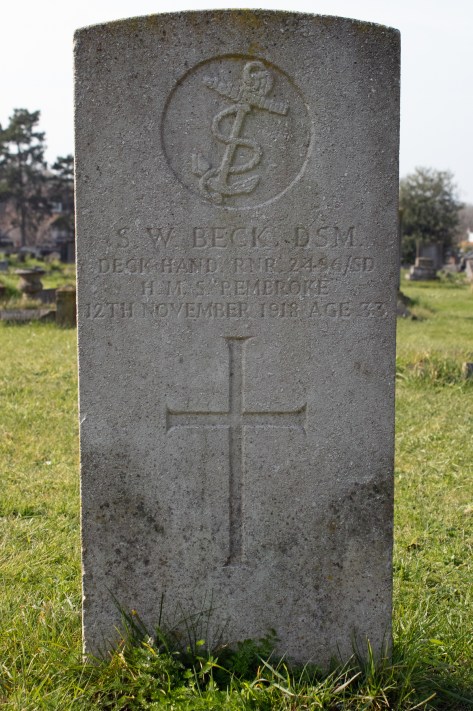
Sydney William Beck was born on the 6th April 1885 in Rochester, Kent. The seventh of nine children, his parents were Albert and Mary Beck. Albert was a bargeman, and this was a line of work into which his son would follow.
There is little concrete information about Sydney’s life. He is recorded as having married Janet Ellis on 16th April 1911, this being backed up by his later service records.
When war broke out, Sydney joined the Royal Naval Reserve as a Deck hand. His papers not that he was 5ft 9ins (1.65m) tall, with brown hair and a fresh complexion. He is also recorded as having a clasped hands tattoo on his right forearm.
The funeral took place, with naval honours… on Saturday of Chief Deck Hand Sydney Beck, DSM, who passed away in the Royal Naval Hospital on the 12th inst., from pneumonia. The deceased, who was 33 years of age, was formerly a barge captain… He was on the trawler Aisne, which took place in the battle with a German submarine off Iceland. It was for this engagement deceased was given the DSM.
[Chatham, Rochester and Brompton Observer: Saturday 30th November 1918]
Sydney William Beck died on 12th November 1918, a day after the Armistice was signed, and a month after he was gazetted. His body was laid to rest in St Margaret’s Cemetery, Rochester, Kent.
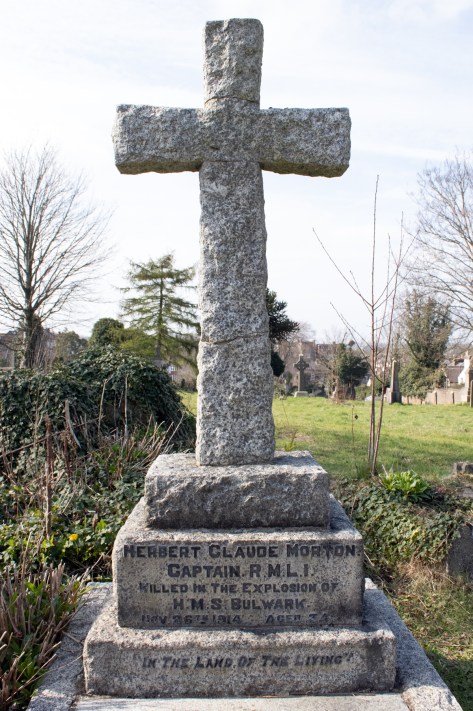
The mortal remains of Capt. Herbert Claude Morton, RMLI, were laid to rest in St Nicholas Cemetery, Rochester, on Tuesday afternoon, the first portion of the Burial Service being conducted in the Cathedral, where the deceased office was married, on September 17th, 1908, to Evelyn St Aubyn Lennard, eldest daughter of Col. and Mrs DL Barratt, late of Star-hill, Rochester. Captain Morton, who was 34 years of age, was the only son of Mr John Ellis Morton, of County Cavan, and Mrs Werry, of Cowes, Isle of Wight. He served during the campaign in China and was awarded the medal. His home was at Gosport.
[Chatham, Rochester and Brompton Observer: Saturday 5th December 1914]
The early life of Herbert Claude Morton is a challenge to piece together. The 1911 census states that he was born in France, and confirms that he and Evelyn were living with their then two children at 139 Stoke Road, Gosport, Hampshire.
This was the only census on which Herbert features and, as the “campaign in China” that the newspaper reported would have been the Boxer Rebellion of 1900, this may account for the lack of other documentation for him.
When war broke out, Captain Morton assigned to the battleship HMS Bulwark. He was on board Bulwark on the 26th November 1914, when she was moored close to Sheerness, Kent. That morning, an explosion ripped through the ship, sinking it and killing more than 740 people. Herbert was amongst them: he was 34 years of age.
The body of Herbert Claude Morton was laid to rest in a marked grave in St Nicholas’ Cemetery, Rochester, Kent.
The summer after her husband’s death, Evelyn gave birth to another child, daughter Stella, who would never know her father.
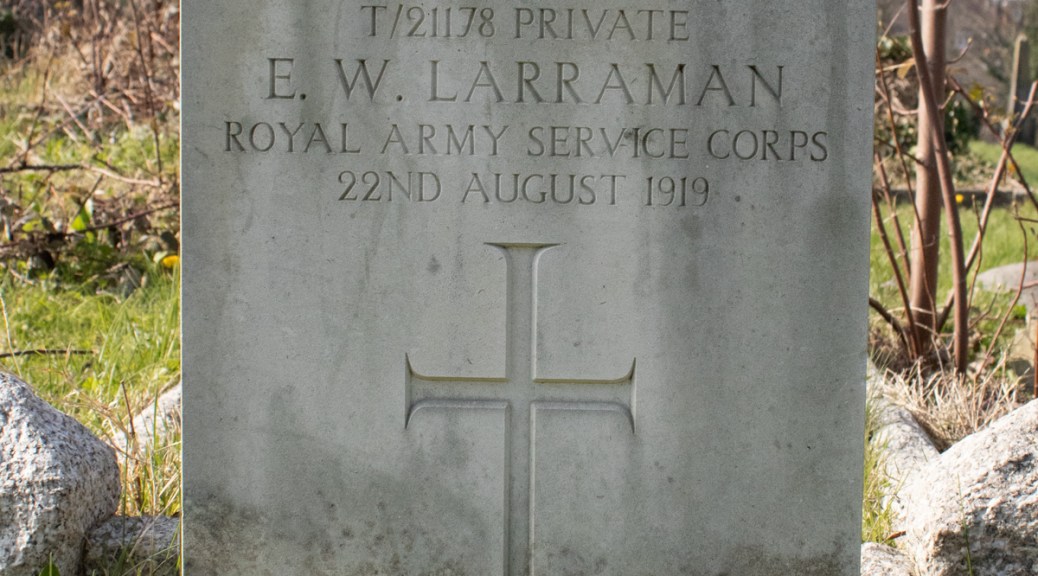
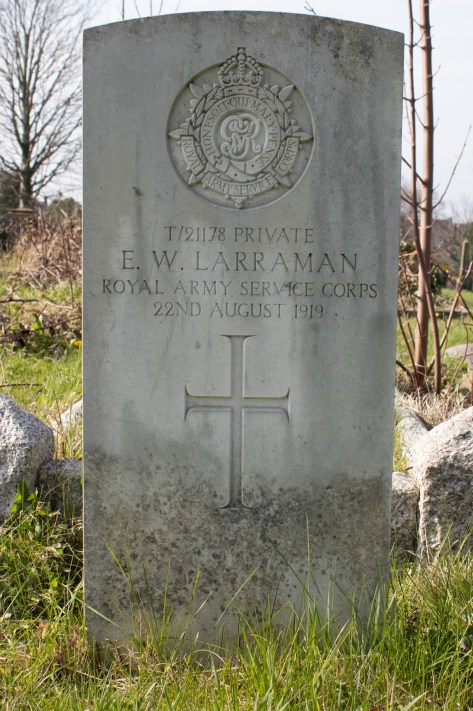
Edward William Larraman was born in Rochester, Kent, in December 1882. The third of seven children, he was one of five sons to Alfred and Mary Larraman. Alfred was a mariner who died when Edward was just ten years old.
Mary took work as a housekeeper, moving the family from their home at 4 Davis Square to rooms at 18 Northgate. Edward is missing from the 1901 census but, with later service records suggesting he volunteered with the Royal West Kent Regiment, it is possible that he was training with them when the return was taken.
The military life seemed to suit Edward and, on 4th November 1902, he gave up his job as a riveter to formally enlist, joining the Army Service Corps as a Private. His service papers from that time show that he was 5ft 4.5ins (1.64m) tall and weighed 120lbs (54.4kg). Hr was noted as having light brown hair, blue eyes and a fresh complexion.
Private Larraman spent the next four years on home soil, using the opportunity to gain a 3rd Class certificate in education, and rising to the rank of Lance Corporal.
On 23rd December 1907, Edward married Mabel Green. Born in Chatham, she was the daughter of a carpenter. The couple set up home at 3 Almon Place, Rochester – just a short walk from where Mary was living – and went on to have two children, Irene (born in 1908) and Thora (born in 1915).
Lance Corporal Larraman was medically discharged from the army on 18th May 1908. While it is unclear what affliction meant he was no longer fit to serve, he was awarded a pension for his service.
The next census, taken in 1911, found him and Mabel living in Almon Place with Irene and Mabel’s father Henry, and brother, George. Edward was listed as an army pensioner, while there were two salaries coming into the household: Henry was a carpenter and joiner at Chatham Dockyard, while George was a shop assistant.
At this point, Edward’s trail goes cold. It is clear that he re-enlisted when war broke out, although in what capacity, and for how long, is unclear. The only other record for him is that of his passing, on 22nd August 1919: he was 36 years of age.
The body of Edward William Larraman was laid to rest in St Nicholas’ Cemetery, Rochester, a short walk from where his family were still living.
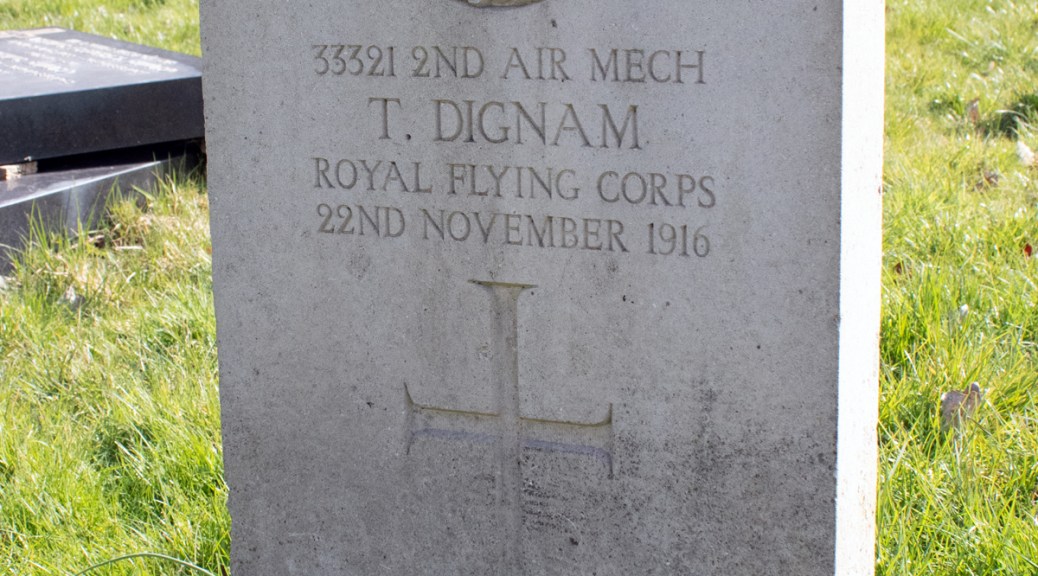
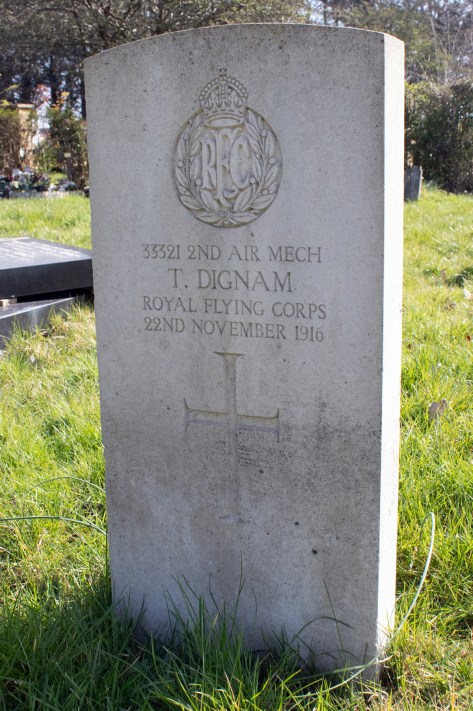
A verdict of “Suicide during temporary insanity” was returned at a Westminster inquest on Thomas Patrick Edgerton Dignam, aged 28, a second-class air mechanic in the Royal Flying Corps.
The evidence was to the effect that Dignam’s final leave expired on the night of November 22. He and his wife got into a taxicab near the Law Courts, telling the driver to take them to their home in Pimlico. Dignam, however, altered his mind, and in the Strand bade his wife good-bye, saying he would drive straight to Waterloo. When his wife had gone, he again told the driver to take him to Pimlico. On the way he shot himself through the head with a service revolver. The only explanation of the tragedy was that Dignam might have been depressed as the result of influenza.
[Illustrated Police News: Thursday 30th November 1916]
Much of the life of Thomas Patrick Edgerton Dignam is a challenge to piece together. His service records suggest that he was born in the Ancoats area of Manchester, Lancashire, but give no indication as to his parents.
Thomas enlisted on 2nd July 1916, joining the Royal Flying Corps as an Air Mechanic 2nd Class. His service papers show that, at 32 years of age, he stood 5ft 10.5ins (1.79m) tall. Living at 83 Alderney Street, South Belgravia, Middlesex, he had given up his job as an NT Driver, privately employed to transport goods or people around the area. His papers show that he was married, having exchanged vows with Elinore Essex on 9th December 1915.
Air Mechanic Dignam was sent to Farnborough, Hampshire, for his training. However, from the start things went awry. On 26th August 1916 he went absent without leave, and was only apprehended back in Pimlico some three weeks later. Tried for desertion, Thomas was sentenced to 14 days’ detention, returning to duty on 26th October.
Given leave towards the end of November, the pressure of returning to base seemed to have proved too much, and Thomas took his life having bid Elinore farewell that last time.
The body of Thomas Patrick Edgerton Dignam was laid to rest in Streatham Park Cemetery, Surrey. His papers note one final tragedy in his tale. Elinore was pregnant when her husband died, giving birth to their daughter, also called Elinore, on 15th January 1917.
While Thomas does not appear in any census records, the 1911 document gives an insight into Elinore’s life. Born in Worthing, Sussex, in around 1884, she had moved to London and, at just 27 years of age, was the manageress of the Devonshire Inn Hotel at 136 Bishopsgate. On the night the census was taken, there were 25 guests and 16 other members of staff.
It is likely that Elinore gave up her position when she and Thomas married. By 1921, she was living with her daughter at 46 Wightman Road, Hornsey, Middlesex. Working as a clerk, she was employed by Frederic Smith & Sons at the West Central Hotel in Southampton Row, Camden. Frederic was the Secretary to the Band of Hope Temperance Society, and the hotel he ran with his sons was run with abstinence in mind.