Tag Archives: Australian Infantry

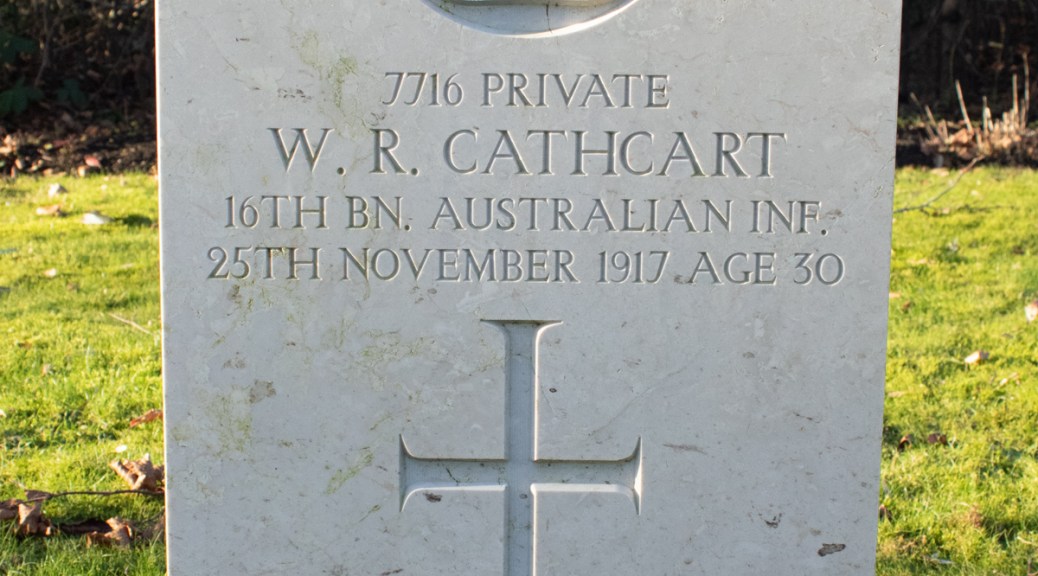
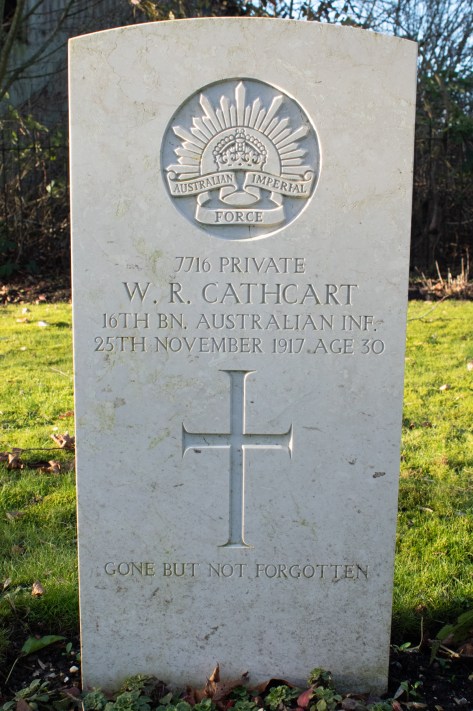
Private William Cathcart

Private William Cathcart

William Rea Cathcart was born in Ballymena, County Antrim, Northern Ireland, on 30th January 1887. The middle of five children, his parents were Thomas and Margaret Cathcart.

Little information is available about William’s early life, but he appears to have been a smart young man and, by his mid-20s was employed as a bookkeeper. Part of him sought a better life for himself and he took the decision to emigrate, arriving in Fremantle, Australia on board the SS Otranto on 14th November 1911.

William settled in Perth, but when war broke out, he was keen to step up and serve his King and Empire. He enlisted on 7th May 1915 but, for some reason, he wasn’t accepted for service at that time.

William did not give up, however, and he succeeded in enlisting on 30th May 1917. His service papers confirm that he was 5ft 8.75ins (1.74m) tall and weighed 150lbs (68kg). A Roman Catholic, he was noted as having brown eyes, brown hair and a fresh complexion.

Assigned to the 16th Battalion of the Australian Infantry, Private Cathcart’s unit set sail from Sydney on the troop ship A7 Medic, on the 1st August 1917. The voyage would take two months, and his unit arrived in Liverpool, Lancashire, at the start of October. It the then marched south to the ANZAC bases near Codford, Wiltshire.

It seems that the journey had exhausted William, and his health began to deteriorate. He was admitted to the camp hospital with diabetes, but moved to the No. 3 New Zealand General Hospital on 22nd November. He was emaciated and barely able to walk, constantly drinking, but eating very little.

Over the next few days, William’s condition worsened. He began getting pains in his arms and legs, was sluggish and restless. The treatment he was provided would ultimately prove too little, too late. Private Cathcart passed away at 1:05am on 25th November 1917: he was 30 years of age.

The body of William Rea Cathcart was laid to rest in the ANZAC extension to the graveyard of St Mary’s Church, Codford, not far from the hospital in which he had been treated.
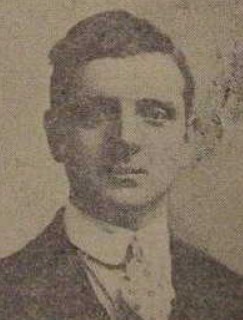

Private William Cathcart
(from ancestry.co.uk)
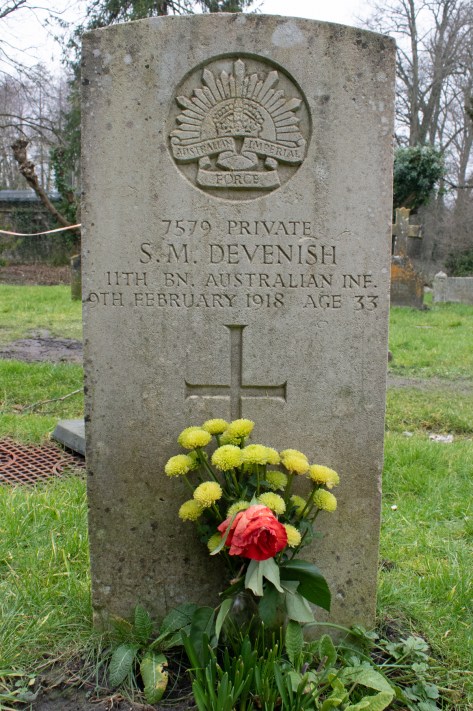
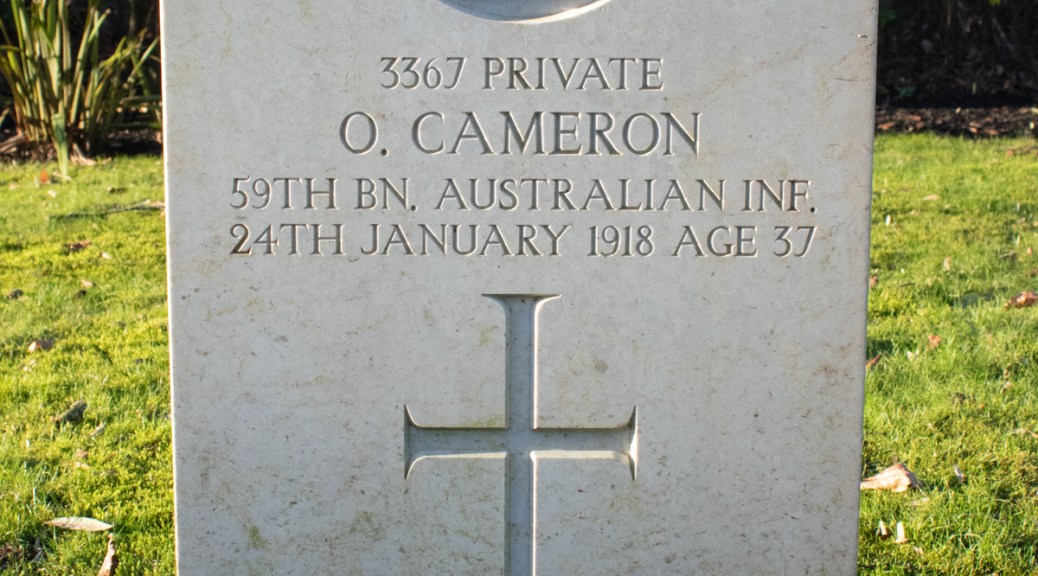
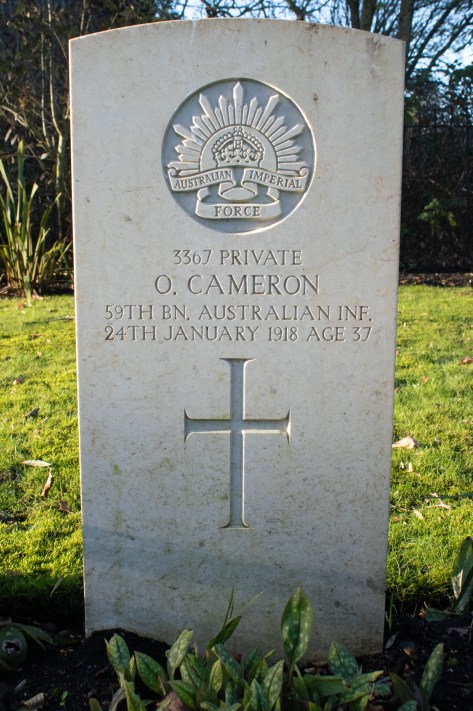
Private Oscar Cameron

Private Oscar Cameron

Born in Shelburne, Nova Scotia, in around 1876, the early life of Oscar Cameron is a challenge to piece together. He was one of four children to ship’s carpenter Christopher Cameron and his wife Alice.

Oscar appears to have followed his father in a sea-faring life, and his later army service records confirm that, by 1917, he was a ship’s officer. When the call came to serve the Empire, he took a discharge from his ship in Australia, and joined up.

Enlisting on 20th February 1917, Oscar’s service records show that he was 5ft 6.5ins (1.69m) tall, and weighed 128lbs (50.1kg). He had fair hair, blue eyes and a fresh complexion, with a tattoo on his right forearm and a vaccination scar on his left upper arm. His age was given as 36 years and 6 months, although he was, in fact 41 by this point.

Assigned to the 59th Battalion of the Australian Infantry, Private Cameron’s unit left from Sydney on board the HMAT A16. The two-month voyage was not uneventful: Oscar spent three days in hospital with an undeclared ailment, and also forfeited two days’ pay for being absent without leave for 34hrs during the ship’s layover in Cape Town, South Africa.

The 59th Battalion disembarked in Liverpool, Lancashire, on 16th September 1917. From there it made the journey to the ANZAC camps in Wiltshire, and this is where Oscar would have continued his training.

At the start of 1918, Private Cameron’s health was suffering again. He was admitted to the No. 3 New Zealand General Hospital in Codford, Wiltshire, suffering from nephritis. Ultimately, the condition was to prove fatal: Oscar passed away at 4:45pm on 24th January 1918, aged 40.

Thousands of miles from home, it wasn’t possible for the remains of Oscar Cameron to be taken back to Canada. Instead, he was laid to rest in the ANZAC extension to St Mary’s Churchyard in Codford, not far from the base where he had received treatment.


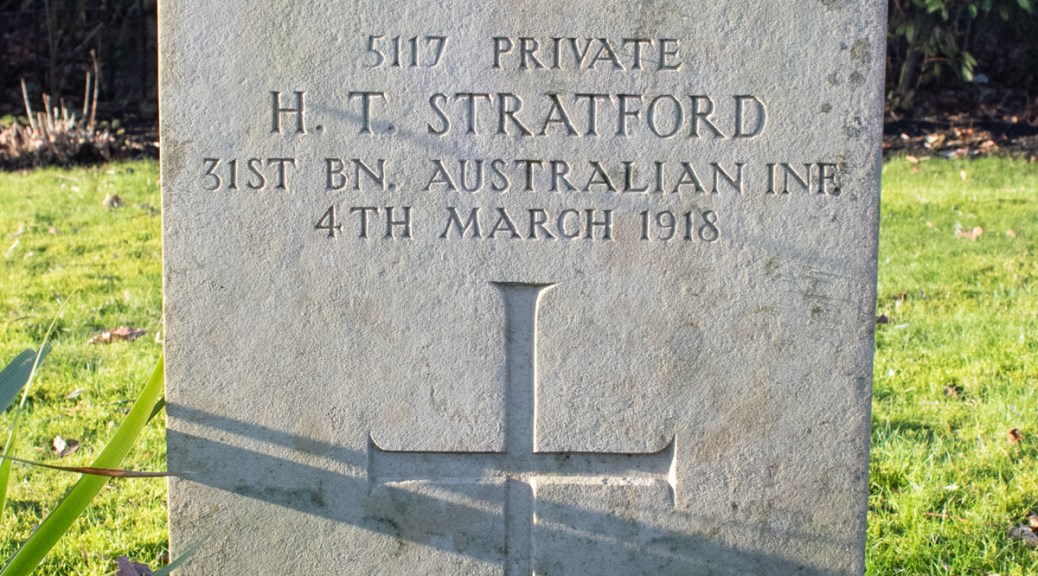
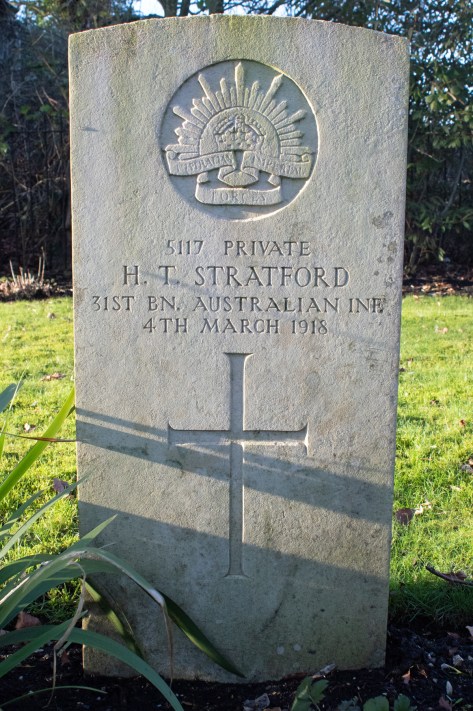
Private Henry Stratford

Private Henry Stratford

Henry Thomas Stratford was born in Southampton, Hampshire, in the autumn of 1870. The youngest of three children, his parents were John and Maria Stratford. When Henry’s father died in 1876, Maria re-married, and went on to have a further child with her new husband, James Simmons.

Maria’s husbands worked away, and likely served on ships: John was absent from the 1871 census, while James was missing from the 1881 return.

By the 1901 census, Maria had been widowed a second time. She was living at 29 Dock Street with her three youngest children – Henry, his older brother John, and his younger half-brother William. By this point, John was employed as a waterman on a barge, while Henry had also taken to the water, and was employed as a seaman.

Maria passed away in 1904, and there is little further information about Henry’s earlier life. His later army records suggest that he served in the Royal Navy for 14 years, although there are no records for his service at that time.

At some point, presumably after his time in the navy had expired, Henry emigrated to Australia. Again, details are scarce, but he was definitely there by the spring of 1917, having settled in Brisbane, and taken up work as a sailmaker.

When war broke out in Europe, Henry stepped up to serve his country, enlisting in the Australian Imperial Force on 3rd Mary 1917. His records confirm that he was 5ft 4ins (1.62m) tall, and weighed in a 152lbs (69kg). With light brown hair and blue eyes, he had a fair complexion and tattoos on both of his forearms.

Assigned to the 31st Battalion of the Australian Infantry, Private Stratford set sail from Sydney on 14th June 1917. After a ten week voyage, he was marched in to Hurdcott Camp near Fovant, Wiltshire, and would remain in the ANZAC base for his training.

On 23rd February, Henry was admitted to the No. 3 New Zealand General Hospital in Codford, Wiltshire, having fallen from a train. He remained in hospital for the next week, but his head injuries would ultimately prove fatal.

An inquest was held at the New Zealand Military Hospital on Wednesday concerning the death of Henry Thomas Stratford…

Mr FAP Sylvester (coroner) conducted the inquiry, and the evidence went to show that on the night of February 23rd last the deceased man met with an accident by trying to leave a train while it was in motion, before reaching Codford GWR Station. He was picked up in an unconscious state and conveyed to the Military Hospital where he died on Monday.

Corporal John Brooks, ASC Cyclist Section, of Codford, stated that he proceeded from Warminster on the 9:45pm train to Codford on February 23rd. He was in the company of Gunner E Ford, RFA, of Boyton, and they were in the came corridor carriage as the deceased man. After leaving Warminster deceased walked down the corridor, and some time later witness found that deceased had opened the carriage door and was sitting with his feet hanging outside, apparently trying to alight from the train. Just after passing Upton Lovel [sic] crossing, he suddenly disappeared, and witness just saw him fall off the footboard. Deceased never spoke or shouted, and when the train pulled up at Codford, witness reported the matter to the military police and stationmaster, and accompanied them to the spot where deceased was found lying face downwards, his head against the main line rail. First aid was rendered and he was moved to the military hospital.

Private Claude E Thompson, Australian military police, stated that deceased had a road pass, but he had no right to travel by train. He had probably endeavoured to leave the train before it reached Codford to evade the military police.

The jury returned a verdict that deceased came to his death by trying to alight from the train and that he accidentally fell and sustained a compound fracture of the skull.

[Warminster & Westbury Journal – Friday 08 March 1918]

Henry Thomas Stratford was 47 years of age when he passed away. His body was laid to rest in the ANZAC extension to St Mary’s Churchyard in Codford, Wiltshire, close to the hospital in which he had breathed his last.


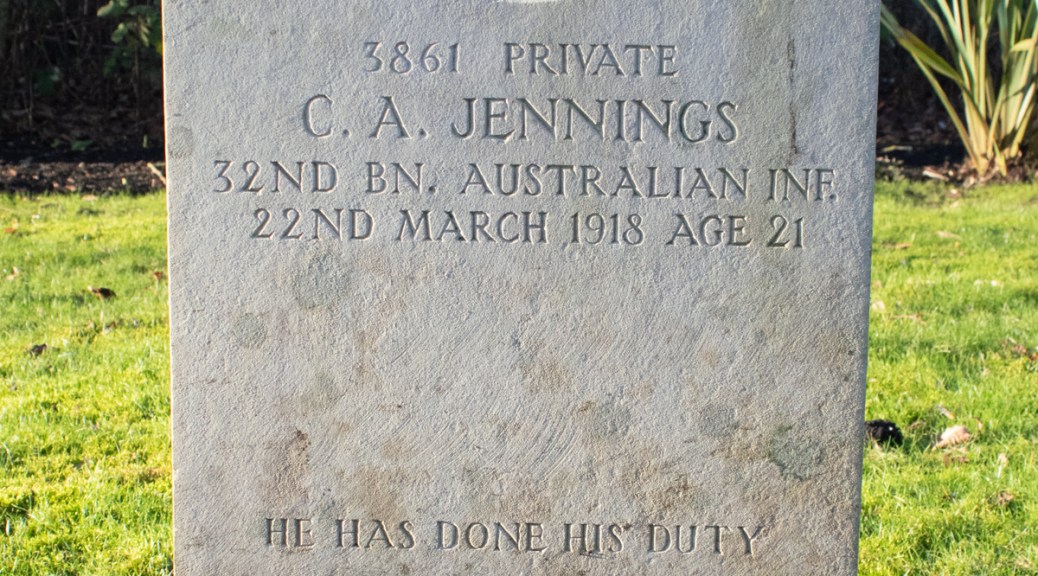
Private Clarence Jennings

Private Clarence Jennings

Clarence Albert Carrison was born on 6th June 1896 in Port MacDonnell, South Australia. His early life is a challenge to uncover: his father is noted as being Robert Carrison, while his mother was Mary Jennings. His parents had eleven other children, whose surnames vary between Carrison and Jennings.

Papers confirm that Clarence went to Mount Schank School from 29th July 1902 to 10th November 1904, although his attendance seems to have been a little haphazard. Intriguingly, his parents are not recorded, but Mr H Ulrich, a carpenter, is noted as being his guardian.

When he finished his schooling, Clarence found work as a labourer. War broke out on the other side of the world in the summer of 1914, and he was called upon to play his part. He enlisted in the Australian Imperial Force on 30th June 1917, and, Robert having passed away nine years earlier, he seems to have reverted to his mother’s name, Jennings.

Private Jennings’ service papers outline the young man he had become. He was a little over 5ft 7ins (1.7m) tall, and weighed 168lbs (76.2kg). He was recorded as having brown hair, blue eyes and a medium complexion.

Clarence spent the next three months training. On 30th October 1917, his unit left Australia for Europe, a journey that would take some eight weeks. The voyage was not uneventful for Private Jennings: he spent a night in the ship’s hospital with seasickness, then three weeks back there with mumps. His gratitude to be back on dry land when the HMAT Aeneas docker in Devonport on 27th December is likely to have been palpable.

Private Jennings was marched into camp in Sutton Veny, Wiltshire. Attached to the 33rd Battalion of the Australian Infantry, he moved to the nearby ANZAC base in Codford on 2nd January 1918, and would remain there for the next few months. This was not without its hiccups either, and he went AWOL from midnight on 7th February until 9:30am on 12th February. For this offence, he forfeited thirteen days’ pay.

By the end of that month, Clarence had fallen ill again. He was admitted to the No. 3 New Zealand General Hospital in Codford, suffering from measles and bronchitis. This combination of ailments would prove Private Jennings’ undoing: he passed away on 22nd March 1918, at the age of just 21 years old.

Thousands of miles from home, the body of Clarence Albert Jennings was laid to rest in the newly extended graveyard of St Mary’s Church, Codford.


Interestingly, Clarence’s burial report presents a clean slate to his family. He was noted as being “a keen soldier [whose] conduct was exemplary. He was very popular and his loss is very keenly felt.”


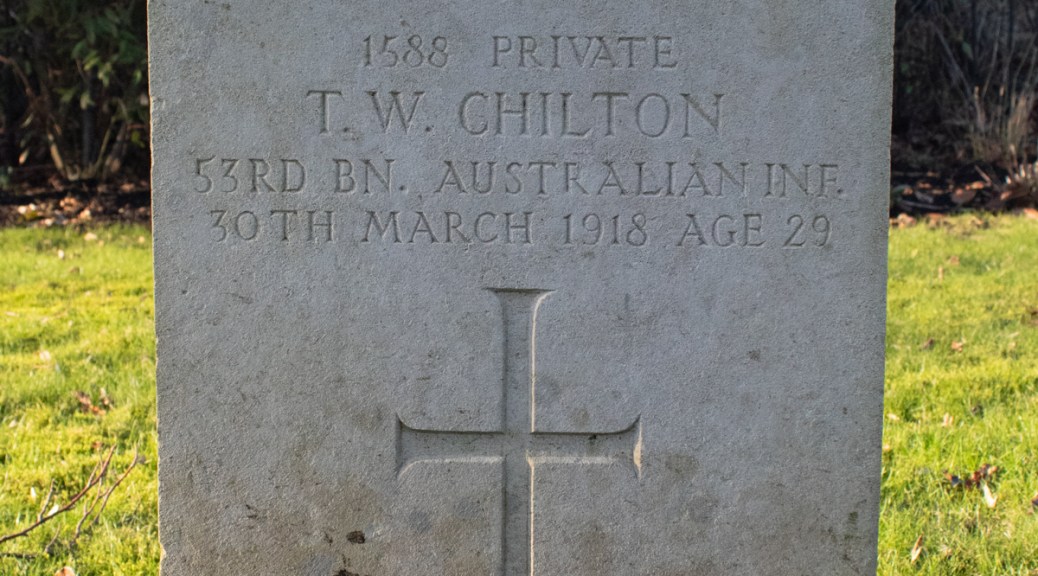
Private Thomas Chilton

Private Thomas Chilton

The early life of Thomas William Chilton is a challenge to unpick. Born in January 1888, his mother is recorded as Sarah Chilton. Documents refer to his place of birth as Darlington, County Durham, or Ripon, Yorkshire, although there are no records to corroborate either location.

When he finished his schooling Thomas found work as a farm labourer, but he had a sense of adventure. By 1911, he had emigrated to Australia to make a new life for himself as a farmer in New South Wales.

War broke out in the summer of 1914, and Thomas would step up to play his part. He enlisted in the Australian Imperial Force on 9th October 1916, his service records showing that he had previously volunteered for the 1st Battalion of the Australian Imperial Forces, but had been discharged on account of wounds. Private Chilton’s papers note that he was 5ft 9ins (1.75m) tall and weighed 159lbs (72.1kg). He had brown hair, blue eyes and a fresh complexion.

Thomas spent the next couple of months training, before his unit was dispatched overseas. He boarded the troop ship A24 Benalla on 9th November 1916, making the journey from Sydney to Devonport in two months. On 10th January, he was marched in to camp in Perham Down, Wiltshire, in preparation for the move to France.

Attached to the 53rd Battalion of the Australian Infantry, Private Chilton arrived in France on 26th April 1917. He was sent to the front, but just three weeks later was wounded by shrapnel in his feet, right side and face. He was sent to a casualty clearing station before being medically evacuated to Britain for treatment. Initially admitted to hospital in Wandsworth, Surrey, over the next few weeks he was moved to wards in Chelsea and Holborn in Middlesex.

Thomas recovered from his injuries and, by August 1917, he had been discharged from hospital. He had two weeks’ leave, before reporting back to his unit in Perham Down. Within days of arriving, he was charged with going AWOL, being absent from 3:30pm on 24th August to 4:30pm on 25th August. The result of his misdemeanour is unclear, but his records suggest he did not cross the line again.

In November 1917, Private Chilton was in hospital again, this time suffering from a bour of gastritis. He was admitted to the military hospital in Sutton Veny, Wiltshire, and, after being discharged on 3rd December, his time would be split between the ANZAC camps here and in nearby Codford.

Thomas undertook more training in January 1918, completing a course in signalling. That spring, however, his health took another downturn, and he contracted pneumonia. He was admitted to the No. 3 New Zealand General Hospital in Codford, but the condition would prove his undoing. Private Chilton passed away on 30th March 1918, at the age of 30 years old.

Although his mother was living in Yorkshire, the body of Thomas William Chilton was not returned home for burial. Instead he was laid to rest in the ANZAC graveyard extension of St Mary’s Church in Codford.


Thomas’ papers confirm that his brother was in attendance, and, although his name is not mentioned, it is likely to have been Ewden Auton, Sarah’s son, with whom Thomas’ will was kept for safe keeping.


Private Frank Cattermole

Private Frank Cattermole

Frank James Cattermole was born in 1899 in the Australian town of Jeparit, Victoria. The third of eight children, his parent were William and Amelia Cattermole.

When Frank completed his schooling, he found work as a baker’s assistant but, when war broke out in Europe, he was keen to step up and play his part. He enlisted on 1st February 1917, joining the Australian Imperial Force.

After a year’s training on home soil, Private Cattermole’s unit – the 48th Battalion of the Australian Infantry – set off from Sydney on 22nd March 1918. The troop ship he was assigned to – A54 HMAT Runic – would take two months to reach its destination, London. Frank spent three weeks of the journey admitted to the ship’s hospital, although the condition is unclear.

Once disembarked, Private Cattermole was marched to the ANZAC camp in Codford, Wiltshire. He arrived there on 24th May 1918, to begin preparations for a move to the Western Front. This was not to happen, however, as he was admitted to the camp hospital on 1st June, suffering from bronchitis.

Over the next two weeks , Frank’s condition worsened, and eventually his body was too weak to take any more. He passed away on 14th June 1918, aged just 18 years old.

Thousands of miles from home, Frank James Cattermole was laid to rest alongside others from his battalion, in the ANZAC extension to St Mary’s Churchyard, Codford.


Private Frank Cattermole
(from findagrave.com)

Private Sydney Clarke

Private Sydney Clarke

The early life of Sydney Clarke is a challenge to piece together. Born in St George, Queensland, Australia, his birth parents are not recorded, and his military records give his friend and foster mother Mrs Ellen Noud.

What can be determined is that he was working as a stockman when he enlisted in the army in April 1917, and was living in the town of Warwick.

Sydney’s service records give a little more information about the man he was. Aged 27 years and two months old, he was 5ft 3ins (1.6m) tall, and weighed 109lbs (49.4kg). He had black hair, hazel eyes and a dark complexion.

Part of the Australian Imperial Force, Private Clarke left Australia on 31st October 1917. His journey on board the troop ship HMAT Euripides was not without incident, and Sydney was placed in the brig for seven days and docked two days’ pay for “neglecting to obey an order given by a superior officer”. The ship reached Britain in December 1917, and he marched in to the ANZAC base in Codford, Wiltshire, on Boxing Day.

The next six months would prove trying for Sydney’s health. On 9th January 1918, he was admitted to the camp hospital with bronchitis. This developed into pneumonia, and he would remain admitted until 18th May, when he was sent to his unit, the 49th Battalion of the Australian Infantry.

Less than a month later, however, Private Clarke was back in hospital, this time with influenza. This time his health would fail him, though: he passed away from the condition on 23rd June 1918, and the age of 28 years old.

Thousands of miles from home, Sydney Clarke was laid to rest in the newly extended graveyard of St Mary’s Church in Codford, not far from the base in which he had been billeted.


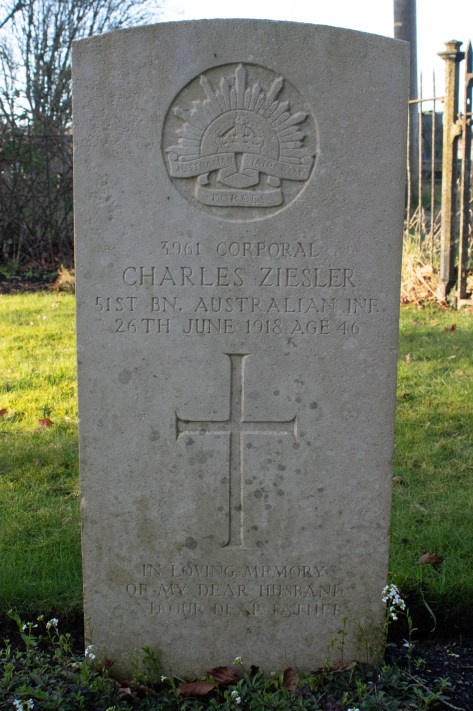
Corporal Charles Ziesler

Corporal Charles Ziesler

Charles Frederick Wilhelm Ziesler was born on 12th February 1877 in Timaru on New Zealand’s South Island. The oldest of nine children, his parents were Norwegian-born Johan Ziesler, and his New Zealand wife, Lucy.

Little information is available about Charles’ early life, but it is clear that he found work as a clerk when he finished his schooling. By the time of the 1899 electoral role, he had set up home at 258 Hereford Street in the Canterbury area of Christchurch.

Things were to change, however, and Charles emigrated to Australia. Taking up a job as a fire adjuster for an insurance company, he settled in the Subiaco suburb of Perth. In 1909 he married Martha Grimwood: the couple went on to have three children, and lived in a house at 97 Park Street.

When war broke out, despite his age, Charles stepped up to serve the Empire. He enlisted in the Australian Imperial Force on 12th November 1915, and was initially attached to the 35th Depot. His service papers show that he was 5ft 11ins (1.8m) tall and weighed 182lbs (82.6kg). He was recorded as having brown hair, blue eyes and a fair complexion.

After several weeks’ training, Private Ziesler’s unit left Australia for the battlefields of Europe. Arriving in Suez, Egypt, on 11th March 1916, he would receive further instruction there over the next couple of months. While many of the ANZAC battalions then set sail for the Dardanelles, the 35th Training Battalion, of which Charles was now a part, headed for Britain.

Private Ziesler arrived in Plymouth, Devon, on 16th June, and was marched into Rollestone Camp in Wiltshire. His preparation continued, and, in August, he was promoted to the rank of Corporal. Charles’ service records suggest that he did not serve on the Western Front, instead remaining attached to the Training Battalions based around Salisbury Plain, in Tidworth and Codford.

By the summer of 1918, Corporal Ziesler had been in Britain for two years and had been promoted to the rank of Acting Sergeant in the 51st Battalion of the Australian Infantry. In June he fell ill, and was admitted to the No 3 New Zealand General Hospital in Codford, suffering from bronchopneumonia. The condition was to prove his undoing: he passed away on 26th June 1918, at the age of 41 years old.

Thousands of miles from home, the body of Charles Frederick Wilhelm Ziesler was laid to rest in the ANZAC extension to the graveyard of St Mary’s Church, Codford, Wiltshire.


Charles’ belongings were returned to his widow: these included his clothing (a leather vest, fur vest, boots, puttees, cap, breeches, underpants and singlets) and more personal items (pipes, coins, photo albums, letters).

Martha may have taken comfort from a detailed letter she received about her late husband’s funeral. “The late Sergeant Ziesler was held in a very high esteem by all ranks in the Unit, and always proved himself a keen soldier, a true and sympathetic comrade and a friend in need and deed. His loss to the Unit is very keenly felt.”

(The CWGC records record the last full rank Charles held: as he held the role of Acting Sergeant, he is noted at the level below, Corporal.)


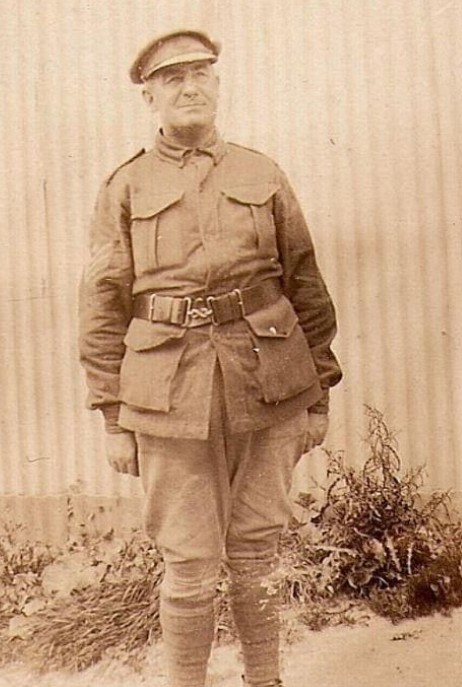
Corporal Charles Ziesler
(from findagrave.com)

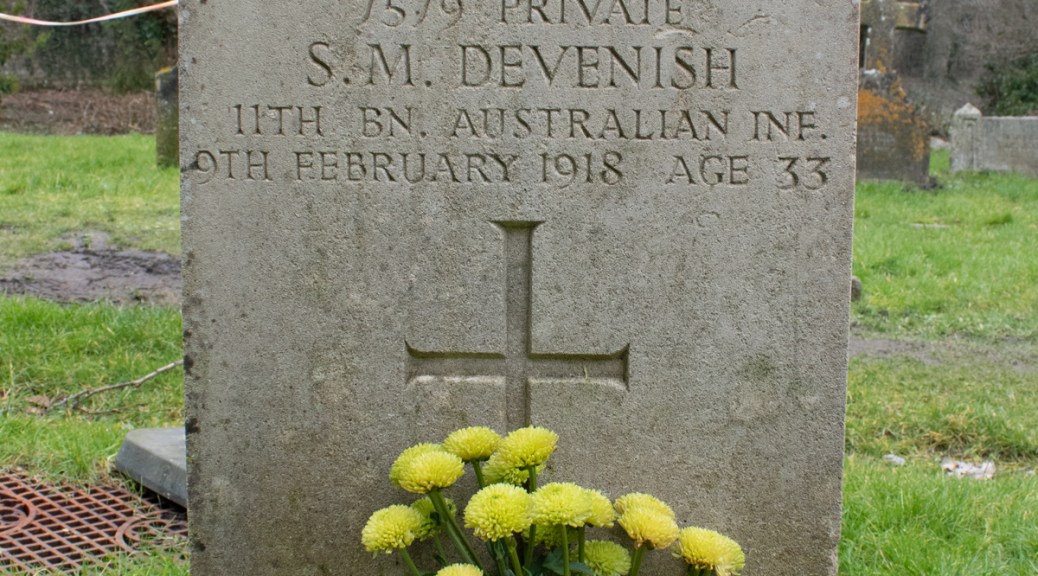
Private Sydney Devenish

Private Sydney Devenish

Sydney Milton Devenish was born in Perth, Western Australia, on 27th October 1884. One of eight children, he was the oldest son to Ralph and Ann Devenish. There is little information about his early life, but when he completed his schooling, he found work as a carter.

On 28th December 1912, Sydney married Matilda Durnin. They set up home in Fremantle, and had four children: Olive Harold, Sydney and Flora.

When war was declared, Sydney was keen to play his part. He tried to enlist at the start of 1916, but was turned down because of a heart issue. He tried again a year later, and was taken on as a Private in the Australian Imperial Force. His service records show that he was 5ft 3ins (1.6m) tall, and weighed 139lbs (63kg). He was noted as having light brown hair, brown eyes and a fresh complexion.

Private Devenish set sail from Perth on 29th June 1917. The voyage to Britain would take two months and, after arriving in Plymouth, Devon, he was marched into base at Durrington, on Salisbury Plain, Wiltshire. The journey took a lot out of the soldiers, and many fell ill because of it. Sydney was soon admitted to the Fargo Military Hospital with influenza, and spent a week there.

Sydney was discharged from hospital on 15th September, and would continue with his training as part of the 51st Battalion. His health was still causing a problem, however, and he was admitted to a military hospital again, this time in Sutton Veny, Wiltshire.

This man paraded in sick at 1.30pm on 8.2.18.. He had a diffuse swelling on the right side of the jaw. This did not extend down to the next, nor were there any other signs of Oedema found. There was a history of these sudden swellings …three day’s medicince [sic] given [to] this man; he complained of no pain.

I was awakened at 3.25am this morning [9th February] and told by two men that a man was choking… On my arrival there I found that life was extinct but did artificial respiration for a few minutes proving that there was a block in the lower respiratory passages somewhere, as air was difficult to force out of the chest. This man was cyanosed and there was a diffuse swelling of the face and neck…

Private Devenish died of an acute angioneurotic odema: he was 33 years of age.

The body of Sydney Milton Devenish was taken to nearby Warminster for burial. He was laid to rest in the graveyard of St Denys’ Church.


Sydney’s personal effects were forwarded to Matilda. The extensive list included ‘5 prs sox, 1 pr knee pads, 3 khaki collars, 3 balaclavas, water-proof cap cover, 1 money belt, 2 hair brushes in case, 1 safety raxor & blades in tin, 1 tin cigarette cards, 1 coo-ee wallet with letters, 2 note books, 2 religious books, 1 Cpl’s chevrons, 1 holdall (containing 2 razors, 1 comb, 1 clasp knife, 1 razor strop, cotton, buttons, cord, badges, metal ring and ribbon), 1 pr mittens, 1 parcel addressed Bailey Devenish, Guildford (containing 5 pieces music, 1 housewife, 2 handkerchiefs, 1 religious book, 1 letter, 1 French book, 1 book of views, 3 pipes, 2 masonic books), 1 tin (containing letters, postcards, signalling and playing cards), 2 novels, 1 prayer book, 1 motor manual, 1 purse, 1 damaged watch, 1 leather watch case, 1 watch protector on strap, 1 pr pliers, 2 kit bag handles & 1 lock, 1 tin opener, 1 pipe, 1 scarf’.


Private Sydney Devenish
(from ancestry.co.uk)
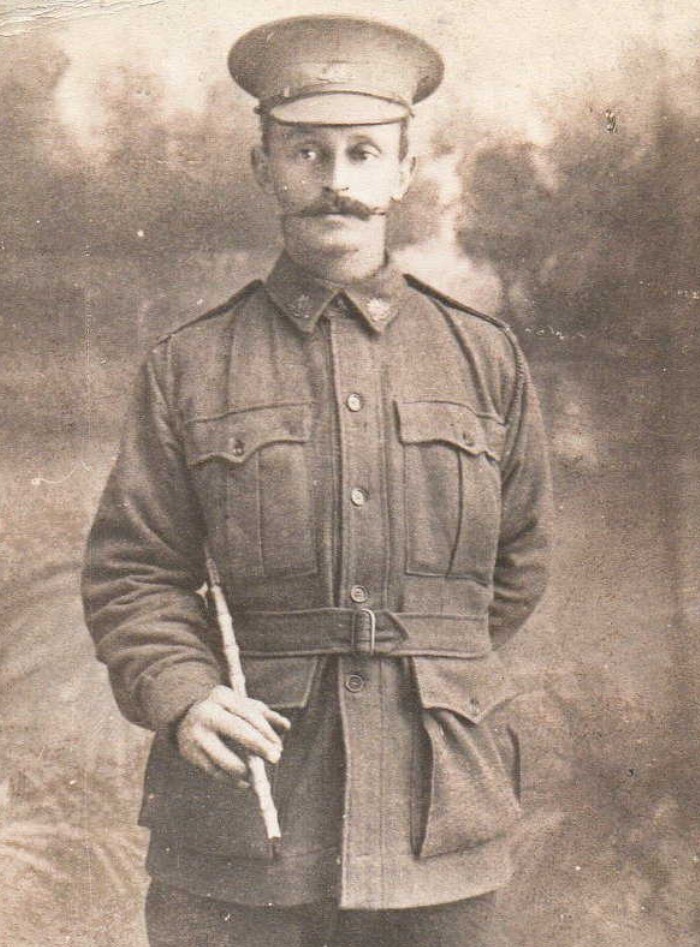
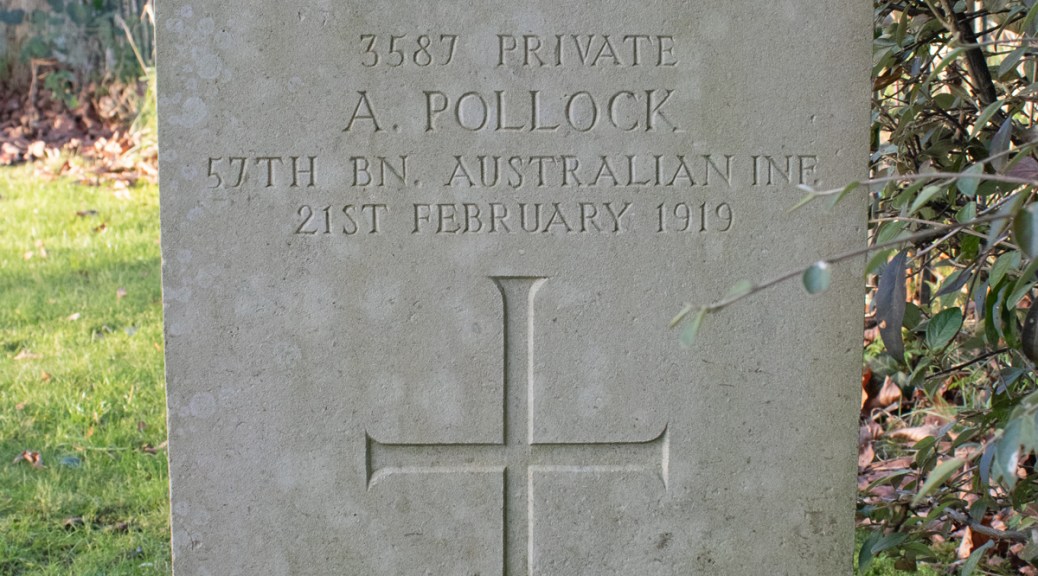
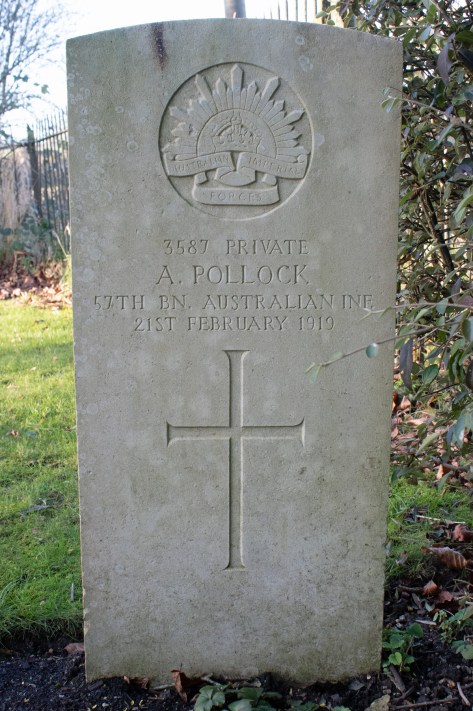
Private Alexander Pollock

Private Alexander Pollock

Alexander Pollock was born on 17th April 1893 in Bendigo, Victoria, Australia. The oldest of eight children, his parents were David and Annie. There is little information about his early life, but when he completed his schooling, he found work as a general labourer.

When war broke out, Alexander – who was better known as Ike – stepped up to play his part. He enlisted in the Australian Imperial Force (AIF) on 12th July 1915, just four months after his father had passed away. Private Pollock’s service records show that he was 5ft 6ins (1.68m) tall and weighed in at 13st 4lbs (84.4kg). He had dark brown hair, blue eyes and a fresh complexion, with a scar on his left bicep.

Private Pollock’s unit – the 57th Battalion – left Australia at the start of 1916, arriving in Egypt towards the end of February. They spent the next couple of months training at the Tell el Kebir camp, to the north of Cairo, before setting off to France, arriving in Marseilles on 23rd June.

Ike’s first taste of battle came within a matter of weeks, when his unit acted as a back-up force during the Battle of Fromelles. Described as the worst day in Australia’s history, the AIF suffered more than 5,000 casualties. The 57th Battalion, held in reserve, did not incur as many losses as other units and, as a result, Private Pollock would have remained entrenched on the Front Line after the worst hit battalions pulled back.

The next few years would see Ike remain on the Western Front. His service papers suggest that he did not see any leave until March 1918, but he was soon back in the action.

After the Armistice was declared, Private Pollock remained in France. He had a second period of leave from 22nd December 1918, spending the festivities in Britain. Back in France on 13th January 1919, he was moved to a training camp in Le Havre. By this point, however, his health was suffering, and he was moved back to Britain weeks after arriving.

Billeted at the ANZAC base in Codford, Wiltshire, Ike came down with influenza and pneumonia. He was admitted to the New Zealand General Hospital not far from the base, but the conditions were to prove fatal. He died on 21st February 1919, at the age of 25 years old.

Thousands of miles from home, and with his mother having also passed the previous year, the body of Alexander ‘Ike’ Pollock was laid to rest in the graveyard extension to St Mary’s Church, Codford.


Private Alexander Pollock
(from findagrave.com)