Tag Archives: Boy

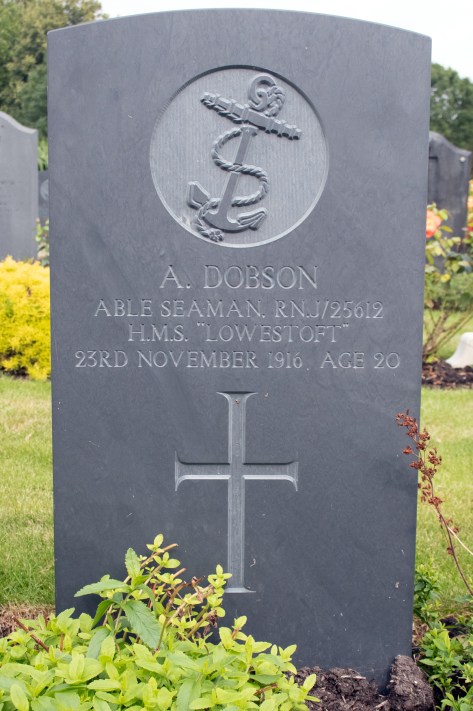
Able Seaman Albert Dobson

Able Seaman Albert Dobson

Albert Dobson was born in Bridlington, Yorkshire, on 7th April 1896. One of seven children, his parents were John and Annie Dobson. John was a bricklayer, and, when he completed his schooling, Albert was apprenticed to him. The 1911 census found the family living in a small terraced house at 55 St John’s Walk, on the outskirts of the town.

Bricklaying was not what Albert wanted from a career and, on 19th July 1913, he enlisted in the Royal Navy. Below the age to formally enlist, he was taken on with the rank of Boy 2nd Class, and sent to HMS Vivid – the Royal Naval Dockyard in Devonport, Devon, for his training.

Over the next nine months, Albert learnt the tools of his trade. Promoted to Boy 1st Class in October 1913, he spent time on board the battleship HMS Irresistible, before moving to HMS Pembroke, Chatham Dockyard in Kent. While he was there, he came of age, and was fully inducted into the Royal Navy as an Ordinary Seaman. Albert’s service papers show the man he had become: he was 5ft 7ins (1.7m) tall, with brown hair, blue eyes and a fresh complexion.

In April 1914, Ordinary Seaman Dobson was assigned to the new cruiser HMS Lowestoft. She would become his home for the next two years, and, while his annual reviews were average (character varying from good to very good and ability from moderate to satisfactory), he did gain a promotion to Able Seaman on 26th April 1915.

A singular fatality to a naval seaman names Albert Dobson, age 30 [sic], a native of Bridlington, was investigated at the Royal Naval Hospital, Chatham, on Monday. On October 20th, Dobson was one of a working party engaged on a battleship in the Dockyard, when, owing to the breaking of a plank, he and three men fell a distance of about eight feet. The knee of one of the men caught him in the stomach, with the result that he sustained a rupture of the spleen. In hospital he developed pneumonia, and died. A verdict of “Accidental Death” was returned.

[Kent Messenger & Gravesend Telegraph: Saturday 2nd December 1916]

Able Seaman Dobson’s service papers confirm that the incident occurred as the men were transferring a torpedo from HMS Illustrious. He was just 20 years of age when he died on 23rd November 1916.

The body of Albert Dobson was taken to Woodlands Cemetery in Gillingham, Kent, close to the dockyard he had come to know as home. He was laid to rest in the graveyard’s naval section.


Chief Petty Officer Albert Boorman

Chief Petty Officer Albert Boorman

Albert Edward Boorman was born on 21st November 1873 in Hadlow, Kent. He was the oldest of seven children, and one of four boys to James and Jane Boorman. James was a maltster’s labourer, but his eldest son sought a longer-term career.

On 5th January 1889, Albert enlisted in the Royal Navy. Due to his age, he took on the rank of Boy 2nd Class, and was sent to the training ships HMS Impregnable and HMS Lion, both based in Devonport, near Plymouth, Devon.

Over the next couple of years, Albert learnt the tools of his trade, rising to the rank of Boy 1st Class in December 1889. The following November he was assigned to HMS Calypso, a corvette, and it was during the eighteen months he spent with her that he came of age.

The now Ordinary Seaman Boorman’s service record show that, having turned eighteen, he was 5ft 7.5ins (1.71m) tall, with dark brown hair, grey eyes and a fresh complexion. He was noted as having a birth scar on his left shoulder.

Albert was obviously dedicated to his naval career and, on 2nd April 1892, he was promoted to Able Seaman. When he came of age, he enlisted for twelve years’ service and, during that time, he would serve on four ships. In between tours he returned to what would become his shore base, HMS Pembroke, the Royal Naval Dockyard in Chatham, Kent. His annual reviews reflected his commitment to the role: in December 1897 he was promoted to Leading Seaman, in January 1899 he gained the rank of Petty Officer 2nd Class, and in September 1900 he rose to Petty Officer 1st Class.

When his contract came to an end in November 1903, Albert immediately re-enlisted and would serve for another decade. In the summer of 1909 he was promoted to Acting Chief Petty Officer: the role was formalised a year later.

Away from his naval career, Albert had fallen in love. He married Eliza in 1909, and, while her husband was at sea, she set up home at 43 East Street, Gillingham, Kent.

In November 1913, after 22 years’ formal service, Chief Petty Officer Boorman was stood down to reserve status. This time away from the sea was not to last for long, however, and he was called upon once more when war was declared just nine months later. Albert resumed his previous role, but was primarily based back at HMS Pembroke.

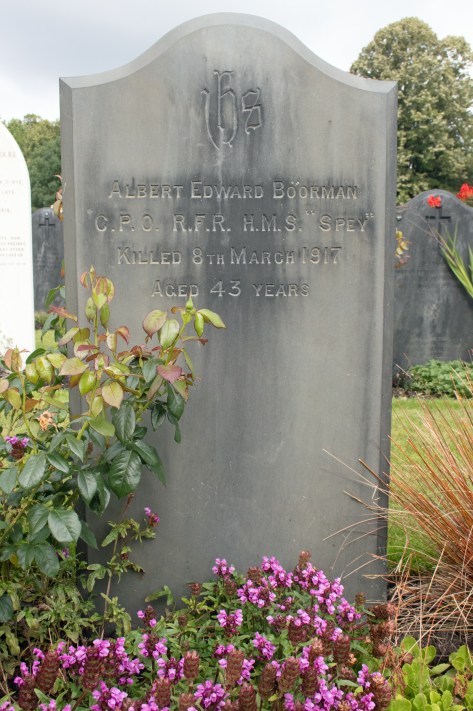
On 7th March 1917, Chief Petty Officer Boorman was on board the gunboat HMS Spey, which was carrying out diving operations in the Thames Estuary. At 4 o’clock in the afternoon, in “bitterly cold and boisterous conditions” [Whitstable Times and Herne Bay Herald: Saturday 24th March 1917], the ship lost an anchor, and the decision was made to return to base at Sheerness, Kent. Another vessel, the HMS Belvedere, was close by and turned towards the Spey, and, despite trying to avoid a collision, the smaller ship was struck a glancing blow.

The Spey was 40 years old, and the impact sheered numerous rivets from the side. Water gushed in, and the gunboat sunk beneath the Thames within a matter of minutes. Some of the crew had managed to escape on a life raft, but it was not fitted with lights or flags. The boat drifted and was not found until five hours later, partially submerged: all on board had died.

In total, twenty of the thirty-seven crew perished on that March afternoon, including Chief Petty Officer Boorman. He was 43 years of age.

The body of Albert Edward Boorman was retrieved. He was laid to rest in the naval section of Woodlands Cemetery, Gillingham, Kent, not far from where his widow still lived.


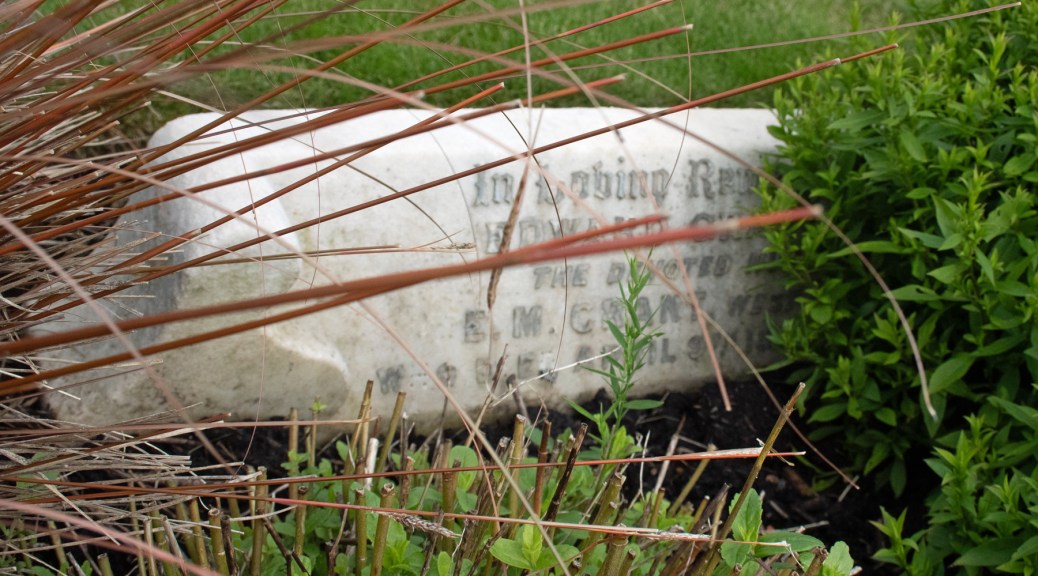
Petty Officer 1st Class Edward Grant

Petty Officer 1st Class Edward Grant

The early life of Edward Grant is a challenge to piece together. Born on 14th May 1863 in Newington, Surrey, he was the son of Thomas and Eliza Grant. The family do not appear on any census records, and it is only when Edward joined the Royal Navy in 1878 that he appears on any documents.

Edward’s service papers tell the story of a young man focused on his career. Underage when he joined up, he was given the rank of Boy 2nd Class, and sent to HMS Impregnable, the school ship based in Devonport, for his initial training. He remained on board for over a year, and rose to Boy 1st Class during that time.

Edward’s first full sea-going assignment was on board the screw corvette HMS Ruby. He would be assigned to her for eighteen months, during which time he came of age. Formally inducted into the Royal Navy, he took the rank of Ordinary Seaman. His service records show that he was a little over 5ft (1.53cm) tall, with brown hair, great eyes and a fair complexion.

Ordinary Seaman Grant’s contract was for ten years. During this time, his commitment to the job was clear: serving on a total of right vessels, he was promoted to Able Seaman in December 1882, Leading Seaman in October 1888 and Petty Officer 2nd Class in December 1889.

When his contract came to an end, Edward did not hesitate to re-enlist. He completed another decade of service, spending much of that time as a Boatman for the Coastguard on the Northumbrian coast.

It was while he was serving in Crastor that he met Elizabeth Smailes. She was a grocer’s daughter from nearby Dunstan, and the couple married in Alnwick on 14th February 1893. Edward and Eliabeth would go on to have five children, all girls, between 1896 and 1907.

By the time of the 1901 census, the Grants family were living in the Royal Naval Reserve Barracks in Hartlepool, County Durham. That November Edward was formally stood down to reserve status, having completed 20 years with the Royal Navy.

The 1911 census found Edward and the family living at the Guardians Offices at Hart Road in Hartlepool. A naval pensioner, he was employed as a caretaker for the town’s Board of Guardians, and the accommodation came with the job. Also living with them was Elizabeth’s mother, 83-year-old widow, Jane Smailes.

When war broke out, Edward stepped up to play his part once more. Now 51 years of age, he took on the role of Petty Officer 2nd Class once more: his papers show that he was now 5ft 5.5ins (1.66m) tall and had tattoos of a sailor woman and the words True Love on his left arm.

Petty Officer Grant remained firmly shore based, and was billeted at HMS Pembroke, the Royal Naval Dockyard in Chatham, Kent. He served for three years, and was promoted to Petty Officer 1st Class in May 1916.

On 9th April 1917, Edward Grant collapsed at his barracks. His passing was quick: he died of an aortic aneurysm and haemorrhage. He was 53 years of age. His body was laid to rest in the naval section of Woodlands Cemetery in Gillingham, not far from the naval base he had known for so many years.


Able Seaman Andrew Jacobs

Able Seaman Andrew Jacobs

Andrew William Jacobs was born on 7th May 1895 in Battersea, Surrey. One of nine children, his parents were Andrew and Ellen Jacobs. Andrew Sr was a bricklayer by trade, and, at the time of the 1901 census, the family lived at 37 Gwynne Road, sharing the house with Arthur and Florence Pitman.

Not long afterwards, the Jacobs family has moved to 31 Farlton Road, and Andrew Jr and his brother Henry were sent to Garratt Lane School. Both were registered on 23rd September 1903, and remained there until 18th November 1904, when they were moved to another school. By this point, Andrew Jr had reached Grade II in the key subjects of reading, writing, arithmetic and spelling.

When he completed his education, Andrew Jr found work as a machine and minder for Price’s Candle Company. According to the 1911 census he was boarding with his older sister, Ellen, and her family, living in a three-room lodging in Durham Buildings, York Road, Battersea.

Later that year, with adventure in mind, Andrew joined the Royal Navy. By this point he gave his employment as a candle wick maker, and, being under the age to fully enlist, he was given the rank of Boy 2nd Class. Sent to the training base in Devonport, Devon, he quickly learnt the tools of his trade and, in January 1912, he was promoted to Boy 1st Class.

On 7th May 1913, Andrew came of age, and formally signed up to the Royal Navy. His papers show that he was 5ft 9.5ins (1.77m) tall, with brown hair, brown eyes and a fresh complexion. The now Ordinary Seaman Jacobs had already served on board the armoured cruiser HMS Leviathan, and was into his second year aboard the training ship HMS St Vincent. Even though he had spent less than two years with the navy, his reviews were promising, noting a very good character and superior ability.

In April 1914, Ordinary Seaman Jacobs was moved to another vessel, the battleship HMS Bulwark. With war on the horizon, she formed part of the Channel Fleet, and was tasked with patrolling and defending Britain’s southern coast. Here Andrew’s dedication continued, and he was promoted to Able Seaman on 9th September 1914.

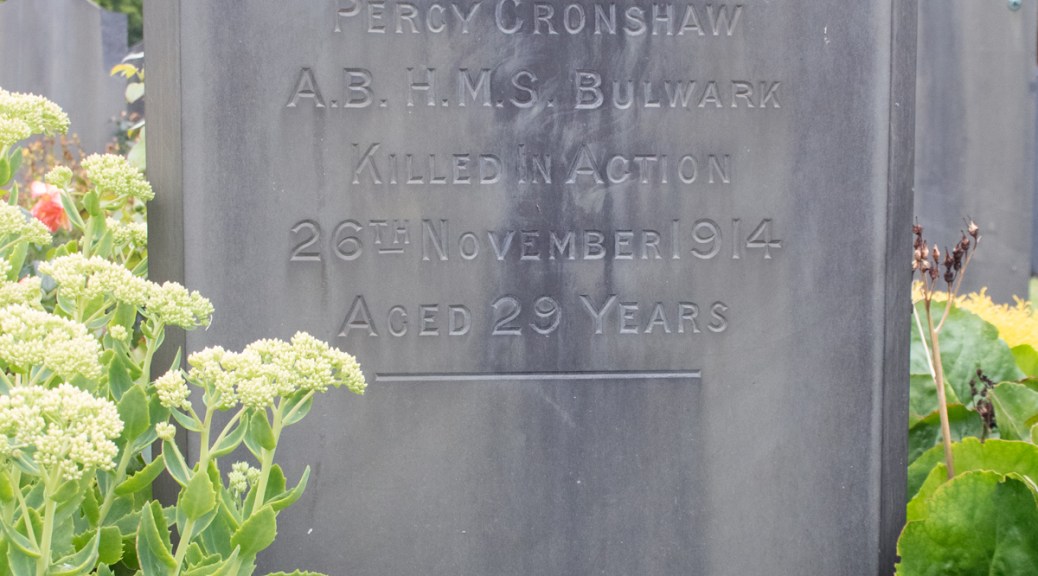
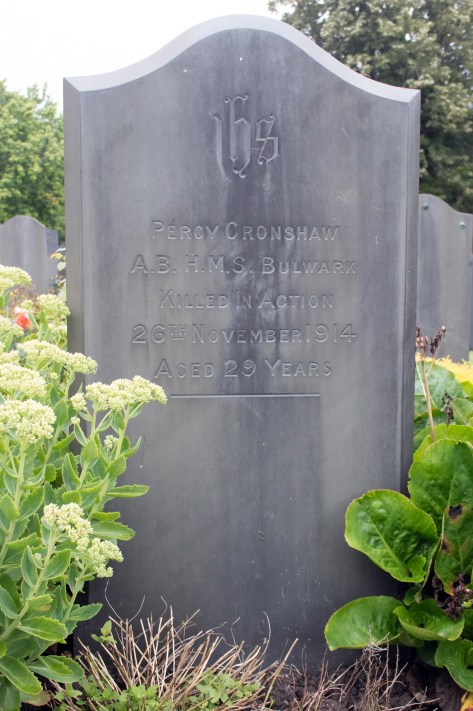
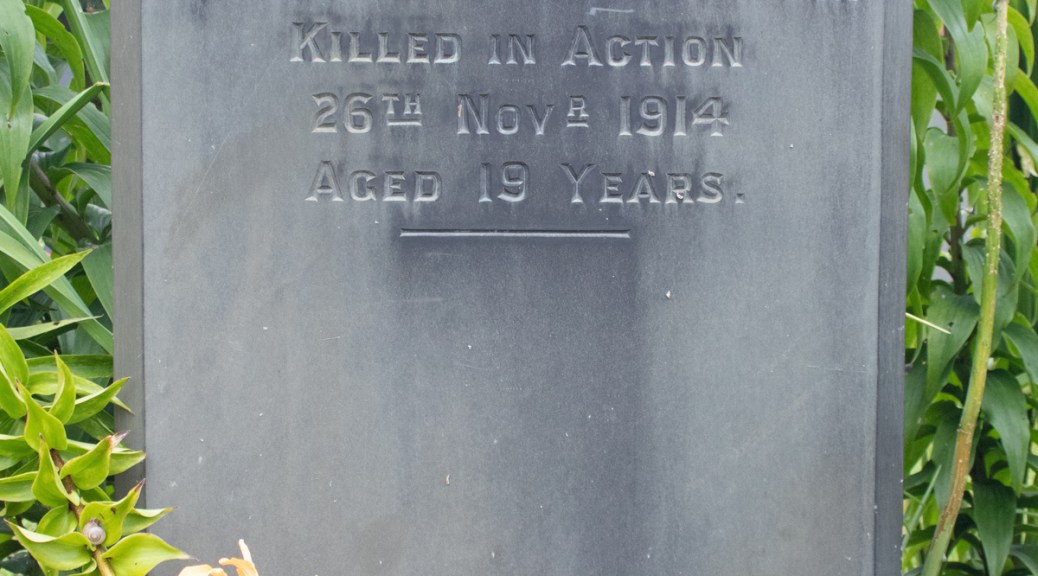
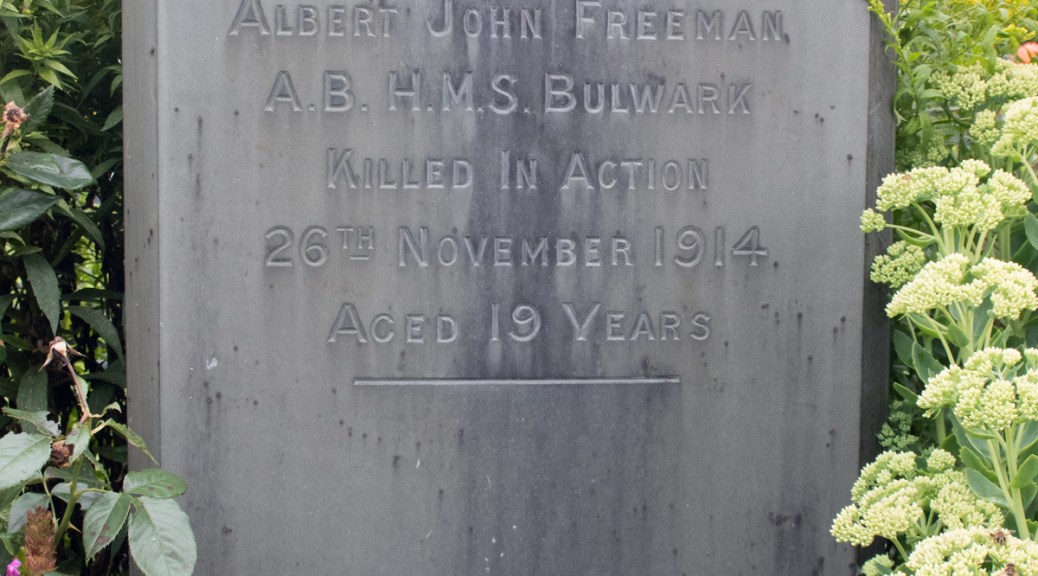
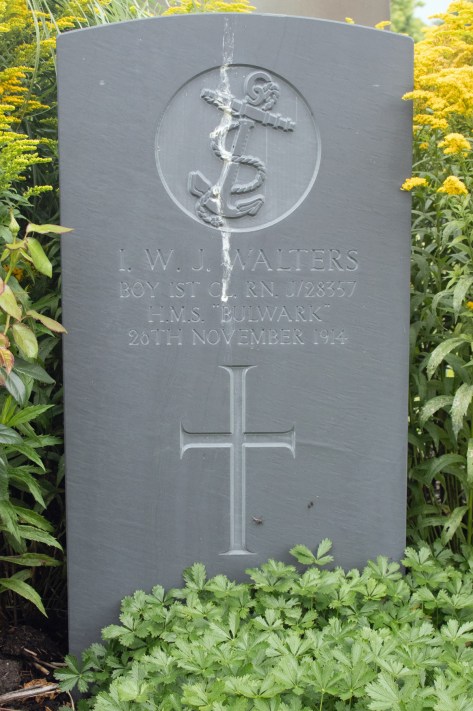
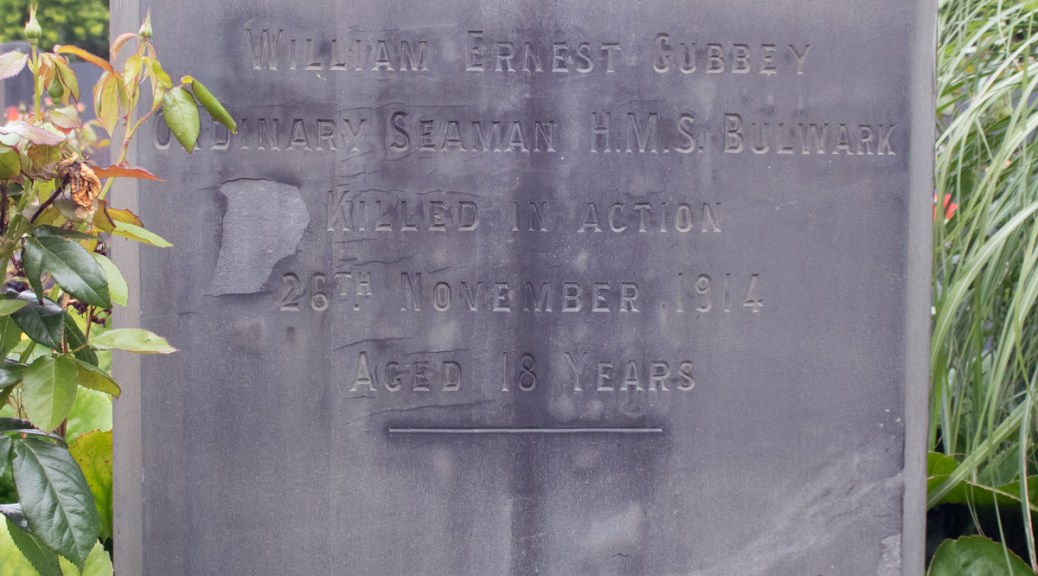
Two months later, on 26th November 1914, Bulwark was moored in the River Medway, close to Sheerness, and was being stocked with shells and ammunition. That morning, some poorly stowed cordite charges overheated, detonating the shells stored nearby. The resulting explosion ripped through the battleship, sinking her and and killing more than 740 crew, Able Seaman Jacobs included. He was just 19 years of age.

Many of the bodies from HMS Bulwark were not recovered, while those that were, but were unable to be identified, were laid to rest in a communal grave in Woodlands Cemetery, Gillingham, Kent. The remains of Andrew William Jacobs were both recovered and identified: he was buried in a marked grave in the same cemetery.


Boy 1st Class Harry Jerrom

Boy 1st Class Harry Jerrom

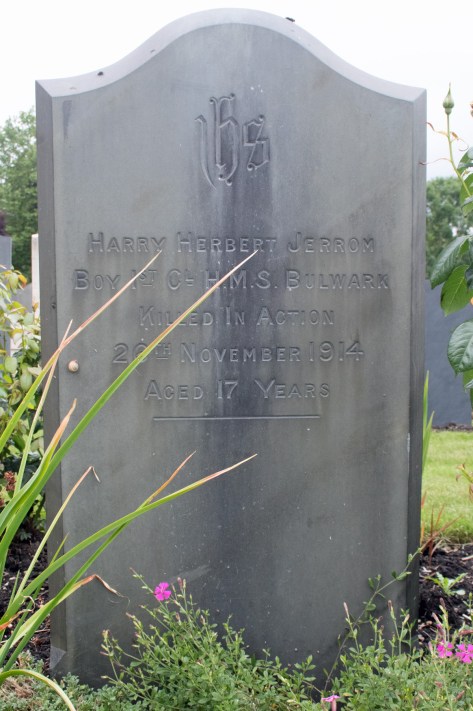
Harry Herbert Jerrom was born in the parish of Shinfield, Berkshire, on 26th July 1897. The oldest of eight children, his parents were caller Harry and Alice. Harry Sr was a farm labourer, and the family lived in Three Mile Cross.

Details of Harry Jr’s short life are scarce. Certainly when war broke out he stepped up to play his part, and had enlisted in the Royal Navy by the autumn of 1914. He was under the age to fully enlist by this point, and so held the rank of Boy 1st Class.

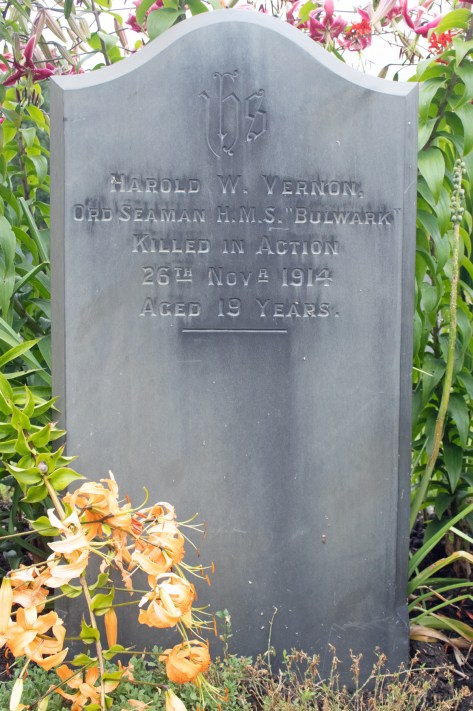
Harry was assigned to the battleship HMS Bulwark. Part of the Channel Fleet, she was tasked with patrolling and defending Britain’s southern coast. On 26th November 1914, Bulwark was moored in the River Medway, close to Sheerness, and was being stocked with shells and ammunition. That morning, some poorly stowed cordite charges overheated, detonating the shells stored nearby. The resulting explosion ripped through the battleship, and more than 740 crew were killed. Boy 1st Class Jerrom’s was among the bodies to be recovered: he was 17 years of age.

Those who were killed in the explosion were laid to rest in the naval section of Woodlands Cemetery, Gillingham, Kent. As his body had been identified, Harry Herbert Jerrom was laid to rest in a marked grave.

Boy 1st Class Harry Jerrom
(from findagrave.com)

Ordinary Seaman Frederick Millis

Ordinary Seaman Frederick Millis

Frederick Harold Millis was born in Marylebone, Middlesex, on 18th March 1896, and was one of five children to horse keeper William Millis and his wife Emily. Details of his early life are a challenge to piece together – he does not appear on the 1901 census, although Emily and his siblings are recorded at 1 Linhope Street.

William died in 1908, and by the time of the 1911 census, Emily had moved to Brighton, Sussex, where she was living at 49 Bernard Street with Frederick and two of his brothers. Fred was 15 years old by this point, and was working as a telegraph messenger, while his older sibling Alfred was working as a draper’s assistant.

Frederick sought a better life for himself, and, on 28th January 1913, he signed up to the Royal Navy. Being under age, he was given the rank of Boy 2nd Class, and was sent to HMS Vivid, the Royal Naval Dockyard in Devonport, Devon, for his training.

After just three months, Frederick was promoted to Boy 1st Class, and just a few weeks later was assigned to the battleship HMS Prince of Wales. In October 1913, he was moved to another battleship, HMS Bulwark, and it was here that he was formally inducted into the navy.

The now Ordinary Seaman Millis signed up for twelve years’ service, and his papers note that he was 5ft 8ins (1.73m) tall, with dark brown hair, dark brown eyes and a fresh complexion. He was also recorded as having a clasped hands tattoo on his right forearm and another of a sailor on his left arm.

Ordinary Seaman Millis would remain on board HMS Bulwark for a year. The battleship was part of the Channel Fleet, tasked with patrolling and defending Britain’s southern coast. On 26th November 1914, she was moored in the River Medway, close to Sheerness, and was being stocked with shells and ammunition. That morning, some poorly stowed cordite charges overheated, detonating the shells stored nearby. The resulting explosion ripped through the battleship, and more than 740 crew were killed. Frederick was amongst those whose bodies were recovered and identified: he was 18 years of age.

The bodies that were recovered from the tragedy were taken to the Woodlands Cemetery in nearby Gillingham and laid to rest. Frederick Harold Millis was buried alongside his colleagues in a marked grave.


Frederick’s headstone suggests he held the rank of Officer’s Steward: this seems to be an error, and possible a mis-interpretation of the initials of Ordinary Seaman.


Able Seaman Bertram Warner

Able Seaman Bertram Warner

Bertram William Warner was born on 16th February 1895 in Greenford, Middlesex. The youngest of four children, his parents were jobbing gardener Henry Warner and his wife, Elizabeth.

Bertram began working with his father after he completed his schooling, but he had his heart set on bigger and better things. A life at sea drew him in and, on 7th February 1913, he enlisted in the Royal Navy. His service records show the young man he had become: he was 5ft 2ins (1.58m) tall, with dark hair, grey eyes and a fair complexion.

Initially taken on as a Boy 2nd Class, Bertram was sent to HMS Vivid, the Royal Naval Dockyard in Devonport, Devon, for his training. His records outline his ability and commitment to the role. On 28th May 1913, as he moved to the training ship HMS Prince of Wales, he was promoted to Boy 1st Class. On 8th August he was deemed to be of age, and officially inducted into the Royal Navy.

On 4th October, Ordinary Seaman Warner was transferred to the pre-dreadnought battleship HMS Bulwark. Based in Portland, Dorset, at the start of the First World War, she would form part of the Channel Fleet patrolling and defending Britain’s southern coast. Bertram was continuing to prove his mettle and, on 13th October 1914, just eighteen months after initially joining the navy, he was promoted again, to Able Seaman.

Bertram was on board Bulwark on the 26th November 1914, when she was moored close to Sheerness, Kent. That morning, some poorly stowed cordite charges overheated, detonating some of the hundreds of shells stored shells nearby. The resulting explosion ripped through the battleship, killing more than 740 people. Able Seaman Warner was amongst those killed whose bodies were recovered and identified: he was 19 years of age.

The body of Bertram William Warner was taken to Woodlands Cemetery in Gillingham, Kent, and laid to rest alongside his colleagues.


Leading Seaman Dan Pierson

Leading Seaman Dan Pierson

Dan Pierson was born in Liss, Hampshire, on 14th February 1884. One of eleven children, he was the third of four sons to Daniel and Annie Pierson. Daniel was an agricultural labourer, but his son wanted a more guaranteed career and, on 21st February 1901, he joined the Royal Navy.

Having only just turned 17, Dan was too young to formally enlist, and so was given the rank of Boy 2nd Class. He would spend the next year on training ships – HMS Northampton and HMS Calliope – and was also billeted at HMS Victory, the Royal Naval Dockyard in Portsmouth, Hampshire. Just two months after joining, he was promoted to Boy 1st Class and, when he came of age in February 1902, he was fully enrolled into the navy, and given the rank of Ordinary Seaman.

Dan was assigned to the gunboat HMS Redbreast by this point, and his service records show the young man he had become. He was 5ft 6ins (1.68m) tall, with dark brown hair, grey eyes and a fresh complexion. He also had two tattoos: one of a woman on his right arm, and another of a swallow on his left.

Ordinary Seaman Pierson’s contract was for twelve years and, over that time, he served on board eight different vessels. His annual reviews commented on his very good character and his superior ability, both of which backed up his progression through the ranks. On 11th June 1903, towards the end of his three years aboard Redbreast, he was promoted to Able Seaman, and on 1st December 1913, just a couple of months before the end of his initial term of service, he rose to Leading Seaman.

By this point, Dan had married. His new wife, Edith, was a railway worker’s daughter from Harting in Sussex. She was working as a housemaid for Reverend John Leake and his wife Helena at the time of their wedding.

When his contract came to an end, Leading Seaman Pierson immediately renewed it. His papers show that he had grown to 5ft 9.5ins (1.77m) in height but that he had been injured in the intervening years: it was noted that the little toe of his right foot was missing, and that he had a scar on his left leg.

By the time war broke out, Leading Stoker Pierson was assigned to the pre-dreadnought battleship HMS Bulwark. During the summer of 1914, she was one of the Channel fleet used to protect ships transporting troops across to France. He was on board Bulwark when, on the morning of 26th November 1914, an explosion ripped through the ship while it was moored near Sheerness, Kent, tearing it apart and sinking it. In all 741 souls were lost, Dan amongst them. He was 30 years of age.

Dan Pierson’s body was recovered and identified. He was laid to rest in Woodlands Cemetery, Gillingham, Kent, not far from Chatham Dockyard.


Edith’s brother Ernest Pay was also serving in the Royal Navy. Attached to HMS Bulwark as well, Leading Stoker Pay was also killed in the explosion: he was 28 years of age. Tragically for Edith and her parents, Ernest’s body was never recovered. His loss is commemorated on the Portsmouth Naval Memorial in Hampshire.


Lieutenant Frederick Hill

Lieutenant Frederick Hill

Frederick Charles Hill was born on 13th June 1882 in the Devon village of Marldon. One of seven children, his parents were William and Elizabeth Hill. William was a carpenter, and the 1891 census found the family living or boarding at the Royal Oak Inn.

When he finished his schooling, Frederick found work as a gardener. However, he sought a bigger and better life and, on 21st April 1897, he joined the Royal Navy. His service record suggests that he lied about his age to do so, giving his year of birth as 1881,

Frederick was below the age to formally enlist in the navy, and was given the rank of Boy 2nd Class. He was sent to HMS Impregnable, the training base in Devonport, Devon, spending the next eighteen months there. Promoted to Boy 1st Class in February 1898, he was given his first posting, on board HMS Agincourt, later that year.

In the autumn of 1898, Frederick was assigned to the cruiser HMS Leander. The following summer, and based on the date of birth he had previously provided, he came of age, and was formally inducted into the Royal Navy. His service records show that he was 5ft 2ins (1.57m) tall, with red hair, grey eyes and a fresh complexion. Hs was also noted as having a scar on his forehead.

The now Ordinary Seaman Hill remained on board HMS Leander for more than two years. He proved a worthwhile member of crew, and was promoted to Able Seaman in May 1900. He left Leander in January 1901, and was billeted at HMS Vivid, the Royal Naval Dockyard in Plymouth, Devon, which would become his base when not at sea.

Frederick’s contract was for twelve years, and during that time he would serve on four vessels. His dedication to the navy was evident by his promotions – he made Leading Seaman in October 1904, Petty Officer 2nd Class in October 1906, and Petty Officer 1st Class in March 1911. When his term of service ended, he immediately re-enlisted, and, at his annual reviews, was regularly noted for his very good character and superior ability. His career kept going from strength to strength, and, in 1914, he was promoted to Chief Petty Officer.

He was sent to Antwerp in September [1914] with the Royal Naval Division, and in 1916 went to the Dardanelles, there gaining his commission for bravery. After the evacuation he was sent to France and won the MC in the Ancre drive in 1916. In February 1918 he was sent for six months’ rest to England. Lieut. Hill volunteered to go to France again in November the same year, and contracted heart disease, from which he died. He returned to England early in June [1919], and, being on sick leave, went to Paignton Hospital, where his death occurred.

[Brixham Western Guardian: Thursday 7th August 1919]

Frederick Charles Hill was 37 years of age when he died on 2nd August 1919. His body was laid to rest in the family plot in St John the Baptist’s Church, Marldon.


Frederick’s headstone records his rank as Lieutenant Commander. However, Commonwealth War Grave Commission documents suggest his rank was Lieutenant.


Able Seaman William Watts

Able Seaman William Watts

William Watts was born on 24th October 1872 in the Devon village of Stockfleming. Details of his early life are unclear, but his later marriage record gives his father’s name as Richard.

The first confirmation of William’s life was his military service records. He left his job as a farmer’s lad and joined the Royal Navy on 3rd January 1888 and, being just 15 years old at the time, he was given the rank of Boy 2nd Class.

William was sent to HMS Impregnable, the navy’s training base in Devonport, Devon, for his initial induction. He remained there for the next eighteen months, and was promoted Boy 1st Class during that time. In October 1889, he was given his first posting, on board the sloop HMS Pylades. She would be his home for more than three years, during which time he came of age.

Now formally inducted into the Royal Navy, William was given the rank of Ordinary Seaman. His service papers show that he was 5ft 1ins (1.55m) tall, with dark hair, hazel eyes and a fair complexion.

Over the twelve years of his initial contract Ordinary Seaman Watts made a career for himself. By the end of that time, he had served on five further ships, returning to HMS Vivid, the Royal Naval Dockyard in Devonport, in between voyages. He was proving his mettle as well, and was promoted to Able Seaman on 1st November 1893.

When, in March 1901, his contract came up for renewal, William immediately re-enlisted. His service record shows that he had grown to 5ft 4ins (1.65m) tall, and now sported a tattoo of a star on his left wrist. He spent another thirteen years in the Royal Navy, but transferred to the Coastguard, serving in Weymouth in Dorset, and Brixham and Dartmouth in Devon.

On 15th September 1903, William married Olief Lawrence. The daughter of a labourer from Fontwell Magna, Dorset, the couple married in her local parish church. They would settle in Brixham, and have one son, William, who was born in October 1907.

When war broke out, William was called up on to play his part. Pensioned off just two months previously, he now returned to sea, joining the battleship HMS Goliath as an Able Seaman. His health was failing him by this point, however, and on 18th December 1914, he was invalided out of naval service.

At this point, William’s trail goes cold. It is clear that he and Olief moved to Marldon, to the west of Paignton, and he took up the role of landlord of the Ship Inn (now Ye Olde Smokey House). His health still seemed to be impacted, however, and it would eventually get the better of him. He died on 16th June 1917, at the age of 44 years of age.

The body of William Watts was laid to rest in the graveyard of St John the Baptist Church in Marldon, the village which he had come to call home.