Tag Archives: Chief Petty Officer

Lieutenant Frederick Hill

Lieutenant Frederick Hill

Frederick Charles Hill was born on 13th June 1882 in the Devon village of Marldon. One of seven children, his parents were William and Elizabeth Hill. William was a carpenter, and the 1891 census found the family living or boarding at the Royal Oak Inn.

When he finished his schooling, Frederick found work as a gardener. However, he sought a bigger and better life and, on 21st April 1897, he joined the Royal Navy. His service record suggests that he lied about his age to do so, giving his year of birth as 1881,

Frederick was below the age to formally enlist in the navy, and was given the rank of Boy 2nd Class. He was sent to HMS Impregnable, the training base in Devonport, Devon, spending the next eighteen months there. Promoted to Boy 1st Class in February 1898, he was given his first posting, on board HMS Agincourt, later that year.

In the autumn of 1898, Frederick was assigned to the cruiser HMS Leander. The following summer, and based on the date of birth he had previously provided, he came of age, and was formally inducted into the Royal Navy. His service records show that he was 5ft 2ins (1.57m) tall, with red hair, grey eyes and a fresh complexion. Hs was also noted as having a scar on his forehead.

The now Ordinary Seaman Hill remained on board HMS Leander for more than two years. He proved a worthwhile member of crew, and was promoted to Able Seaman in May 1900. He left Leander in January 1901, and was billeted at HMS Vivid, the Royal Naval Dockyard in Plymouth, Devon, which would become his base when not at sea.

Frederick’s contract was for twelve years, and during that time he would serve on four vessels. His dedication to the navy was evident by his promotions – he made Leading Seaman in October 1904, Petty Officer 2nd Class in October 1906, and Petty Officer 1st Class in March 1911. When his term of service ended, he immediately re-enlisted, and, at his annual reviews, was regularly noted for his very good character and superior ability. His career kept going from strength to strength, and, in 1914, he was promoted to Chief Petty Officer.

He was sent to Antwerp in September [1914] with the Royal Naval Division, and in 1916 went to the Dardanelles, there gaining his commission for bravery. After the evacuation he was sent to France and won the MC in the Ancre drive in 1916. In February 1918 he was sent for six months’ rest to England. Lieut. Hill volunteered to go to France again in November the same year, and contracted heart disease, from which he died. He returned to England early in June [1919], and, being on sick leave, went to Paignton Hospital, where his death occurred.

[Brixham Western Guardian: Thursday 7th August 1919]

Frederick Charles Hill was 37 years of age when he died on 2nd August 1919. His body was laid to rest in the family plot in St John the Baptist’s Church, Marldon.


Frederick’s headstone records his rank as Lieutenant Commander. However, Commonwealth War Grave Commission documents suggest his rank was Lieutenant.


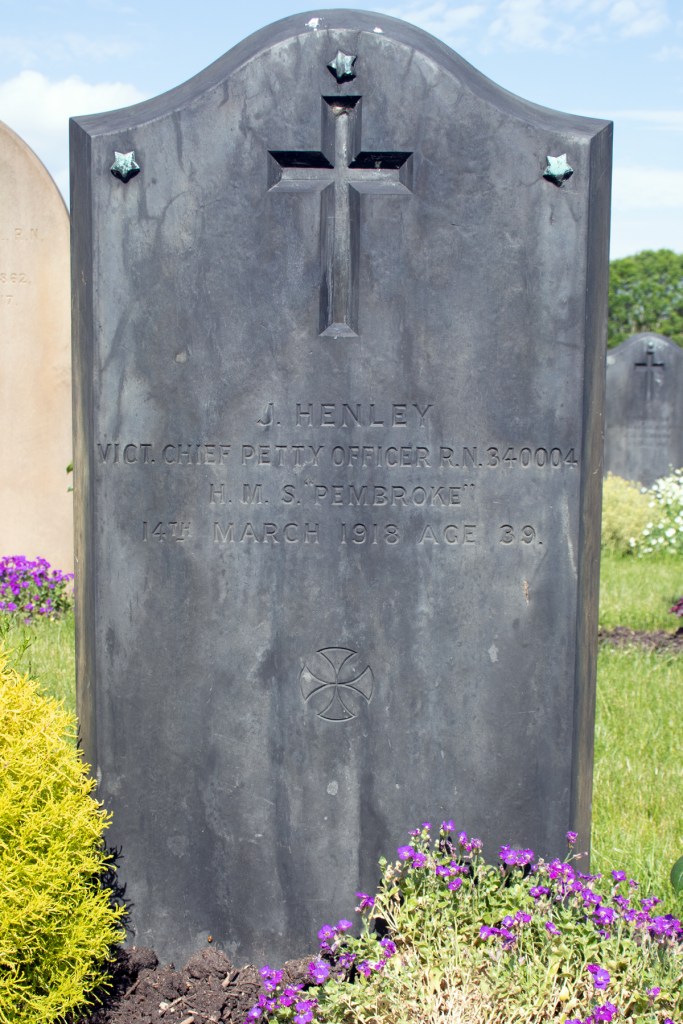
Chief Petty Officer John Henley

Chief Petty Officer John Henley

John Henley was born on 4th September 1878, and was the second of five children to William and Frances. William was a navy pensioner from Maidstone, Kent, but it was in the nearby village of Loose that John was born and the family raised.

Given his father’s background, it was inevitable that John would go to sea as well. The 1891 census recorded him as being one of nearly 1000 pupils of the Royal Hospital School in Greenwich, and just three years later he formally enlisted in the Royal Navy. Just sixteen years of age, he was given the rank of Ship’s Steward Boy. His service records confirm that he was 5ft 4ins (1.63m) tall, with dark brown hair, light blue eyes and a fresh complexion.

Initially based at HMS Pembroke, the Royal Naval Dockyard in Chatham, Kent, over the next eighteen months, John spent time on five ships. This gave him enough grounding so that when he came of age in September 1896, he could be formally inducted into the navy, with the rank of Ship’s Steward Assistant.

Over the next decade, John’s career flourished. He was promoted to Acting Ship’s Steward in January 1901, and full Ship’s Steward fifteen months later. He had spent time on a further ten ship by this point, returning to HMS Pembroke in between postings.

In July 1905, John married Maud Norton, a carpenter’s daughter from his home village. While her husband was away at sea, she set up home at 88 Kingswood Road, Gillingham, Kent, and the couple went on to have three children: John, William and Lionel.

Back at sea, and by the time war broke out, Ship’s Steward Henley had completed more than twelve years in the role. In February 1918, he received a further promotion, this time to Victualling Chief Petty Officer, but this new role was to be cut tragically short. The following month, he was admitted to the Royal Naval Hospital in Chatham, Kent, suffering from a gastric ulcer. This haemorrhaged, and he passed away while still admitted. John died on 14th March 1918: he was 39 years of age.

We regret to announce the death of Mr John Henley, Victualling Chief Petty Officer (Ship Steward)… Deceased was a native of Loose and… had served 25 years in the Royal Navy, having commenced his career in the Royal Hospital School, Greenwich, at the age of eleven years. He took part in the battle off the Falkland Islands, and also in the operations in the Dardanelles whilst serving on HMS Inflexible. He leaves a widow and three sons.

[Kent Messenger & Gravesend Telegraph: Saturday 30th March 1918]

John Henley was laid to rest in the naval section of Woodlands Cemetery, Gillingham, walking distance from where his widow still lived.

Chief Petty Officer John Henley
(from britishnewspaperarchive.co.uk)

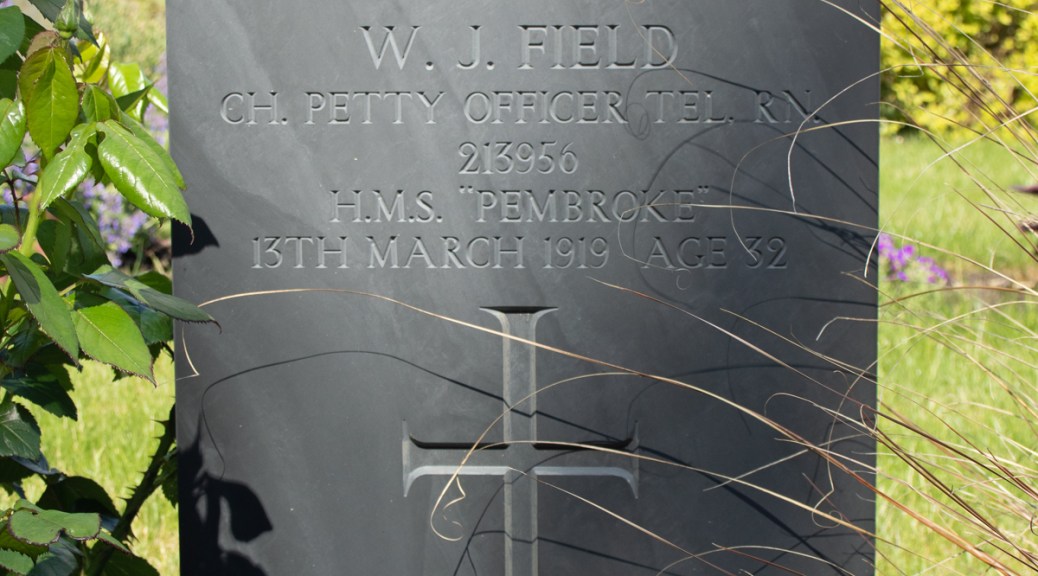
Chief Petty Officer Telegraphist William Field

Chief Petty Officer Telegraphist William Field

William John Field was born on 8th October 1885 in Boston, Lincolnshire. The eldest of four children, his parents were Charles and Ellen. Charles was a boatman for the coastguard; his job, by the time of the 1891 census, had taken the family to the village of Dawdon on the County Durham coastline.

Given his father’s job, it is not unsurprising that William was destined for a life at sea. As soon as he left school in the spring of 1901, he joined the Royal Navy and was sent to HMS Ganges, the shore-based training establishment in Suffolk. Being underage, he was initially assigned the role of Boy, moving, after a year, to HMS Pembroke, also known as the Naval Dockyard in Chatham, Kent.

By November 1902 Boy Field was moved to HMS Venerable, a ship that was to be his home for the next three years. During this time, William came of age, and was formally enrolled in the Royal Navy as a Signalman. He evidently worked hard on the Venerable, rising through the ranks to Qualified Signalman and Leading Signalman.

In June 1905, William was moved to HMS Leviathan, where he was again promoted, to Second Yeoman of Signals, before again being assigned to Chatham Naval Dockyard six months later.

While based in Kent, William met Nelly Watt, the daughter of a labourer at the dockyard. The couple married in 1906, and went on to have four children.

Over the next few years, the now Petty Officer Telegraphist Field spent an almost equal amount of time at sea and on shore. War was coming and when his initial term of service came to an end in October 1915, he immediately renewed his contract through to the end of the hostilities.

All of William’s time was now spent on land, primarily at HMS Pembroke, but also at HMS Actaeon in Portsmouth, HMS Victory VI at Crystal Palace, London and HMS Bacchante in Aberdeen.

While Chief Petty Officer Telegraphist Field’s naval service records are quite detailed, his passing is anything but. The war over, he moved back to Chatham Dockyard in January 1919. At some point he was admitted to the Royal Naval Hospital in the town, and died from ‘disease’ on 13th March that year. He was just 33 years of age.

William John Field was laid to rest in the Woodlands Cemetery in nearby Gillingham.


A sad aside to the story is that, at the time of he husband’s death, Nellie was pregnant with the couple’s fourth child. John William Field was born on 16th October 1919, destined never to know his father.


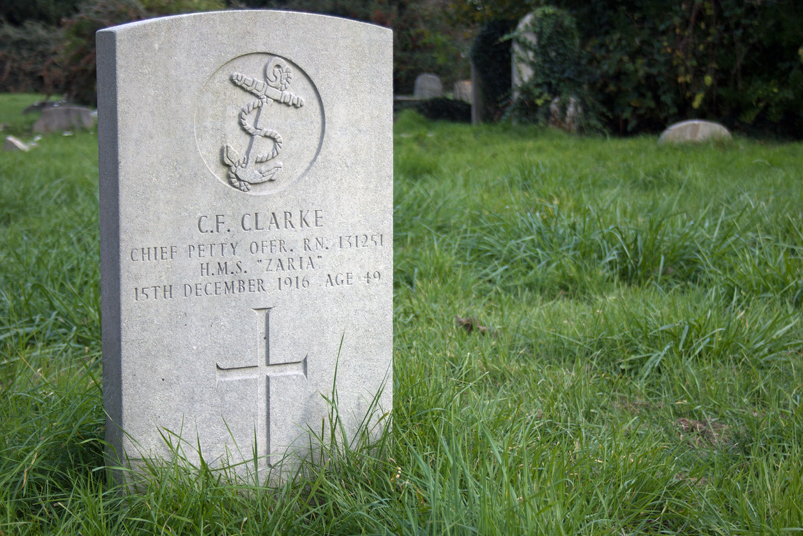
Chief Petty Officer Charles Clarke

Chief Petty Officer Charles Clarke

Charles Frederick Clarke was born on the 14th April 1869 to James and Jane Clarke. James was born in Suffolk, but moved to London, where he found work as a watchman (guarding the city streets at night). Jane was from Essex, and the couple went on to have five children, of whom Charles was the middle child.

Charles was set on a life of adventure, joining the Royal Navy in 1887, for a period of twelve years. During this time, he served on eleven vessels, working his way up through the ranks from Boy to Ordinary Seaman to Able Seaman, Leading Seaman and eventually Petty Officer.

In October 1895, he married Lydia Rogers, a sailor’s daughter from Portsmouth. The couple would go on to have nine children, eventually settling in Sussex.

When his naval service ended in 1899, Charles enlisted again. Within six years, he had achieved the rank of Chief Petty Officer, and in March 1909, after 22 years’ service, retired from active duty. He was obviously well respected, however, and was selected to serve on the staff of the Royal Naval Recruiting Office in Portsmouth. His service records suggest that he resigned from this role on 14th April 1914.

It seems that Chief Petty Office Clarke took on a role on the vessel HMS Zaria. This was a ship that was requisitioned by the Royal Navy, which acted as a patrol ship, guarding the coastal waters around the UK. While details are scant, Charles certainly served on board for a couple of years, and he died on board, from causes undisclosed, on 16th December 1916, at the age of 47 years old.

Brought back to West Sussex, Charles Frederick Clarke was laid to rest in the Broadwater Cemetery in Worthing. This was where Lydia was now living; she was buried in the same grave, when she passed away eight years after her husband.