Charles Pratt was born in the West Sussex village of Findon in the autumn of 1899. The oldest of five children – all boys – his parents were farm labourer Charles and his wife, Emily.
Charles Jr was still a schoolboy at the time of the 1911 census. The family were living in the five-roomed cottage called Sheepcombe by now: farm labourer Charles Sr, Emily, Charles Jr, his three younger siblings (youngest boy Albert being born in 1915), and Emily’s brother, farm horseman Daniel Hollingdale.
When war was declared, the oldest Pratt boy was still just fourteen years of age, and too young to enlist. As the fighting raged across the continent, it seems likely that he was disappointed to miss out on the adventure. Full details of his army service have been lost to time but records suggest that he joined up no later than April 1918.
Private Pratt was attached to the 9th (Service) Battalion of the East Surrey Regiment. He was certainly sent to France, and may have been caught up in the Battles of the Somme in 1918. He fought at Cambrai, and this is where he would be injured. Charles’ wounds were bad enough for him to be medically evacuated to Britain, and he was admitted to the 4th Northern General Hospital in Lincoln, Lincolnshire, for treatment.
Sadly, the soldier would succumb to his injuries. He passed away on 27th October 1918, at the age of just 19 years old.
Charles Pratt was taken back to Sussex for burial. He was laid to rest in the graveyard of St John the Baptist Church in Findon, walking distance from his family home.
Charles’ was a family plot: he would be reunited with his parents when the passed away: Charles Sr in 1953 and Emily in 1958.
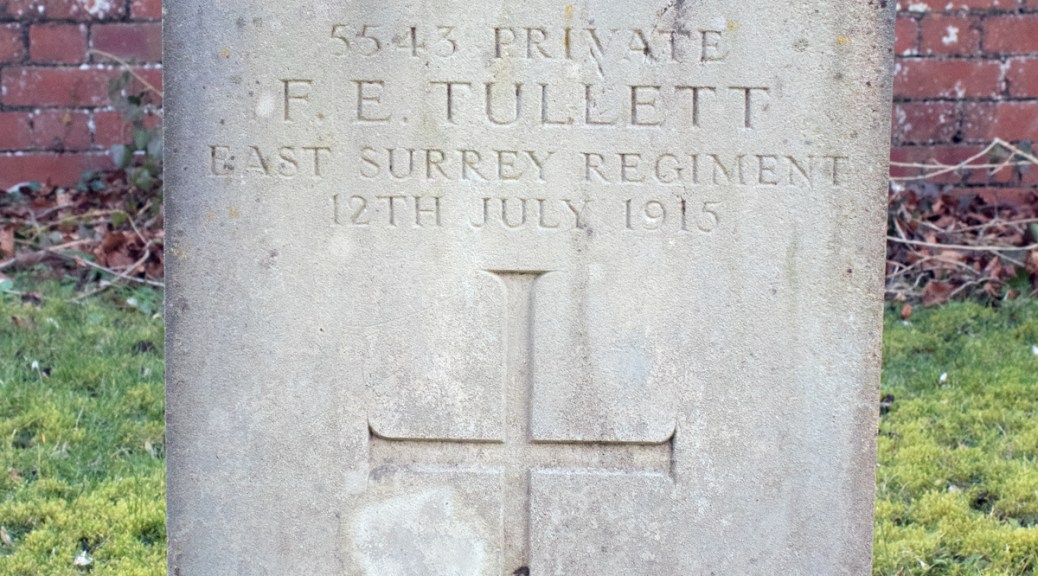
Frederick Edward Tullett was born in 1885 in Islington, Middlesex. The seventh of nine children, he was the fourth son of house painter John Tullett and his wife, Sarah.
When he completed his schooling, Frederick found work as an errand boy for a greengrocer. This appears to have been a trade he enjoyed: by the time of the 1911 census, he was employed as a greengrocer’s porter; while his marriage certificate records him as a fully-fledged grocer.
Frederick’s betrothed was Eliza Gundry, the daughter of a bricklayer from Wimbledon, Surrey. The ceremony was held on 18th April 1915 in the town’s All Saints’ Church. The couple were already living at 15 Dryden Road at this point.
It would appear that Frederick had already stepped up to serve his King and Country by the time of his marriage and, while his profession was listed as greengrocer, it may be that this was the job he continued while waiting to be formally mobilised.
Frederick had enlisted in the army by the start of 1915, and was assigned to the 8th (Service) Battalion of the East Surrey Regiment. The unit was based on Salisbury Plain, Wiltshire, and this is where Private Tullett would end up by that summer.
Crowded barracks were notorious as breeding grounds for infections diseases, and Frederick, sadly, was not to be immune. He contracted pneumonia, and was admitted to a military hospital in Codford. The condition was to prove his undoing: he passed away on 12th July 1915, at the age of 30 years old.
Finances may have prevented Eliza, who had been widowed after just 12 weeks of marriage, from bring her husband back home. Instead, Frederick Edward Tullett was laid to rest in the graveyard of St Peter’s Church in Codford, Wiltshire.
Richard George Birch was born on 8th July 1878, in Westminster, Middlesex. One of nine children, his parents were Samuel and Alice Birch. Samuel started work as a messenger for the House of Lords, and went on to be a military cap maker by the time of his son’s baptism.
When he finished his schooling, Richard found employment as a printer and compositor. He married Evelyn Groom in 1906, and the couple went on to have three children: Harry, Doris and Richard Jr.
The 1911 census showed a change in circumstances for the family. They were living in Farnham, Surrey, and their household was made up of Richard, a pregnant Evelyn, Harry, Doris and a servant, Florence. Richard had now left the printing business, as was employed as a comedian.
When war came to Europe in August 1914, Richard stepped up to play his part. Having enlisted by the spring of 1917, he initially joined the East Surrey Regiment, although at some point he made the transfer to the Royal Fusiliers.
Little information remains available about Private Birch’s military life. Attached to the 22nd (Service) Battalion, he seems not to have served overseas. It appears that he either served in Somerset, or was sent there to recuperate following an illness or injury, as he was in Burnham-on-Sea by the autumn of 1917. He passed away in the town on 19th September, the cause of his passing not freely recorded. He was 39 years of age.
Richard George Birch’s body was not taken back to Surrey, possibly because of financial constraints. Instead laid to rest in Burnham Cemetery, Somerset.
William Stringer was born in Warlingham, Surrey, on 4th December 1885, and was one of nine children to Stephen and Jane Stringer. Stephen was a carter, but is seems that William wanted an escape.
On 18th April 1901, he enlisted in the Royal Navy and, because of his age, he was granted the rank of Boy 2nd Class. He was initially sent to HMS Impregnable, the school ship, and remained there for just over a year, during which his hard work paid off and he was promoted to Boy 1st Class.
His basic training complete, and after a short stint at HMS Vivid, the Royal Naval Dockyard at Devonport, he was assigned to HMS Collingwood. Over the next couple of years, William served on a couple more vessels and, in 1903, when he came of age, he was formally inducted into the navy, and given the rank of Ordinary Seaman.
William’s service records show that he was 5ft 4ins (1.63m) tall, had auburn hair, brown eyes and a fresh complexion. For distinguishing marks, he was noted as having two dots on his left forearm and scars on his legs.
Now that he was tied to a twelve year contract, Ordinary Seaman Stringer’s seems to have viewed his life in a different light. His ‘very good’ conduct quickly changed to ‘fair’ and, at the end of 1904, he spent two separate stints in the cells, presumably because of his attitude or behaviour.
This shock to the system seems to have been what William needed, however, as in 1905, he took to the new role, and his ratings improved once more. Over the next couple of years, he served on HMS Montagu and HMS Diamond, returning to Devonport in between voyages. In January 1907 he was promoted again, this time to Able Seaman, but, as with the previous promotion, things began to go downhill again.
In March, he spent two weeks in Diamond’s brig, a punishment that was repeated in September. The following month Able Seaman Stringer’s service records not his character as ‘indifferent’ and, the following month he was discharged from the Royal Navy, having refused to work for 42 days.
It was while he was serving on board HMS Diamond that William met Lena Cropp, who was presumably working in one of the ports on the South Coast. She was the daughter of labourer Jesse Cropp and his wife, Philadelphia. When Jesse died in 1897, Philadelphia married bricklayer James Smith, who had boarded with the family for a number of years.
William and Lena had a son, Joseph, on Christmas Day 1907. Now removed from the Navy, William moved his young family back to Surrey, where he found work as a cowman, and Lena took in laundry to bring in an extra income. The couple went on to marry in 1911, and went on to have two further children – Elsie, who was born in 1912, but who died when just a toddler; and Gladys, who was born in the summer of 1918.
When war closed in on Europe, something of a sense of duty must have pulled on William. He enlisted in the summer of 1915, joining the East Surrey Regiment. He seems to have quickly transferred across to the Labour Corps, and arrived in France on 15th July.
It is unclear for how long Private Stringer served in France, but at some point he returned to Britain. In October 1918, he was admitted to the War Hospital in Bath, suffering from stomach problems. His health was to prove his undoing, and he passed away from a biliary calculi peritonitis on 8th October 1918, at the age of 34 years of age.
Finances may have been tight for Lena, as William was buried in the city where he died, rather than being brought back to Surrey, where she was living. Because of this, it is unlikely that he ever met his daughter, who had been born just two months before.
William Stringer was laid to rest in the Roman Catholic Cemetery in Bath.
William’s Pension Ledger notes Lena as his widow, but only mentions one child – Joseph – as a dependent. The document also records him as an illegitimate stepchild, as he had been born a couple of years before the couple married.
The record notes that it, while Joseph’s legitimacy meant he was not eligible for a share of his William’s pension, it had been decided that the basic rate should be provided while he remained in Lena’s care.
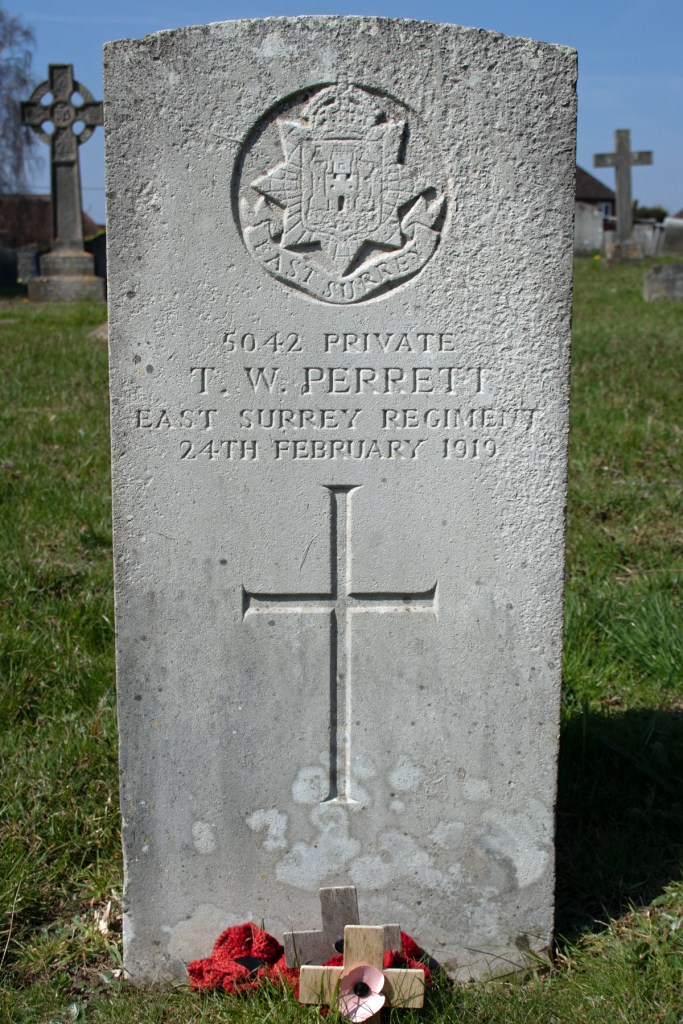
Thomas William Perrett was born in October 1878, the seventh of eight children to Lewin and Ann Perrett. Lewin was an agricultural labourer from Wiltshire, and it was in Aldbourn, near Marlborough, that the family were raised.
Initially finding work as a farm labourer, Thomas was soon drawn to the bright lights and big city. By the early 1900s he had moved to London, and it was here that he met, and in 1909 married, Mary Sterry, a labourer’s daughter from Middlesex. The couple went on to have three children, Elsie, Rose and Alice.
Thomas, by this point, had found work on the railways: the 1911 census records him as a railway porter, presumably at Paddington Railway Station, which was within a few minutes’ walk of where the Perrett family were living.
War came to Europe, and Thomas was keen to play his part. Full details of his service are not available, but he enlisted in the East Surrey Regiment, where he was assigned to the 2nd/5th Battalion. This was a second line unit, and Private Perrett remained on home soil for the duration of the war.
This territorial role was reinforced when he transferred across to the 696th Agricultural Company of the Labour Corps. Details of his work are not available, but it seems likely that he was assigned to farm work in the mid-Sussex area.
This too is where Private Perrett remained after the war and where, on 24th February 1919, he was to pass away. Details of his death are vague and the cause is unknown, but he was 40 years of age.
Thomas William Perrett was laid to rest in the cemetery in Cuckfield, West Sussex.
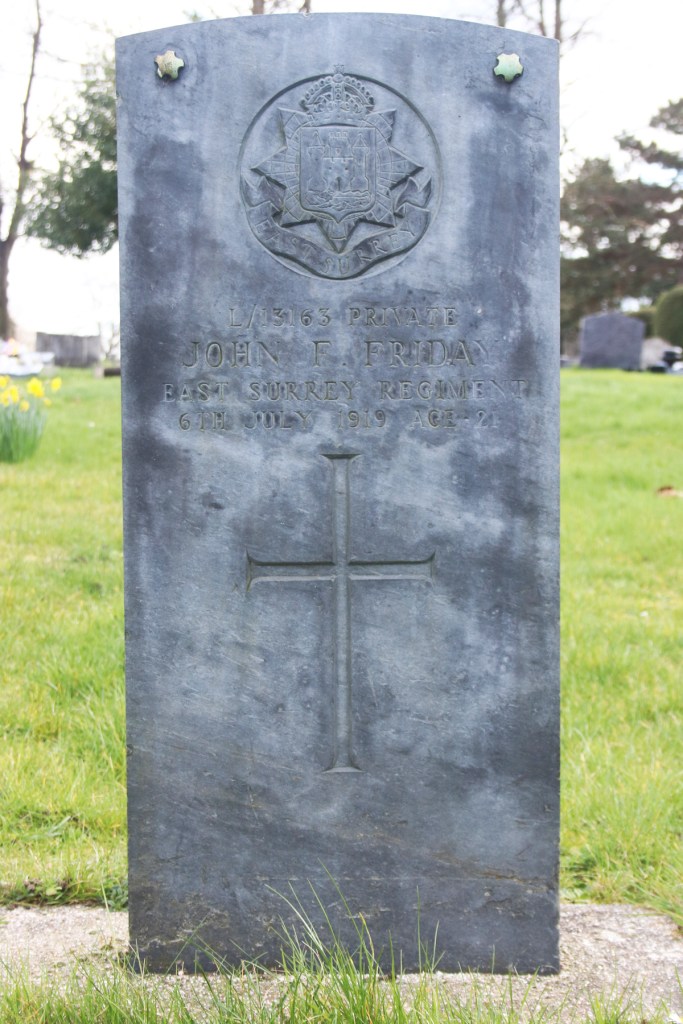
John Francis Friday was born in June 1898 to John and Laura Friday from Gillingham in Kent. Laura passed away when John Jr was only ten years old, and his dad remarried, meaning John Jr had eight full and half siblings. John Sr was a farm labourer, and the family lived on the river front in Gillingham, Kent.
John’s military service seems a bit of a challenging one. A letter to Gillingham Police Station dated November 1916 stated that he had not received his call up papers, but that he would present himself that day for enlistment.
John eventually enlisted on 27th December 1916; his joining records show that he was 18 years and six months old, and stood at just under 5ft 3ins (1.57m) tall. He also noted that his preference was to be assigned to the Royal Engineers.
Private Friday initially joined the Manchester Regiment, and, while serving on the Western Front, seemed to have a bit of a rebellious streak in him. He was pulled up on misdemeanours such as neglect of duty on at least five occasions before being admitted to hospital in Calais in December 1917, suffering from trench foot. After serving some further time in England, he again found himself in France in the summer of 1918.
On 11st March 1919, he was transferred to the East Surrey Regiment, and was shipped back to England at the beginning of April. Sadly, it looks like John was stricken by poor health; he passed away on 6th July 1919, having contracted pneumonia. He was just 21 years old.
John Francis Friday lies at rest in the Woodlands Cemetery in his home town of Gillingham in Kent.






 Death and Service