Harold Wheeler was born on 22nd May 1898 in Gloucester. One of nine children, his parents were George and Emma Wheeler. George, who worked as a telegraphist and clerk for the Post Office, was from Rugby, but by the time he and his Swansea-born wife has their second child, they had settled down in Gloucestershire.
There is tragically little information on Harold’s life and it is impossible to know what he did between leaving school and enlisting in the army. War broke out in 1914, and, while too young at the time, he had joined up by early 1917.
Private Wheeler was assigned to the 3rd (Reserve) Battalion of the Gloucestershire Regiment. Based in Kent, he was billeted in Maidstone. The only other record available for him is that of his passing. He had been admitted to the Military Hospital in Aylesford, and died, through causes unknown on 24th June 1917. He had just turned 19 years of age.
Harold Wheeler was laid to rest in the graveyard of the nearby St Peter’s & St Paul’s Church in the Kent village where he had passed.
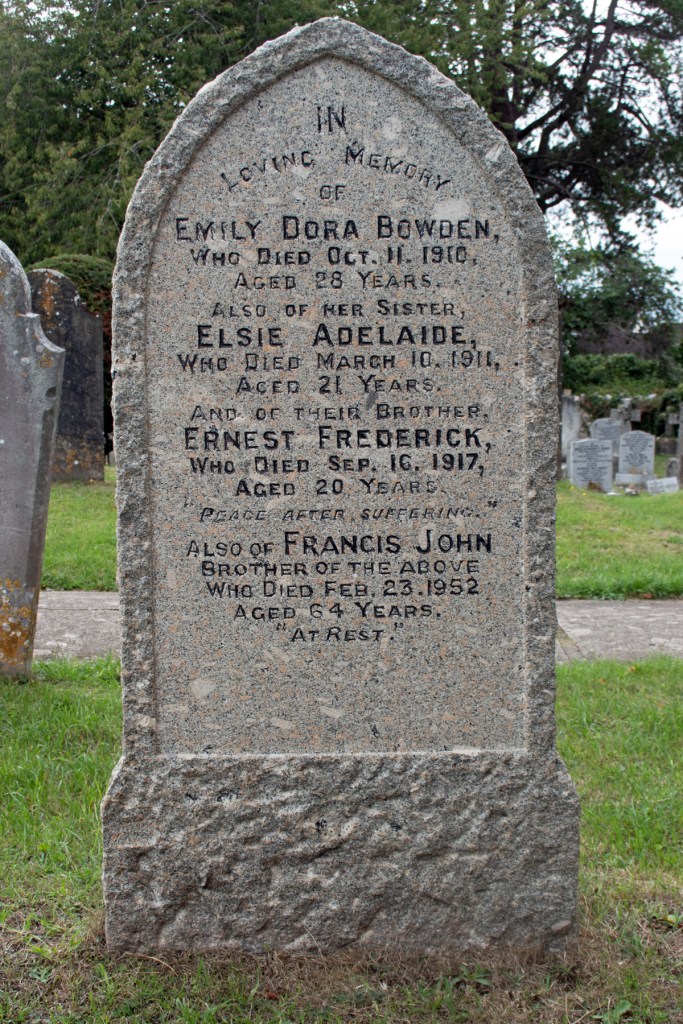
Ernest Frederick Bowden was born on 2nd November 1896 in Ipplepen, Devon. He was one of eleven children – and one of twins – to Frederick and Dora Bowden. Tragically, Dora died when Ernest was just over a year old, leaving Frederick and his older sisters to raise the family as best they could.
When he left school, Ernest found work as a page for a surgeon living in Paignton, before finding other employment as a chauffeur in Bovey Tracey. In his spare time, he was an avid bellringer at his local church.
War was coming to Europe, however, and in November 1915, he enlisted in the Gloucestershire Regiment. His service records noted that he was 19 years of age, and stood just 5ft 1.5ins (1.56m) tall. Assigned to the 14th Battalion, Private Bowden soon found himself on the front line. Arriving in France in July 1916, he spent four months there, during which he contracted tuberculosis and trench foot.
Medically evacuated to Britain for treatment, his conditions proved too severe for him to continue in the army. He was discharged from active service in December 1916.
For some months he had been at the Ivybank Dispensary, Exeter. Complications set in, and he rapidly sank just before reaching his 21st year.
Western Times: Friday 28th September 1917
Ernest Frederick Bowden had passed away on 16th September 1917, aged just 20 years old. He was laid to rest in the family grave at St Andrew’s Church, Ipplepen.
Thomas David William Denny was born on 26th December 1890 in Glasgow, Lanarkshire. There is little information on his early life, other than that his parents were Thomas and Annie Denny.
By the time of the 1911 census, Thomas Jr was serving as a Lance Corporal in the 2nd Battalion of the Gloucestershire Regiment, and was based at the Verdola Barracks in Malta.
When war broke out, the battalion was called back to mainland Europe. By 19th December 1914, Thomas found himself in France; two years later, he was in Salonika, Greece.
Thomas’ bravery was not in doubt. While serving in France, he received the Military Medal for conspicuous gallantry. This went hand in hand with a promotion to Sergeant. In 1917, he received a commission as Second Lieutenant and was moved to the regiment’s 3rd Battalion.
In the spring of 1918, Second Lieutenant Denny married Elsie, a woman from Bearsted, near Maidstone in Kent. Sadly, little else is known of her, and even a later newspaper report only referred to her as “a Bearsted lady” [East Kent Gazette: Saturday 15th March 1919].
By early 1919, Thomas was back in Britain. Whether he had been demobbed is unclear, but is seems more likely that he had returned home for medical treatment. On 6th March, he passed away in Maidstone. He was just 28 years of age.
Thomas David William Denny was laid to rest in the graveyard of Holy Cross Church in Bearsted close to where the now-widowed Elsie must have lived.
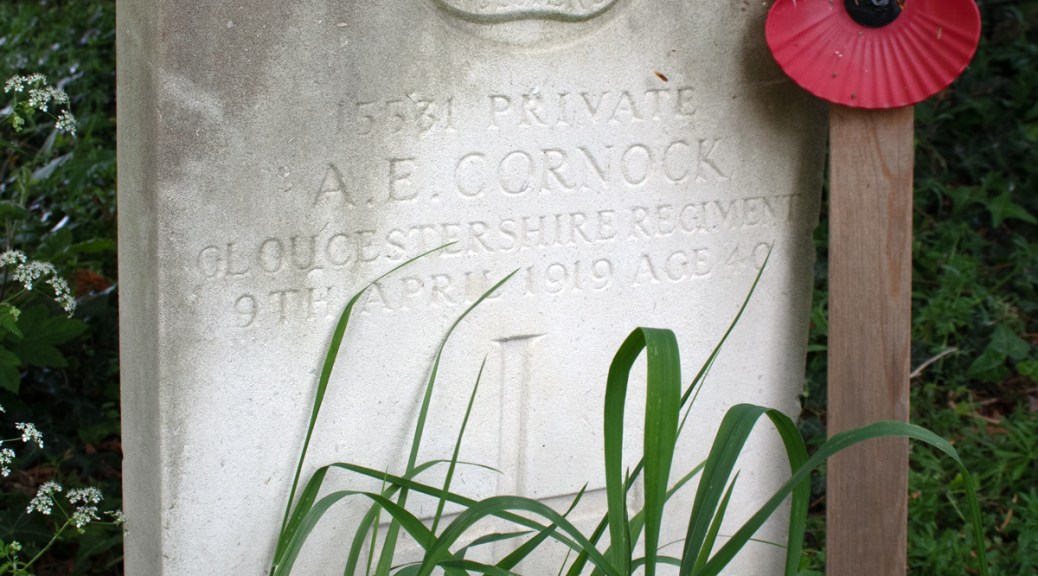
Albert Edward Cornock was born in 1878, and was one of eight children. His parents, John and Hannah Cornock, were both born in Wotton-under-Edge, Gloucestershire, ant this is where the family were brought up.
John was a labourer, and this was the trade than Albert also fell into. On 2nd August 1903, he married local woman Bessie Carter. The couple settled in their home town and went on to have eight children.
War came to Europe in 1914, and Albert was amongst those to enlist early on. He joined the 10th (Service) Battalion of the Gloucestershire Regiment in Bristol on 13th November. Albert’s service records show that he was 5ft 4ins (1.62m) tall and weighed 119lbs (54kg). He had a fresh complexion, brown eyes and black hair.
Private Cornock’s initial training was split between Cheltenham and Salisbury Plain, but he was eventually sent out to France as part of the British Expeditionary Force in August 1915. He spent nearly eighteen months overseas, but, towards the end of the following year, he contracted tuberculosis, and was sent back to England for treatment.
Albert’s lung condition was to ultimately lead to his discharge from the army on medical grounds. His last day of service was 8th February 1917.
At this point, Albert’s trail goes cold. He returned home to Gloucestershire, and lived on another couple of years. He passed away at home on 9th April 1919, aged 40 years old: while the cause of his passing is not clear, it seems likely to have been as a result of the illness that saw him discharged from the army.
Albert Edward Cornock was laid to rest in the graveyard of St Mary the Virgin Church in his home town of Wotton-under-Edge. He lies not far from his cousin, Ernest Cornock, another victim of the First World War, who was buried just a week later.
Leslie Vines was born on 16th September 1898, and was one of seventeen children to John and Emma. John was an elastic web maker or braider from Stroud, Gloucestershire, and it was in nearby Wotton-under-Edge that he and Emma raised their growing family.
Braiding and weaving ran in the family: the 1911 census recorded six of the Vines’ children who were over school age were employed in the local mill. When he finished school, Leslie also found work there.
When war came to Europe, Leslie was eager to play his part. He enlisted in the Gloucestershire Regiment on 18th June 1915, just a month after his older brother, Wilfred, had joined up. His service records confirm that he was 5ft 2ins (1.57m) tall: Keen as he was to follow his older brothers into glory, he gave his age as 19 (two years older than he actually was) in order to be accepted for duty.
Private Vines’ eagerness, however, was to be thwarted. On 29th June, less than two weeks after joining up, he was discharged from service. Details are scant, but this seems to have been on the basis that, following his medical examination, he was considered to be unfit for duty.
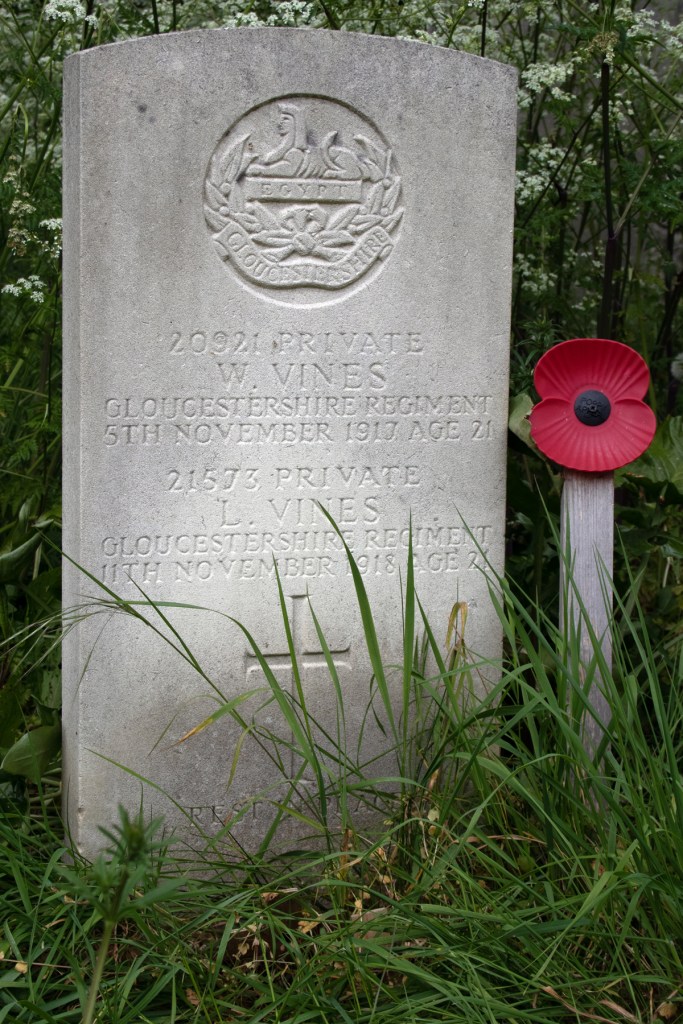
At this point, Leslie’s trail goes cold and the next available record is that for his death on Armistice Day, 11th November 1918. He was just 20 years of age. While the cause of his passing is not readily available, it was not reported on in any of the contemporary newspapers, so is likely to have been of natural causes.
Leslie Vines was laid to rest alongside his brother, Private Wilfred Vines, in the graveyard of St Mary the Virgin Church in his home town, Wotton-under-Edge.
Wilfred Vines was born on 19th March 1897 and was one of seventeen children to John and Emma Vines. John was an elastic web maker or braider from Stroud, Gloucestershire, and it was in nearby Wotton-under-Edge that he and Emma raised their growing family.
Braiding and weaving ran in the family: the 1911 census recorded six of the Vines’ children who were over school age were employed in the local mill. This included Wilfred, who was working as a bobbin collector.
War came to Europe, and Wilfred was keen to play his part. He enlisted on 25th May 1915, joining the 15th Battalion of the Gloucestershire Regiment as a Private. His records show that he stood just 5ft 2ins (1.57m) tall.
Private Vines was sent for training to the camp at Chiseldon, Wiltshire. It seems that, while he was there, he was injured and, although full details are not available, his wounds were serious enough for him to be discharged from the army because of them. He was formally released on 30th May 1916, and returned home to recover and recuperate.
At this point, Wilfred’s trail goes cold. All that is recorded is that, on 5th November 1917, he passed away at home from his injuries. He was just 20 years of age.
Wilfred was laid to rest in the graveyard of St Mary the Virgin Church in his home town. He shares his grave with his younger brother, Leslie, who died the following year.
Lionel Millard Gibbons was born in the spring of 1898 and was one of four children. His father, Benjamin, was a seed merchant from Camerton, Somerset, while his mother, Mary, had been born in Taunton. The family lived at Sheep House Farm in Camerton, where Benjamin employed a couple of servants to help manage things.
When war broke, out, Lionel was keen to play his part. He enlisted in the 4th Battalion of the Gloucestershire Regiment as a Private. While there are no dates to confirm when and where Lionel served, the regiment itself was involved at the Somme in 1916 and Ypres the following year.
Private Gibbons was badly wounded by shrapnel in the autumn of 1917, and returned to England to recover. Once he had, he was transferred to the 449th Agricultural Company of the Labour Corps and employed on farm work in Egford, near Frome.
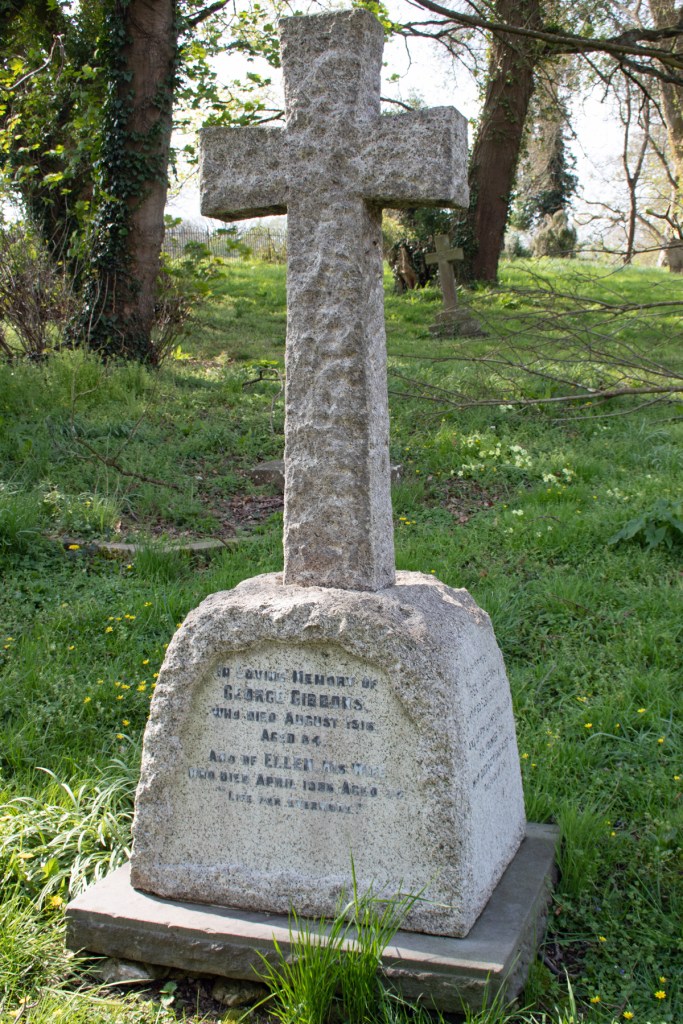
It was while he was there that Private Gibbons contracted influenza and pneumonia; he passed at the farm on 28th October 1918, at the age of just 20 years old.
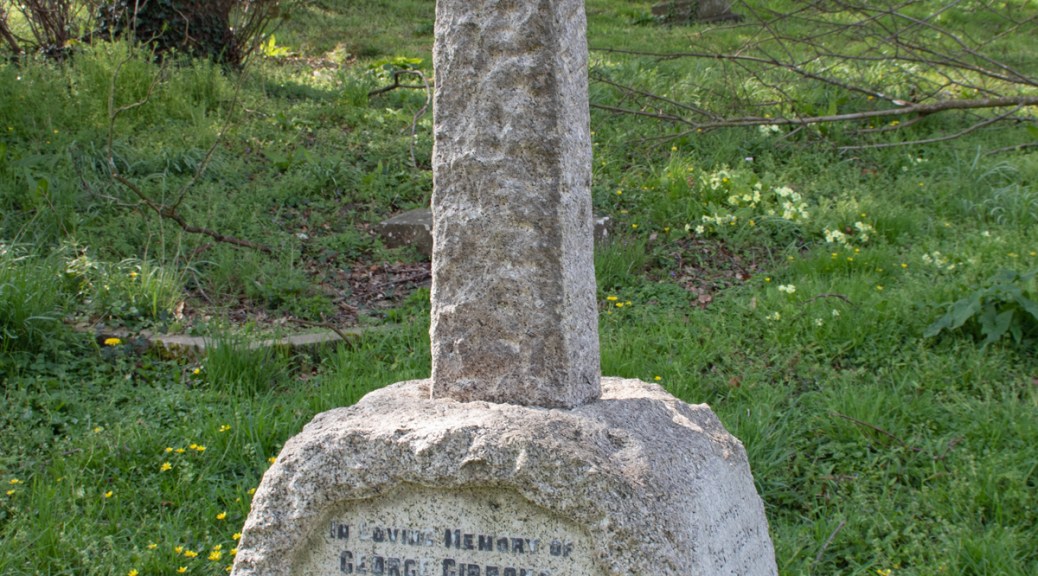
Lionel Millard Gibbons’ body was brought back to Camerton for burial. He lies at rest in the family grave in the ground of St Peter’s Church there.
Graham Grant was born in early 1891, one of ten children to Charles and Emma Grant. Charles was a sign painter and both he and his wife were from Wiltshire, but it was in Frome, Somerset, that they chose to settle and raise their family.
When he left school Graham found work as an assistant in a jeweller’s shop, but when war came to England’s shores, he was keen to do all that he could for King and Country.
While full details of his military service are not available, it is noticeable that the local newspaper – the Somerset Standard – dedicated a full column to news of his death in 1916, and then a further full column to his funeral a week later. The newspaper reported that:
Private Graham Grant, who was just 25 years of age, was living in Bristol when the war broke out, and in September 1914, he joined the 4th Gloucesters along with his eldest brother, Private Charles Grant, and being in the same platoon they were inseparable companions both in training and in the trenches… They went out to the Front just over 12 months ago – January 1915 – and for practically a year they escaped injury…
Private Grant had not been home since he landed in France, but he and his brother were expecting to have leave at Christmas to visit their family and friends at Frome. On the 23rd December… [he] was with his platoon in a trench, the top of which was some three feet above the heads of the men. At 8:30 in the evening they were about to be relieved… when a German machine-gun opened fire on the trench.
Somerset Standard: Friday 11th February 1916
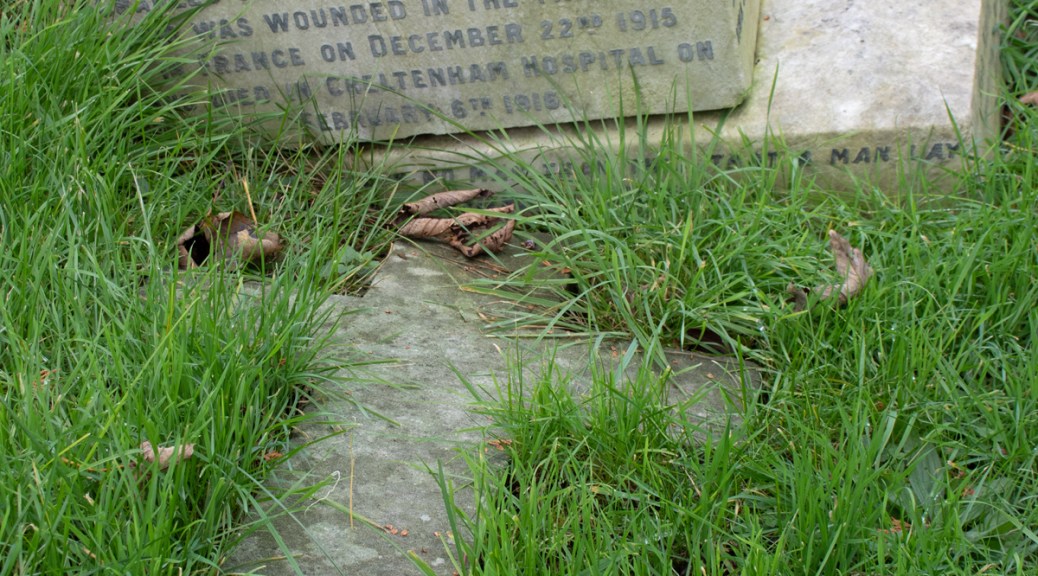
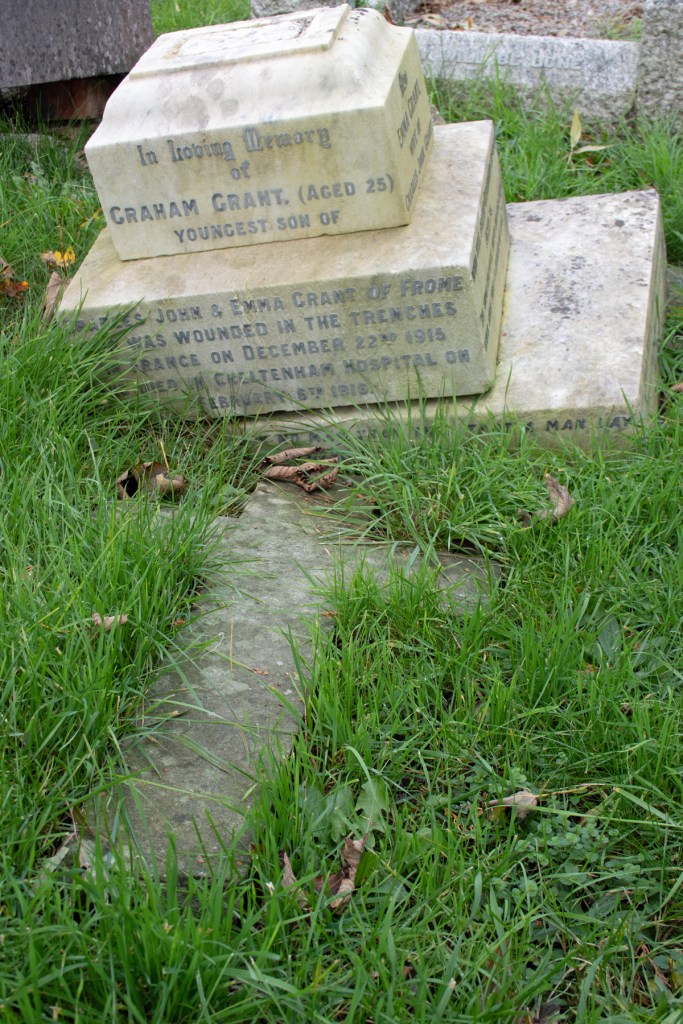
A bullet hit Graham in the back and he was taken first to a hospital in Rouen, then medically evacuated back to England. Admitted to the Racecourse Hospital in Cheltenham, x-rays showed that his spine had been shattered by the bullet, and he was paralysed from the waist down. “[His] case was regarded as hopeless from the first” and as many friends and family went to see him as possible. Private Grant passed away on 6th February 1916, Emma and his three sisters at his bedside. He was just 25 years of age.
Graham Grant’s body was brought back to Frome, and laid to rest in the graveyard of Christ Church in the town. The funeral, at the family’s request, was devoid of any military fanfare or involvement.
While there was a lot of reporting on both the death and funeral, the vicar of St John’s Church in the town noted in his sermon that Graham had been a member of the choir there, both as a boy and a man. He was also the first chorister of the church to give his life for his country. Reverend Randolph went on to say that:
…there were things connected with Graham Grant’s death for which [he was] thankful… he did not die on the battlefield, maybe after hours of suffering unattended and without succour… he did not die in the hands of the enemy or in the enemy’ country… he died surrounded by his relatives and friends, those who were near and dear to him, and that he had the most skilful medical treatment and tender nursing.
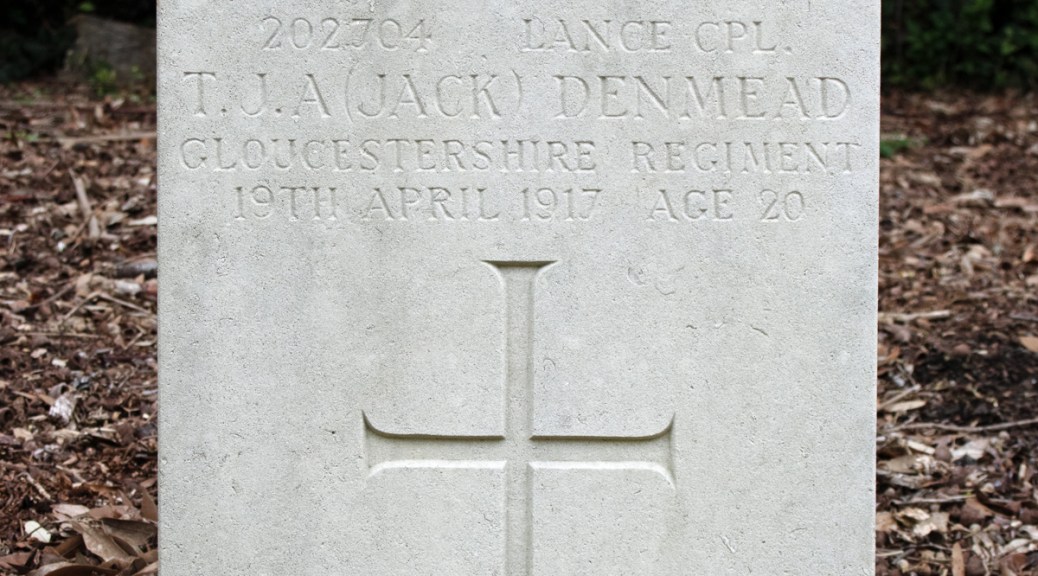
Thomas John Ambrose Denmead – better known as Jack – was born in Yeovil in the summer of 1896. The oldest of seven children, his parents were Thomas and Elizabeth Denmead. Thomas was a glover – the key industry in the Somerset town – who raised his young family in the middle of the town.
When he left school, Jack found work as a clerk at Petters’ Ltd, a local engine manufacturer and iron foundry. War was on the horizon, though, and he enlisted in the spring of 1916.
Jack joined the Gloucestershire Regiment, and was assigned to the 2nd/4th (City of Bristol) Battalion. He was sent to France in May 1916, and was involved in the Attack at Fromelles, part of the larger Somme offensive. He had started as a Private, but rose to the rank of Lance Corporal.
Towards the end of 1916, Jack fell ill. He was medically evacuated to the UK, and was admitted to the Royal General Infirmary in Paisley, Scotland. His condition was serious enough to need an operation, but the Lance Corporal sadly passed away not long after this treatment. He was just 20 years of age.
Jack’s body was brought back to Somerset for burial. He was laid to rest in the cemetery in his home town, Yeovil.
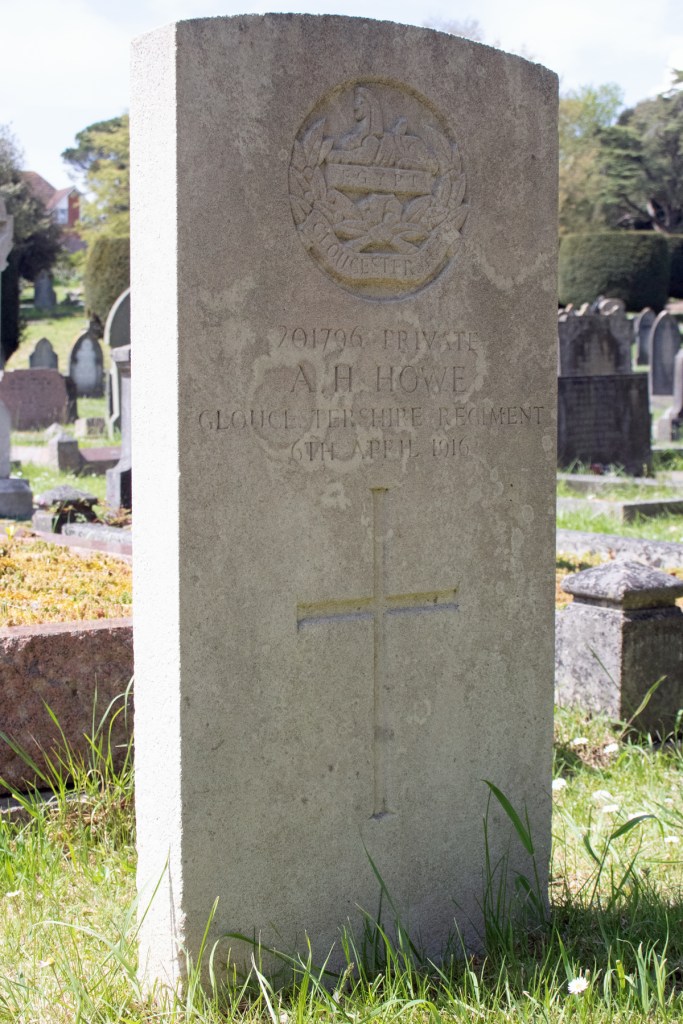
In the Milton Cemetery in Weston-super-Mare is a gravestone to Alfred Harry Howe. He seems destined, sadly, to be one of those servicemen whose stories are lost to time. The stone confirms that he died on 6th April 1916 and that he was a Private in the Gloucestershire Regiment. Further research adds that he was assigned to the 3rd/4th Battalion.
The UK Army Register of Soldier’s Effects gives his father’s name as William. It also confirms that he was not eligible for a war gratuity, as he had insufficient service; given the date of his death, it is likely, therefore, that he enlisted on or after October 1915.
Beyond this information, however, there is little documentation to confirm exactly who Alfred was. As there is no date or place of birth, it is difficult to get an exact match. There are at least three William/Alfred matches in the Somerset/Bristol area, but nothing to connect them to the headstone in Weston-super-Mare, and nothing to even confirm that Alfred was from the South West.
There is nothing in any contemporary newspapers to suggest that Private Howe’s passing was anything out of the ordinary.
Sadly, therefore, he remains a name lost to history. Alfred Harry Howe, whoever he was, and however he died, lies at rest in a Somerset cemetery.









 Death and Service