Tag Archives: Gunner

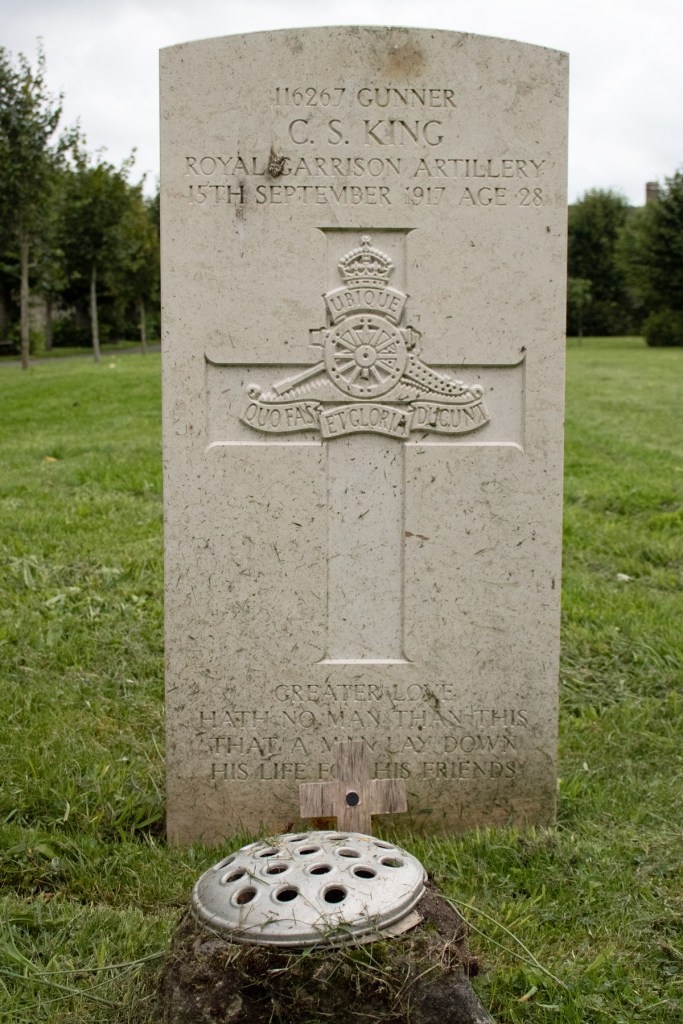
Gunner Charlie King

Shaftesbury

Charlie Stephen King was born in Dorset on 18th October 1888, one of six children to Stephen and Virtue King. Stephen was a painter, glazier and paperhanger from Gillingham, and this is where he and Virtue raised their children.

When Charlie left school, he also went on to become a painter, but specifically for the railways, but whether this was on the rolling stock or stations, is not certain.

In October 1909, Charlie married Bessie Imber, a postman’s daughter from Shaftesbury. The couple set up home in Gillingham, before moving back to Bessie’s home town; they went on to have three children.

War was coming, though, and Charlie enlisted in December 1915. He was not formally called up until August 1916, and was assigned a Gunner in the Royal Garrison Artillery. After initial training, he was sent to the Western Front in March 1917.

Exact details of Gunner King’s service are not available. He was certainly involved in fighting during the summer of that year, and, in September, was wounded. Evacuated back to England with a gunshot wound to his left ankle and shell shock, he was admitted to the War Hospital in Sunderland. Sadly, septicaemia set in, and he passed away on 15th September 1917, at the age of just 28 years old.

Charlie Stephen King’s body was brought back to Dorset, where he was laid to rest in the Holy Trinity Churchyard in Shaftesbury.


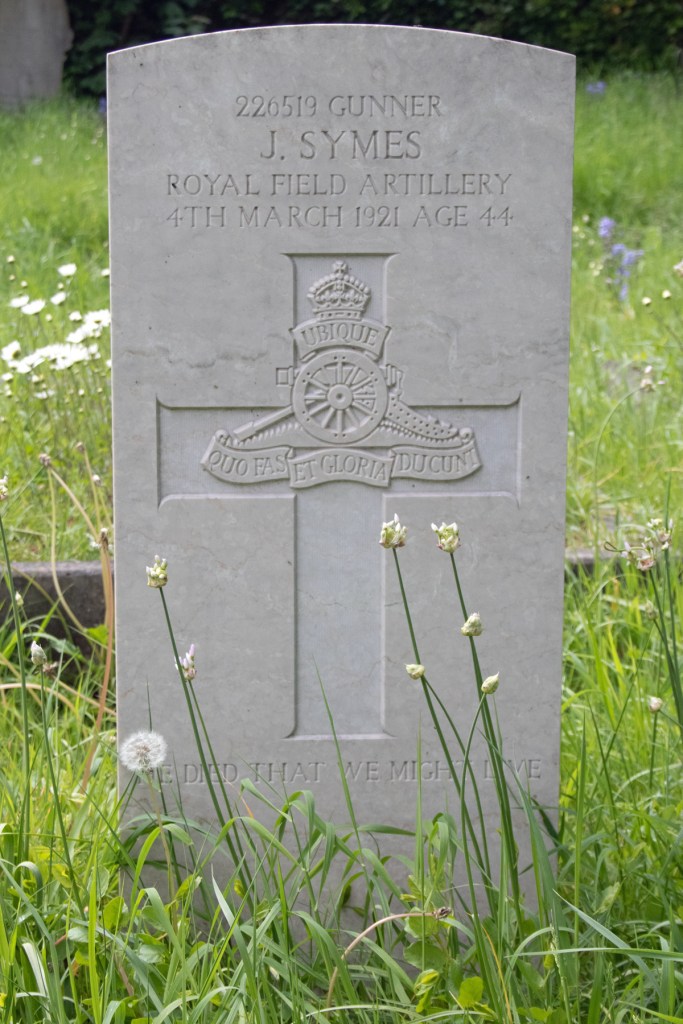
Gunner Joseph Symes

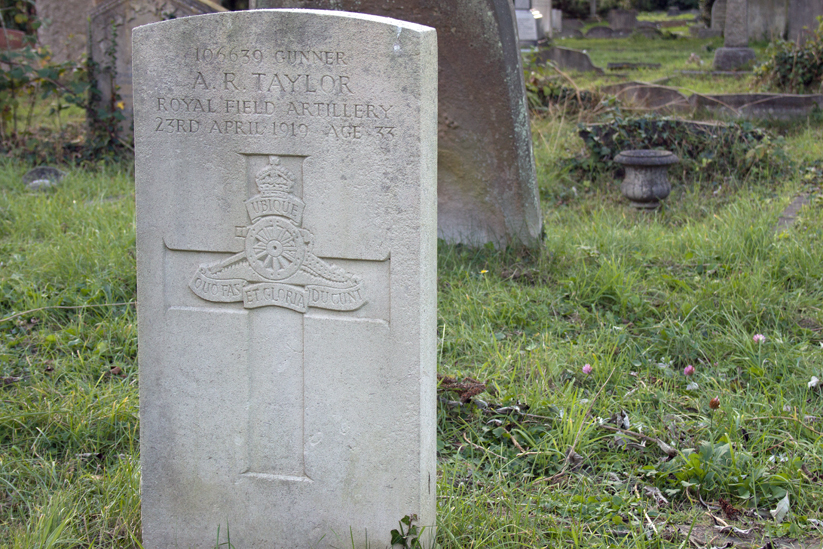
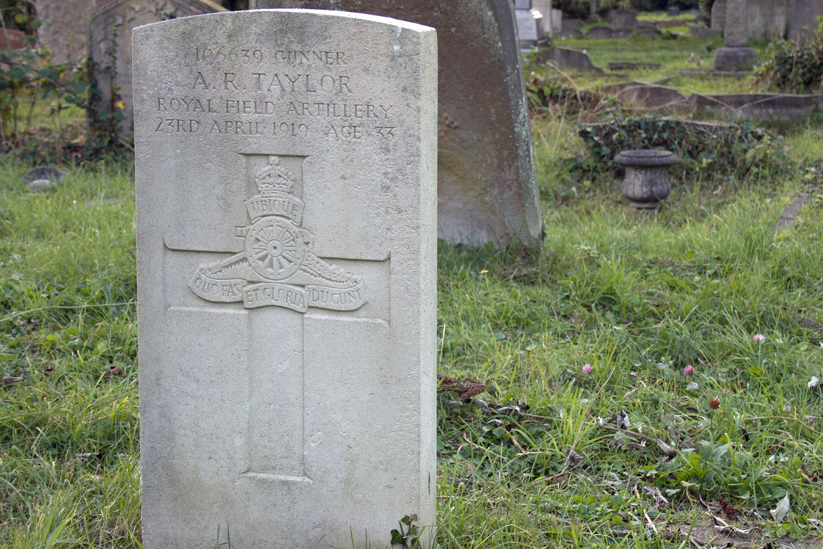
Gunner Joseph Symes

Joseph Symes was born in May 1876, and was the youngest of ten children to Joseph and Caroline Symes. Joseph Sr was a shoemaker who had been born in Shepton Mallet, Somerset, but who had moved to Bristol for work in the late 1860s.

As with some of his older siblings, Joseph Jr followed in his father’s shoemaking footsteps. He worked as a boot clicker, punching the eye holes in footwear, and cutter, taking the shaped pieces out of large leather hides.

In June 1905, he married Emily Delling, who was also from Bristol, and the couple went on to have a son, Douglas, a year later. The couple moved into a two-up-two-down terraced house in a cul-de-sac to the north east of the city centre.

War was coming to the British Isles. Full details of Joseph’s military service no longer exist; however, his gravestone confirms that he enlisted in the Royal Field Artillery.

There is no documentation to confirm whether Gunner Symes saw active service abroad; he certainly survived the war, but in February 1919 was discharged on medical grounds, suffering from myalgia. He was granted a pension, and the family soon replaced the busy city life for a quieter one down the coast in Weston-super-Mare.

Joseph’s trail goes cold for a couple of years, and he passed away on 4th March 1921, at the age of 44 years old. Sadly, there is nothing to confirm the cause of his death; it seems likely that his ongoing medical condition got the better of him.

Joseph Symes was laid to rest in the Milton Cemetery in Weston-super-Mare.


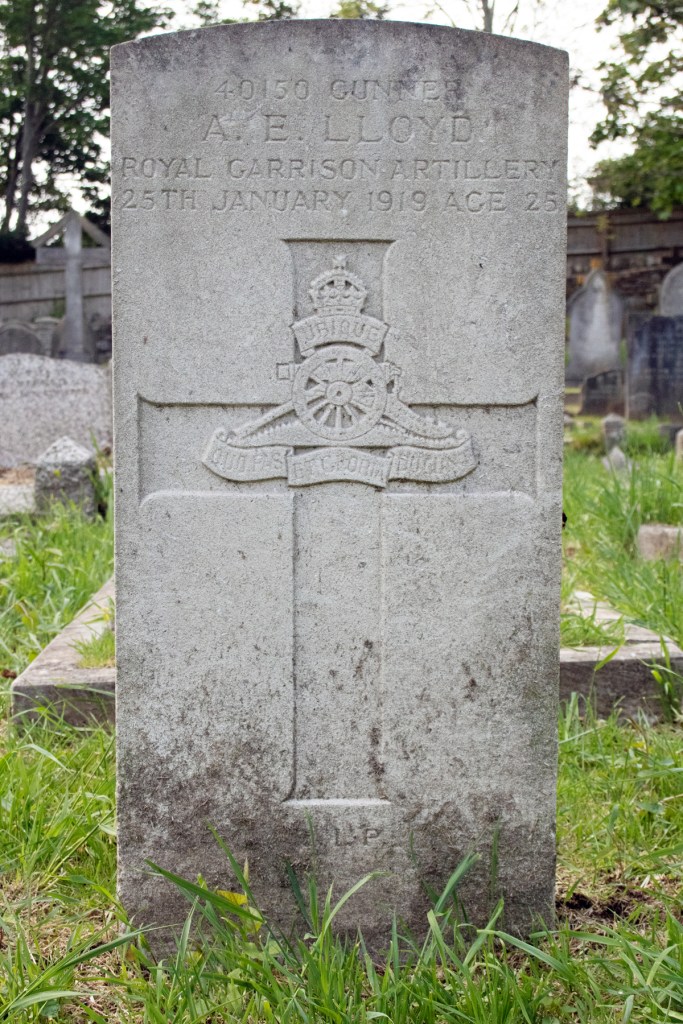
Gunner Albert Lloyd

Gunner Albert Lloyd

Albert Edward Prankard Lloyd was born in Somerset on 25th September 1893, in the Somerset village of Kewstoke (now a suburb of Weston-super-Mare). He was one of eight children to Jabez and Charity Lloyd. Jabez was initially a mason, but later went on to find work as a miner in South Wales. Charity worked as a laundress to help bring in extra money.

When Albert left school, he found employment as a labourer, remaining at home with Charity, with Jabez working away, and three of his sisters working as housemaids or laundresses. By 1911, however, he had moved to Wales with his father to work as a miner; steady employment that brought in a little more money because of the risks involved.

War, however, was on the horizon, and Albert enlisted before hostilities broke out. Joining up on 12th January 1914, his military records show him as standing 5ft 7ins (1.7m) tall and weighing in at 166lbs (75.3kg). He joined the Royal Garrison Artillery and, over the next five years, served three tours of duty in France, totalling just over three years on the Western Front.

Gunner Lloyd’s military service was not without incident, however. In November 1914 he was admitted to hospital for a week, suffering from shock. In April 1917, a shell exploded close to him and he was again found to be suffering from shock. His records note that, following the injury, he had had suicidal thoughts, and wished he was dead.

Just a month later, back on the battlefield, Albert received a gunshot wound to his right thigh. Nine months later, he was admitted to the Hermitage General Hospital in Higham, Kent for three weeks. (The ailment is a mystery, with just the term SCT Toe to identify it.)

When the Armistice came, Gunner Lloyd remained in France, finally returning home on 13th January 1919 ready to be demobbed. While not clear in his records, it seems that the initial ‘shock’ he had suffered from in 1914 had continued throughout the war.

One of the last comments on Albert’s service records is stark. “Found dead on Great Western Railway near Weston-super-Mare. 25.01.19“. Frustratingly, there is no other documentary evidence to expand on this curt phrase, no contemporary newspapers seem to have reported on the event, and nothing more than a scribbled police report was provided for the inquest (again, of which nothing remains).

It seems that the effects of five years of conflict proved too much for Gunner Lloyd; he committed suicide at the age of just 25 years old.

Albert Edward Prankard Lloyd lies at peace at last in the Milton Cemetery in his home town of Weston-super-Mare.


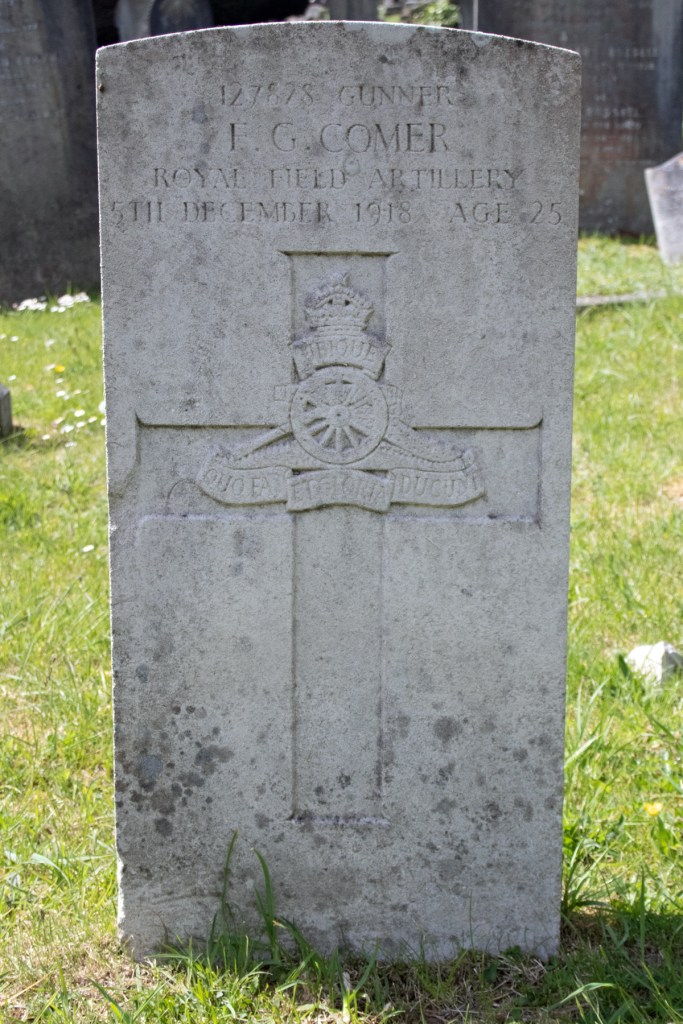
Gunner Frederick Comer

Gunner Frederick Comer

Frederick George Comer was born on 8th July 1893, the older of two children to Fred Comer and his wife Fanny. Fred Sr was a decorator, and raised his family in his town of his birth, Weston-super-Mare.

While his younger brother Clifford followed in his father’s footsteps and became a decorator, Frederick Jr had set his sights elsewhere. The Western-super-Mare Gazette and General Advertiser reported on 31st December 1910, that he had gained a certificate by Pitman’s Shorthand with a speed of 60 words per minute. Within a year, he was working as a news reporter in the local area.

War was on the horizon, but sadly this is where Frederick’s trail goes a bit cold. He enlisted in the Royal Field Artillery, although existing documents do not confirm a date for this. Gunner Comer definitely served overseas, however, and was wounded in action.

Sadly, the other information available confirms that Gunner Comer died from his wounds on 5th December 1918. He was just 25 years old.

Frederick George Comer’s body was brought back to Weston-super-Mare; he lies at rest in the Milton Cemetery in his home town.


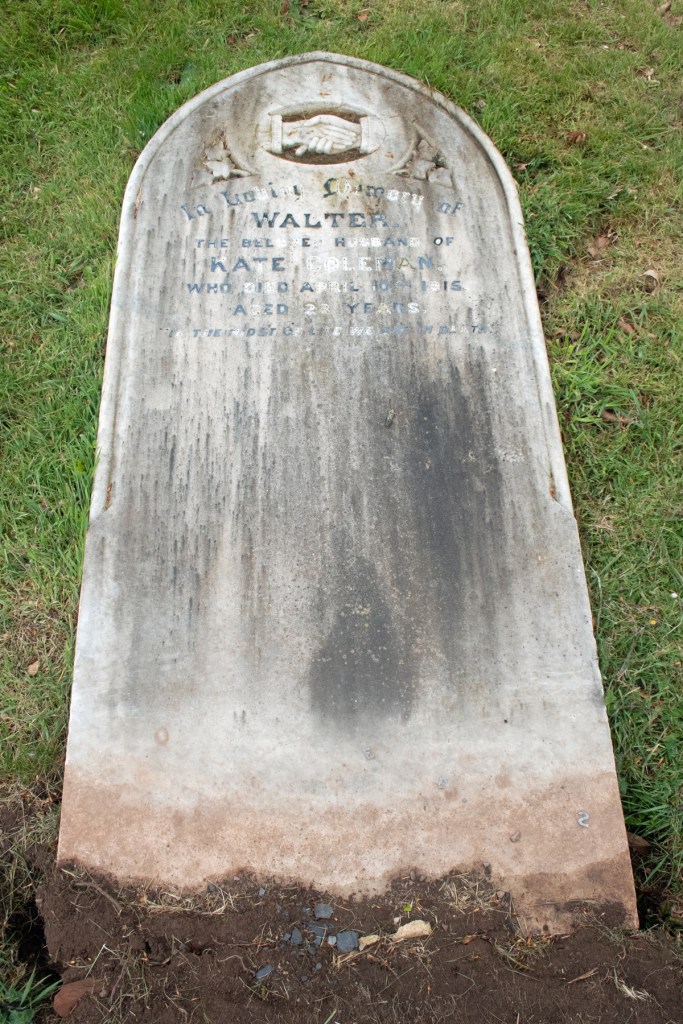
Gunner Walter Coleman

Gunner Walter Coleman

Walter Coleman was born in the spring of 1887, one of seven children to James and Emily Coleman. James was a hairdresser and the family lives in the Somerset town of Taunton.

Walter didn’t follow his father’s trade; instead, after a spell working at a collar factory when he left school, he was soon employed as a groom.

On Christmas Day 1910, he married Kate Norris, and the couple set up in a two-up, two-down in the middle of the town.

War was on the horizon, however, and when it broke out, Walter signed up straight away. He joined the 72nd Brigade of the Royal Field Artillery as a Driver and trained at the Bulford Camp on Salisbury Plain. It was while he was here on 10th April 1915 that he had an accident and fell off his horse. Sadly, Driver Coleman fractured his skull and died of his injuries that day. He was just 28 years old.

Walter Coleman lies at rest in the St James’ Cemetery in his home town of Taunton.


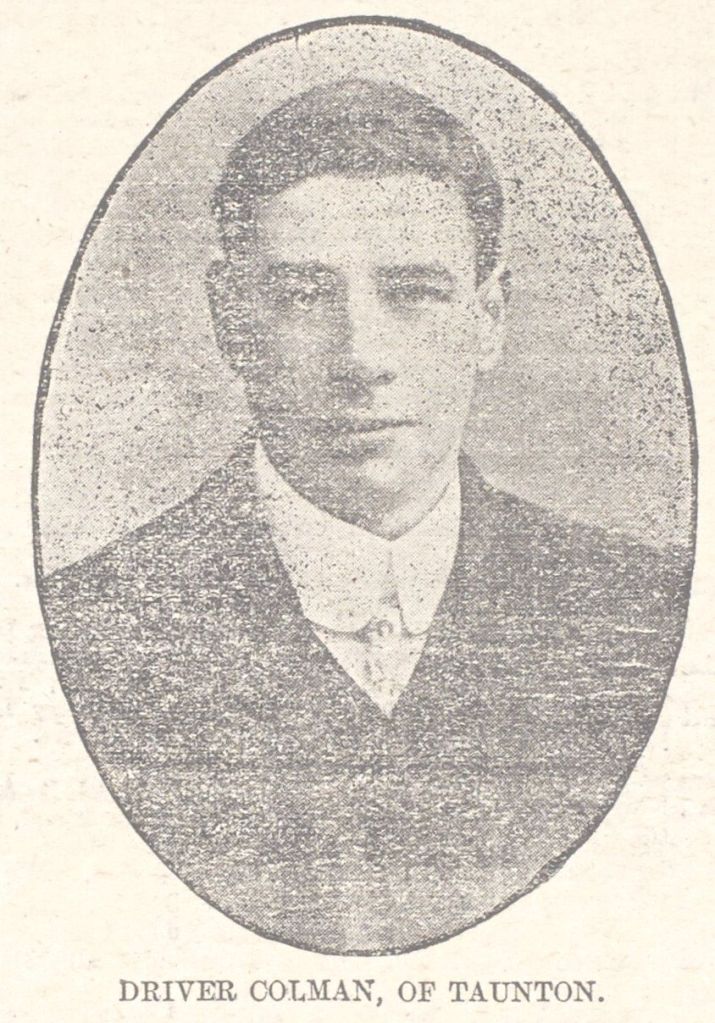
Walter Coleman (from findagrave.com)

Walter’s older brother Henry James Coleman also served in the Great War. Posted to France as part of the Labour Corps, he died of wounds on 12th April 1918. He was 33 years old, and left behind a widow and four children. He is buried at the Longuenesse Souvenir Cemetery in France.


Gunner William Howard

Gunner William Howard

William Arnold Howard was born in Cumbria towards the end of 1887. He was the youngest of two children, the son of gospel minister Edwin Howard and his wife Alethea. Edwin’s role took him across the country; by the time William was four, the family were settled in Worksop, Nottinghamshire; ten years later, they were based in Taunton, Somerset.

William’s older sister became a music teacher, and was presumably inspired by her father’s calling. William, however, took a different route, and, by the time of the 1911 census, was listed as a physical culture expert.

He had, by this time, met and married a woman called Alice, and the couple had two children, Edna and Marjorie. The census found the young couple living in a three-roomed house in the middle of Taunton.

War was on the horizon, and William enlisted as a Gunner in the Royal Garrison Artillery. His battalion – the 3rd/4th Siege Reserve Brigade – were those manning with large scale weaponry, although, as part of the reserve, Gunner Howard was based in England for the duration of the conflict.

William was awarded the Victory and British Medals for his service but once the Armistice was declared it seems that he fell ill. He was admitted to the Military Hospital in Taunton with exhaustion following a bout of enteritis, and succumbed to this on 15th January 1919. He was 31 years old.

William Arnold Howard lies at rest in the St James Cemetery in Taunton, Somerset.


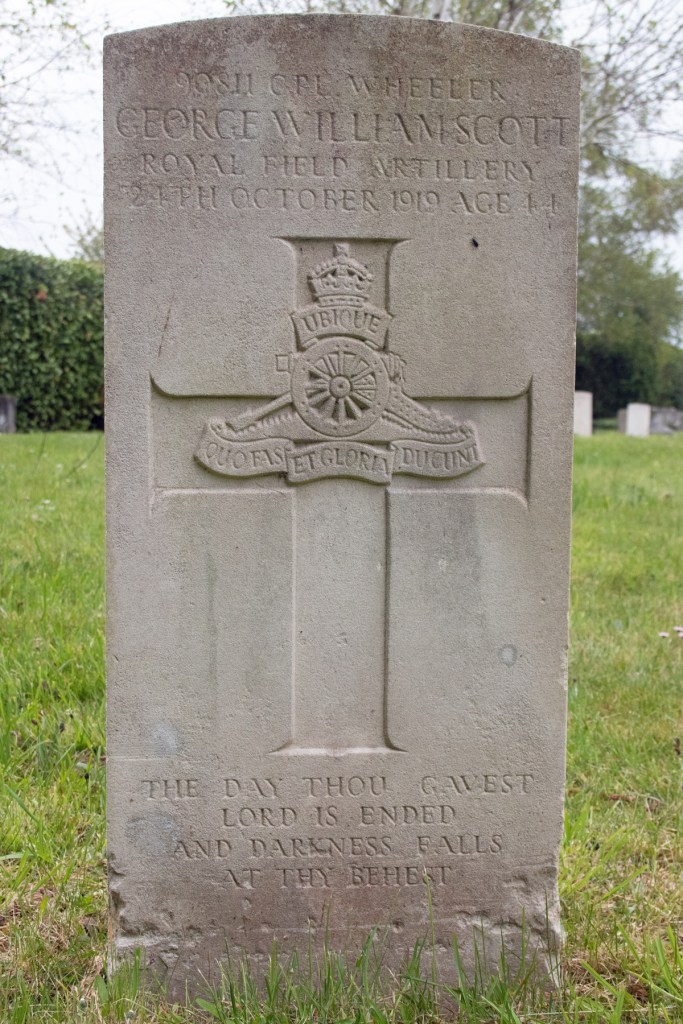
Corporal Wheeler George Scott

Corporal Wheeler George Scott

George William Scott is destined to be one of those names who is sadly lost to time. While there is information relating to him, there is not enough detail to flesh out a concrete history around him.

The facts that we do know about George are that his parents were John and Mary who, at the time that his grave was commemorated, were living in County Tyrone in Northern Ireland.

George enlisted in the Royal Field Artillery in November 1914. He was assigned to the 5th Battery of the 45th Brigade, and given the rank of Wheeler – one of the positions in a team of horses, pulling the artillery.

During his service, George was awarded the 1914 Star, as well as the Victory and British Medals. He seems to have been in a bit of trouble to begin with, however, as he was reverted down to Gunner because of misconduct. This may only have been temporary, as he ended with the rank of Corporal Wheeler.

And that is it, that is all the concrete information available for George Scott. How he died is a mystery, lost to time.

George William Scott lies at rest in St Mary’s Cemetery in Taunton, Somerset.


Gunner William Pearn

Gunner William Pearn

William Henry Pearn was born in January 1896, one of two children to Richard and Selina Pearn from Bridgwater in Somerset. Selina had been married previously, and had been widowed, and so William had a further four half-siblings. Richard was a lath renderer – a plasterer in today’s terms – and he was not the only one of the household to be working. According to the 1901 census, Selina was a collar maker and William ‘s two older half-brothers were a landscape gardener and a bookshop assistant.

When William left school, he went to work for a local coal yard as a porter. The next census finds him living with his mother and his older brother, Wallace, who was a labourer in a brickyard. Richard is noticeable in his absence, but Selina is having been married for 18 years.

Sadly, though, at this point William’s trail goes cold. His military records are sparse, but we know that he enlisted as a Gunner in the Royal Field Artillery, although I have been unable to identify when he enrolled. The only other information I have I have been able to locate for him are his pension records, that confirm that he passed away from pneumonia on 19th October 1918. Gunner Pearn was just 24 years old.

William Henry Pearn lies at rest in St John’s Cemetery in his home town of Bridgwater in Somerset.


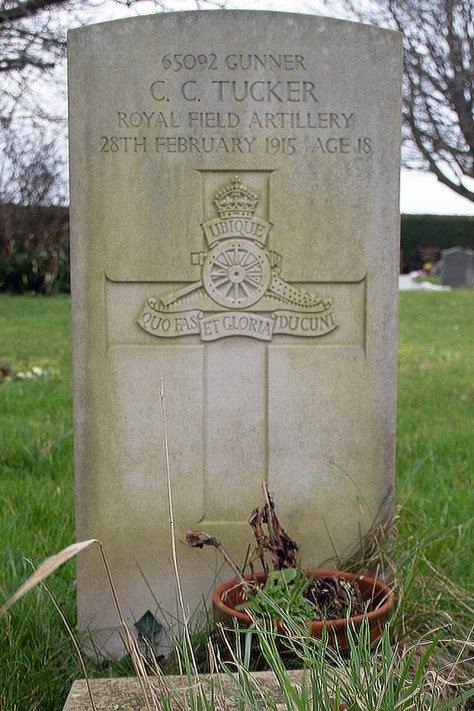
Gunner Clifford Tucker

Gunner Clifford Tucker

Clifford Charles Tucker was born in 1896, one of five children to John and Ellen Tucker. John was a shoemaker in the Somerset village of Othery, while Clifford became a farm labourer when he left school.

There is little documented of Clifford’s life, and what I have been able to identify about his military career has come from a newspaper article.

Much regret is felt in Othery at the new of the death of Clifford Tucker, one of the young fellows who volunteered for the service of their King and Country. Deceased, who was only 18 years of age… enlisted in the Royal Artillery about six weeks ago and was stationed at Brighton.

He was taken ill with pneumonia and died, his father arriving in time to see him before he breathed his last.

Taunton Courier and Western Advertiser: Wednesday 17th March 1915.

Gunner Tucker passed away on 28th February 1915, aged just 18 years old.

He lies at rest in the cemetery of his home village of Othery.


Serjeant Ernest Morris

Serjeant Ernest Morris

Ernest George Morris was born in September 1879, one of six children to John and Eliza Morris. John was a carter for the railways, and this was a trade his son was to follow.

Ernest married Sarah Garrett in Bristol on Christmas Eve 1904, and the young couple went on to have two children, Charles and William.

Ernest’s father died in 1907, and Ernest became head of the family. He moved them in with him in Bristol, and by the 1911 census, the household consisted of Ernest, his mother Eliza, his brothers Frank and William, sister Lily and his own son William.

The census also lists Ernest as a widow; I have not been able to track down any records of when Sarah died. Their eldest boy, Charles, passed very early on, however, so this is likely why Ernest set up home with his family.

By this time, Ernest was working as a carman in the Bristol Goods Yards, and it appears that had a strong character. In September 1912, he was cautioned for “smoking whilst on duty and refusal to give an undertaking to refrain from doing so in future.” He cited his reason that the rulebook “did not prohibit men from smoking when not with a load.”

Ernest was suspended for two days, and was only allowed back to work when he promised to follow instructions in the future. This, it seemed he may not have done, as he was dismissed just three months later.

Ernest’s military service records are hard to piece together. He enlisted in the Rifle Brigade as a Gunner, going on to achieve the rank of Serjeant. He was awarded the Victory and British medals – the standard awards for men involved in the Great War.

Serjeant Morris survived the war, but there is little information for him after that. He passed away on 28th June 1920, aged 40 years old, although there is no record of how he passed. His war pension was awarded to his mother, who was acting as guardian for his son William.

Ernest George Morris lies at rest in the cemetery of his home town of Langport.