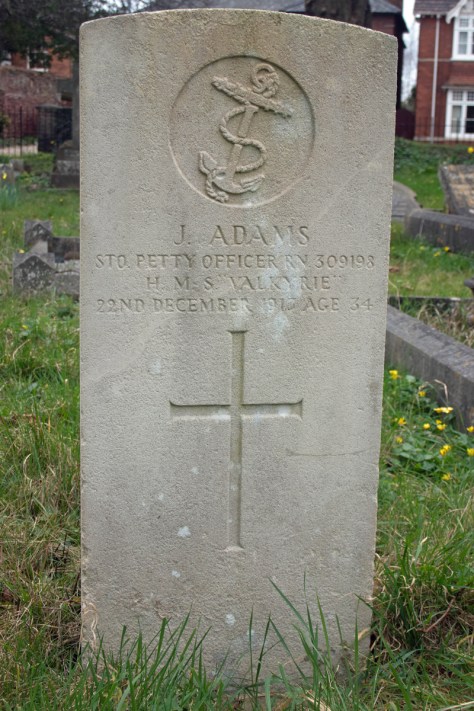
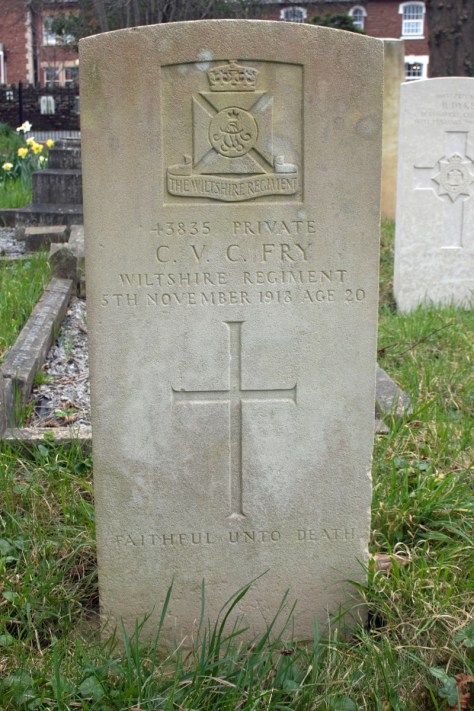
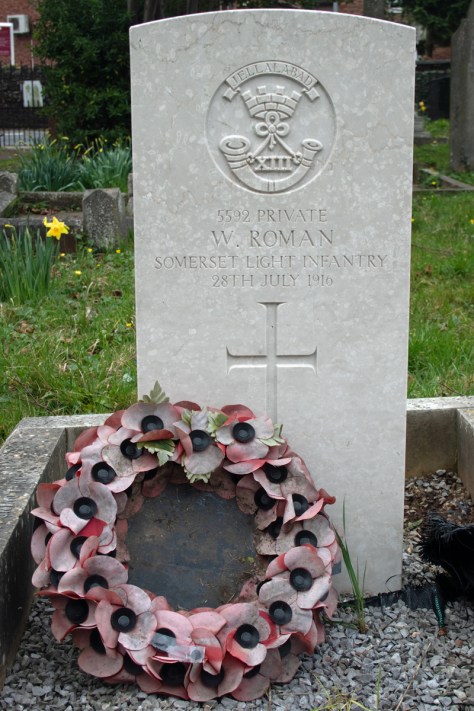
Alfred Henry Richards was born in 1891, the oldest of five children to William Henry Richards and his wife Jane. William (who was known as Henry) worked in the local paper mill, and this is a trade that his two sons – Alfred and Leslie – were to follow as well.
Paper making was a driving force in this part of Somerset during the Victorian era, employing a large number of people in Wells and the nearby village of Wookey, which is where Alfred and his siblings were born.
Details of Alfred’s military service are sketchy. He enlisted as a Gunner in the Royal Horse Artillery, although when during the war this happened is unknown.
His troop – the 18th Brigade, 1st Somerset Royal Horse Artillery – was stationed in the UK for the first couple of years of the war, before serving in the Middle East. Again, I have not been able to confirm how much of this service Gunner Richards was involved in.
Alfred returned to Somerset after being demobbed, but within a few months of the end of the war, he succumbed to double pneumonia. He passed away on 1st March 1919, aged just 28 years old.
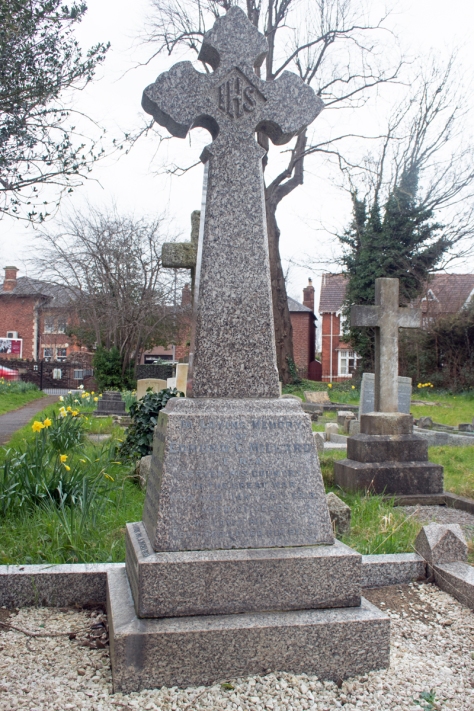
Alfred Henry Richards lies at rest in the cemetery in Wells, Somerset, not far from his home.
Francis George Smith was born in Glasgow in 1890. Records are scattered, but some of the pieces pull together to give an outline of his life.
The son of William and Mary Smith, Francis was the fourth of six children. His tombstone confirms that William had worked as an optician, but passed away when Francis was a young man.
Francis was an electrical engineer, and had assisted Mary in her business in Glasgow before signing up.
Private Smith enlisted early on in the war, “on February 24th of this year [1915], when he left his native city for London, where he joined the motor transport section of the Army Service Corps” [Wells Journal, Friday 12th March 1915].
Billeted in Wells, he had been assigned to the 133 Mechanical Transport Company. Within weeks of moving there, however, it seems that Francis fell ill. Sadly, his was a life cut too short, and he passed away from pneumonia on 6th March 1915, aged just 25 years old.
Francis George Smith lies at rest in the cemetery in Wells.
William James Waterhouse was born in 1875, the eldest of seven children to Richard and Elizabeth Waterhouse. The family lived in Cumberland, where Richard initially worked a grocer before becoming a music teacher.
William followed his father into food retail, working initially as a butcher’s boy in Barrow-in-Furness, before moving 400 miles to the south coast and settling in Eastbourne. Travel was definitely on William’s mind, however, as, by the 1911 census, he was a butcher’s manager at a hotel in Leicester.
William’s service records are limited; he was 39 when war broke out, and enlisted in the Eastern Mounted Brigade, before transferring Army Service Corps. During his time, he was promoted to Serjeant, and according to a newspaper report of his funeral “was most popular among the men.” [Wells Journal: Friday 9th July 1915]
It seems that, as part of his service, Serjeant Waterhouse had been assisting with haymaking in the Wells area, and it was after this that he fell ill. He developed pneumonia, and passed away on 30th June 1915. He 40 years old.
William James Waterhouse lies at rest in the cemetery of his adopted home town of Wells, in Somerset.
Albert Charles West was born in Aldershot, Hampshire, in 1870. The second of nine children, his father Charles was in the army, while his mother Hannah is listed on the 1871 census as a “Soldier’s Wife”.
By the time of the next census, ten years later, Charles had relocated the family to Wells in Somerset – Charles had been born just up the road in Shepton Mallet, so, in effect, he was bringing his family home. By this point, the Wests were a family of seven; Albert had an older sister, Eliza, and three younger siblings, Mary, Joseph and Earnest.
Albert seemed keen to make his own way in the world; by the 1891 census, he had relocated again, this time to South Wales, where he worked as a minor. He boarded with a grocer in the village of Llantwit Fardre. It would have been a bustling house, because Albert was living there with the grocer, his wife and four children and three other lodgers.
The following year, Albert enlisted in the 2nd Battalion Welsh Regiment. Posted to India, he served there for ten of his twelve years’ service.
After completing his enlistment, Albert moved back to Somerset and married Emily Sparrow in Wells. The couple moved back to South Wales for work, however, this time with Albert working in a mine in Llanwonno, ten miles up further up the Taff Valley from Llantwit Fardre.
When war broke out, Albert re-enlisted, this time joining the South Wales Borderers. Sadly, little documentation of his second time in the army remains. He is recorded as having served in the 51st (Graduating) Battalion, which was a training unit based in Suffolk; presumably his experience made him ideal to train others and enabled him to take the rank of Serjeant.
There is nothing to confirm how Serjeant West died. All that is know is that he passed on 9th July 1918. The lack of any media reports around his funeral suggests it is likely to have been illness, rather than injury, that took him. He was 48 years old.
Albert Charles West lies at rest in Wells Cemetery in Somerset.
Charles and Hannah had nine children in total. Two years before Albert passed, their youngest son – Alfred Augustus West – died suddenly and unexpectedly. Records confirm that he was working on the lines at Wells Railway Station, when his foot got caught in the points. Unable to free himself, he was hit by a train and killed.
William Gardner was born in Cirencester, Gloucestershire, in around 1877. While I have been unable to totally confirm this, his parents seem to have been William and Sarah Carpenter; William Sr was an agricultural labourer, and both he and his wife were from Cirencester.
It has been difficult to track down William’s early life, because of the potential variations of his surname and the number of William Gardner’s in the Gloucestershire area.
The first time I can definitively identify him is on the 1911 census; he was living in Cheltenham and working as gardener. While the census shows that he had been married for 16 years and had one child. However, William’s wife is not recorded on the census; instead a Lily Marie Denley is boarding with him, as is her daughter, Irina May Gardner Denley.
William’s military life also needs a little piecing together. His gravestone confirms that he was a Serjeant in the Gloucestershire Regiment, and it seems that he enlisted towards the end of the 1800s, as he is recorded as having served in South Africa.
Serjeant Gardner re-enlisted (or was called back up) when the Great War broke out; at the age of 39, he was sent to France, collecting the Victory Medal, the British Medal and the 1915 Star for his service. At some point, however, he transferred back to England, joining the 440th Agricultural Coy. Labour Corps.
While there is no evidence of why William transferred, his later records certainly seem to suggest there were some issues going on in his life. When he was demobbed in February 1919, this seems to have been for medical reasons; his pension records show that he was suffering from neurasthenia (or shell shock), and that this was directly attributable to his war service.
William’s suffering evidently continued: a further record shows that he was admitted to an asylum in March 1921 and the 1921 census corroborates this. William was noted as being one of nearly 900 patients at the Somerset and Bath Pauper Lunatic Asylum in Wells and this is where he died, just a month later. While there is no cause of death, he passed away on 14th July 1921, at the age of 45 years old.
William Gardner lies at peace in the Cemetery in Wells, Somerset.
One additional point for William’s story. Another part of his was pension records give Miss Lily Denley as his dependent, and that she was guardian of his child. No eyebrows raised now, but how must their relationship have been viewed in 1911?
Ronald Victor Knight was born in March 1894, the youngest of two children – both sons – to John Knight, an Ironmonger from London, and his Swiss wife, Marie.
Ronald was well educated – being taught at Wells and Bedford Grammar Schools in the UK and Neuchatel in Switzerland, not far from where his mother was born. After studying at Bristol University, he went to work at Guys Hospital in London, training as a dental student.
When war broke out, he volunteered at once, being enlisted in the 8th Battalion London Regiment. Lieutenant Knight went with his regiment to France, and was involved in the Battle of Festubert and the fighting at Loos.
Returning home towards the end of 1915, Ronald married Gwendoline Dawkes, in a ceremony overseen by the Bishop of Bath & Wells.
Rather than returning to the front line, Lieutenant Knight accepted a commission to lead a section of the London Cyclist Corps, a position he held for a year or do. While in this service, Ronald and Gwendoline had their one and only child, a little girl they called Beryl.
In 1916, Ronald accepted a further move to the Royal Naval Air Service, becoming involved in flying as a Flight Lieutenant. It was while he was based at RNAS Cranwell that he was involved in the accident that led to his death.
An inquest was held into the incident, and evidence was taken.
Air Mechanic Charles Deboo [said] that the machine had been recently inspected, and that it was alright. He did not see the deceased flying, but saw the machine come down, nose first, in corkscrew fashion. He saw it at a height of 400ft. He went to the machine after it had fallen and found the officer was dead. The machine struck the ground and smashed up, but he could not say how the accident happened.
Charles Barrett, air mechanic, said he saw the accident. The deceased seemed as if he was going to turn towards the wind to land, and, as he turned, he banked, but he never righted himself. He nose-dived and spun round to the earth. He thought he lost control as he was turning, or the wind might have caught him. The machine was smashed, except for the tail.
The jury returned a verdict that deceased accidentally met his death while flying.
Retford and Workshop Herald and North Notts Advertiser: Tuesday 20th March 1917.
Flight Lieutenant Knight died in an aeroplane crash on 12th March 1917. He was 22 years old.
Ronald Victor Knight lies at rest in Wells Cemetery, Somerset.
Sadly, Ronald’s daughter, Beryl, died in the spring of 1923, when she was only 7 years old. She is buried with her father.
Gwendoline went on to marry Henri Booth in months after the death of her daughter. The couple went on to have two children, Elizabeth and William. She requested that her late husband’s war medals be given to his father, John.
One of the things I have found during this research is that occasionally a mystery will come to light. In the case of the gravestone in the Somerset village of Coxley – nestled on the main road between Wells and Glastonbury – it was the very identity of a person buried there that threw me.
The headstone in question simply says “WG Collins served as Private G Clark in the Army Veterinary Corps”, but the research tools I normally use drew blanks.
Unfortunately, the Findagrave website does not have the burial listed under either name, so that too was a dead end.
The British Newspaper Archives site – a record of media across the UK covering 250 years – similarly has no entry for either name around the time of his death, which suggests it was either not ‘out of the ordinary’ (not headline-grabbing) or his death and funeral were just not submitted to the local paper.
Fold3 – which stores military records – has a record for 9978 Private Geoffrey Clark. The Register of Soldiers’ Effects confirms that a war gratuity was awarded to his sister, Ada Jane Waldron, after his death.
And, as it turns out, it was Ada who proved the key to the mystery of her brother. Working on the basis that Ada’s maiden name was Collins, I used Ancestry.co.uk to try and track her down. The site presented a family tree featuring both an Ada Jane Collins and, more importantly, a William George Collins, and the game was afoot…
William George Collins was born in the Somerset village of Coxley in the summer of 1889. He was the youngest of seven children – Ada was his oldest sister – to James Collins, an agricultural labourer, and his wife Jane.
Following the death of his mother in 1901, and his father a decade later, it’s evident that William wanted to make his way in the world. By the 1911 census, he had moved to Wales, working as an attendant at the Glamorgan County Lunatic Asylum. The asylum, which was in Bridgend, South Wales, was home to nearly 900 patients, and William acted as one of the 120 staff looking after them.
War was on the horizon, however, and the mystery surrounding William returned once more. Military records for William (or Geoffrey) are limited; he enlisted in the Royal Army Veterinary Corps in the summer of 1915 and was shipped to France in September of that year.
There is no record why he enlisted under the name Geoffrey Clark, nor does there seem to be any evidence of either names in his family. As to his passing, there is nothing to give a hint to how he died. All that can be confirmed for certain is that he passed away at the University War Hospital in Southampton on 25th October 1918, at the age of 32.
William’s probate records give his address as Railway Terrace in Blaengarw and show that his effects went to his sister, Ada.
William George Collins – also known as Geoffrey Clark – lies at peace in the graveyard of Christ Church, in his home village of Coxley.
Wilfred James Hockey was born in September 1892, the sixth of nine children to William and Mary. William was the village butcher, but Wilfred followed his older brother Oliver into the gardening business.
Military records for Wilfred are difficult to locate, but it appears that there is a reason for this.
He enlisted in February 1915, joining the Royal Marine Light Infantry. His initial service took him to Crystal Palace in South London – then a naval training base.
Returning home on leave on 12th March, Private Hockey fell ill on his first evening at home. Quickly diagnosed with ‘spotted fever’ (or meningitis), he sadly passed away on 25th March. He was just 23 years of age.
Wilfred Hockey lies at rest in the graveyard of St Matthew’s Church in his home village of Wookey, in Somerset.
Charles Curtis was born in Wells, Somerset, in January 1894, one of fifteen children to Charles and Mary Jane Curtis. Charles Sr worked as a gardener in the Wells area, and, after leaving school, Charles Jr started work as a mill hand for the local paper mill (this would have been either St Cuthbert’s Mill in Wells, or the Wookey Hole Mill in the nearby village).
Charles enlisted in October 1915, joining the Royal Army Medical Corps. He was posted to France a month later and, while specifics of his military service are not readily apparent, Private Curtis was awarded the Victory Medal, the British Medal and the 1915 Star.
Charles was admitted to hospital on 1st November 1917 with an inflamed cervical gland (reported as Trench Fever), for which he underwent an operation. He remained hospitalised at Whalley Range for more than two months, and was passed for active service, having apparently recovered.
Private Curtis was suddenly taken ill again on 1st July, and his family telegrammed. His mother and one of his sisters boarded a train for the hospital – again in Whalley – but they had not gone far when word came that he succumbed to rheumatic fever. He was 24 years old.
Charles Curtis Jr lies at rest in the graveyard of St Matthew’s Church in the village of Wookey, Somerset.
A newspaper report of his funeral confirms that Charles was one of five brothers who had entered military service during the Great War. Amazingly, given that seven of the brothers ended up serving, Charles was the only one to die as a result of the war.
Victor Charles Edelsten Bracey was born in October 1897, the only child of William and Florence Bracey. William was a physician and surgeon, practicing in Lancashire when Victor was born. The young family soon moved south, however, and by the time of the 1901 census, they were living in Wedmore, Somerset, where William had taken up as the village’s general practitioner.
Military records for Victor are not available, but his life can readily be pieced together from newspaper reports of his death and the de Ruvigny’s Roll of Honour, published after the war.
TWO PILOTS KILLED IN THE NEW FOREST
Two air fatalities have occurred within twenty-four hours of each other in the New Forest. On Saturday [22nd September 1917] Second Lieutenant Ernest Hargrave’s machine nose-dived from the height of 200ft, and crashed to earth.
Second Lieutenant Victor Bracey was flying on Sunday morning at a height of 300ft, when his machine turned and came down in a spinning nose-dive.
At the inquests verdicts of “Death by misadventure” were returned.
Western Gazette: Friday 28th September 1917
BRACEY, VICTOR CHARLES EDELSTEN, 2nd Lieut., RFC, only child of William Edelsten Bracey, LRCP [Licentiate of the Royal College of Physicians], Lieut. (Hon.) RAMC (retired), by his wife, Florence Marion, dau. of the late James Canning Gould.
[Victor was] educated St Peter’s School, Weston-super-Mare, and Blundell’s School, Tiverton, where he was a member of the OTC [Officers’ Training Corps]; passed into the Royal Military Academy in April 1915; joined the Inns of Court OTC in December 1916; was gazetted 2nd Lieut. RFC [Royal Flying Corps] 27 April 1917, obtaining his wings in July, and was killed in an aerial accident at the Beaulieu Aerodrome, Hampshire, 23 September, while testing a new machine.
A brother officer wrote that he was a gallant gentleman and a most skilful pilot.” He was a keen cricketer and footballer, and while at Blundell’s played in the First Cricket XI and the Second Football XV, and was also captain of the First Hockey XI; later played for the Royal Military Academy, Woolwich, and the RFC Rugby Football XV at Oxford.
de Ruvigny’s Roll of Honour, 1914-1919
A note on Second Lieutenant Bracey’s Roll of Honour states that he was ineligible for medals as he saw no overseas service; this seems to have been challenged by Victor’s father in 1921, but nothing confirms whether this anything was subsequently awarded.
Victor Charles Edelsten Bracey lies at rest in the churchyard of St Mary’s in Wedmore, where his father continued to practice. He died, aged just 19 years of age.
William’s prominence in the village played a big part in Victor’s legacy. A Memorial Fund was set up; this helped fund “necessitous cases for medical requirements and for conveying patients to hospitals“. The Victor Bracey Cup was also awarded into the 1940s for sporting achievement in the schools he had attended.